Exterior Cleaning Permit Requirements for South Florida
Discover the essential permit requirements for exterior cleaning in South Florida. Ensure compliance and avoid costly mistakes!
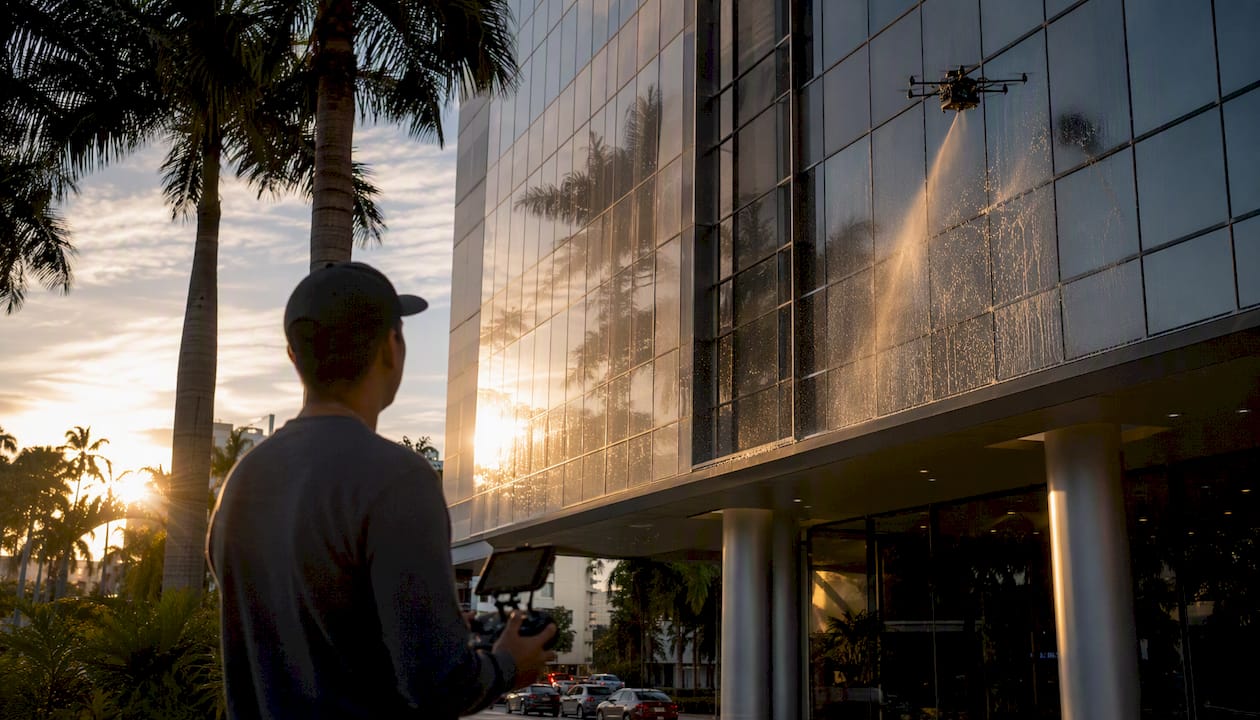
Most exterior cleaning work on commercial buildings in South Florida does require some form of permit review, though the specific trigger depends on scope, method, and county. Florida Building Code Section 105 establishes the baseline: constructing, altering, repairing, or changing any structure generally requires a permit unless the work falls within a narrow list of exemptions. Pure cleaning (water and detergent, no coatings, no structural repair) often qualifies for that exemption. Add a sealant, coating, or structural repair to the scope, and the exemption disappears.
For South Florida commercial properties, the controlling authorities are Miami-Dade’s Building and Neighborhood Compliance department, Broward County’s Permitting, Licensing and Consumer Protection division, Palm Beach County’s Building Division, the Florida Department of Environmental Protection (FDEP) for wash-water discharge, and the FAA when drones are part of the crew. Vistadronecleaning operates as an FAA Part 107-certified provider, which means its drone operations already satisfy the federal layer of that compliance stack.
Quick red flags that almost always trigger a permit:
- Scaffolding, suspended swing stages, or boom lifts attached to the building
- Roof coatings, elastomeric coatings, or any water-tight membrane application
- Stucco repair, EIFS installation, or concrete spalling restoration
- Façade recoating beyond localized touch-up (Miami-Dade thresholds apply)
- Paving, seal coating, or parking-lot striping
- Any work over a public right-of-way
Key Takeaways
Exterior cleaning permit requirements in South Florida turn almost entirely on scope: cleaning-only work is usually exempt, but any coating, structural repair, or right-of-way impact triggers a formal permit process under Florida Building Code Section 105.
Table of Contents
- Which exterior-cleaning activities commonly trigger permits?
- Which agencies issue permits in Miami-Dade, Broward, and Palm Beach?
- How do drone operations intersect with FAA rules and local permits?
- What do permit applications usually require?
- How do you verify permit requirements for a specific property?
- Practical ways to reduce or avoid formal permits
- How Vistadronecleaning reduces permitting complexity for South Florida buildings
- What South Florida property managers should actually prioritize
- Permit-compliant drone cleaning for South Florida commercial accounts
- Sources
- FAQ
Which exterior-cleaning activities commonly trigger permits?
Straight pressure washing or soft washing of a building facade (water only, or water plus a biodegradable detergent) sits in the permit-exempt zone under most South Florida codes. The moment scope expands, that changes fast.
Miami-Dade’s permit-exemptions guidance lists interior and exterior painting as generally exempt but carves out water-tight roof coatings as permit-required. Paving and drainage work requires a Zoning Improvement Permit. Parking-lot striping and seal coating are specifically called out. Balloon signs and wall signs can also require a Zoning Improvement Permit depending on placement.
For exterior elevation rehabilitation, the bar is higher. Miami-Dade requires permits for stucco repair, concrete spalling restoration, EIFS installation, and façade recoating when the scope exceeds localized aesthetic touch-up or addresses moisture intrusion and substrate deterioration. EIFS systems must carry Miami-Dade County Product Approval (NOA) for each component, and any work affecting structural elements requires certification by a Florida-licensed engineer.
Wash water reaching storm drains can trigger EPA/NPDES obligations and South Florida Clean Coastal Waters Act requirements: a separate environmental layer that sits alongside building permits.
Pro Tip: Combining a cleaning scope with any coating, paint, or sealant application is the single most reliable way to convert a permit-exempt wash into a full rehabilitation permit. Write contract scopes deliberately: cleaning-only contracts stay cleaner from a permitting standpoint.
Which agencies issue permits in Miami-Dade, Broward, and Palm Beach?
Three counties, three sets of offices, and several state-level agencies all have a hand in this.
| County / Agency | Permit type | Primary contact |
|---|---|---|
| Miami-Dade Building & Neighborhood Compliance | Building permit, HVHZ/NOA review | miamidade.gov/building |
| Miami-Dade Zoning | Zoning Improvement Permit (paving, signs, striping) | Miami-Dade Zoning Division |
| Broward County Permitting, Licensing & Consumer Protection | Building permit, contractor licensing | broward.org/BPLC |
| Palm Beach County Building Division | Building permit, plan review | Discover |
| FDEP / South Florida Water Management District | Environmental/discharge permits | Floridadep |
| Local DOT / Traffic Engineering | Right-of-way closure, traffic control | City or county traffic engineering office |
| FAA | Part 107 certification, airspace authorization | Faa |
Miami-Dade’s High Velocity Hurricane Zone (HVHZ) designation adds a layer that Broward and Palm Beach do not have in the same form. Any exterior envelope system (EIFS, stucco assemblies, coating systems) must carry a Miami-Dade NOA. Wind-load analysis is required when structural elements are affected. Historic districts (Coral Gables, Coconut Grove, Miami Beach) add a Certificate of Appropriateness review on top of the building permit.
When you call a building department, have the parcel ID ready and ask specifically: “Does this scope require a building permit, a Zoning Improvement Permit, or both?” Those are two different desks in Miami-Dade.
How do drone operations intersect with FAA rules and local permits?
FAA Part 107 governs all commercial drone operations nationally. Local governments cannot override federal airspace rules, but they can require permits for property access, public right-of-way operations, or work that affects pedestrian and traffic safety at ground level.
For South Florida high-rises, the practical considerations break down this way:
- Part 107 certification is required for any commercial drone operation; pilots must pass an FAA knowledge test and maintain currency.
- Airspace authorization via LAANC or a formal FAA waiver is required near controlled airspace (Miami International Airport, Fort Lauderdale-Hollywood International, Palm Beach International, and their Class B/C/D rings).
- Tethered vs. free-flying classification: tethered drones operating below 400 feet AGL with a physical tether may qualify for different FAA treatment, but local ordinances in Miami-Dade and Broward may still require notification or access permits for operations over occupied public areas.
- BVLOS or night operations require a specific FAA waiver, which adds weeks to the authorization timeline.
- $2,000,000 liability insurance is the minimum Vistadronecleaning carries, and most commercial property managers and HOA boards require a COI at or above that threshold before any contractor accesses the building.
Pro Tip: A drone-based cleaning approach that keeps all equipment tethered and crews on the ground often eliminates the scaffold permit, swing-stage permit, and right-of-way closure plan entirely. That alone can cut weeks from a project’s pre-work timeline.
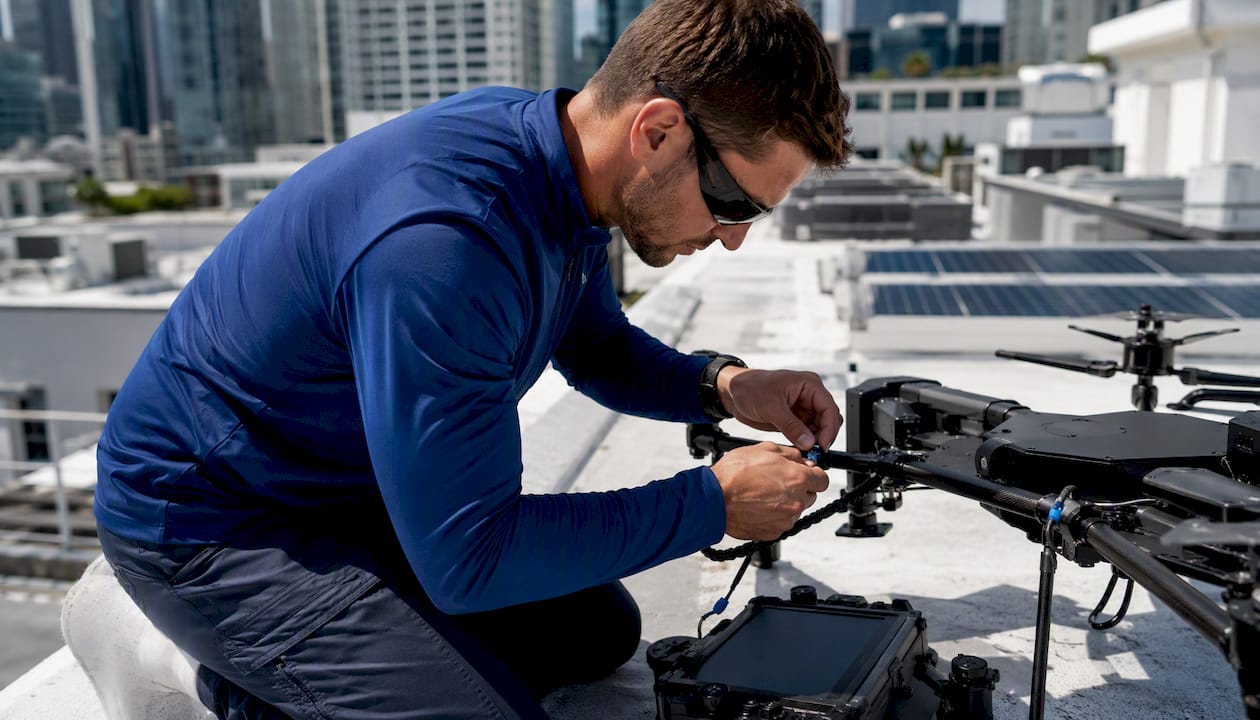
Vistadronecleaning uses Lucid Bots Sherpa industrial tethered drones with FAA Part 107-certified pilots on every project. No anchor points are drilled into the building envelope, which removes the structural-attachment trigger that typically requires a building permit for traditional rigging.
What do permit applications usually require?
A complete permit application for exterior elevation rehabilitation in Miami-Dade, Broward, or Palm Beach typically includes:
- Completed county permit application form with parcel ID and scope description
- Contractor license documentation (Chapter 489 for structural or coating work)
- Certificate of Insurance (COI) meeting the county’s minimum limits
- Notice of Commencement when total project value exceeds county thresholds
- Elevation drawings and site plan (engineer-sealed for structural repairs)
- Product approvals / NOAs for all exterior envelope components in HVHZ
- Wind-load analysis when structural elements are affected
- Safety Data Sheets (SDS) for all cleaning chemicals and coatings
- Traffic control plan when work affects public right-of-way
Contractor licensing under Chapter 489 and local business tax receipts are commonly required before a permit is issued. Pressure washing alone may not require a contractor license, but any scope that includes sealing, coating, or painting typically does.
Realistic review timelines by scope:
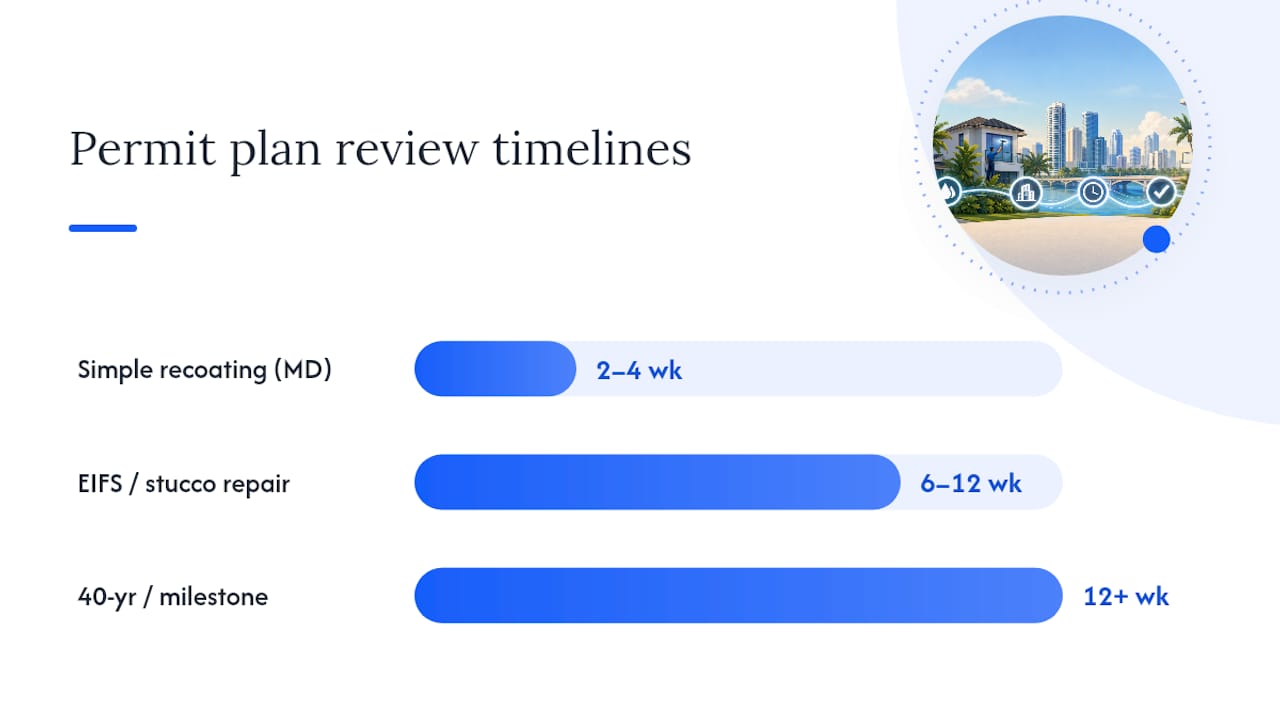
Simple recoating or painting (no structural repair, no HVHZ NOA issues): 2–4 weeks for plan review in Miami-Dade; Broward and Palm Beach can run faster for straightforward scopes.
Exterior elevation rehabilitation with EIFS, stucco, or spalling repair: 6–12 weeks is common once NOA documentation, engineer-sealed drawings, and wind-load analysis are assembled. Missing or incorrect NOA documentation is the most frequent cause of review delays.
Milestone or 40-year recertification projects with structural observation requirements: 12+ weeks from application to permit issuance is realistic. For 40-year recertification prep in Miami-Dade, starting the permit process at least three months before the inspection deadline is advisable.
How do you verify permit requirements for a specific property?
Follow this sequence before any contractor mobilizes:
- Confirm the property’s jurisdiction. Miami Beach, Coral Gables, and Hialeah each have their own building departments separate from Miami-Dade County’s office. Search the property address in the county’s GIS portal to confirm which municipal department has authority.
- Check the building permit portal. Miami-Dade uses the iBuild portal; Broward uses CSS (Contractor Self-Service); Palm Beach uses the Accela Citizen Access portal. Search the address for any open permits or violations before starting new work.
- Confirm HVHZ status. Miami-Dade’s entire county is HVHZ. If the project involves any exterior envelope system, NOA documentation is required.
- Contact the Zoning Division for any work involving paving, signage, striping, or right-of-way impacts.
- Contact FDEP or the local stormwater office if wash water may reach storm drains, swales, or coastal waters.
When you reach a building official, send a brief written summary first. Here is the key information to include:
Subject: Permit determination request: [Property Address] Parcel ID: [XXXXXX] Proposed scope: [e.g. exterior soft-wash cleaning of building facade, no coatings, no structural repair] Proposed method: [e.g. tethered drone, ground-based crew, no scaffolding or anchor points] Proposed chemicals: [list SDS-documented products] Question: Does this scope require a building permit, Zoning Improvement Permit, or environmental notification?
Expect a response within 3–5 business days for straightforward scopes. If the reviewer requests engineering documentation or NOA submittals, allow an additional 2–4 weeks before resubmitting.
Practical ways to reduce or avoid formal permits
Several approaches genuinely lower permitting burden without cutting corners:
- Use tethered drones or ground-based equipment that requires no structural anchor points, eliminating the scaffold and swing-stage permit triggers.
- Contain and recover all wash water on-site. Documenting a containment plan is often the decisive factor in whether FDEP or local stormwater enforcement gets involved.
- Keep scope strictly to cleaning. No coatings, no sealants, no paint. The building exterior cleaning types that stay permit-free are almost always cleaning-only scopes.
- Stay under local area thresholds for recoating. Small aesthetic touch-ups below Miami-Dade’s permittable thresholds may not require a building permit, though historic-district review can still apply.
- Plan work to avoid public right-of-way. Ground-based containment that stays on private property avoids the traffic control plan requirement.
Know the hard limits. Structural repairs, NOA-required coating systems, and work requiring engineered observation cannot be permit-minimized. If the scope involves spalling repair, EIFS replacement, or any moisture-intrusion remediation, a permit is required regardless of method. Attempting to frame structural repair as “cleaning” to avoid a permit is a code violation with real liability exposure.
When using a permit-minimizing approach, document the following: a written methods statement describing scope and equipment, a wash-water containment plan, COI from the contractor, and the FAA Part 107 pilot certificate when drones are used. Keep copies on-site during the project.
How Vistadronecleaning reduces permitting complexity for South Florida buildings
Vistadronecleaning’s approach removes several of the most common permit triggers before a project even starts. By using FAA Part 107-certified pilots and Lucid Bots Sherpa industrial tethered drones, the company cleans high-rise facades, windows, roofs, and solar arrays without scaffolding, swing stages, or structural anchor points. No anchor points means no scaffold permit. No swing stage means no suspended-access permit. No boom lift means no right-of-way closure plan in most cases.
What Vistadronecleaning brings to a commercial project:
- FAA Part 107-certified pilots on every job
- $2,000,000 liability insurance with COI provided at proposal stage
- Tethered industrial drones (Lucid Bots Sherpa), no building penetrations
- Substrate-matched soft-wash chemistry with SDS documentation for all products
- Services: drone window washing, commercial facade cleaning, roof soft-wash, and solar panel pure-water cleaning
- Before/after 4K documentation included with every project
- Most projects complete in 1–3 days; cost typically runs 30–60% below traditional scaffold or lift methods (brand-reported metric)
- Service area: Miami-Dade and Broward counties, with coverage extending to Palm Beach
Pro Tip: Request the COI and Part 107 certificate from any drone cleaning vendor before signing a contract. Both documents should be current and name your property as an additional insured. A vendor who hesitates on either is a compliance risk.
For EIFS and stucco cleaning specifically, Vistadronecleaning uses low-pressure soft-wash chemistry matched to the substrate, which avoids the high-pressure damage that can turn a cleaning project into a repair project requiring a permit.
What South Florida property managers should actually prioritize
The permit question for exterior cleaning is almost always a scope question, not a method question. Most boards and property managers I speak with assume the permit risk lives in the cleaning itself. It rarely does. The risk lives in what gets added to the cleaning: a coating here, a sealant there, a stucco patch that seemed minor. Those additions are what pull a project into permit territory.
The practical move is to separate scopes deliberately: cleaning contract first, restoration or coating contract second with its own permit process. And when the cleaning method itself can eliminate scaffold and right-of-way triggers, as drone-based approaches do, the compliance picture simplifies considerably. Part 107 pilots, a current COI, and a documented containment plan cover the compliance bases for most cleaning-only commercial projects in Miami-Dade and Broward. Request a site review from a compliant vendor before committing to a scope, and you will have the information you need to make a permit decision with confidence.
Permit-compliant drone cleaning for South Florida commercial accounts
Vistadronecleaning delivers commercial exterior cleaning across Miami-Dade, Broward, and Palm Beach without the scaffold permits, right-of-way closures, or weeks of pre-work that traditional methods require. FAA Part 107-certified pilots, $2,000,000 liability insurance, and tethered industrial drones mean the compliance documentation arrives with the proposal, not after a delay.
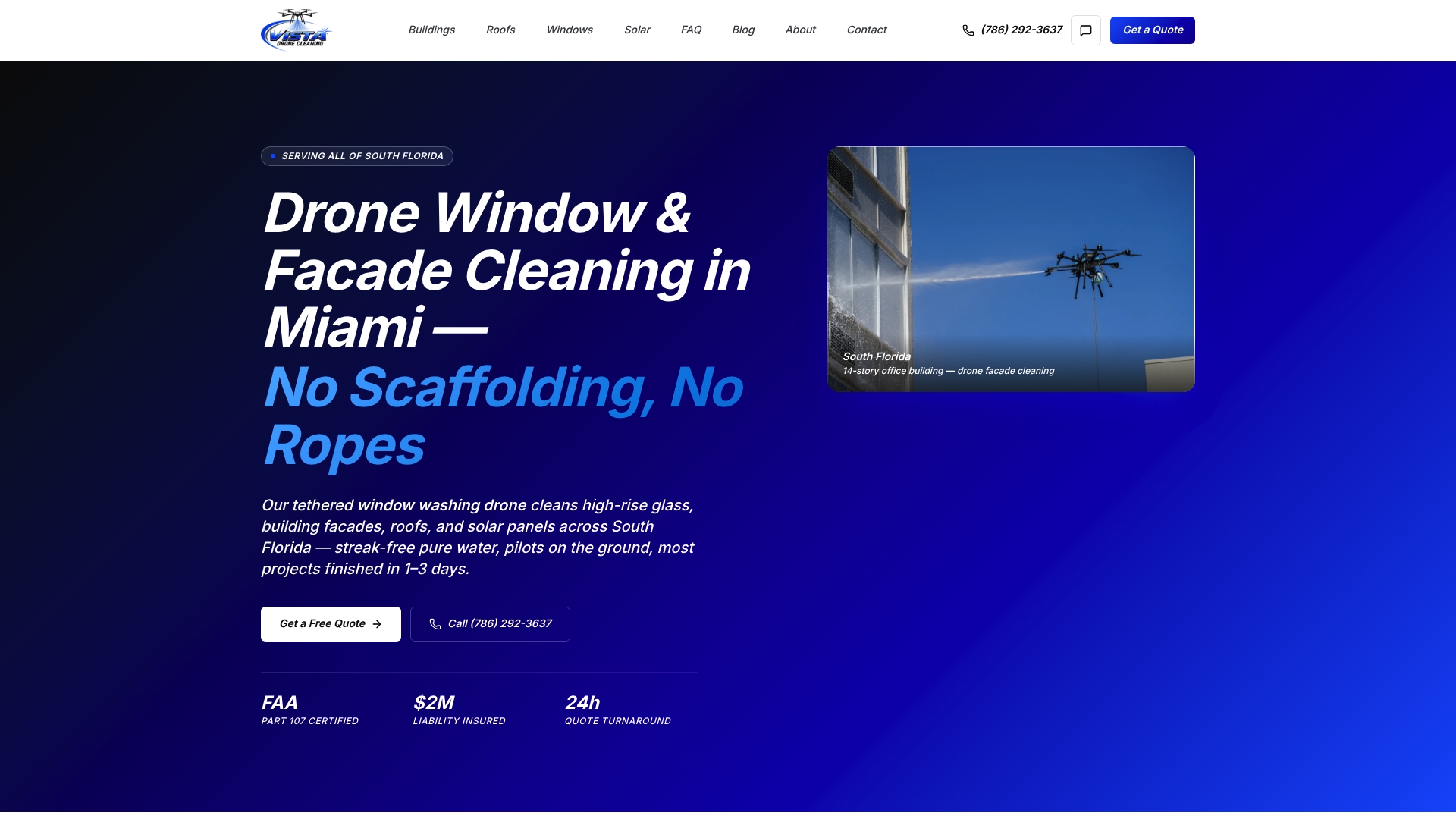
Services cover high-rise window washing, building facade cleaning, EIFS and stucco soft-wash, roof cleaning, and solar panel pure-water washing on commercial properties up to 200 feet tall. Every proposal includes a free site review, SDS documentation for all chemistry, and COI naming your property as an additional insured.
Request a free quote and get a permit-readiness assessment with your proposal.
Sources
- Miami-Dade County
- Pressure Washing Services in Florida
- Required Construction Permits 2026 | Royal Custom
This article is general information, not a substitute for advice from a qualified lawyer. Consult a qualified legal professional about your own circumstances before acting on anything here.
FAQ
Does exterior pressure washing require a permit in Miami-Dade?
Pressure washing alone (water and detergent, no coatings or structural repair) is generally permit-exempt under Miami-Dade’s guidelines. Adding any coating, sealant, or repair scope to the same contract typically triggers a building permit requirement.
What documents does a South Florida exterior cleaning permit application need?
A complete application typically requires a contractor license, COI, site plan, SDS for all chemicals, and, for rehabilitation work, engineer-sealed elevation drawings, product approvals (NOAs), and a Notice of Commencement when project value exceeds county thresholds.
How long does a permit take for exterior facade work in Miami-Dade?
Simple recoating reviews generally run 2–4 weeks. Exterior elevation rehabilitation involving EIFS, stucco repair, or spalling restoration with NOA documentation typically takes 6–12 weeks from application to permit issuance.
Do drone cleaning operations require a separate permit in South Florida?
FAA Part 107 certification covers the federal airspace requirement. Local permits may still apply for operations over public right-of-way or occupied public areas, but tethered drone cleaning that stays on private property and avoids structural anchor points generally does not trigger a building permit.
How does Vistadronecleaning handle permit compliance for commercial clients?
Vistadronecleaning provides FAA Part 107 pilot certification, liability insurance that meets or exceeds most commercial property requirements, and SDS documentation for all cleaning chemistry with every proposal, covering the core compliance documents most South Florida commercial accounts require before work begins.
Recommended
- HOA Building Exterior Cleaning South Florida: 2026 Guide, Vista Drone Cleaning
- Complete building cleaning checklist for South Florida high-rises
- Post-Construction Facade Cleaning Checklist for South Florida, Vista Drone Cleaning
- Commercial Facade Restoration Cleaning: A Property Manager’s Guide, Vista Drone Cleaning