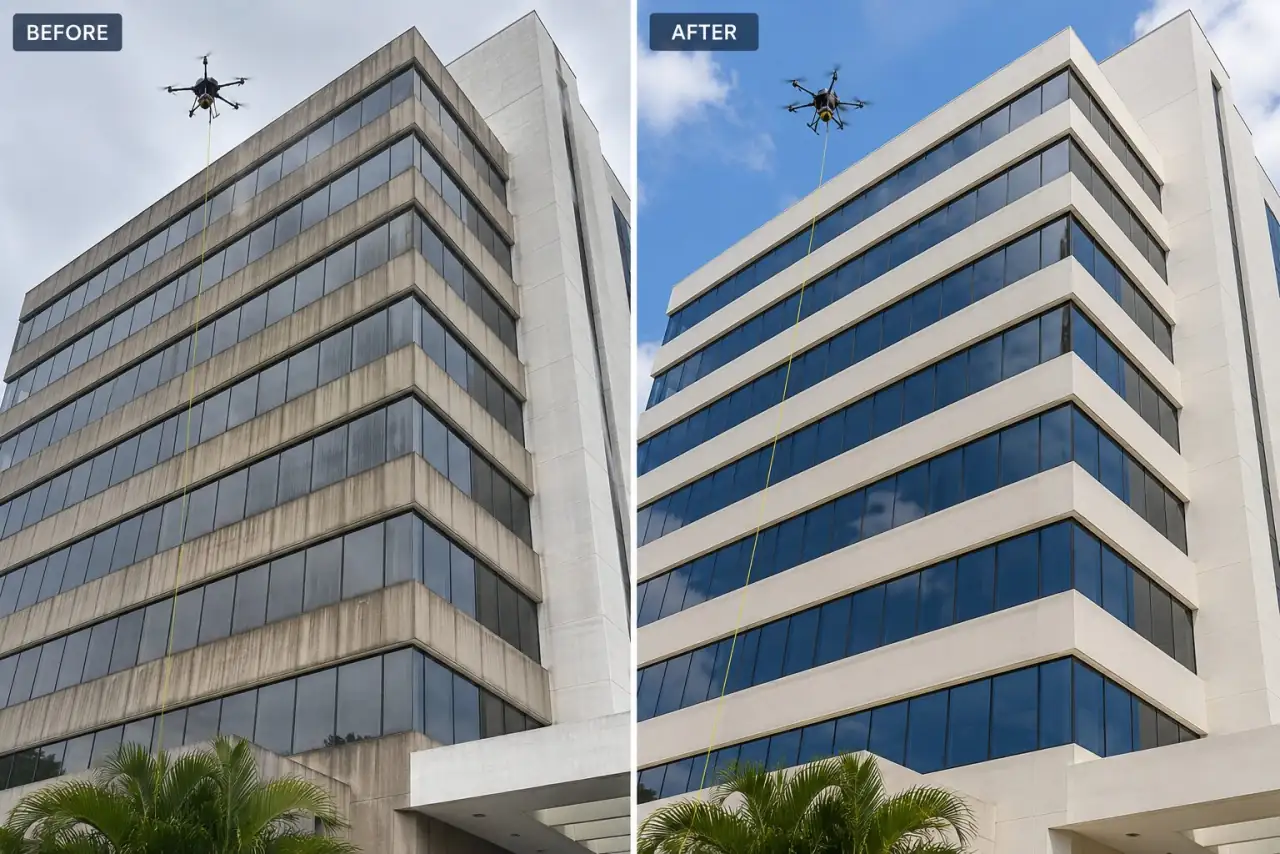
Direct answers for property managers, condo boards, and asset managers comparing drone window cleaning with rope access, swing stages, and scaffolding.
How much does drone window cleaning cost in Miami?+
Drone window cleaning in Miami runs $0.12–$0.25 per square foot of glass, fixed-price after a free site survey. Totals follow glass area rather than storey count: $1,200–$2,375 at 10,000 sq ft of glass, $4,800–$8,000 at 40,000 sq ft, and $10,364–$20,000 at 100,000 sq ft. That is 30–60% less than scaffolding or a boom lift on equivalent scope, and a fraction of rope-access rates, because there is no rigging, no anchor inspection, and no per-drop crew time. Quarterly maintenance contracts drop per-visit cost by 20–30%.
Does drone window cleaning actually work?+
Yes, on exterior glass. The result comes from the water: the drone rinses each pane with de-ionized pure water (0 TDS), which leaves nothing behind when it dries, so the glass ends up streak-free without a squeegee. At Belmont Village in Coral Gables we cleaned more than 130,000 sq ft of exterior, windows included, in 7 days with no lifts, scaffolding, swing stages, rope access or closures. The limits are real too: the drone cleans exteriors only, works within 200 ft per staging position, and does not fly above its wind limit.
Is there a drone that can clean windows, and can I buy one?+
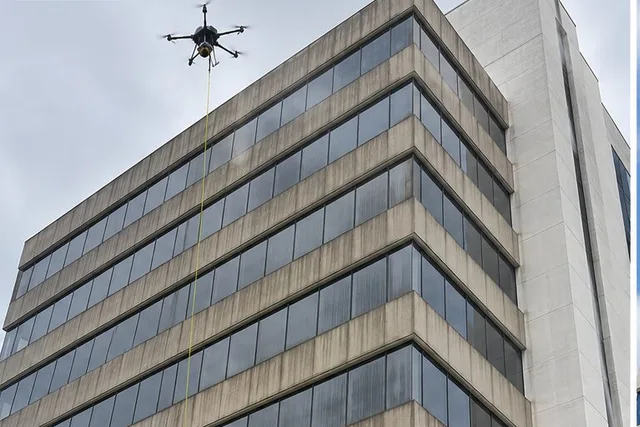
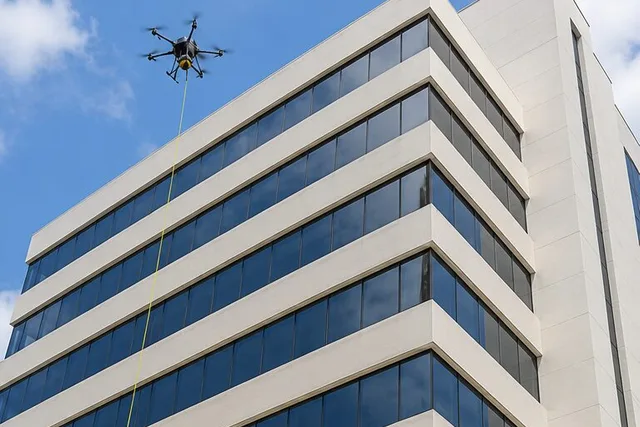
Yes. A window cleaning drone is a tethered industrial drone, not a camera drone: it is fed water and cleaning solution through a tether from the ground, carries detergent and pure-water nozzles, and is built for sustained flight close to glass. We fly Lucid Bots Sherpa cleaning drones. We do not sell drones. An industrial cleaning drone and its ground rig are a six-figure purchase that also needs a Part 107 pilot, pure-water filtration, and aviation insurance before the first job, which is why most building owners hire the service instead.
Is drone window cleaning the same as commercial window cleaning in Miami?+
It's the modern method for it. Commercial window cleaning in Miami traditionally meant rope-access crews, swing stages, or boom lifts. Our drone window cleaning service delivers the same result (clean, streak-free commercial glass on Miami office buildings, condos, and hotels) using a tethered window washing drone instead of workers at height. Same outcome, a lower bill, no rigging, and no lane or lobby closures.
Can drones replace rope access on Miami high-rises?+
Yes, on exterior glass within reach of a staging position. Drones eliminate roof anchor use, IRATA/SPRAT rescue planning, and per-drop labor costs. A drone handles several floors per day versus one drop at a time per crew for rope access, while the operator stays safely on the ground.
How does drone window cleaning compare to rope access on cost?+
Rope access on Miami high-rises is commonly quoted at $1.75–$3.50 per square foot of glass, against our $0.12–$0.25, so the gap is wide; against scaffolding and boom lifts the comparison we publish is 30–60% lower total project cost. The savings come from what disappears, not from cheaper cleaning: multi-day anchor inspections, rigging setup, rescue-plan rehearsal, swing-stage rental, and the per-day rope-tech labor stack. On the lower floors our water-fed pole does a rope drop's job better: pure water never streaks, and it cleans the sills in the same pass as the glass.
How is drone window cleaning different from traditional window washing?+
Traditional exterior window washing relies on squeegees, rope access, or boom lifts, all of which require staging, anchor points, or ground clearance. Drone window cleaning applies a pure-water rinse directly to the glass from a hovering position, reaching every pane on every elevation without anyone touching the building. It is the same 0 TDS water our 70 ft water-fed pole uses on the lower floors; the drone carries it to floors a pole can never reach.
How does a window cleaning drone clean a high-rise without rope access?+
A ground-based pump pushes de-ionized pure water and a separate soft-wash detergent line up the tether to the drone's twin nozzles, so the water never runs out mid-elevation; the aircraft itself runs on batteries that are hot-swapped on the ground. Detergent goes on first, then the pure-water rinse sheets the dirt off the glass while the pilot flies from the ground. No rigging, no anchor inspection, no crew at height.
Can drones reach the top floors of Miami's tallest condo towers: Panorama, Aston Martin, Brickell Flatiron, Waldorf?+
Yes, by staging strategically. The drone works a 200 ft envelope (about 18 stories) from each staging position; the tether handles water delivery, and FAA Part 107 rules govern airspace, not the drone's reach. On taller towers we stage from parking podiums, upper setbacks, or the roof and work down elevation by elevation. That approach lets us clean Brickell, Edgewater, Sunny Isles, and downtown Miami towers floor-by-floor without ropes, swing stages, or scaffolding.
Is drone cleaning safe for low-E, tinted, and mirrored glass on Class A buildings?+
Yes. De-ionized water (0 TDS) plus biodegradable soft-wash detergent is safe for low-E coatings, ceramic-frit, tinted, mirrored, and laminated glass: the glass types common on Brickell, Sunny Isles, and Boca Raton Class A buildings and on most new construction in Miami, Fort Lauderdale, and West Palm Beach. Operating pressure stays in the soft-wash range, no high-PSI impact, no coating-stripping chemicals, no abrasive brushes.
Will drone window cleaning damage exterior window film, decals, or balcony screens?+
No. The cleaning is done by low-pressure soft-wash chemistry and a 0-TDS pure-water rinse, not by force, so there is no impact and no abrasion that could lift the edges of exterior window film, vinyl signage and decals, painted aluminum railings, or fabric balcony screens. Anything fragile or already peeling is noted at the site survey.
Will pure-water window cleaning leave hard-water spots in Miami's mineral-heavy supply?+
No. Miami-Dade and Broward municipal water carries 100–250 ppm dissolved solids, which is exactly why pure-water cleaning matters. We push every drop of rinse water through reverse osmosis and de-ionization beds down to 0 TDS before it hits the glass. With zero minerals in the water, there's nothing to leave behind when it evaporates. Glass dries streak-free and spot-free across every elevation.
Will my windows spot if it rains right after a drone cleaning?+
No. Because the rinse is 0-TDS pure water with no dissolved minerals, there's nothing left on the glass to spot. Even Miami rain won't create the hard-water spotting you'd get after a tap-water or squeegee clean. The glass stays clear between visits.
How long does it take to clean a 30-story Miami tower?+
Most 20–40 story Miami high-rises finish in 1–3 days. The drone covers several floors per day depending on glass square footage, frit pattern, and wind conditions off Biscayne Bay, where a rope crew works one drop at a time. A four-to-ten story commercial building is usually a single day.
Can you clean windows while the building is occupied, without closing the lobby or sidewalk?+
Yes. There's no swing stage outside windows, no rope crew over the sidewalk, no boom lift in the porte-cochère. The ground crew sets up in a single parking space or service drive, spotters hold a small zone only directly under the active flight, and pedestrian flow continues. Tenants get a brief notice, the drone flies one elevation at a time, and no interior access is needed, so a tenant who is away does not hold up the job. Pre-dawn or post-hours flights are available for Brickell and Downtown office towers.
Does the drone work in Miami's wind, humidity, and afternoon storms?+
Our industrial drones fly in sustained wind up to 15 mph, with gusts up to 25 mph, and in light rain only (the manufacturer's limits). Miami's sea breeze usually builds after midday, so we schedule glass work for the calmer morning hours, monitor NOAA marine and aviation forecasts, and plan around afternoon thunderstorms and any tropical system. Operations halt above those wind limits or with lightning within 10 miles. Humidity does not affect cleaning quality; pure water still dries streak-free.
Is drone window cleaning legal in Miami, and do you need permits?+
Yes, it is legal. Our drones are FAA-registered and Remote ID compliant, and every flight is flown by an FAA Part 107 certified remote pilot. In controlled airspace near MIA, FLL, OPF, TMB, and PBI we file LAANC authorizations before each operation. Most South Florida municipalities don't require special permits for Part 107 operations on private commercial property; we handle building-management approvals and certificates of insurance before mobilization.
What insurance is required to clean high-rise windows in Miami?+
We carry $2M commercial general liability plus dedicated UAS (drone) aviation liability and hull coverage. Certificates of insurance naming the building owner, property manager, and HOA are issued before mobilization on every project.
Do I need HOA or condo association approval before booking drone window cleaning?+
For residential condos and HOA-managed properties: yes. Every building requires board or PM approval before exterior work. We provide a board-ready package (COI, FAA Part 107 cert, LAANC authorization, flight plan, tenant notice template). Most approvals take 1–2 board cycles; some PMs approve administratively within a week. Commercial office buildings without a board skip this step and typically schedule within a week of the site survey.
What's included in a drone window cleaning quote?+
Site survey, flight plan, LAANC airspace coordination, tenant notification template, soft-wash + pure-water rinse on every pane, 4K aerial proof-of-clean footage, and COIs for the owner and property manager. Pricing is fixed after the survey, no surprise add-ons.
Do you provide before-and-after documentation?+
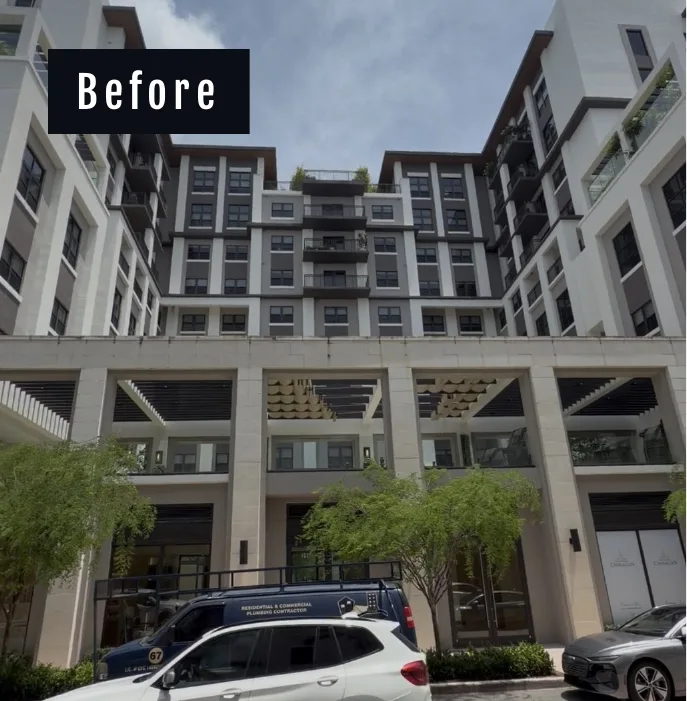
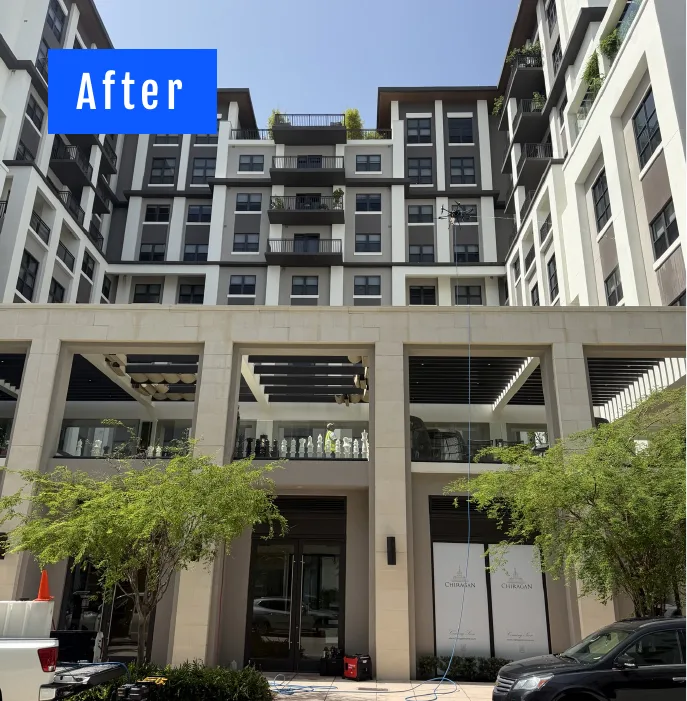
Yes. Every drone window cleaning project includes 4K aerial footage and photo documentation of every elevation, delivered to the property manager as proof of clean, the record condo boards and insurers ask for when exterior maintenance is questioned.
How often should Miami glass be cleaned, and do you offer maintenance contracts?+
Properties directly on the ocean (Miami Beach, Sunny Isles, Hallandale Beach) build up salt haze within weeks, so quarterly cleaning is the practical minimum for a tour-ready finish. One block back from the water, every 4–6 months; inland Brickell, downtown, Doral, and Coral Gables glass runs cleanly on a 6-month schedule. Quarterly, semi-annual, and annual contracts are available, and recurring service drops the per-visit price by 20–30% versus one-time cleans.
How do you handle balconies, retractable awnings, and amenity decks during high-rise window cleaning?+
We pre-coordinate with building management to publish exact flight times per elevation. The 48-hour tenant notice instructs residents to retract awnings, move balcony furniture, and bring pets inside during their elevation's scheduled window, usually 45–90 minutes. Amenity decks (pool, rooftop lounge, sky terrace) are closed only for the 30–45 minutes the drone is actively over them and reopened immediately after.
Can you clean glass on a building still under construction or before a warranty walk-through?+
Yes. Construction debris, mortar splatter, sealant residue, and adhesive films can be removed before the final punch-list walk, so the GC and owner inspect actual glass condition rather than construction soiling. We also coordinate with curtain-wall installers for pre-handover documentation.
Do you clean interior glass, or only the exterior?+
Drone window cleaning is exterior-only: that's where the salt haze, pollution film, pollen, and bird residue live on a Miami building, and exterior grime is usually the larger contributor to a dirty appearance. Interior glass is cleaned by hand and is rarely the maintenance problem on a commercial building. We recommend pairing the exterior drone service with your janitorial team's interior schedule, or we can refer an interior crew for a turnkey package.
Can the drone reach recessed glass, setbacks, and balcony enclosures?+
In most cases, yes. The tethered drone repositions in three dimensions and can angle into setbacks, light wells, and recessed curtain-wall sections that boom lifts can't reach from the street. Deeply enclosed atrium glass is assessed during the site survey. We tell you up front what the drone can and can't reach.
What happens to the pure-water runoff and the landscaping below?+
Soft-wash uses a fraction of the water of pressure washing, and the rinse is 0-TDS pure water with a biodegradable detergent. Runoff is minimal and non-toxic, and we pre-wet landscaping below the work zone so the diluted rinse causes no plant stress. No storm-drain permits are required for this volume.
Can window cleaning be combined with facade washing, glass railings, signage, or solar cleaning in the same mobilization?+
Yes, and bundling almost always saves money because mobilization is the single largest cost on a small job. While the drone and ground pump are already staged, we can extend the same visit to glass balcony railings, spandrel glass, lobby and entry curtain wall, porte-cochère glass and soffits, building signage, adjacent solar arrays, and rooftop equipment. One mobilization, one COI, one documentation package.
How does drone window cleaning compare to robotic facade-cleaning machines (BIWS, Serbot Gekko)?+
Fixed-asset robotic systems require building-specific rail or track installation, weather-restricted operation, and significant capex per installation. They make sense for purpose-built new construction with the geometry to accommodate them. Drone window cleaning is a flexible service with zero capex, works on existing Miami buildings regardless of facade geometry or anchor availability, and adapts to weather and tenant scheduling on demand. For existing portfolios, drones almost always pencil out better.
Which parts of South Florida do you cover for window cleaning?+
All three counties. In Miami-Dade: Brickell, Downtown Miami, Edgewater, Aventura, Miami Beach, Coconut Grove, Sunny Isles, Coral Gables, and Doral. In Broward: Fort Lauderdale, Hallandale Beach, Hollywood, Pompano Beach, Plantation, and Sunrise. In Palm Beach: Boca Raton, Delray Beach, West Palm Beach, Boynton Beach, Jupiter, and Palm Beach Gardens. Same-week scheduling is standard for commercial buildings once the survey is done.