Porous Cementitious Facades · Miami

Stucco Soft-Wash by Drone — Built for Humid Coastal Facade Systems

Stucco isn't a surface. It's a porous, alkaline, capillary-active facade system that behaves very differently in humid coastal Miami than it does anywhere else in the country. We treat it that way. Our drones apply pH-tuned soft-wash chemistry at sub-500 PSI elevation by elevation — killing Gloeocapsa magma cyanobacteria at the root, lifting efflorescence and chloride salt haze, and finishing with a 0 TDS pure-water rinse that won't lift paint or tear an elastomeric membrane. Painted, unpainted, elastomeric, acrylic, Sto, Dryvit, Parex — coating-specific protocols, every job.

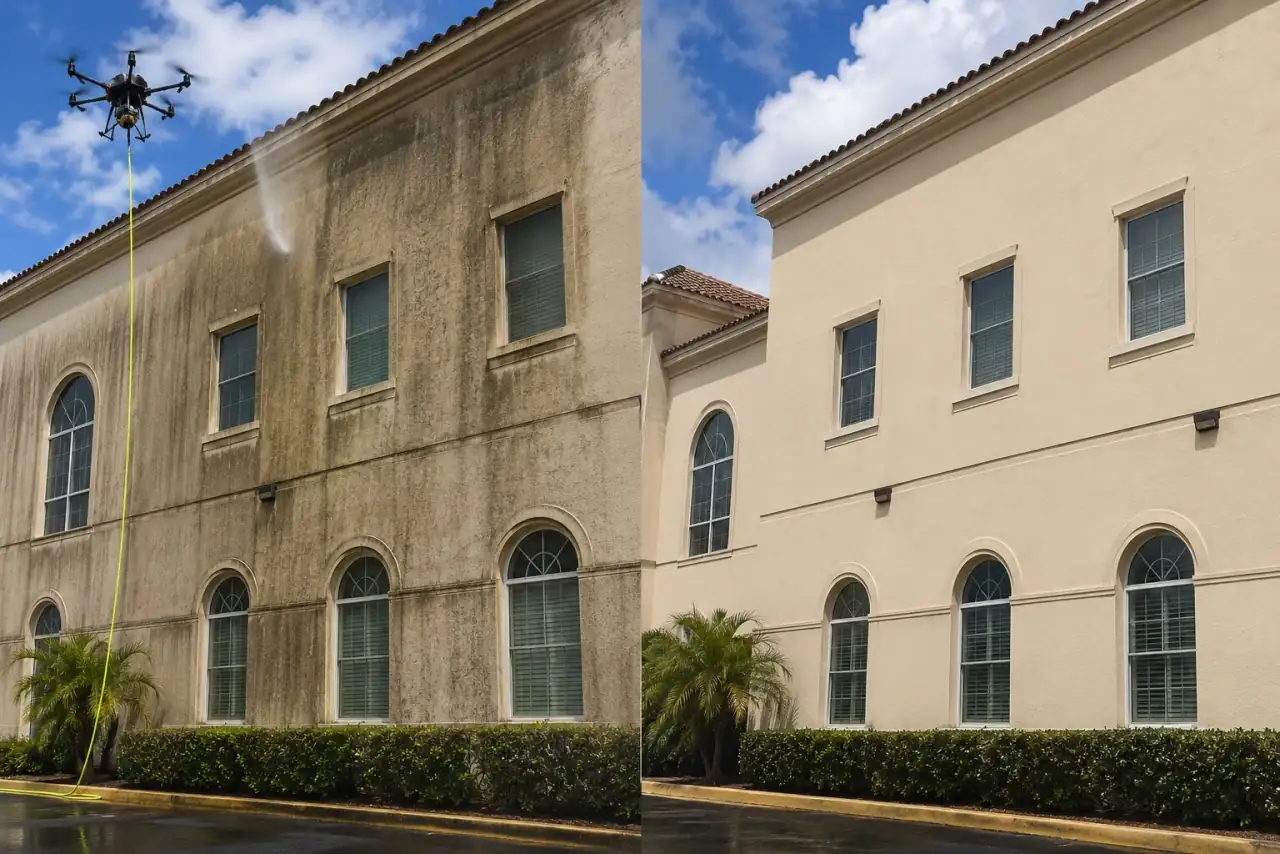
Before and after drone stucco cleaning in Miami — black algae streaks removed, textured finish preserved

Fully Insured

$2M Liability

FAA Compliant

Part 107 Certified

Commercial Projects

Up to 200+ ft

The Problem

Pressure washing fights the wall instead of the algae

Stucco is a thin cementitious finish over lath, block, or rigid insulation — porous, alkaline, and built to breathe vapor. Ground pressure washing at 1,500–4,000 PSI drives water into that porous matrix by capillary action, opens hairline cracks, tears elastomeric and acrylic membranes off the substrate, and only removes the visible upper layer of Gloeocapsa magma. The living colony underneath survives and recolonizes within months. You damaged the facade and bought half a year.

Our Solution

Chemistry-led soft-wash, dialed to the coating

Sodium hypochlorite at 1–2% active with surfactant package, pH-buffered to match the finish system (lower for acrylic and elastomeric, neutral-pH only if we encounter EIFS). Applied by tethered drone at sub-500 PSI. 5–10 minute dwell oxidizes the cell wall of Gloeocapsa magma to depth. A 0 TDS de-ionized rinse sheets dead biomass, salt, and chemistry off the wall — no mineral spotting, no paint lift, no membrane damage. Results hold 18–36 months on Miami stucco.

Why drone cleaning wins

Treats stucco as a facade system, not a surface — coating-specific chemistry every job

Sub-500 PSI soft-wash — no capillary intrusion, no crack propagation, no membrane tears

Kills Gloeocapsa magma to depth — not just the visible biofilm

0 TDS pure-water rinse — safe on dark elastomeric, acrylic & painted finishes

Lifts efflorescence and chloride salt haze without HCl/muriatic etch

Sto / Dryvit / Parex-trained — concentration matched to manufacturer spec

Reaches parapets, banding, soffits & architectural detail no ground crew can

4K aerial proof-of-clean for HOA boards, asset managers & insurance files

Common use cases

  • Mid-rise & high-rise condos
  • Office buildings & medical plazas
  • Hotels & resorts
  • Mixed-use & retail strips
  • HOA single-family communities
  • Government & municipal buildings

Transparent project pricing

Stucco cleaning is priced at $0.20–$0.50 per square foot of wall area. Most mid-rise and commercial projects fall between $1,500 and $8,000. Fixed price after a free site survey, with annual-maintenance discounts available.

Request a Site Quote
Drone Cleaning FAQ

Looking for alternatives to scaffolding?

See how commercial properties across Miami are cleaned without scaffolding, boom lifts, or rope access — safer, faster, and 30–60% more cost-efficient.

Get a free quote in 24 hours

Tell us about your property. We'll send a fixed-price proposal — no scaffolding, no surprises.

Quick answer

What is drone stucco cleaning in Miami?

Stucco is a porous cementitious facade system — alkaline, capillary-active, and uniquely vulnerable in humid coastal environments like South Florida, where airborne calcium dust, salt aerosol, and 9-month UV-driven humidity feed Gloeocapsa magma cyanobacteria and pull efflorescence to the surface. We treat it as a building-envelope system, not a surface to blast. Our drone applies pH-tuned soft-wash chemistry at sub-500 PSI elevation by elevation — killing biological growth at the root, dissolving salt and mineral haze, and finishing with a 0 TDS pure-water rinse that won't lift paint, tear elastomeric membranes, or drive water behind the cladding. Results hold for 18–36 months on Miami stucco vs roughly 6 months for pressure washing, across painted, unpainted, elastomeric, and acrylic (Sto / Dryvit / Parex) finish systems.

Substrate class
Porous cementitious + coated finish systems
Cleaning pressure
Sub-500 PSI soft-wash (chemistry-led)
Chemistry pH window
11.5–12.5 alkaline, surfactant-buffered
Dwell time
5–10 min per panel before rinse
Rinse water
0 TDS de-ionized — no paint lift
Targets
Gloeocapsa magma, efflorescence, chloride salt haze
Coatings cleared
Painted, elastomeric, acrylic (Sto/Dryvit/Parex)
Results last
18–36 months in Miami climate
Pricing
$0.20–$0.50 per sqft of wall
Compliance
FAA Part 107 · $2M CGL + UAS
Frequently asked

Drone cleaning, answered

How much does stucco cleaning cost in Miami?+

Drone stucco cleaning in Miami runs $0.20–$0.50 per square foot of wall area. Most mid-rise condo and commercial buildings fall between $1,500 and $8,000 per project, with multi-building and annual-maintenance discounts available.

Why are there black streaks on my stucco?+

Almost always Gloeocapsa magma — a cyanobacteria algae endemic to South Florida — not permanent staining. It looks like soot or dirt but it's a living organism. Soft-wash chemistry kills it at the root and the streaks rinse off completely.

Will pressure washing damage my stucco?+

Yes. High-pressure washing strips the stucco texture, opens hairline cracks, drives water behind the cladding, and can blow finish coats off elastomeric and acrylic systems. Drone soft-wash at sub-500 PSI avoids all of that.

How often should Miami stucco be cleaned?+

Oceanfront stucco from Brickell to Hallandale Beach: every 12–18 months. Inland Miami-Dade, Broward, and Palm Beach: every 24–36 months. Soft-wash results last 4–6× longer than pressure washing, so the long-term cost is lower even at a higher per-visit price.

Before & after

Black streaks gone — finish intact

Soft-wash chemistry kills Gloeocapsa magma at the root without touching the stucco texture. Drone applies cleaner from the air — no lifts, no scaffolding, no crew at height.

Drone soft-washing a Miami stucco facade — algae-streaked before on the left, restored cream finish on the right
Mid-rise stucco facade · drone-applied soft-wash · single-day project, no scaffolding
Specialized methodology

Why Stucco Requires Specialized Cleaning Methods

Stucco surfaces trap moisture, airborne contaminants, algae, and salt residue more aggressively than many exterior materials in South Florida's humid coastal environment. Improper pressure washing can permanently scar textured stucco finishes, force water intrusion, or damage acrylic coatings.

Our drone-assisted stucco cleaning process uses controlled soft-wash application methods specifically designed for porous exterior wall systems. This allows us to safely remove algae, mildew, black streaking, pollution buildup, and organic staining without excessive pressure or lift equipment.

We regularly clean:

  • Commercial stucco buildings
  • HOA communities
  • Mid-rise residential exteriors
  • Hospitality properties
  • Coastal mixed-use developments
  • High-access facades

Our Miami stucco cleaning process is designed to reduce risk while maintaining coating integrity and long-term exterior appearance.

Substrate expertise

Stucco systems we work on — and the protocol for each

"Stucco" is a category, not a single material. Cementitious stucco, EIFS, elastomeric overcoat, and acrylic finish coats behave very differently under chemistry and pressure. We identify the system in the pre-job survey and dial the protocol to match — concentration, pH, PSI, dwell, and rinse all change.

Traditional 3-coat cementitious stucco

Portland-cement plaster over metal lath: scratch coat, brown coat, finish coat. Highly alkaline, porous, capillary-active.

Failure mode

Gloeocapsa magma colonizes the porous matrix; hairline cracks open under freeze-thaw and seismic micro-movement.

Our protocol

Sub-500 PSI · sodium hypochlorite + surfactant at 1–2% active · 5–10 min dwell · 0 TDS rinse.

One-coat fiber-reinforced stucco

Single-pass Portland-cement plaster with chopped polymer fiber for crack resistance. Thinner section, faster to wet through.

Failure mode

Faster moisture uptake means biological recolonization is faster if rinse is incomplete or sealer fails.

Our protocol

Sub-400 PSI · same chemistry, slightly lower concentration · extended pure-water rinse.

Synthetic stucco / EIFS (Sto, Dryvit, Parex)

Thin acrylic basecoat + finish over expanded polystyrene foam insulation board. Hollow tap sound. Vapor-impermeable.

Failure mode

Chlorine-aggressive chemistry yellows the acrylic and degrades the EPS foam under any breach.

Our protocol

Sub-300 PSI · neutral-pH detergent · no chlorine · short dwell, immediate rinse. We refer EIFS work to our /eifs-cleaning-miami protocol.

Elastomeric-coated stucco

Cementitious stucco overcoated with high-build elastomeric paint that bridges hairline cracks and forms a flexible moisture barrier.

Failure mode

Pressure washing punctures the membrane; biological growth lives on top of the coating, not in the substrate.

Our protocol

Sub-500 PSI · pH-buffered chemistry to protect the elastomeric binder · surfactant-led lift, not chlorine-led.

Acrylic finish coats (Sto / Dryvit / Parex over cement)

Premixed acrylic-resin finish applied over cementitious basecoat. Common on Mediterranean / coral-accent facades in Palm Beach and Coral Gables.

Failure mode

Aggressive chemistry strips the acrylic binder and dulls the integral pigment; pressure leaves swirl marks.

Our protocol

Sub-400 PSI · concentration-dialed chemistry matched to the manufacturer's chemical-resistance chart · short dwell.

Painted stucco (latex or elastomeric paint over cement)

Cementitious stucco coated with latex or elastomeric exterior paint. The coating is the moisture barrier — substrate is no longer exposed.

Failure mode

High pressure strips paint film; high-mineral rinse water leaves spotting on dark colors.

Our protocol

Sub-500 PSI · paint-safe surfactant chemistry · 0 TDS de-ionized rinse to prevent mineral spotting.

Florida climate + biology

Why South Florida stucco fails faster than anywhere else

UV intensity, year-round humidity, airborne calcium dust from the Oolite limestone bedrock, and chloride salt aerosol from breaking waves all converge on every Miami facade. Three forces drive 95% of what shows up on a stucco wall here.

Gloeocapsa magma — South Florida is the global capital

Gloeocapsa magma is a cyanobacteria (blue-green algae) whose gelatinous sheath protects the colony from UV and desiccation. South Florida concentrates every variable it needs: 75%+ relative humidity nine months of the year, year-round UV, and airborne calcium dust from the Oolite limestone bedrock — which the organism metabolizes. It's why Miami stucco streaks faster than the same stucco anywhere else in North America.

  • Colony lives in the top 1–2 mm of the porous cementitious matrix — pressure can't reach it intact
  • Visible black streaks are biofilm + dead cells; the living organism is below and recolonizes within months after pressure washing
  • Sodium hypochlorite at 1–2% active oxidizes the cell wall and kills the colony to depth — surfactant carries chemistry into the pores

Efflorescence — what the white powder is telling you

Efflorescence is calcium hydroxide (and other soluble salts) leached from the cementitious substrate by water moving through the wall. It crystallizes on the surface as the water evaporates. The deposit is cosmetic — soft-wash chemistry will lift it — but its presence is diagnostic: it means there's a moisture-intrusion path behind the cladding that needs remediation, or the bloom returns.

  • Common sources in Miami: failed parapet-cap sealant, missing through-wall flashing, leaking window perimeters, hydrostatic pressure at grade
  • Surface lift only — we do not chemically etch with HCl/muriatic acid (it damages cement paste and adjacent coatings)
  • Post-clean report flags the suspected moisture path so your facade contractor or waterproofing consultant can address it

Chloride salt aerosol — oceanfront chemistry

Breaking waves aerosolize sodium and magnesium chloride; prevailing easterlies deposit chloride on facades in measurable concentrations 0–3 miles inland. Chloride is hygroscopic — it pulls humidity to the wall and keeps it there, accelerating biological growth and slowly attacking the binder in acrylic and elastomeric finish coats.

  • 0–1 mi coast (Brickell, Miami Beach, Sunny Isles, Hallandale Beach): clean every 12–18 months
  • 1–3 mi inland (Aventura, Edgewater, Wynwood, Coconut Grove): clean every 18–24 months
  • Deep inland (Doral, Plantation, Boca Raton west): clean every 24–36 months
Low-pressure methodology

Chemistry-led, not pressure-led — the actual sequence

Soft-wash is a category defined by sub-500 PSI application — the cleaning is done by oxidation and surfactant action, not mechanical force. The sequence matters as much as the chemistry.

  1. 1

    Pre-wet landscape + adjacent finishes

    Landscaping, pool decks, walkways, and adjacent painted finishes are saturated with potable water before any chemistry is applied. A pre-wet substrate dilutes incidental overspray on contact — runoff at the wall base is effectively dilute brine, not concentrated detergent.

  2. 2

    Substrate-matched chemistry, drone-applied

    Concentration is dialed to the coating system (see substrate matrix above). Sodium hypochlorite 1–2% active for unpainted/painted cementitious stucco; pH-buffered surfactant-led for elastomeric and acrylic; neutral-pH only for EIFS. Drone applies elevation by elevation at sub-500 PSI — chemistry-led, not pressure-led.

  3. 3

    Controlled dwell (5–10 minutes)

    Chemistry needs contact time to oxidize the cell wall of Gloeocapsa magma and lift atmospheric soiling. Too short and the colony survives; too long on a coated finish and the surfactant can flash-dry. We work elevation by elevation so dwell time is consistent across the panel.

  4. 4

    0 TDS pure-water rinse

    De-ionized rinse sheets dead biomass, chloride salts, and chemistry residue off the finish. Municipal water (200–400 TDS in South Florida) leaves mineral spotting on dark elastomeric and acrylic coatings and can interact with chlorine residue. De-ionized water dries clean.

  5. 5

    Post-clean documentation

    4K aerial footage of every elevation before and after, plus a written report flagging any pre-existing damage, efflorescence sources, or coating-failure zones we observed — accepted by HOA boards, insurance carriers, and asset managers for reserve-study files.

What pressure washing actually does to stucco

Four failure modes — every one of them avoidable

These aren't theoretical. Every facade contractor in South Florida sees them on walls that have been pressure-washed once a year for a decade.

  • Capillary water intrusion

    Water driven into the cementitious matrix at 1,500–4,000 PSI saturates the wall and migrates behind the cladding — feeding sheathing rot, interior mold, and accelerated efflorescence.

  • Finish-coat delamination

    Pressure rupture lifts elastomeric and acrylic finishes off the substrate. The damage is often invisible until the next rain, when blisters form and the coating peels in sheets.

  • Hairline crack propagation

    Existing hairline cracks open under pressure and become water-intrusion pathways. The crack network expands every subsequent rinse.

  • Texture loss + paint stripping

    High pressure mechanically erodes the stucco texture (smooth, sand, dash, knockdown) and strips paint film. The finish you're trying to clean is the finish you're destroying.

Step-by-step process

How drone stucco cleaning works in Miami

Every project follows the same controlled, documented workflow — from substrate confirmation through 4K proof-of-clean.

  1. 1

    Substrate confirmation

    We confirm the wall is cementitious stucco — not EIFS — by tap test and visual inspection during the site survey. The two require different chemistry; getting this wrong damages walls.

  2. 2

    Chemistry selection

    Soft-wash detergent is dialed in for the specific stucco system: painted, unpainted, elastomeric, or acrylic. Concentration is matched to the coating to lift algae without attacking the finish.

  3. 3

    Landscape protection & LAANC

    Landscaping below the wall line is pre-wet. LAANC airspace authorization is filed for controlled airspace near MIA, FLL, or PBI before mobilization.

  4. 4

    Soft-wash application

    The drone applies biodegradable detergent at sub-500 PSI elevation by elevation. Dwell time is 5–10 minutes per panel — chemistry does the work, killing the algae at the root.

  5. 5

    Pure-water rinse

    Twin nozzles flood every elevation with 0 TDS pure water, sheeting dead algae and salt residue off the finish.

  6. 6

    4K aerial proof-of-clean

    4K aerial footage of every elevation before and after is delivered to the property manager — accepted by HOA boards, insurance carriers, and asset managers.

Equipment & specs

Drone stucco cleaning equipment & specs

An engineered soft-wash system tuned for stucco substrates — industrial tethered drone, ground pump, substrate-matched chemistry, FAA-certified pilot.

Drone class
Industrial tethered UAS
Reach
Ground to 200+ ft
Cleaning pressure
Sub-500 PSI soft-wash
Detergent
Biodegradable, substrate-matched
Rinse water
0 TDS de-ionized
Wind rating
Sustained 25–30 mph
Pilot cert
FAA Part 107 commercial
Insurance
$2M CGL + UAS aviation
Documentation
4K aerial video + stills
Safety, insurance & compliance

Safety, insurance & coating compliance

Drone stucco cleaning eliminates the highest-risk activity on any facade — workers at height — and replaces ground-pressure equipment that routinely damages the finish it's trying to clean.

Zero crew at height

No scaffolding, swing stage, boom lift, or rope access. The pilot flies from a ground station — fall risk is removed entirely.

No pressure damage to stucco

Sub-500 PSI soft-wash leaves stucco texture, hairline cracks, and finish coats intact. Chemistry does the work, not pressure.

Coating-safe chemistry

Detergent concentration is matched to painted, elastomeric, and acrylic systems. No chlorine bombs, no acid washes — nothing that attacks the finish.

FAA Part 107 + LAANC compliance

Every Miami flight is conducted by an FAA-licensed Part 107 pilot. LAANC airspace authorizations are filed and carried on every job site.

$2M commercial general liability + UAS coverage

We carry $2M CGL plus dedicated UAS (drone) liability and hull coverage. COIs naming the owner, property manager, and HOA or condo board are issued before mobilization.

Landscape-safe runoff

All detergents are biodegradable. Landscaping is pre-wet so runoff is diluted on contact, and pool decks are rinsed clean of overspray as part of the workflow.

Pricing ranges

Miami stucco cleaning pricing

All projects are fixed-price after a free site survey. Stucco is priced per square foot of wall area at $0.20–$0.50/sqft.

Small commercial / strip retail

$1,500 – $3,000

  • Up to ~15,000 sqft of wall
  • Full soft-wash + pure-water rinse
  • Coating-matched chemistry
  • Single-day completion
  • 4K proof-of-clean footage

Mid-rise condo or office

$3,000 – $8,000

  • 15,000–50,000 sqft of wall
  • 1–2 day completion
  • COI naming owner & PM
  • LAANC airspace coordination
  • Annual maintenance available

High-rise / portfolio

$8,000 – $20,000+

  • 50,000+ sqft / multiple buildings
  • Multi-elevation flight planning
  • Pre-dawn / off-hours options
  • Dedicated drone crew
  • Portfolio discount applied

Final pricing depends on wall square footage, coating system, ground-pump staging access, airspace coordination, and frequency. Annual contracts for oceanfront Brickell, Miami Beach, Sunny Isles, and Hallandale Beach buildings drop per-visit pricing by 15–25%.

Frequently asked

Miami stucco cleaning FAQ

What is drone stucco cleaning?+

An FAA Part 107-licensed pilot flies a tethered industrial drone carrying a low-pressure soft-wash spray head. The drone applies pH-tuned biodegradable detergent and a 0 TDS pure-water rinse to stucco facades from the air — reaching the full envelope including parapets, soffits, banding, and architectural details, without scaffolding or boom lifts. The process treats stucco as a porous cementitious system, not a surface to blast.

Why is pressure washing bad for stucco?+

Stucco is a thin cementitious finish over lath, block, or rigid insulation. High-pressure water (1,500–4,000 PSI) strips the surface texture, opens hairline cracks through capillary intrusion, and forces water behind the cladding where it can rot sheathing and feed mold inside the wall cavity. On painted stucco it strips the paint film; on elastomeric or acrylic coatings (Sto, Dryvit, Parex) it tears the elastic membrane and breaks the moisture-vapor barrier. Soft-wash chemistry cleans deeper than pressure ever can — without any of that mechanical damage.

What causes the black streaks on Miami stucco?+

Gloeocapsa magma — a cyanobacteria that thrives on South Florida's humidity, UV intensity, and airborne calcium/limestone dust from the Oolite bedrock. It looks like dirt or soot but it's a living organism with a gelatinous sheath that protects its colony. Pressure washing only removes the visible upper layer; the underlying organism survives and recolonizes within months. Sodium hypochlorite-based soft-wash chemistry oxidizes the cell wall and kills the colony at the root, so streaks don't return for 18–36 months.

What's the difference between real stucco and EIFS — and why does it matter?+

Real cementitious stucco is a 3-coat or 1-coat Portland-cement plaster applied over lath or block; it sounds solid when you tap it. EIFS (Exterior Insulation and Finish System — synthetic stucco) is a thin acrylic finish over expanded polystyrene foam insulation; it sounds hollow. The two need different chemistry — EIFS requires neutral-pH detergent with no chlorine and even lower PSI to avoid puncturing the foam. We confirm the substrate by tap test during the pre-job survey, and refuse to apply cementitious-stucco chemistry to EIFS.

Is drone soft-wash safe for elastomeric and acrylic coatings?+

Yes. Soft-wash chemistry is pH-matched to the coating and applied at sub-500 PSI — well below the rupture threshold for elastomeric membranes and acrylic finish coats from Sto, Dryvit, and Parex. There's no mechanical impact to lift the coating from the substrate, and the surfactant package is non-stripping for acrylic resins. We document the coating system in the pre-job survey and dial concentration to match.

Does drone cleaning damage paint on painted stucco?+

No. Pressure washing strips paint; soft-wash chemistry plus a 0 TDS pure-water rinse does not. The detergent breaks down algae and atmospheric soiling without attacking the binder in latex or elastomeric paint films. The pure-water rinse matters — high-mineral municipal water leaves spotting and can interact with chlorine residue, while de-ionized water sheets cleanly off the finish.

How long do drone stucco cleaning results last?+

On Miami stucco: 18–36 months before visible algae return. Variables: tree shade (shorter), irrigation overspray (much shorter), oceanfront chloride loading (shorter), south-facing UV exposure (longer). Pressure washing on the same stucco lasts roughly 6 months because Gloeocapsa magma spores survive the mechanical blast. The chemistry drives the duration, not the pressure.

What's the white powder on my stucco — and will cleaning fix it?+

That's efflorescence: calcium hydroxide and other soluble salts that migrated through the cementitious substrate to the surface, carried by water moving through the wall. The white deposit itself is cosmetic — soft-wash will lift it from the surface. But efflorescence indicates a moisture-intrusion path behind the cladding: a failed sealant joint, missing flashing, leaking parapet cap, or hydrostatic pressure at grade. Without addressing the moisture path, efflorescence returns. We flag the suspected source in the post-clean report.

What does oceanfront exposure do to stucco — and how often should beachfront buildings be cleaned?+

Chloride salt aerosol from breaking waves deposits on facades within 0–1 miles of the coast, accelerating both biological growth (salt holds humidity against the wall) and coating breakdown (chlorides attack the binder in acrylic and elastomeric finishes). Oceanfront stucco in Brickell, Miami Beach, Sunny Isles, and Hallandale Beach typically needs cleaning every 12–18 months; 1–3 miles inland stretches to 18–24 months; deep inland Miami-Dade, Broward, and Palm Beach run 24–36 months.

How much does drone stucco cleaning cost in Miami?+

$0.20–$0.50 per square foot of wall area. A 10,000 sqft mid-rise stucco facade typically runs $1,500–$2,500; a 50,000 sqft condo tower runs $7,500–$12,000. Pricing is fixed after a free site survey and includes substrate-matched chemistry, pure-water rinse, and 4K aerial documentation. Annual-maintenance contracts on oceanfront buildings drop per-visit pricing 15–25%.

How long does a stucco cleaning project take?+

Single-story commercial strips: a few hours. Mid-rise (4–10 stories): 1 day. High-rise condos and office towers: 1–3 days. The drone covers far more facade per day than ground crews because there's no rigging setup and no walking elevations — but dwell time for the chemistry is fixed at 5–10 minutes per panel regardless of access method.

What insurance do you carry?+

We carry $2M commercial general liability plus dedicated UAS (drone) liability and hull coverage. Certificates of insurance naming the building owner, property manager, and HOA or condo board are issued before mobilization.

Do you need permits or FAA authorization?+

Most Miami-Dade, Broward, and Palm Beach municipalities do not require special permits for FAA Part 107 operations on private commercial property. For controlled airspace near MIA, FLL, and PBI we file LAANC airspace authorization with the FAA before mobilization.

Can you clean stucco on an occupied building?+

Yes. No scaffolding, no swing stage, no lobby disruption. Tenants get a 48-hour notice and the drone works one elevation at a time. Pedestrian access and business operations continue normally throughout.

What about stucco with hairline cracks or prior pressure-wash damage?+

Soft-wash chemistry will not enlarge existing cracks — it has no mechanical impact. We document any pre-existing damage during the pre-job survey and note it in writing. For severely compromised stucco, we recommend repair and recoat before cleaning so the new finish doesn't immediately re-soil. We can coordinate with your facade-restoration contractor on sequencing.

Should stucco be sealed after cleaning?+

For unpainted cementitious stucco in heavy-shade or irrigation-overspray zones, a breathable silane/siloxane water-repellent sealer applied after cleaning can extend results by 12+ months. The sealer must be vapor-permeable — film-forming sealers trap moisture in the cementitious matrix and accelerate spalling. For painted, elastomeric, or acrylic-coated stucco, no additional sealer is needed; the existing coating is the moisture barrier.

Local Coverage

Stucco cleaning across South Florida

We clean stucco facades throughout Miami-Dade, Broward, and Palm Beach. Coastal exposure, building height, and coating system all factor into how we sequence the project.

Miami-Dade

Miami-Dade County

Miami-Dade stucco fights salt haze, humidity, and 9+ months of algae growing season. Drone soft-wash kills Gloeocapsa magma at the root on Brickell condos, Coral Gables office buildings, and Coconut Grove mixed-use without scaffolding or lane closures.

  • Miami
  • Brickell
  • Coral Gables
  • Aventura
  • Coconut Grove
  • Edgewater
  • Wynwood
  • Miami Beach
  • Doral
Brickell building cleaning
Broward

Broward County

Broward stucco — from Fort Lauderdale beachfront condos to Plantation office parks — needs soft-wash chemistry, not pressure. We clean entire HOAs and commercial portfolios in one mobilization without renting boom lifts or closing parking.

  • Fort Lauderdale
  • Hallandale Beach
  • Hollywood
  • Pembroke Pines
  • Plantation
  • Sunrise
  • Coral Springs
Fort Lauderdale commercial cleaning
Palm Beach

Palm Beach County

Palm Beach stucco — coral-accent buildings, ornate Mediterranean facades, high-end HOAs — has zero tolerance for pressure-wash damage. Soft-wash drone cleaning preserves the finish from Boca Raton to West Palm Beach.

  • Boca Raton
  • Delray Beach
  • West Palm Beach
  • Boynton Beach
  • Jupiter

Local FAQs — Miami, Broward & Palm Beach

Do you clean stucco buildings throughout Miami-Dade?

+

Yes — across Miami, Brickell, Coral Gables, Aventura, Coconut Grove, Edgewater, Wynwood, Miami Beach, and Doral. Same-week scheduling is standard for Miami-Dade properties.

Do you serve Broward County for stucco cleaning?

+

Yes. We regularly clean stucco facades in Fort Lauderdale, Hallandale Beach, Hollywood, Pembroke Pines, Plantation, Sunrise, and Coral Springs. Multi-building HOA portfolios get a single-mobilization discount.

Do you offer stucco cleaning in Palm Beach County?

+

Yes — Boca Raton, Delray Beach, West Palm Beach, Boynton Beach, and Jupiter. Soft-wash is the only safe method for Palm Beach's coral-accent and high-end Mediterranean stucco.

Are permits required for drone stucco cleaning?

+

Most South Florida municipalities do not require special permits for FAA Part 107 operations on private property. We handle building-management approvals, COIs, and LAANC airspace clearance before mobilization.

Coatings · Substrates · Edge cases

Stucco cleaning — common questions

Direct answers for property managers, HOA boards, and owners comparing drone soft-wash to ground pressure washing on Miami stucco.

How do I know if my stucco is real stucco or EIFS?+

Tap the wall. Real cementitious stucco sounds solid; EIFS (synthetic stucco over foam insulation) sounds hollow. The cleaning chemistry differs significantly between the two — EIFS requires neutral-pH detergent and absolutely no chlorine. We confirm substrate during the pre-job survey before any chemistry hits the wall.

Will drone stucco cleaning lift efflorescence (white powder) off the surface?+

Partially. Efflorescence is mineral salt that leached through the stucco from moisture inside the wall — it indicates a water intrusion issue behind the cladding. Soft-wash will lift the surface deposit, but the underlying moisture path needs to be repaired or the efflorescence returns. We flag this in the post-clean report.

Does runoff from stucco cleaning hurt landscaping?+

No. Detergents are biodegradable, and we pre-wet all landscaping below the wall line before chemistry is applied — runoff is diluted on contact. Pool decks, walkways, and irrigation systems get a final pure-water rinse as part of the workflow.

Can you clean stucco that has been painted multiple times?+

Yes. Multiple paint layers do not interfere with soft-wash chemistry — the detergent works on the surface biological growth, not the paint underneath. The only situation where we recommend caution is failing paint that's already lifting; on those walls we recommend recoating after cleaning.

What's the difference between drone stucco cleaning and ground pressure washing?+

Drone soft-wash uses chemistry at sub-500 PSI; ground pressure washing uses water at 1,500–4,000 PSI. The drone reaches every elevation from the ground up without ladders, scaffolding, or boom lifts. Pressure washing only reaches what a wand can reach safely from the ground or a lift — typically 2 stories — and it strips the surface texture it's trying to clean.

Can you handle architectural details — quoins, banding, parapets, decorative moldings?+

Yes. The drone holds position at any elevation and angle, so quoins, banding, parapet caps, sunshades, decorative moldings, and recessed soffits all get reached and cleaned. These are the surfaces ground crews skip because they require a lift to access.

What time of day do you typically clean?+

Most Miami stucco projects run 7 AM to early afternoon to avoid the daily thunderstorm window. For occupied office buildings we offer pre-dawn or weekend flights at no premium. Soft-wash chemistry works in light rain but not in lightning, so we monitor radar continuously.

What to expect

What stucco cleaning day looks like

From the site survey that locks the quote to the 4K proof-of-clean delivered after.

  1. 01

    T-7 days: Site survey & quote lock

    We walk every elevation, photograph the facade, confirm the substrate is cementitious stucco (not EIFS — different chemistry), and lock the fixed-price quote based on actual wall square footage.

  2. 02

    T-3 days: COI & flight plan issued

    Certificate of insurance naming the owner, PM, and HOA/condo board is delivered. The elevation-by-elevation flight plan and LAANC airspace authorization go to building management.

  3. 03

    T-2 days: Tenant notice distributed

    Property management distributes the 48-hour notice with timing by side of building so tenants close shades, move balcony furniture, and bring pets inside.

  4. 04

    Cleaning day, 7:00 AM: Crew mobilizes

    The ground crew occupies one parking space, sets up the pump, pre-wets landscaping below the wall line, mixes substrate-matched detergent, and stages spotters. Setup runs 30–45 minutes.

  5. 05

    Application & dwell: Elevation by elevation

    The drone applies soft-wash chemistry at sub-500 PSI elevation by elevation. Dwell time is 5–10 minutes per panel — chemistry kills Gloeocapsa magma at the root while the drone sets up the next pass.

  6. 06

    Rinse + 4K documentation

    Pure-water rinse sheets dead algae off every elevation. 4K aerial footage of every elevation before and after is delivered to property management within 48 hours for HOA board records and insurance file.