
No Scaffolding: Off Season Exterior Cleaning for South Florida Hotels
An operations-first 90 day playbook for South Florida hotels to plan off season exterior cleaning, protect assets, and use drone cleaning to avoid...
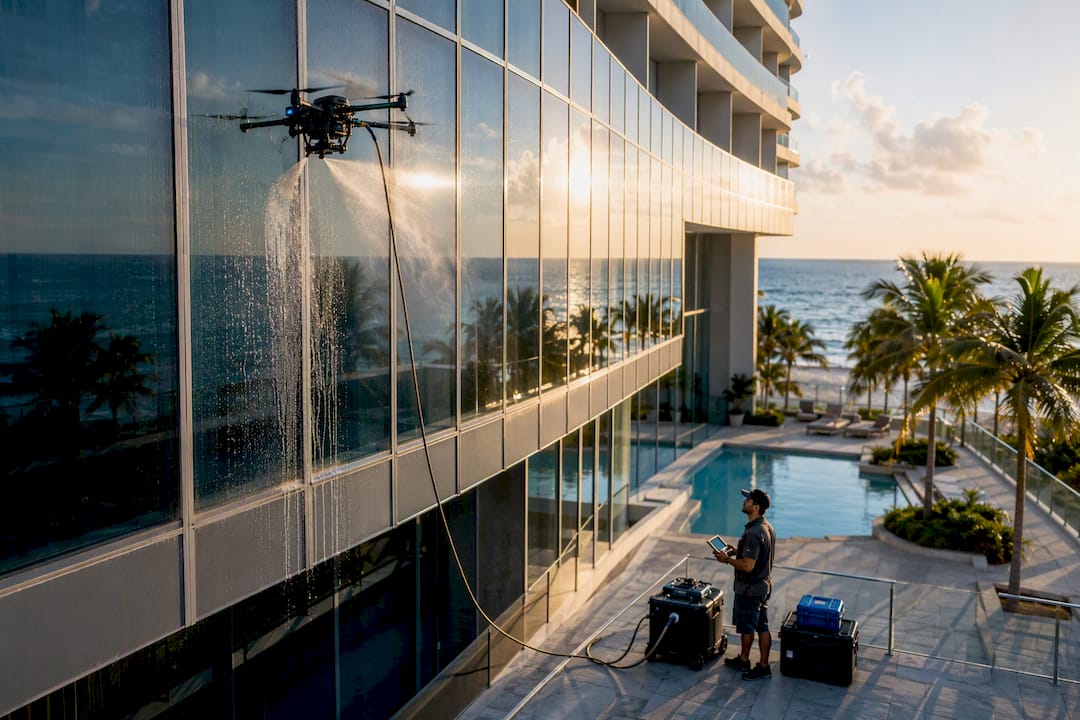
Treat the off-season as your primary window for deep exterior cleaning. Schedule the highest-access, highest-impact facade and roof work in a 90-day off-season window, before guest counts climb again. Urban luxury and resort properties in Miami-Dade, Broward, and Palm Beach counties, typically require multiple facade and glass cleanings annually; suburban and select-service hotels can usually get by on one thorough pass. Anchor the schedule to industry guidance like the 90-day off-season planning framework, and line up a vendor early.
TL; DR:
- Scheduling exterior cleaning during a 90-day off-season window boosts efficiency, especially for salt-exposed coastal properties that require more frequent maintenance.
- A detailed inspection and prioritization phase, followed by early procurement, significantly increases completion rates from around 55-65% to over 90%.
- Contractors should have clear safety plans, proof of insurance, and specific removal thresholds for adverse weather, with early booking securing better pricing.
- Cost factors include building height, access method, and surface complexity, making bid itemization essential to avoid surprises.
- Drone-assisted cleaning is ideal for high-rise windows and facades, provided pilots hold FAA Part 107 certification and proper liability coverage.
Table of Contents
- When Should You Schedule Hotel Exterior Cleaning Off Season?
- What Belongs on a Surface-by-Surface Cleaning Checklist?
- Soft-Wash, Low-Pressure, or Pressure Wash: Which Method Fits?
- How Do You Schedule Contractors Without Disrupting Guests?
- What Drives the Cost of Off-Season Exterior Cleaning?
- What Should Be in Every Off-Season Cleaning Contract?
- Where Does Drone-Assisted Cleaning Actually Fit?
- An Operations Manager’s Off-Season Checklist
- How Vistadronecleaning Handles Off-Season Exterior Cleaning
- Sources
- FAQ
When Should You Schedule Hotel Exterior Cleaning Off Season?
South Florida hotels don’t get a true off-season shutdown, but occupancy dips still create windows for shutdown-dependent work. A structured 90-day framework turns that dip into productive time instead of wasted capacity.
- Days 90 to 60: assessment and prioritization. Walk the property, log every façade stain, roof issue, and glazing problem, and rank tasks by guest impact and repair urgency.
- Days 60 to 30: procurement and scheduling. Solicit bids, verify insurance, and book contractor windows before their calendars fill. Properties that follow this staged approach see completion rates jump from an industry average of roughly 55 to 65 percent to over 90 percent.
- Days 30 to 0: team prep and communication. Brief front desk and housekeeping, post guest notices, and confirm access routes and equipment staging.
Tasks that need multi-day room access or full system shutdowns belong in this window; routine filter changes and touch-up work can happen year-round without eating into your off-season capacity. Coastal properties in Fort Lauderdale, Boca Raton, and Miami Beach should run cleaning cycles more often than inland Palm Beach County locations, since salt exposure accelerates grime buildup and metal corrosion.
What Belongs on a Surface-by-Surface Cleaning Checklist?
Before any crew touches a surface, document existing damage with photos. That record protects you in warranty disputes and helps a vendor scope the job accurately.
- Façade (stucco, EIFS, concrete, metal panels): Inspect for cracking and efflorescence before cleaning, then apply anti-efflorescence treatment after rinsing.
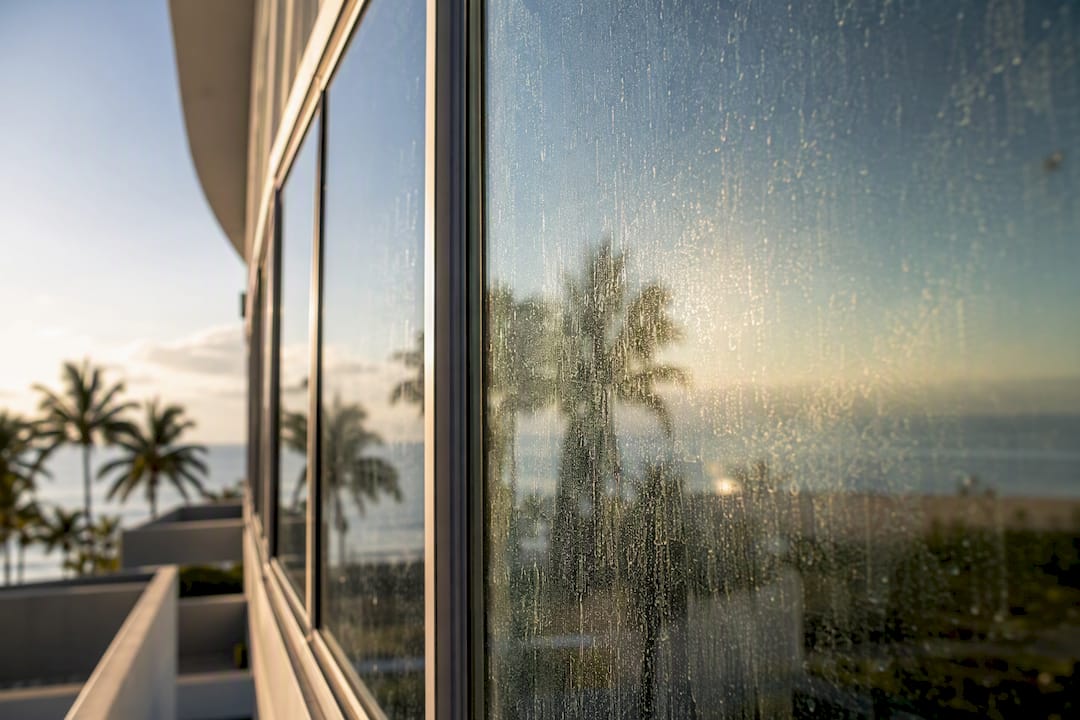
- Glass curtain walls and windows: Check seals and gaskets first; streaking on high-rise glass often signals a rinse-water problem, not a dirt problem.
- Roofs: Combine cleaning with an inspection. Roofing guidance calls for at least two professional roof inspections per year, plus unscheduled checks after named storms.
- Decks, pool surrounds, and sidewalks: Test slip resistance after cleaning, especially around pool decks where sunscreen residue and algae build up fast, in South Florida humidity.
- Parking structures and porte-cocheres: Clean before repainting striping or sealing joints, since grime traps moisture against concrete.
Pro Tip: Walk the property with your vendor before signing anything, and photograph every existing crack, stain, or loose panel together so there’s no dispute later about what the cleaning caused versus what was already there.
Glass curtain walls typically need cleaning one to four times a year depending on pollution, salt exposure, and bird activity, with coastal and urban luxury properties trending toward the higher end. A South Florida property within a few hundred feet of the shoreline shows measurably higher repair rates tied to chloride exposure, which is reason enough to budget more frequent salt-removal cycles for beachfront resorts. For a fuller task list, Vistadronecleaning’s building exterior maintenance checklist breaks these items down by inspection point.
Soft-Wash, Low-Pressure, or Pressure Wash: Which Method Fits?
The method has to match the substrate, not just the stain. Get this wrong and you can void a warranty or etch a finish that was fine the week before.
- Soft-wash (low pressure, chemical-assisted): Best for stucco, EIFS, and painted surfaces where high pressure can drive water behind the wall assembly.
- Low-pressure rinse: Works for sealed concrete and most masonry once soft-wash chemistry has broken down organic growth.
- Pressure washing: Reserve for unsealed concrete, pavers, and parking decks. Never use it on EIFS or aged stucco.
- Drone-assisted cleaning: A practical option for high-rise glass and facades where scaffolding or lift access would otherwise shut down a building side for days.
Pro Tip: Ask any contractor what PSI they run on stucco before signing off. If the answer is “whatever gets it clean fastest, ” get a second bid. Vistadronecleaning’s guide on low-pressure washing for high-rises covers substrate-matched pressure settings in more detail. Whichever method you choose, insist on a full de-ionized water rinse. Mineral-heavy rinse water leaves spotting on glass that looks like the job wasn’t finished at all.
How Do You Schedule Contractors Without Disrupting Guests?
Booking early gets you better pricing and better crews, since off-season is when specialists are both available and cheaper before demand spikes again in winter.
- Book contractor windows during your property’s lowest midweek occupancy, and stagger building sides so you’re never blocking two entrances at once.
- Schedule high-rise glass and facade work to start at early morning hours and wrap before peak check-in, pairing the work with lobby signage and a digital guest notice.
- Set a rain-out and high-wind threshold in the contract, with two backup dates already agreed on both sides.
Before signing, require:
- A written safety plan specific to your property’s access points
- Proof of general liability insurance, ideally $2 million or more
- Traffic or valet coordination for any work near the porte-cochere
- At least one hospitality reference you can actually call
Vistadronecleaning’s scheduling guide for South Florida hotel operations walks through staggered scheduling in more detail, and a partner resource on marketing for cleaning contractors is worth a look if you’re trying to gauge how legitimate a smaller vendor’s booking pipeline actually is.
What Drives the Cost of Off-Season Exterior Cleaning?
Height and access dominate the estimate. A ground-level sidewalk rinse costs almost nothing to mobilize; a 20-story glass tower needing suspended access or a lift rental is a different budget entirely.
- Access method: Ground-based soft-wash runs the lowest cost per square foot; swing-stage or boom-lift access adds daily rental and rigging fees; drone-assisted cleaning often falls between the two since it skips scaffolding setup.
- Height and surface complexity: Ornate facades, balconies, and multiple substrate types on one wall all add labor hours.
- Restoration vs. maintenance: Removing years of biological growth or rust staining costs more than a routine annual wash.
Ask every bidder for an itemized line estimate, not a flat number, and bundle façade, glass, and roof work into one mobilization to cut setup costs across the board.
What Should Be in Every Off-Season Cleaning Contract?
A clean bid on paper doesn’t mean a clean job in practice. The contract is where you protect the property, not the handshake.
- Scope and access plan: Exactly which surfaces, floors, and elevations are included, and how the crew will reach them.
- Safety plan and insurance: A documented plan plus proof of liability coverage, submitted before the first ladder goes up.
- Photo documentation and deficiency reporting: Before-and-after photos with a written deficiency log protect you if a dispute comes up months later.
- Warranty and repair terms: Who fixes it if the cleaning reveals or causes damage.
- Weather clauses: Named thresholds for rescheduling, not vague “weather permitting” language.
Pro Tip: If a bidder can’t produce a hospitality reference within a day, that’s your answer. A vendor with real hotel experience will have one ready. For a rundown of the mistakes properties make most often, see Vistadronecleaning’s guide to common hotel facade cleaning oversights.
Where Does Drone-Assisted Cleaning Actually Fit?
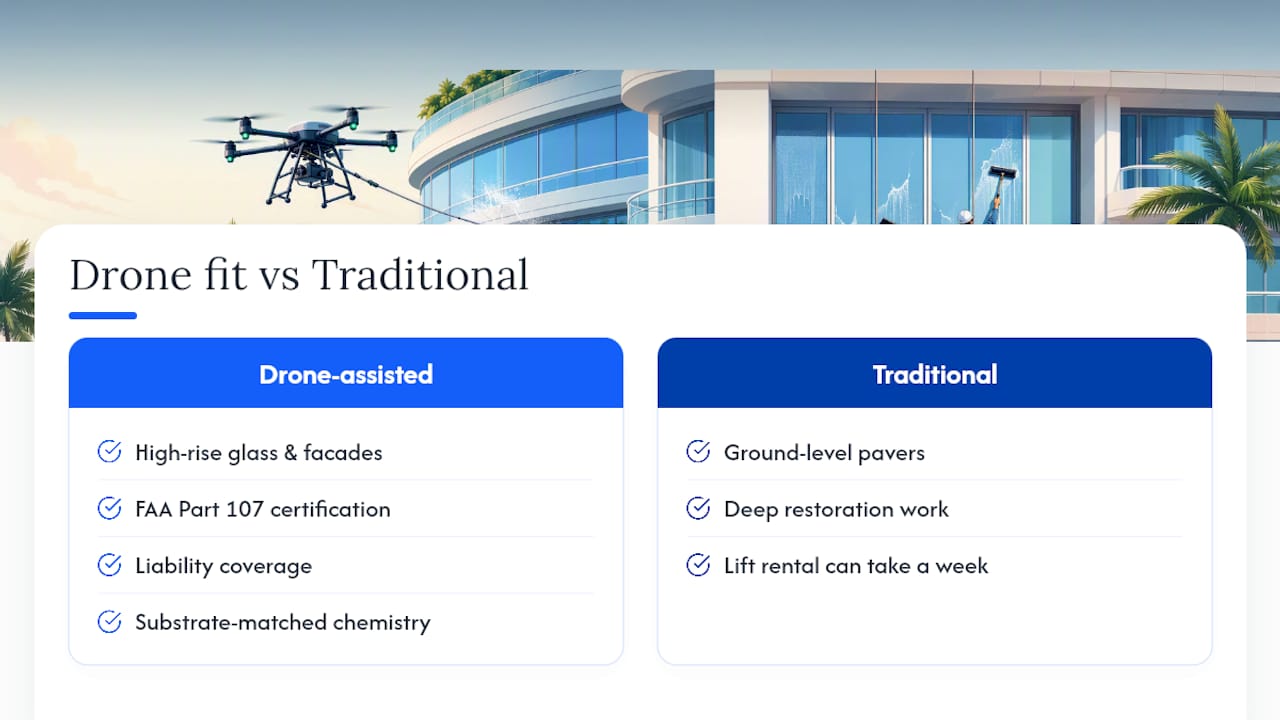
Drone-assisted cleaning cuts scaffolding time and keeps crews grounded, which matters most on tall glazing and facades where lift rental alone can stretch a job to a week. Before hiring, confirm the pilot holds FAA Part 107 certification, carries adequate liability coverage, uses substrate-matched chemistry, and documents the job with HD before-and-after footage. It’s a strong fit for high-rise glass and facade washing; ground-level pavers and deep restoration work still call for traditional methods.
An Operations Manager’s Off-Season Checklist
Three things separate a smooth off-season from a scramble: start the 90-day plan on time, never accept a finished job without photo proof, and lock contractor windows the moment bids come back. Every dollar saved by delaying a facade clean tends to show up later as a bigger repair bill. Balance cost against guest experience, not against the calendar.
, Eliot
How Vistadronecleaning Handles Off-Season Exterior Cleaning
There’s a real cost to the traditional route: scaffolding rental, road or valet closures, and crews on your property for a week or more. Vistadronecleaning is the alternative for South Florida hotels and resorts that need façade, window, roof, or solar cleaning done without any of that disruption.

One company uses FAA Part 107-certified pilots and tethered industrial drones to clean high-rise windows, facades, roofs, and solar arrays up to 200 feet, with crews staying safely on the ground the entire time. Most projects wrap in one to three days, backed by liability coverage and a streak-free pure de-ionized water rinse. See how the approach compares directly on the drone versus traditional window cleaning breakdown, or request a free quote through the Miami high-rise window cleaning page to get a site assessment scheduled before your off-season window closes.
Sources
- Hotel Maintenance in the Off-Season: How to Maximize Downtime, Oxmaint
- Seasonal maintenance planning for hospitality properties, Hospitality Maintenance Authority
- Hotel facade & window cleaning systems, Hotel Facility Guide
- Assessment of Inspection Reporting and Building Conditions in South Florida – Phase II
FAQ
What Is the 15/5 Rule in Hotels?
The 15/5 rule is a guest-service standard about acknowledging guests at specified distances. It’s a service protocol, not a maintenance guideline, but it matters for scheduling exterior cleaning, since crews working near entrances need to stay clear of guest sightlines during those interactions.
What Is the Slowest Season for Hotels?
Slow season varies by market, but South Florida properties typically see lower occupancy in late summer and early fall before winter demand returns. That dip is exactly when off-season exterior cleaning and facade work should be scheduled, ahead of the busier months.
What Is the 20-Minute Rule of Cleaning?
The 20-minute rule generally refers to housekeeping standards for turning over a guest room within roughly 20 to 30 minutes. It doesn’t apply directly to exterior building cleaning, where façade and glass work is scoped in days, not minutes, based on height and access method.
How Often Should a Hotel Room Be Deep Cleaned?
Guest rooms typically get a deep clean on a rotating schedule, often every 30 to 90 days depending on occupancy, separate from daily housekeeping. Exterior surfaces follow a different clock: glass and facades usually need attention one to four times a year, with coastal properties leaning toward the higher end due to salt exposure.
Is Drone Cleaning Suitable for All Hotel Exteriors?
Drone-assisted cleaning works well for high-rise glass, facades, and rooftop solar arrays where scaffolding or lift access would otherwise take days to set up. Ground-level pavers, pool decks, and heavy restoration work still call for traditional pressure or soft-wash equipment.