
Low-pressure washing: Efficient exterior cleaning for high-rises
Discover what low-pressure washing really is and how it outperforms traditional methods for high-rises, ensuring effective and safe cleaning.
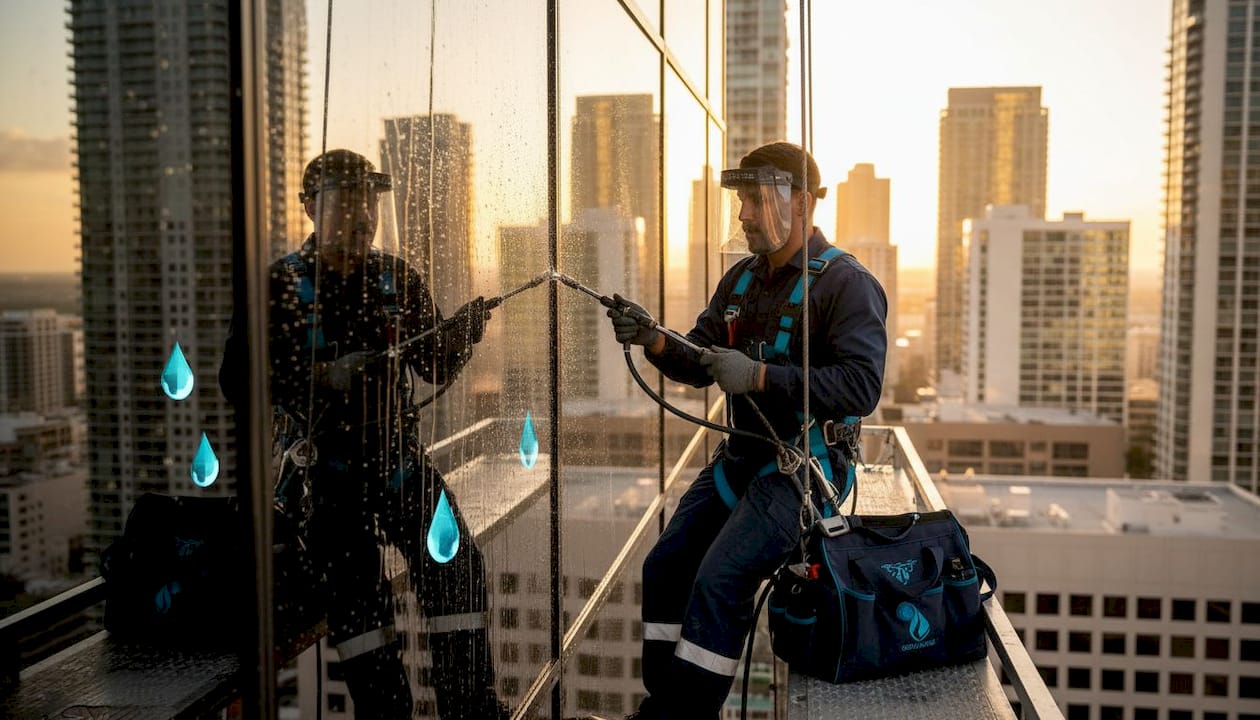
Most commercial property managers in South Florida assume more pressure equals more cleaning power. That assumption costs money, damages facades, and accelerates building deterioration in one of the most demanding climates in the country. Low-pressure washing is often misunderstood as a "gentler" option that trades results for safety, when the opposite is true. This guide breaks down low-pressure washing, how it compares to traditional methods, and why it outperforms high-pressure approaches for high-rise buildings, condos, hotels, and commercial facilities across Miami and South Florida.
Table of Contents
- What is low-pressure washing?
- How low-pressure washing compares to other methods
- Benefits of low-pressure washing for commercial properties
- Choosing the right cleaning method for your South Florida high-rise
- Why most South Florida property managers should rethink pressure washing
- Explore the South Florida commercial cleaning solutions
- Frequently asked questions
Key Takeaways
Point
Details
Safer exterior cleaning
Low-pressure washing reduces risk to building surfaces compared to high-pressure blasting.
Cost-effective solutions
This method saves time and labor for large commercial facilities and high-rises.
Surface-specific application
Chemistry and dwell time are adapted based on exterior materials for optimal results.
Benchmarked PSI levels
Managers use a 500 PSI threshold to distinguish low-pressure from traditional power washing.
Smarter maintenance choices
Choosing the right approach preserves building value and streamlines exterior upkeep.
What is low-pressure washing?
Low-pressure washing is a fundamentally different approach to exterior cleaning. This distinction matters when managing a 30-story facade with stucco panels, impact glass, and exposed concrete.
Low-pressure washing uses a low-pressure water stream, often below 500 PSI, delivered through specialized nozzles. Instead of relying on mechanical force to blast contaminants, it uses water flow and targeted cleaning solutions to lift and rinse away dirt, algae, mold, salt deposits, and biological growth. Chemistry does the work, not raw power.
Common terms for this category:
- **Soft washing: ** Biodegradable cleaning agents applied at low pressure, allowed to dwell, and rinsed gently.
- **House washing: ** A general term used for residential and commercial low-pressure facade cleaning.
- **Low-pressure cleaning: ** An umbrella term for any exterior wash process staying below standard pressure thresholds.
"Low-pressure washing generally refers to cleaning exterior surfaces using a low-pressure water stream, often delivered with specialized equipment and nozzles, rather than using the high-velocity blast approach of pressure washing."
The technique is key for soft washing for high-rises, where vulnerable materials, complex architecture, and tenant risks make aggressive pressure a liability.
How low-pressure washing compares to other methods
The difference lies in the cleaning philosophy. Soft washing relies on chemistry and dwell time; traditional pressure washing relies on mechanical blasting.
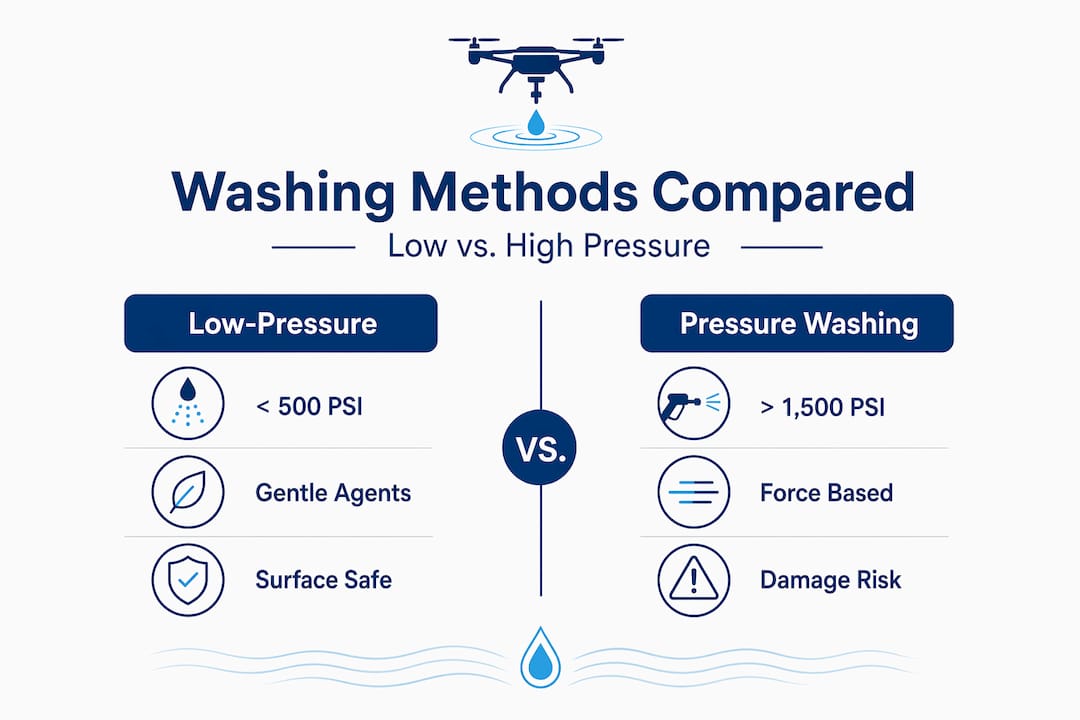
Comparison for commercial property managers:
| Factor | Low-pressure washing | Traditional pressure washing |
|---|---|---|
| PSI range | Under 500 PSI | 1,500 to 4,000+ PSI |
| Primary mechanism | Cleaning agents and dwell time | Mechanical water force |
| Surface risk | Low; safe for glass, stucco, paint | High; can strip paint, etch concrete |
| Cleaning effectiveness | Removes algae/mold/salt at root | Removes surface-level buildup only |
| Water consumption | Lower | Higher due to rinse times |
| Worker access needed | Minimal with drone-based systems | Often requires lifts or scaffolding |
| Recurrence of stains | Slower regrowth due to cleaning solutions | Faster regrowth without treatment |
**Practical applications: **
- **Glass curtain walls: ** Anything above 500 PSI risks window gasket failure.
- **Painted stucco: ** Standard jets can blister or peel these surfaces.
- **Concrete parking structures: ** Repetitive high-PSI washing erodes the finish over time.
- **Coastal salt and algae: ** Best eliminated with surfactants, not just displaced by water force.
Review the drone cleaning vs pressure washing comparison or cost-saving exterior cleaning analysis for budget benchmarks.
Benefits of low-pressure washing for commercial properties
Low-pressure washing delivers a better return on investment when accounting for lifecycle costs, tenant impact, and warranties.
Core advantages:
- **Warranty protection: ** Many window and facade manufacturers prohibit high-pressure washing. Low-pressure methods comply with these maintenance guidelines.
- **Biological elimination: ** High-pressure washing moves visible growth but leaves spores. Low-pressure cleaning solutions remove growth at the source, extending the time between cleanings.
- **Structural integrity: ** High pressure creates micro-fractures in concrete and grout, leading to moisture intrusion. Low-pressure eliminates this cumulative damage.
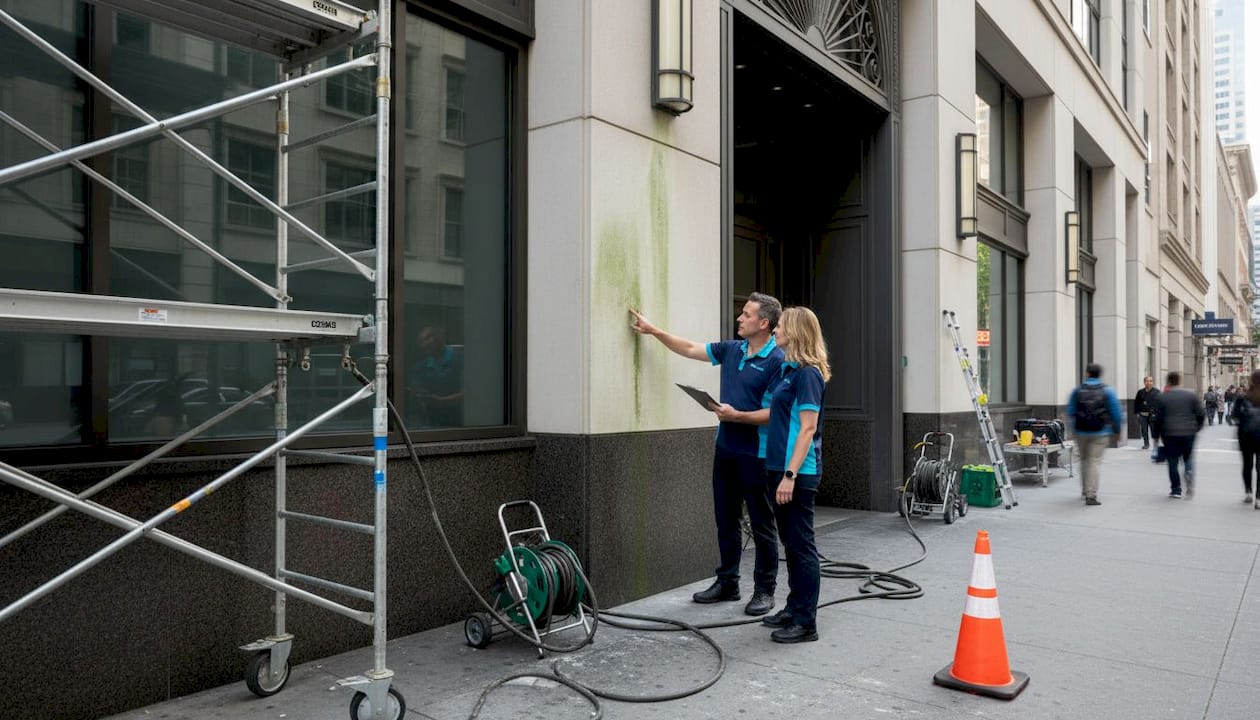
- **Faster completion: ** Since chemistry does the work during a dwell period, technicians cover area efficiently. This reduces scaffolding time and costs.
- **Reduced liability: ** Worker risks are minimized, especially when using drone-based delivery.
**Pro Tip: ** Ask vendors to specify their PSI range and cleaning formulations in writing. A pressure-only quote risks facade damage.
Consult the safe window cleaning guide or the South Florida building cleaning checklist for planning.
Choosing the right cleaning method for your South Florida high-rise
The right approach depends on building-specific factors:
**Building material and facade type: **
- **Glass and Impact Windows: ** Require low-pressure to avoid seal stress or thermal shock.
- **Painted Stucco: ** Susceptible to paint lift; needs low-pressure protection.
- **Architectural Concrete: ** Tolerates moderate pressure but benefits from chemistry pre-treatment.
- **EIFS: ** Highly damage-prone; must be cleaned at low PSI.
**Height and access complexity: ** For buildings over 10 stories, scaffolding costs scale rapidly. If a building exceeds 150 feet, the access method impacts project cost as much as the cleaning method.
**Climate considerations: ** Miami’s salt air and humidity accelerate growth. A cycle that lasts 18 months elsewhere may last only 10 months here. Select a method with proven longevity.
**Budget and maintenance cycle: ** Low-pressure washing may have higher material costs per visit, but total annual costs are lower due to longer intervals between cleanings and reduced repair needs. See exterior cleaning cost-saving ideas for more.
**Pro Tip: ** Schedule cleaning during the dry season. Lower humidity slows biological re-establishment after treatment.
Why most South Florida property managers should rethink pressure washing
High-pressure washing is quietly eroding property values. We see the pattern often: a building is pressure washed, looks clean for three months, then algae returns faster because the spores were never killed. The cycle repeats, making stucco more porous and degrading caulk lines.
High PSI provides false confidence because the immediate visual result is impressive. You do not see the micro-damage or the surviving root structures.
Property managers also overestimate the cost gap. Pressure washing quotes rarely account for scaffolding, permits, higher cleaning frequency, and facade repairs. Our soft washing data shows the lifecycle cost of low-pressure cleaning is lower for any building over five stories. Protect your asset and keep your budget predictable.
Explore the South Florida commercial cleaning solutions
Our drone-based system delivers low-pressure soft washing up to 200 feet without scaffolding or lane closures.
- **Brickell high-rise cleaning: ** Tailored for dense urban corridors and specific facade materials.
- **Drone window cleaning: ** De-ionized water and soft-wash delivery for streak-free impact glass.
- **Solar panel cleaning: ** Restores output without voiding warranties.
Contact us for a property assessment with detailed documentation.
Frequently asked questions
Is low-pressure washing safe for all exterior surfaces?
Yes, it is safe for delicate materials like glass, painted stucco, and EIFS. Always verify manufacturer guidelines for specialty coatings.
How does low-pressure washing prevent damage to high-rise buildings?
It eliminates abrasion risk and protects window seals by operating under 500 PSI, preventing the micro-fracturing caused by high-pressure blasting.
How much does low-pressure washing cost for large-scale commercial facilities?
Costs vary by building size and access. However, because it reduces cleaning frequency and eliminates scaffolding, it delivers lower total annual costs than traditional pressure washing contracts.
What equipment is used in low-pressure washing?
Pumps calibrated below 500 PSI are used with biodegradable surfactants. Drone-based systems mount this equipment on FAA-registered drones for scaffold-free delivery.