How to Select a Drone Cleaning Vendor for Your Property
Discover how to select a qualified drone cleaning vendor for your property. Ensure they meet essential certification and experience requirements.
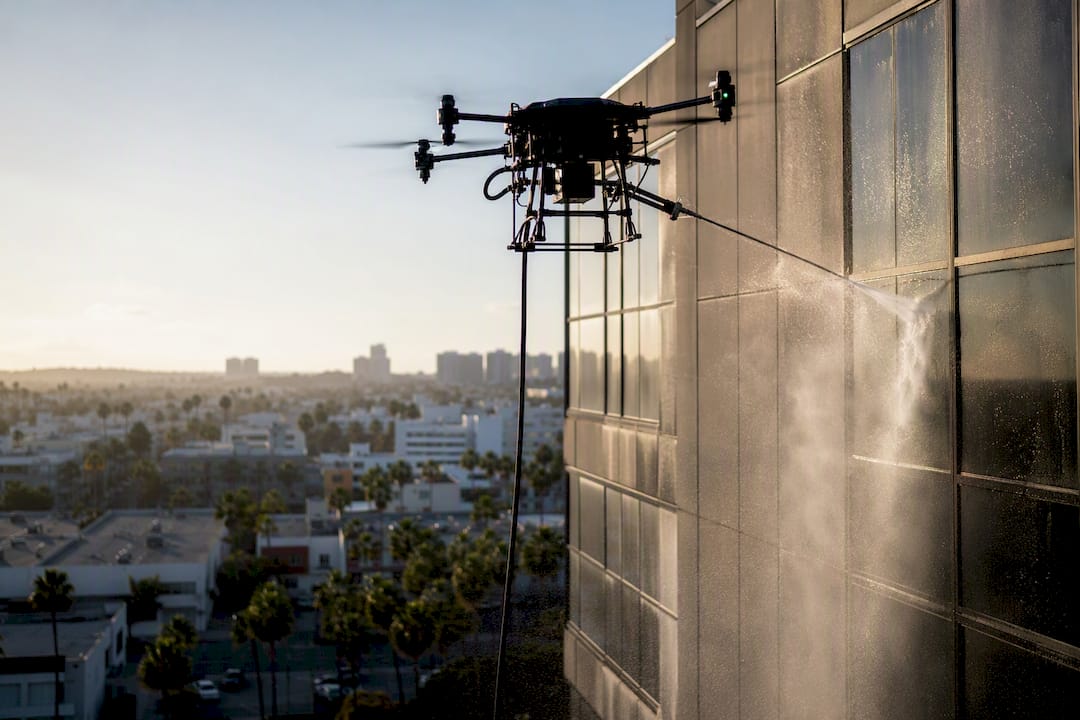
Any vendor you hire must be FAA Part 107 certified, carry commercial liability insurance with a certificate you can verify, run a site feasibility review before quoting, and hand over before/after documentation on every job. If a company can’t produce all four without hesitation, keep looking. Most legitimate projects on a mid-rise or high-rise facade run a few days, cost significantly less than scaffolding or lift work, and start with a feasibility visit and a certificate of insurance, not a sales call.
TL; DR:
- Vendors must have FAA Part 107 certification, proper insurance, and conduct site feasibility reviews before providing quotes to ensure safety and compliance.
- Experience with specific facade types and building heights, as well as knowledge of cleaning chemistry, are critical for effective drone facade cleaning.
- Verifiable liability coverage, including a certificate of insurance naming the property as additional insured, is essential to mitigate property manager exposure.
- A thorough site evaluation beforehand helps prevent scope creep and inaccurate pricing by identifying obstacles and permit requirements.
- Use detailed proposals with clear scope, unit pricing, exclusions, and documentation expectations to compare bids accurately and avoid hidden costs.
Table of Contents
- What to look for when you select a drone cleaning vendor
- What FAA credentials should a drone cleaning vendor have?
- What insurance should you require in a drone cleaning contract?
- How does a site feasibility review work before a drone cleaning project?
- What equipment and cleaning method claims should you verify?
- What safety protocols should a drone cleaning vendor follow?
- How should you evaluate proposals, pricing, and timelines?
- What questions and red flags separate qualified vendors from risky ones?
- Vista Drone Cleaning’s approach to compliance and local service
- How vendors earn long-term trust with property managers
- Get a compliant drone cleaning quote for your South Florida property
- Sources
- FAQ
What to look for when you select a drone cleaning vendor
Property managers rarely get burned by bad drone work itself. They get burned by hiring a pilot who’s never cleaned a 15-story facade, doesn’t know the difference between EIFS and precast concrete, and can’t produce a single reference from a commercial job. Flying a drone and running a commercial exterior cleaning operation are different skill sets, and the gap between them is where most vendor problems start.
Relevant experience means specific experience: facade types (glass curtain wall, stucco, EIFS, metal panel), building heights comparable to yours, and if you have a rooftop array, solar panel work specifically. A pilot who’s only done single-family roof washes has no business quoting a 200-foot condo tower in Brickell.
Before you sign anything, request:
- At least two case studies from commercial buildings similar in height and material to yours
- Contact information for two references you can actually call
- Before/after 4K photo or video documentation from a recent project
- A sample project proposal showing scope, pricing structure, and deliverables
Cleaning chemistry knowledge matters as much as flying skill. A vendor who understands that EIFS and glass need different rinse approaches, and can explain why, is operating at a different level than one who treats every surface the same. Ask how they’d approach your specific substrate before you ask about price.
What FAA credentials should a drone cleaning vendor have?
Every commercial drone operation flying in United States airspace needs a pilot holding an FAA Part 107 remote pilot certificate, earned by passing the UAG knowledge test through the agency’s testing centers. This certification is mandatory and cannot be substituted with recreational flying experience.
Ask for three specific documents before you consider a bid final:
- A copy of the pilot’s current Remote Pilot certificate
- Proof of drone registration through FAADroneZone, the FAA’s portal for registration, airspace authorization, and safety reporting
- Confirmation of Remote ID compliance status for the aircraft they’ll fly on your property
Statistic Callout: Part 107 defines four operational categories for flights over people, and Categories 2 and 3 require documented means of compliance or an FAA-accepted declaration before a vendor can legally fly over pedestrians, tenants, or staff below the work zone.
Verification isn’t hard. FAA remote pilot certificates carry a unique number you can cross-check, and legitimate operators won’t blink when asked to produce their FAADroneZone registration record. Hesitation on this point is the clearest early warning sign in the entire vetting process.
What insurance should you require in a drone cleaning contract?
Insurance is where property managers carry the most exposure if a vendor cuts corners, and it’s the easiest thing to verify before you sign anything.
- General liability coverage, typically in the $1 million to $2 million range, covering property damage and third-party injury during operations.
- UAS-specific liability coverage, since standard general liability policies often exclude aircraft-related incidents, drones included. Commercial UAV insurance products exist specifically to close this gap.
- A certificate of insurance (COI) naming your property or association as an additional insured, not just listing the vendor’s business name.
- Contract language covering scope, indemnity, liability limits, emergency remediation if something goes wrong mid-project, and a clear list of documentation deliverables.
Naming the property owner as additional insured matters because it puts your entity directly on the claim, not behind the vendor’s. Any legitimate operator issues this within a day or two of request; if a vendor stalls or asks you to “trust” their coverage without producing the COI, that’s a contract you don’t sign.
How does a site feasibility review work before a drone cleaning project?
A real feasibility review happens before pricing, not after. The vendor walks or flies the site, checks facade material and working height against their equipment specs, notes nearby airspace constraints (proximity to airports, helipads, or restricted zones common near coastal South Florida properties), and maps pedestrian flow and rooftop access points.
That review should tell you:
- Which sections of the building are straightforward drone work and which need a hybrid approach
- Constraints that could affect timeline, like recessed balconies, heavy landscaping, or wind exposure on upper floors
- Mitigation measures for anything flagged as a risk
- An honest estimated timeline, not a placeholder number
- Whether any local permit or FAA waiver applies to your specific site
Skipping this step is the single biggest source of scope creep in this industry. A vendor who quotes sight-unseen from a satellite photo is guessing, and guesses turn into change orders once the crew shows up and finds obstacles the quote never accounted for.
What equipment and cleaning method claims should you verify?
Not all commercial drone cleaning equipment performs the same, and the difference shows up on the invoice and the finished facade.
- Tethered industrial drones draw continuous water through a ground line, which means no mid-job landings to refill a tank. Consumer-grade drones that carry their own water simply can’t sustain multi-hour facade work at height.
- Pure de-ionized water rinse leaves no mineral spotting on glass, a common failure point with tap-water pressure washing.
- Substrate-matched soft-wash chemistry treats glass, EIFS, concrete, metal panel, and solar arrays differently, since each material reacts differently to cleaning agents.
- 4K before/after documentation on every job, not just the ones the vendor chooses to show you.
Pro Tip: Ask the vendor to explain their rinse water source and filtration method in plain terms. If they can’t describe it without reaching for a brochure, they probably don’t run it themselves.
What safety protocols should a drone cleaning vendor follow?
Safety on a commercial job isn’t a slogan, it’s a paper trail. Ask to see it before the drone ever leaves the ground.
- Pilot-in-command checklists covering pre-flight inspection, weather thresholds (wind speed limits, precipitation cutoffs), and maintenance logs on the aircraft itself.
- Documented incident response procedures, so you know exactly what happens if something goes wrong mid-flight.
- Evidence of FAA compliance for operations over people, whether that’s a Category 1 aircraft under 0.55 pounds or documented means of compliance for heavier equipment working near pedestrians.
- On-site controls: cordoned work zones, ground spotters, visible signage, and direct coordination with your building’s operations staff before the crew arrives.
A vendor who treats these as paperwork rather than routine practice is telling you something about how they’ll behave when a problem actually happens on your roof.
How should you evaluate proposals, pricing, and timelines?
Comparing bids on price alone is how property managers end up with the cheapest vendor and the most change orders. A complete proposal needs specific components, and pricing should track building complexity, not guesswork.
- Detailed scope of work, broken down by facade section, surface type, and service (window, facade, roof, solar).
- Unit pricing tied to square footage or linear footage, not a single lump number with no breakdown.
- Explicit exclusions, so you know what’s not covered before day one.
- A contingency allowance for weather delays or access issues found during the feasibility review.
- Deliverables list, including documentation format and any warranty terms on the work performed.
Price is driven mainly by building size, height, facade material complexity, access logistics, and whether special authorizations apply to the airspace above your property. A straightforward 8-story glass tower in Fort Lauderdale prices differently than a 20-story mixed-material high-rise in downtown Miami. Most single projects finish in 1 to 3 days; properties on a recurring schedule often negotiate quarterly or semi-annual maintenance pricing that runs lower per visit than one-off jobs.
What questions and red flags separate qualified vendors from risky ones?
Evasive answers are the fastest disqualifier in this process. If a sales rep hedges on insurance limits, can’t name their FAA certification status directly, or pushes back on doing a site visit before quoting, that’s your answer.
Ask these directly, and expect straight answers:
- Can you provide your Remote Pilot certificate number and FAADroneZone registration?
- What are your general liability and UAS liability coverage limits, and can I get a COI naming my property as additional insured?
- What equipment will you use on this specific facade, and what’s your rinse water source?
- Can I see your standard operating procedures and two references from comparable buildings?
- Will you walk the site before finalizing a quote?
If answers come fast and specific, consider a small pilot project, one section of facade or a single elevation, before committing to the full building. If answers come slow, vague, or defensive, decline and move to the next bid.
Vista Drone Cleaning’s approach to compliance and local service
Eliot, who covers commercial exterior maintenance for this publication, notes that Vista Drone Cleaning operates with FAA Part 107 certified pilots across every South Florida job it takes on. The company runs tethered industrial drones for a continuous water supply on multi-hour facade and roof projects, carries $2 million in liability insurance, and uses pure de-ionized water rinses matched to substrate type on glass, EIFS, concrete, metal, and solar installations.
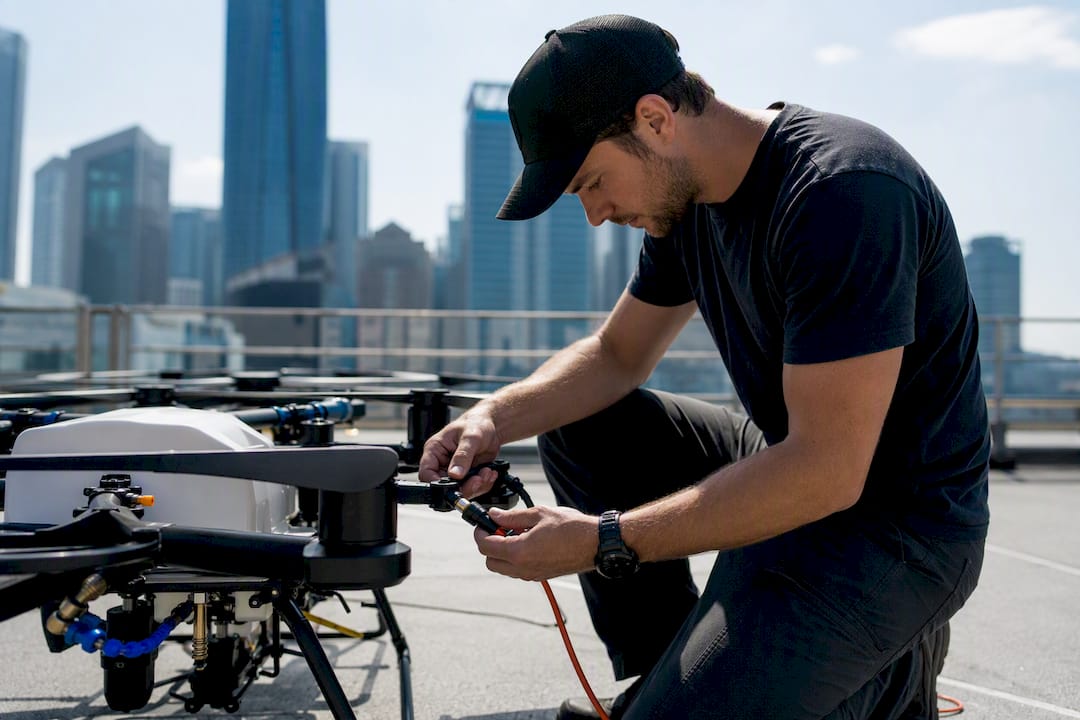
Coverage spans commercial high-rises, condominiums, hotels, office towers, warehouses, and retail centers across Miami-Dade and Broward counties, with most projects completing in 1 to 3 days. Every job includes 4K before/after documentation as a standard deliverable, not an add-on.
How vendors earn long-term trust with property managers
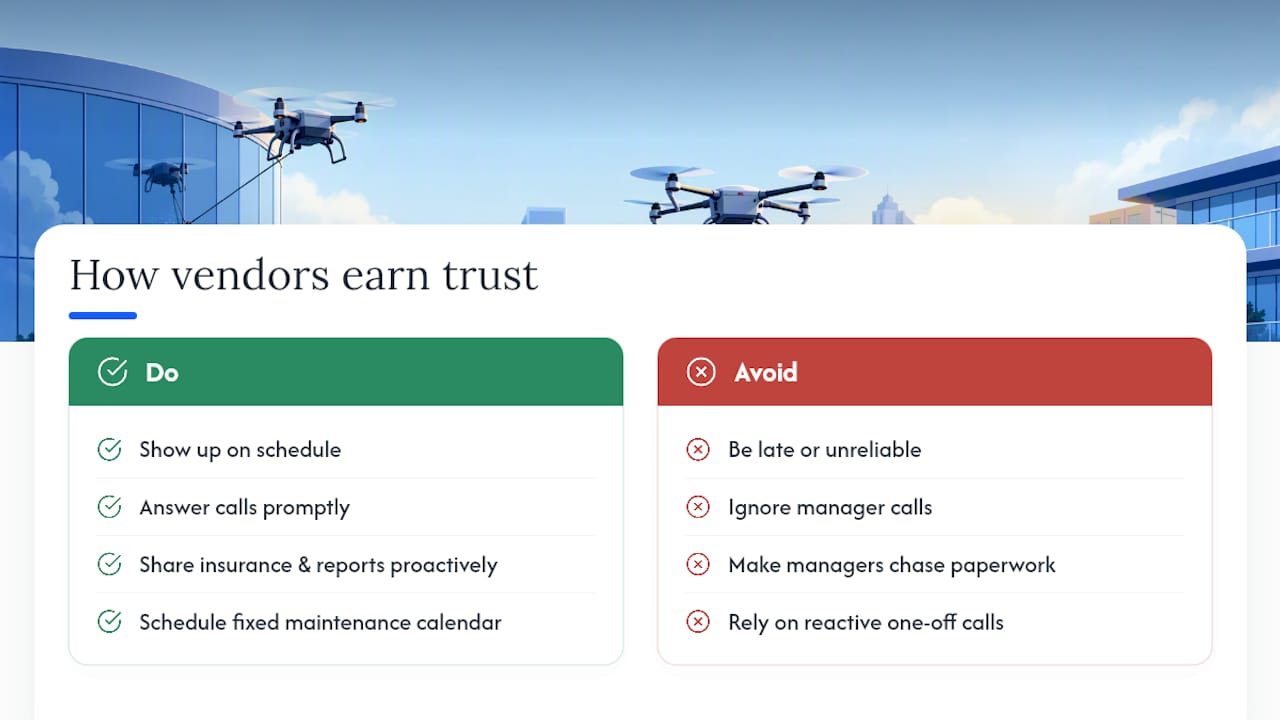
The vendors that keep contracts year after year aren’t necessarily the cheapest or the flashiest with their equipment. They’re the ones who show up when they say they will, answer the phone when something looks off, and never make a property manager chase them down for a COI or an inspection report.
Documentation transparency speeds up procurement approval boards more than any sales pitch does. A management company deciding between two similar bids will almost always favor the vendor who handed over full insurance and compliance paperwork without being asked twice. One recurring pattern worth noting: buildings that schedule maintenance cleanings on a fixed calendar, rather than reactive one-off calls, report far fewer emergency requests and fewer disputes over scope, simply because the vendor already knows the building’s quirks going in.
, Eliot
Get a compliant drone cleaning quote for your South Florida property
Vistadronecleaning gives property managers a faster, lower-cost alternative to scaffolding and boom lifts for high-rise exterior work across Miami-Dade and Broward counties, and it checks every box covered above without you having to chase down paperwork. Crews stay grounded, pilots hold FAA Part 107 certification, and every job runs on tethered industrial drones with a pure de-ionized water rinse and $2 million in liability coverage.
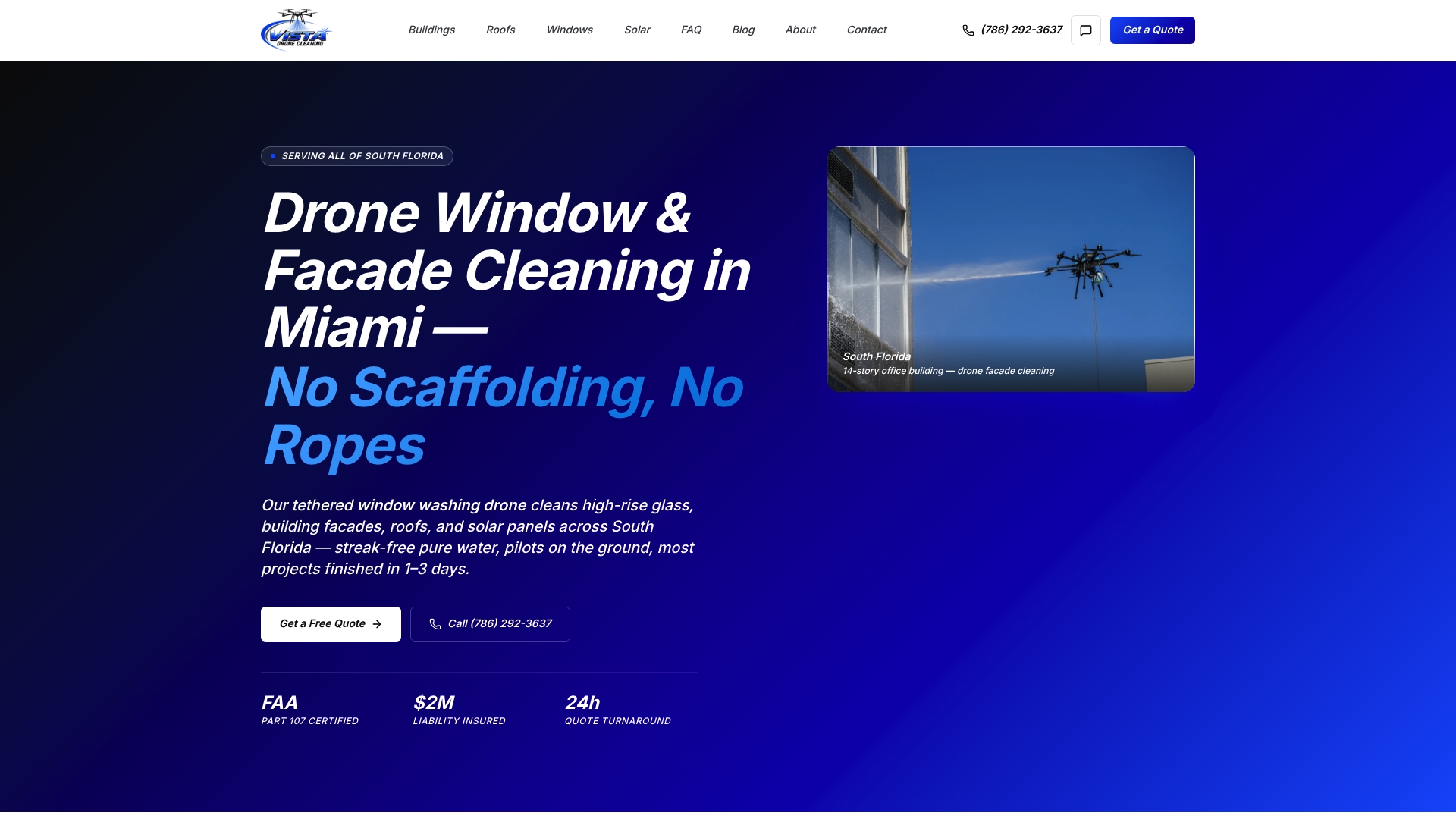
Most projects on facades, roofs, or solar arrays finish within a few days and cost notably less than traditional rigging methods, with 4K before/after documentation included as standard. There’s no permitting hassle, no road closures, and no rope access crew to coordinate. If your building needs window washing, facade cleaning, roof soft-wash, or solar panel cleaning, request a free site feasibility visit and quote, delivered within 24 hours, and compare the numbers yourself against traditional window cleaning costs.
Sources
For primary regulatory detail, review the FAA’s Part 107 overview and registration steps through FAADroneZone. Operations-over-people rules and compliance categories appear in the Part 107 regulatory text. For operational detail specific to South Florida properties, see Vista Drone Cleaning’s commercial drone cleaning guide.
- Certificated remote pilots including commercial operators | Federal Aviation Administration
- Code of Federal Regulations, Part 107 (excerpts): operations over people and means of compliance
FAQ
Is drone cleaning profitable as a business?
Commercial drone cleaning can run healthy margins because tethered systems cut labor costs and completion time versus scaffolding, though profitability depends heavily on securing recurring commercial contracts rather than one-off residential jobs.
How much does a commercial powerwashing drone cost to buy?
Industrial tethered drone systems built for commercial facade and roof work represent a significant equipment investment well beyond consumer drone pricing, which is one reason vetted vendors with existing fleets, like Vistadronecleaning, are usually more cost-effective than a property trying to buy equipment itself.
What is the price range for a commercial cleaning drone?
Pricing varies widely by manufacturer and specification, and exact figures aren’t standardized across the industry, so property managers should focus vendor evaluation on service pricing per project rather than equipment cost.
What’s the most profitable segment of the drone cleaning business?
High-rise commercial facade, roof, and solar panel cleaning for properties too tall for cost-effective ladder or scaffold work tends to generate the strongest margins, since drones eliminate the labor and rigging costs that make traditional methods expensive at height.
Why does site feasibility review matter before getting a quote?
Skipping a feasibility review is a common cause of under-quoting followed by change orders once crews find access obstacles, so a vendor that insists on a site visit before pricing is protecting you from surprise costs later.