Commercial Drone Cleaning: The Complete 2026 Guide
How drone cleaning works, what it costs, the surfaces it handles, how it compares to scaffolding, boom lifts, and rope access, and how to choose a provider that actually meets the FAA, insurance, and HOA standards. Written for Florida property managers, asset managers, and building owners.
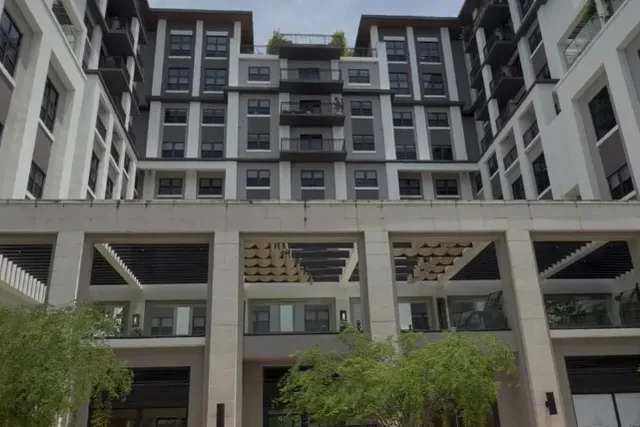 Before
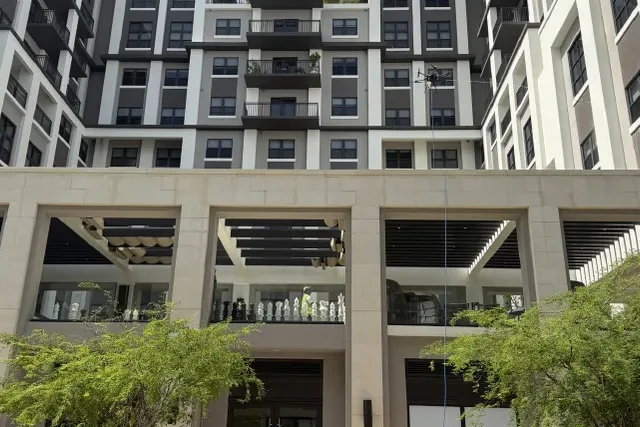 After
What is commercial drone cleaning?
Commercial drone cleaning uses a tethered industrial drone, flown by an FAA Part 107 certified pilot, to apply biodegradable soft-wash chemistry and de-ionized pure water to building exteriors. The pilot, pump, and water supply remain on the ground while the drone reaches the entire envelope from the air. It replaces scaffolding, boom lifts, swing stages, and rope access for the cleaning portion of building maintenance. It runs 30–60% cheaper than scaffolding or lifts on most commercial buildings and completes the same building in a fraction of the time.
- Service area
- All of Florida
- Max height
- 320 ft single mobilization
- Facade pricing
- $0.06–$0.15 / sq ft
- Window pricing
- $0.06–$0.15 / sq ft
- Speed
- several floors per day per side
- Compliance
- FAA Part 107 · LAANC · $2M insured
How drone cleaning actually works
A commercial cleaning drone is not a hobbyist quadcopter with a spray bottle. It is a tethered industrial unit, typically the Lucid Bots Sherpa or a comparable platform, that receives water and detergent through a high-pressure umbilical from a ground-mounted pump. The pilot, pump, water tank, and ground spotter occupy roughly the footprint of a single parking space. The drone itself does the work at altitude.
On a typical project, the drone positions 6–10 feet from the building surface, applies biodegradable soft-wash chemistry, allows brief dwell time for the chemistry to break down salt deposits, mildew, algae, and pollution, then rinses with de-ionized pure water. Pure water has a Total Dissolved Solids (TDS) reading at or near zero, which means there are no minerals left on the glass or facade to dry into streaks or water spots. This is the same reason modern window-cleaning equipment has migrated toward pure-water systems even on ground-level work.
Coverage is sequential, one elevation at a time. The drone covers several floors per day per side depending on substrate and contamination level, so a building is a matter of days, fixed in the quote, not weeks. Our 130,000+ sq ft Coral Gables high-rise took 7 days.
What surfaces drone cleaning handles
Substrate is the variable that drives chemistry selection. Every surface gets matched chemistry. What cleans salt haze off mirrored glass is not what lifts mildew off painted stucco, and what lifts mildew off stucco would damage low-E glass coatings if misapplied.
Glass
All commercial glass: clear annealed, tinted, mirrored, low-E coated (Solarban, SunGuard, SageGlass), ceramic-frit patterned, and laminated. Pure-water rinse is the manufacturer-preferred method for low-E coatings, and drone application is gentler on coatings than the squeegee-blade method used by most traditional window cleaners.
Stucco, EIFS, and painted concrete
These substrates are damaged by high-pressure washing, anything above 1,500 PSI strips paint, blows out joints, and delaminates EIFS. Drone soft-wash chemistry plus low-pressure pure-water rinse cleans these surfaces deeper than pressure washing while eliminating the damage risk.
Metal cladding
Aluminum composite panel (ACM), anodized aluminum, painted steel, and porcelain rainscreens. Salt-air corrosion on metal cladding accelerates if not maintained, and the drone reaches the parapet caps and recessed reveals that boom-lift cleaning routinely skips.
Roofing
Clay and concrete barrel tile, asphalt shingle, metal standing-seam, and flat membrane. Drone soft-wash applies sodium percarbonate or sodium hypochlorite chemistry (the customer's choice) to remove the dark-streak algae (Gloeocapsa magma) that plagues South Florida tile roofs, without anyone walking on the tile. Walk-on roof cleaning is the single largest source of tile-cracking damage on Florida residential and HOA roofs.
Architectural details and signage
Louvers, vertical fins, horizontal sunshades, decorative parapets, illuminated signage cabinets, address numerals, porte-cochère soffits, and balcony glass railings. These are the surfaces traditional methods skip or undercharge for, and the surfaces where dirt accumulates first.
Drone cleaning vs traditional methods
The honest comparison breaks into four buckets: scaffolding, boom lifts, swing stages, and rope access. Each has a specific historical use case, and each loses to drone cleaning on commercial buildings above 4 stories.
vs Scaffolding
Scaffolding for facade cleaning is a 1–2 week project before the cleaning crew even starts. It requires sidewalk closures, engineering review, permits, and rigging. Drone cleaning replaces the entire setup with a single parking space and starts cleaning on day one. See scaffolding vs drone cleaning for the full breakdown.
vs Boom lifts
Common boom lifts cap around 125 feet, carry a daily rental and operator cost, require lane and sidewalk permits, and concentrate 35,000–50,000 pounds of ground load on outrigger pads that can crack asphalt and damage landscape. Drone cleaning eliminates the lift entirely. See drone cleaning vs boom lift.
vs Swing stages and rope access
Rope-access window cleaning runs $1.75–$3.50 per square foot vs $0.06–$0.15 for drone pure-water cleaning, covers one drop at a time, and exposes workers to fall risk on every job. Drone cleaning reaches the same elevations far faster with no rigging. See rope access vs drone cleaning and drone vs traditional window cleaning.
Cost: what drone cleaning actually runs in Florida
Pricing on commercial drone cleaning is straightforward: $0.06–$0.15 per square foot for facade cleaning and $0.06–$0.15 per square foot for window cleaning. Most commercial projects are priced per square foot of surface, so the total follows building size mix.
That pricing already reflects a 30–60% discount to scaffolding or boom-lift work on the same building, because there's no rigging, no lift rental, no sidewalk permits, no traffic-control crew, and no multi-day mobilization. The drone operator does not pass through costs that don't exist.
Maintenance frequency drives total annual cost more than per-visit pricing. Oceanfront properties from Brickell through Hallandale Beach typically run on a quarterly cleaning cycle. Intracoastal and bayfront properties run on a 6-month cycle. Inland Class A office and retail run annually. See our full pricing model for itemized breakdowns.
How to choose a drone cleaning provider
The drone cleaning industry is growing fast, and the gap between providers operating to industry standard and providers improvising with hobbyist equipment is large. Verify these five items before hiring any drone cleaning company in Florida.
- FAA Part 107 certification. The pilot in command must hold a current Part 107 remote pilot certificate. This is a federal requirement for any commercial drone operation, not an industry nice-to-have.
- LAANC airspace authorization. Most of urban Florida, Miami, Fort Lauderdale, Tampa, Orlando, Jacksonville, sits in controlled airspace. LAANC authorization is filed with the FAA before each flight. Ask to see the authorization for your specific job site.
- Insurance. At minimum: $2M commercial general liability plus dedicated UAS (drone) liability. A general construction GL policy without aviation coverage does not cover drone operations.
- Certificate of insurance before mobilization. The COI must be issued before the crew shows up, and it must name the building owner, property manager, and condo/HOA board. Providers who promise to send the COI after the work is not operating professionally.
- 4K before/after documentation. Every elevation should be documented in 4K before and after cleaning, and that documentation should be delivered to property management within 48 hours of job completion. Insurance carriers, condo boards, and asset managers all need this for their records.
Compliance, water, chemistry & ground safety standards
Beyond FAA paperwork, four operational standards separate a qualified drone cleaning contractor from an unqualified one. Property managers and HOA boards should verify all four before signing a contract. See our full drone cleaning contractor vetting checklist for the printable version.
Aviation & UAV liability insurance
Standard commercial general liability does NOT cover drone crashes or aerial property damage, the FAA classifies commercial drones as aircraft and virtually every commercial GL policy carries an aviation exclusion. The contractor must carry a dedicated UAS aviation liability policy: $2M minimum. The COI must be issued before mobilization and name the owner, property manager, and condo/HOA board as additional insured.
Water quality: 0 TDS pure water
The ground rig must use a multi-stage RO/DI (Reverse Osmosis / Deionization) filtration system producing water at or near 0 TDS (Total Dissolved Solids). Any higher and minerals dry into visible spotting, especially on tinted, mirrored, and low-E coated glass. Pure water is also the manufacturer-preferred rinse for Solarban, SunGuard, and SageGlass low-E coatings. Ask to see the in-line TDS meter reading on the rig before the first flight.
Chemistry & SDS documentation
Every soft-wash surfactant or detergent sprayed on the building must have a published Safety Data Sheet on file: biodegradable, eco-friendly, and explicitly rated safe for the specific facade material, window seals, and surrounding landscape. Substrate-matched chemistry is mandatory: glass curtain wall, low-E glass, painted stucco, EIFS, ACM panel, tile roof, and shingle roof each need a different surfactant and dwell time. One-size-fits-all chemistry is a red flag.
OSHA ground safety & perimeter control
A written protocol for cordoning off the ground area directly beneath the drone's flight path protects pedestrians and parked vehicles from overspray, dropped equipment, and the unlikely event of in-flight failure. Required elements: a dedicated ground spotter in radio contact with the pilot, a coned/taped exclusion zone matched to the elevation being cleaned, pedestrian and vehicle re-routing, and a written equipment-failure contingency aligned with OSHA 29 CFR 1926.
Compliance, insurance, and HOA approval
Drone cleaning operates under 14 CFR Part 107, the federal regulation governing commercial small Unmanned Aircraft Systems (sUAS). The pilot in command must hold a current Remote Pilot Certificate, must file LAANC authorization in controlled airspace, must comply with operating altitude and visual-line-of-sight rules, and must carry registration on the airframe.
On the insurance side, drone cleaning removes the worker at height, the rigging over public sidewalks, and the aerial-lift fall exposure, the exposures most carriers ask about on a renewal; confirm with your own carrier.
Condo and HOA boards almost always approve drone cleaning on first submission when the provider supplies: FAA Part 107 documentation, LAANC airspace clearance, the COI naming the board, a written flight plan with elevation-by-elevation schedule, and a 48-hour tenant notice template. We supply all five in a single packet, most boards approve within one meeting cycle.
What to expect on cleaning day
Setup takes 30–45 minutes. The ground crew arrives, occupies one parking space, sets up the pump and water tank, runs the tether, and stages the spotter. There's no scaffold rigging, no lobby intrusion, and no equipment in the porte-cochère.
The drone works one elevation at a time on a published schedule. Tenants on the active side close their shades for the 2–4 hours the drone is on that elevation; tenants on the other three elevations continue normal business. Ground spotters maintain a brief perimeter zone directly under the drone: pedestrian access, valet, and lobby operations continue normally throughout the project.
At end of day, equipment is broken down, the parking space is released, and the area is rinsed clean of any chemistry. 4K documentation of every elevation is delivered to property management within 48 hours.
Which method fit which building: five recent jobs
The drone is one tool on the truck. On the five jobs we have documented, the building decided the method: how tall it is, who is inside, and what the street allows.
Three-story office
Cypress Plaza, Fort Lauderdale
Ground rig soft wash and water-fed poles. No drone.
A three-story office is the job the ground rig and water-fed poles do best. The poles reached every pane from the ground, so there was nothing to fly.
Four-story Class A office
Miramar Centre II, Miramar
Drone on the facade, with water-fed poles and a ground crew at grade.
The job took 48 hours. With no lift or scaffold to bring in, work started the morning after it was confirmed.
Six-story hotel, open throughout
Courtyard by Marriott Miami Coral Gables, Coral Gables
Drone on the upper floors, water-fed poles on the lower levels.
Rooms were booked, so the work went one elevation at a time, with the rig at the curb.
Mixed-use building over street-level shops
Sentral Wynwood, Wynwood, Miami
Drone and a rope access crew, working at the same time.
The drone is fastest on open glass, so it took that. Rope access took the glass it could not finish: behind railings and metal fins, and in the inside corners. Every shop stayed open.
Occupied senior living high-rise
Belmont Village, Coral Gables
Drone on the facade and windows, water-fed poles on lower-story windows and parts of the pool deck, and a ground crew on the floor surfaces. No lifts, scaffolding, swing stages or rope access.
No entrance could close and no resident could be moved, and the parapet was out of reach of any lift or rope crew.
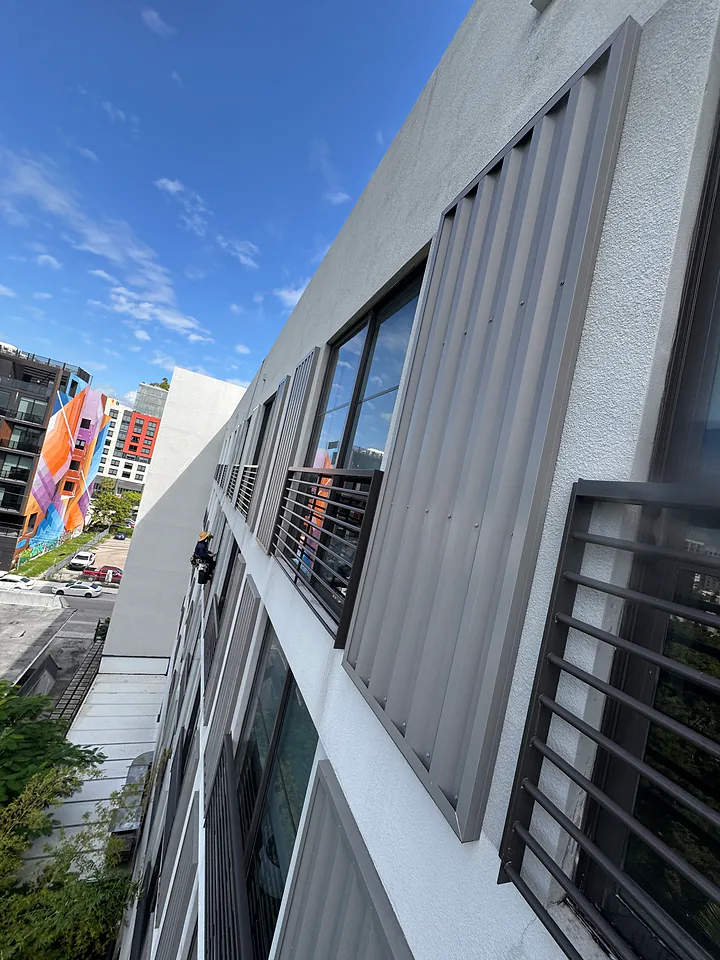
When you compare bids, ask each contractor which method they would use on each elevation of your building, and why.
Where we operate
Vista Drone Cleaning serves South Florida: Miami-Dade, Broward, and Palm Beach counties. Single-pad mobilization makes long-distance jobs economically practical because there's no multi-day rigging to recover. Multi-property HOAs and asset managers with portfolios across South Florida receive bundled pricing across the entire portfolio.
Frequently asked about commercial drone cleaning
What is commercial drone cleaning?+
Commercial drone cleaning is the use of a tethered industrial drone, flown by an FAA Part 107 certified pilot, to apply biodegradable soft-wash chemistry and de-ionized pure water to a building's exterior. The drone reaches the entire envelope from the air while the pilot, pump, and water supply remain on the ground. It replaces scaffolding, boom lifts, swing stages, and rope access for the cleaning portion of building maintenance.
How does drone cleaning actually work?+
A tether carries water and detergent from a ground-mounted pump to a spray head on the drone. The pilot positions the drone 6–10 feet from the surface, applies soft-wash chemistry, allows brief dwell time, then rinses with pure water. The drone moves elevation by elevation across the building, covering several floors per day per side. A ground spotter monitors a small perimeter under the active flight zone.
What does commercial drone cleaning cost in Florida?+
Commercial drone cleaning in Florida is priced by area, so the total follows the building: $800–$1,425 at 10,000 sq ft and $3,200–$4,800 at 40,000 sq ft. Facade cleaning typically runs $0.06–$0.15 per square foot. Window cleaning typically runs $0.06–$0.15 per square foot. Across most mid-rise and high-rise buildings, drone cleaning runs 30–60% less than scaffolding or boom-lift work on the same property, and a fraction of rope-access rates.
What surfaces can a drone clean?+
Glass curtain walls and balcony glass, painted and unpainted stucco, EIFS, painted concrete, GFRC and precast concrete, brick, metal cladding (aluminum composite, anodized, painted steel), porcelain rainscreens, terracotta tile roofs, asphalt shingle roofs, signage cabinets, and architectural details like louvers, fins, and parapets. Each substrate gets matched chemistry.
Is drone cleaning safe for low-E and tinted glass?+
Yes. Soft-wash chemistry plus pure-water rinse is the manufacturer-preferred cleaning method for Solarban, SunGuard, SageGlass, and similar low-E coatings. Pure water leaves zero mineral residue, which is what causes the visible spotting that squeegee-and-tap-water cleaning leaves behind on tinted and low-E glass.
How long does a commercial drone cleaning project take?+
A four-story office took 48 hours, a six-story hotel 3 days, and a 130,000+ sq ft Coral Gables high-rise 7 days. Every quote carries a fixed completion window. The drone covers several floors per day where a traditional crew works one drop at a time, and there is no multi-day rigging setup beforehand.
How do I choose a commercial drone cleaning provider?+
Verify five things: (1) FAA Part 107 certified pilot on every job, (2) LAANC airspace authorization filed for controlled airspace, (3) at least $2M commercial general liability plus dedicated UAS aviation liability, (4) certificate of insurance issued before mobilization naming the owner, property manager, and board, and (5) before/after 4K documentation included in the project deliverables. Anything missing means the provider is operating outside industry standard.
Does drone cleaning meet condo and HOA insurance requirements?+
Yes. Drone cleaning removes the crew at height and the rigging over public sidewalks, the exposures most carriers ask about on a renewal; confirm with your own carrier. COIs are issued before mobilization naming the owner, property manager, and condo/HOA board.
Where in Florida do you operate?+
We serve South Florida: Miami-Dade, Broward, and Palm Beach counties. Single-pad mobilization makes long-distance jobs economically practical because there's no multi-day rigging setup to recover.
Does standard general liability cover drone operations?+
No. Standard commercial general liability specifically excludes aerial property damage and aircraft-related incidents, and the FAA classifies commercial drones as aircraft. A drone cleaning contractor must carry a dedicated UAS aviation liability policy. $2M minimum. The COI must list aviation/UAS coverage and name the owner, property manager, and HOA board before mobilization.
What water quality do you use for window cleaning?+
Multi-stage RO/DI (Reverse Osmosis / Deionization) filtration on the ground rig, producing water at or near 0 TDS (Total Dissolved Solids) at the pump. Anything above ~10 TDS leaves visible mineral spotting on tinted, mirrored, and low-E coated glass once it dries. Pure water is also the manufacturer-preferred rinse for Solarban, SunGuard, and SageGlass low-E coatings.
Are your cleaning chemicals safe for landscaping and building seals?+
Yes. We use biodegradable, eco-friendly soft-wash chemistry matched to each substrate: different surfactants for low-E glass, painted stucco, EIFS, ACM panel, tile roof, and shingle roof. A Safety Data Sheet (SDS) is available on request for every chemical we spray. Landscape is pre-wetted and post-rinsed with pure water, and we don't use high-concentration sodium hypochlorite anywhere near plantings or storm drains.
How do you protect pedestrians and vehicles on the ground?+
Every job runs an OSHA-compliant ground perimeter: a dedicated ground spotter in radio contact with the pilot, a coned/taped exclusion zone directly beneath the active flight path sized to the elevation being cleaned, pedestrian and vehicle re-routing through the property, and a written equipment-failure contingency. The perimeter shifts elevation by elevation as the drone moves around the building.
A real job, not a stock photo
What a three-day deadline actually looks like
Workspace Property Trust · Miramar, FL, a four-story Class A office building in Miramar Centre Corporate Park.
A prospective tenant walkthrough was booked for Thursday and the job was only confirmed on Monday afternoon. Lifts and scaffolding could not clean the building in the time available, and nothing could block the entrances or take over the parking lot.
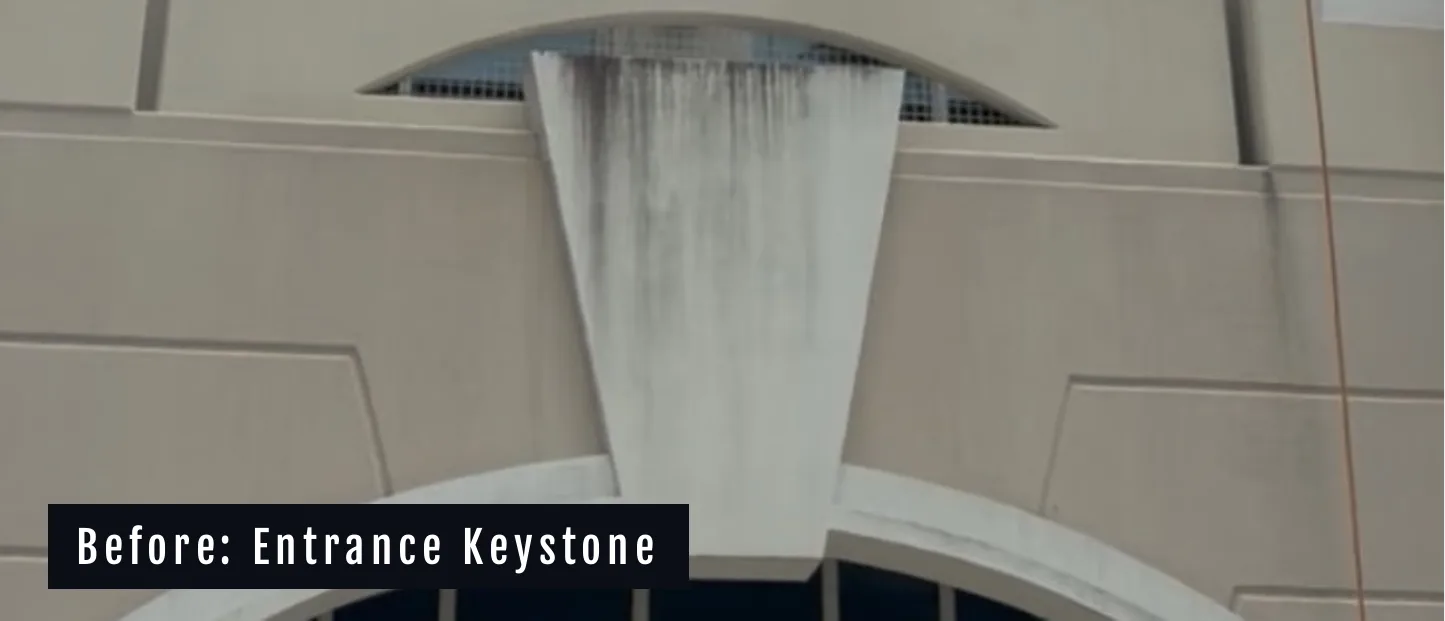 Before
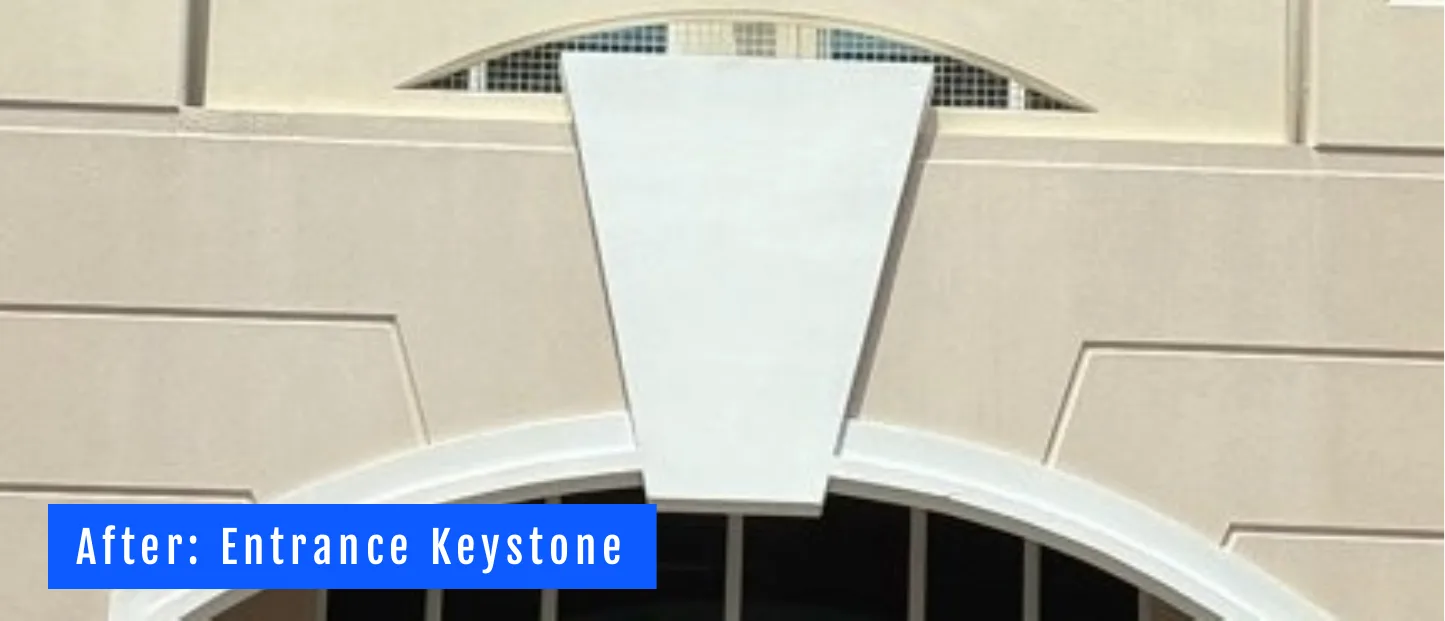 After
- 48 hours
- to complete the entire building
- ~29%
- below traditional pricing for the same scope
- Zero
- lifts or scaffolding on site
- Minimal
- disruption to tenants and daily operations
What property managers say
Google reviews from the managers of buildings we cleaned, word for word.
“We hired Vista Drone Cleaning to clean the windows and exterior of Cypress Plaza, our three-story, 40,000-square-foot office building in Fort Lauderdale. Algae and buildup had accumulated along the panel joints, ledges, and glass on every side of the building, and the difference afterward was impressive.
Their team cleaned every window, the entire building exterior, and the entrance walkway, all in a single day. The entire job was completed from the ground without lifts or scaffolding. They soft washed the exterior and used purified water on the glass, leaving the building looking noticeably cleaner and brighter.
The crew kept the work areas safely coned off and got everything done with very little disruption to our tenants.
If you manage a commercial property in Fort Lauderdale or Broward County and need professional window cleaning or exterior building washing, I’d recommend Vista Drone Cleaning.”
“We were very pleased with the work performed by Vista Drone Cleaning at Sentral Wynwood. Finding a reliable company for professional high-rise window cleaning and commercial pressure washing can be challenging, and Vista delivered an excellent experience. Their advanced drone technology provides an innovative way to handle building facade cleaning and exterior maintenance, particularly on taller buildings and hard-to-reach areas. Their team was knowledgeable, professional, and efficient throughout the project. We highly recommend Vista Drone Cleaning to property managers, condominium associations, and commercial building owners looking for exterior cleaning services in Miami and throughout Florida.”
Our core services
- Drone Facade Cleaning MiamiStucco, EIFS, painted concrete, glass and metal panel, cleaned from the air.
- Drone Roof Cleaning MiamiSoft-wash for tile, metal, shingle and flat roofs with no foot traffic.
- Drone Window Cleaning MiamiPure-water drone glass cleaning for high-rise and commercial buildings.
- Parking Garage Cleaning MiamiDecks, drive lanes, walls and stairwells at a flat per-square-foot rate.
Get a free quote in 24 hours
Tell us about your property. We'll send a fixed-price proposal, no scaffolding, no surprises.