Florida Property Managers: Drone TPO Cleaning That Protects Warranties
Manufacturer aligned TPO care for South Florida owners: low pressure (≤2,000 psi), neutral soap, plus drone soft wash to protect warranties.
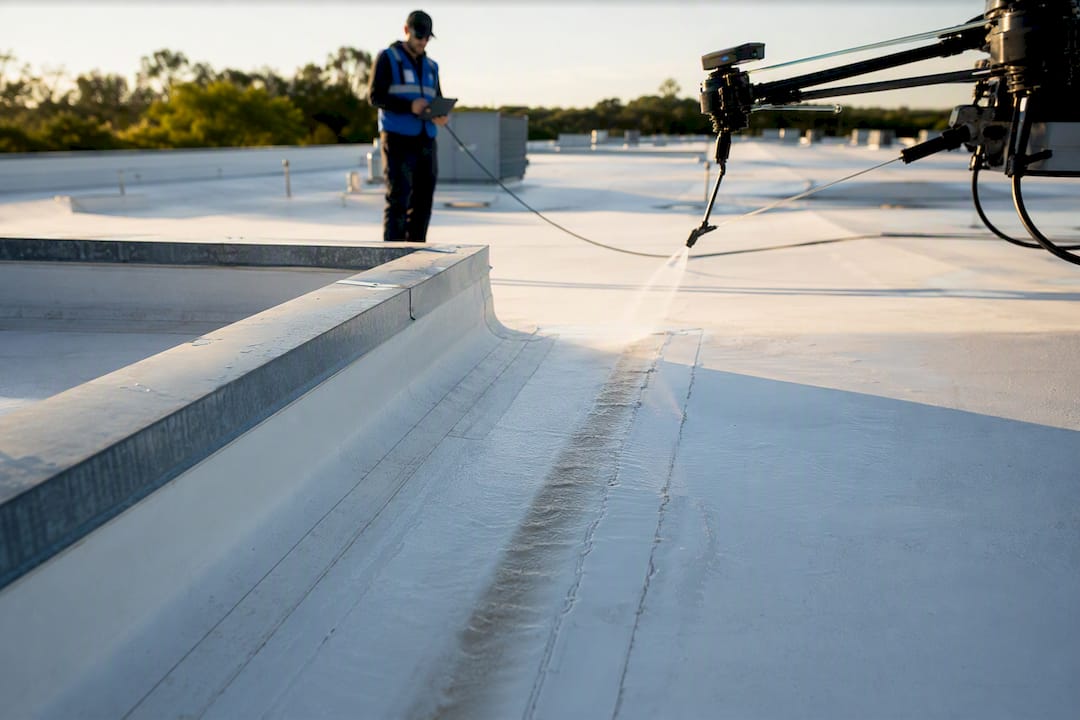
The safest way to handle TPO roof cleaning is a low-pressure rinse combined with a mild, manufacturer-approved detergent, applied at or below 2,000 psi with a 40-degree fan tip held at least 12 inches from the membrane. Simple Green, Spic n’ Span, or a dedicated weathered membrane cleaner all work. Anything more aggressive, or any roof with brittle spots, active leaks, or serious height, belongs to a professional applicator.
TL; DR:
- Inspect for damage, map runoff, and confirm cleaning methods won’t void warranties before starting DIY maintenance.
- Consider professional cleaning for roofs over three stories, with active leaks, brittle sections, or those requiring lift access to avoid damaging the membrane.
- Implement drone-based soft washing to mitigate fall risk on high, unstable, or hard-to-reach roofs, particularly in urban South Florida environments.
- Cleanings should occur at least twice annually, with extra inspections after storms, focusing more on membrane condition than strict calendar schedules.
Table of Contents
- What to Check Before You Start Cleaning a TPO Roof
- How Do You Clean a TPO Roof Step by Step?
- Safety Gear and Runoff Rules You Can’t Skip
- When Should You Call in a Professional Instead of DIY Cleaning?
- How Often Should Commercial TPO Roofs Be Cleaned?
- Treating Algae, Grease, and Rust Stains on TPO
- Cleaning Mistakes That Void Warranties and Wreck Membranes
- Why Manufacturers Standardized This Cleaning Sequence
- What South Florida Building Owners Get Wrong About TPO Cleaning
- Get a Roof Cleaned Without Anyone Setting Foot on It
- Sources
- FAQ
What to Check Before You Start Cleaning a TPO Roof
South Florida roofs take a beating between salt air, storm debris, and biological growth that thrives in our humidity. Before anyone steps on a TPO membrane, run through this list.
- Walk the roof (or send someone qualified to) and flag brittle, blistered, or previously patched sections that could tear under a brush or foot traffic.
- Map where runoff will go and set up containment so wash water doesn’t reach drains, storm sewers, or landscaping below.
- Pull the manufacturer’s warranty documentation and confirm the cleaning method won’t void coverage. Carlisle, Versico, and GAF all specify exact procedures, and deviating from them can matter if you ever file a claim.
- Gather PPE, a wide-fan nozzle, a soft-bristle brush or long-handled broom, and an approved cleaner before anyone climbs a ladder.
If the building sits at height or the membrane shows real wear, a commercial roof cleaning checklist built for high-rises is worth reviewing before you commit to a DIY approach.
How Do You Clean a TPO Roof Step by Step?
Manufacturer procedures for TPO cleaning follow the same basic sequence whether you’re reading Carlisle’s literature or GAF’s technical bulletins: rinse, apply cleaner, agitate gently, rinse again.
- Document and test first. Photograph the roof’s current condition, then test your chosen cleaner on a small, inconspicuous section. Wait to see how the membrane responds before treating the whole surface.
- Pre-rinse loose debris. Use low pressure to knock off leaves, dust, and grit. Carlisle SynTec Systems caps pressure at 2,000 psi, but many working contractors run closer to 1,000 to 1,500 psi to reduce cumulative wear from repeated cleanings over the membrane’s lifespan.
- Apply a neutral pH detergent. Mix Simple Green, Spic n’ Span, or a weathered membrane cleaner per the label’s dilution ratio. Work in manageable sections so the cleaner doesn’t dry on the surface before you can rinse it.
- Agitate gently. A soft-bristle brush or long-handled broom lifts embedded grime without scoring the membrane’s surface. Skip this step on heavily biological growth areas until the cleaner has had time to work.
- Rinse thoroughly, high to low. Work from the roof’s high points downward so residue and dirty water flow toward drains rather than pooling. Check seams and flashing details once the surface dries; these areas show wear before the field membrane does.
GAF’s EverGuard guidance reinforces the same sequence and adds a specific note on protecting facades and landscaping from runoff, which matters even more on tight urban lots common in Fort Lauderdale and Brickell.
Pro Tip: Keep the nozzle angled away from seams and flashing rather than pointed straight down at them. A direct blast at a T-joint or penetration is the fastest way to force water under a properly welded seam.
For contractors handling multiple properties, the same pressure and technique guidelines apply whether the substrate is TPO, EPDM, or a coated metal roof.
Safety Gear and Runoff Rules You Can’t Skip
Rooftop work on commercial buildings carries real fall risk, and TPO membranes get slick fast once wet. Nobody should be up there without the basics covered.
- Non-slip footwear rated for wet surfaces, plus a harness and anchor system on any roof with unprotected edges or a pitch steeper than dead flat.
- Eye protection and gloves rated for the cleaning chemistry in use, especially anything involving diluted bleach solutions.
- Spotters or a second person present anytime someone is working near a roof edge or skylight.
Runoff containment isn’t optional in most South Florida municipalities. Cover drains before you start, or build a temporary berm around the work zone, and neutralize wash water before it leaves the roof if you’ve used anything beyond plain water and a neutral detergent. GAF’s technical bulletin specifically calls out protecting plants and facades below the work area, a detail that matters on properties with ground-floor retail or pool decks directly underneath.
Manufacturers recommend professional applicators for a reason: they carry proper fall protection, and they know how to balance chemical dwell time against membrane sensitivity without guessing.
When Should You Call in a Professional Instead of DIY Cleaning?
Some roofs are fine for a maintenance crew with a hose and a soft brush. Others aren’t, and pretending otherwise is how warranty claims get denied.
Call in a professional applicator when any of these apply:
- The building exceeds two or three stories, or the roof requires a lift or scaffold to reach safely.
- The membrane shows brittleness, existing patches, or any sign of prior leak repair.
- There are active leaks or soft spots you haven’t had inspected yet.
- Sections of the roof are hard to reach, like areas boxed in by HVAC units, parapet walls, or solar arrays.
- The warranty documentation requires certified applicators for any cleaning beyond a plain water rinse.
Professional crews bring the right chemistry dilution, proper containment gear, documented fall protection, and a post-cleaning inspection that catches problems before they become leaks. That combination is exactly why manufacturers point toward trained applicators for anything beyond routine maintenance.
Tethered industrial drones can now soft-wash a TPO roof from above without putting a single technician on the actual membrane, which sidesteps both the fall risk and the foot-traffic wear that comes with scaffolding or lift-based cleaning crews walking the surface repeatedly.
For high-rises and warehouses across Miami-Dade and Broward, that approach is worth exploring through a dedicated flat roof cleaning service built for TPO and EPDM, particularly on buildings where lift access is expensive or logistically painful.
How Often Should Commercial TPO Roofs Be Cleaned?
Commercial roof cleaning frequency depends more on exposure than calendar dates, but a workable baseline covers most South Florida properties.
- Inspect the roof twice a year at minimum, and always after a major storm or hurricane passes through.
- Photograph anything that looks off. A discolored patch or blistered seam this quarter tells you something different six months from now if you have the earlier photo to compare against.
- Plan for one light cleaning annually on most roofs. Industry guidance from commercial roofing maintenance resources treats this as the standard cadence for membrane roofs generally.
- Reserve targeted cleaning solution treatments for when you actually see algae or mildew growth rather than applying them on a schedule.
- Keep a simple log: date, product used, dilution ratio, and photos. That record becomes your evidence if you ever need to defend a warranty claim.
Roofs shaded by taller neighboring buildings or sitting near coastal humidity in places like Hollywood or Pompano Beach tend to grow biological staining faster and may need inspection closer to quarterly.
Treating Algae, Grease, and Rust Stains on TPO
Not every stain responds to the same fix, and using the wrong one can do more damage than the stain itself.
Algae and mildew show up as gray-green or black patches, usually on north-facing slopes or shaded areas that stay damp longer. Diluted sodium hypochlorite or a commercial cleaning solution handles this effectively, but protect any nearby plants first and rinse the treated area thoroughly once the growth lifts. Neutral pH detergents remain the safer default for routine cleaning, with bleach reserved specifically for biological growth that mild soap won’t touch.
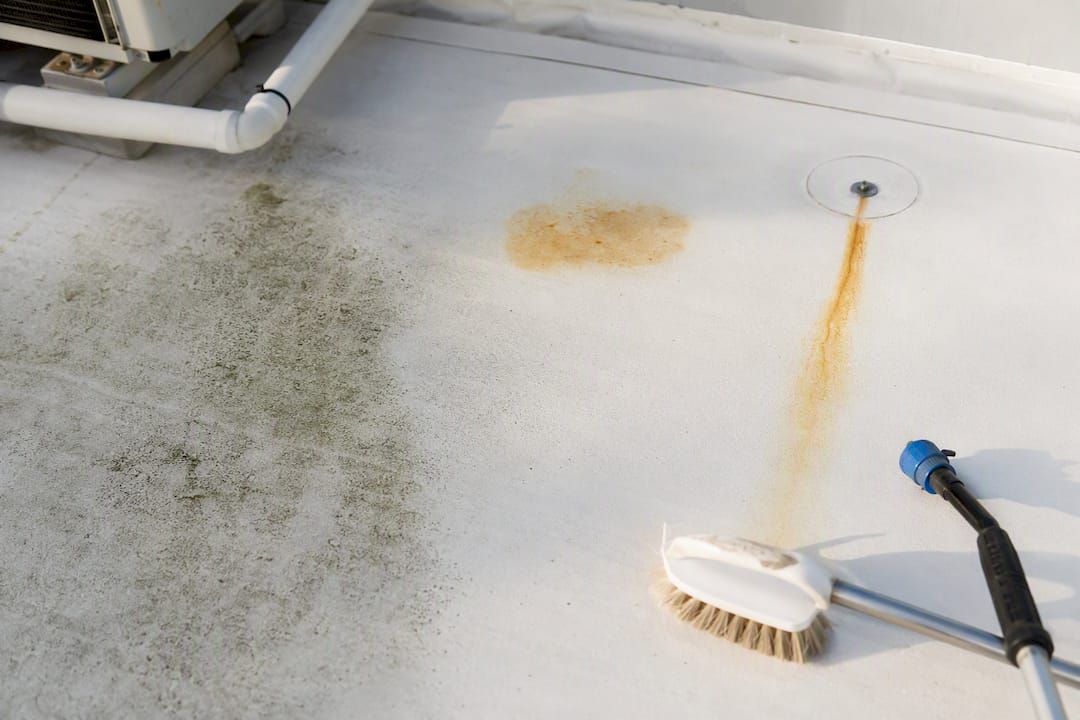
Grease, oil, and silicone residue typically comes from rooftop HVAC units or nearby kitchen exhaust vents. Spot-clean with isopropyl alcohol or a manufacturer-approved solvent, and always test a small area first since some solvents can soften TPO if left too long.
Rust stains, often from HVAC condensate lines or exposed fasteners, respond to chelating agents formulated for single-ply membranes. Apply, then rinse immediately. Don’t scuff or scrub at rust with an abrasive pad; that just embeds the stain deeper into the membrane’s surface texture.
Cleaning Mistakes That Void Warranties and Wreck Membranes
Manufacturer warranties get voided more often by cleaning mistakes than by storm damage, and most of these mistakes come from treating TPO like it’s as tough as concrete.
- Skip abrasive scrub pads, steam cleaners, and pressure above the manufacturer’s 2,000 psi ceiling. Any of these can wear through the membrane’s surface layer over time.
- Never use undiluted solvents, and don’t let any harsh cleaner sit and dry on the membrane before rinsing.
- Remove petroleum products and food oils as soon as you spot them rather than waiting for the next scheduled cleaning.
Manufacturer cautions on membrane care specifically warn that harsh solvents can strip organic light stabilizers from the membrane, which accelerates weathering long after the stain is gone.
Why Manufacturers Standardized This Cleaning Sequence
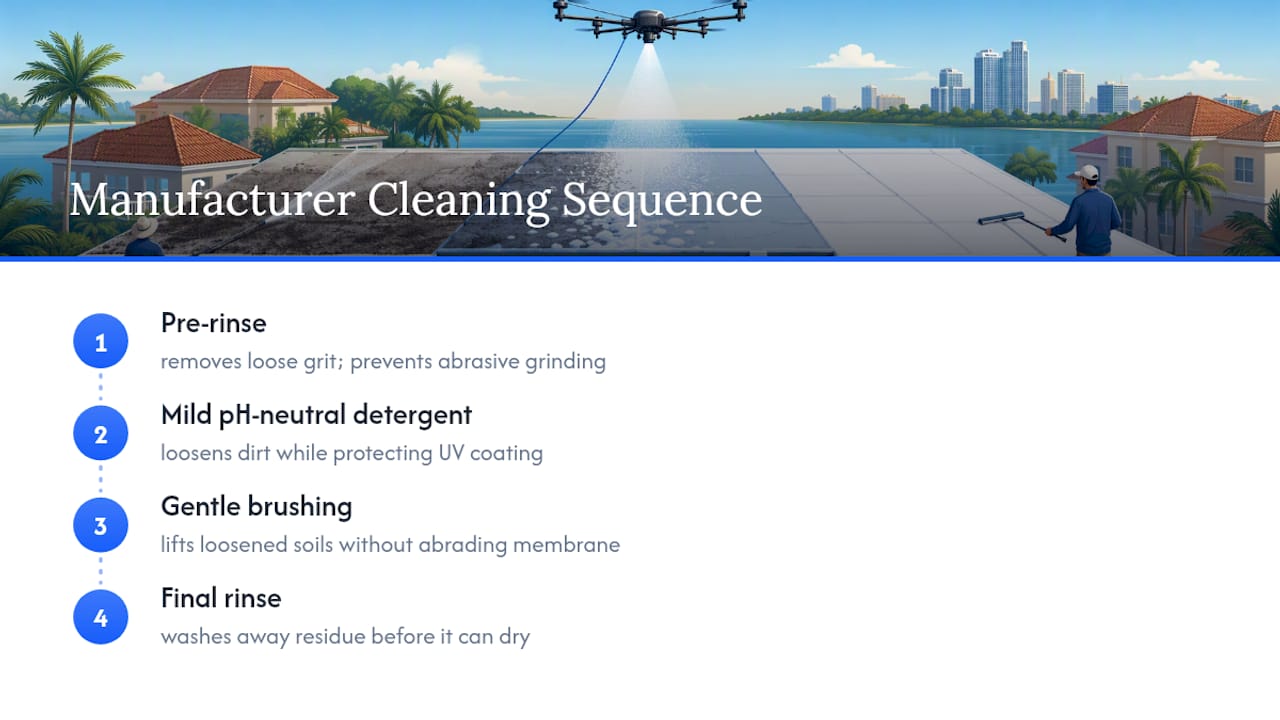
The rinse, detergent, brush, rinse sequence isn’t a suggestion pulled from a random contractor’s blog. Carlisle, Versico, and GAF each publish nearly identical procedures, and that consistency tells you something: it’s the sequence least likely to damage the membrane while still lifting dirt and biological growth.
The pre-rinse matters more than most people assume. Skipping it means grinding grit into the membrane surface once you start brushing, which is exactly the kind of abrasion that shortens membrane life. The detergent step works because TPO’s surface chemistry responds well to mild, pH-neutral cleaners; anything more aggressive risks degrading the same UV-reflective coating that gives TPO its energy-efficiency advantage in the first place. Brushing lifts what the detergent loosens, and the final rinse has to happen before residue dries back onto the surface.
Versico’s VersiWeld documentation adds one detail Carlisle’s procedure implies but doesn’t spell out as directly: professional applicators exist partly to protect the warranty, not just the roof. A cleaning method that technically works but falls outside documented manufacturer procedure can leave a property owner without recourse if a seam fails later and the manufacturer questions how the roof was maintained.
That’s the real value of following these steps exactly rather than improvising. A clean roof that still qualifies for warranty coverage is worth more than a slightly cleaner roof that doesn’t.
What South Florida Building Owners Get Wrong About TPO Cleaning
Most guidance treats TPO cleaning as a one-size-fits-all task, and that’s where the conventional advice thins out. A four-year-old membrane on a Boca Raton office park and a twelve-year-old membrane on a Miami warehouse near industrial exhaust don’t tolerate the same pressure setting or dwell time, even though most articles hand out one universal procedure.
Age and condition should drive the decision more than they currently do. An older membrane that’s already lost some flexibility needs gentler agitation and shorter chemical contact time, not the same treatment recommended for a roof installed last year. Property owners chasing the cheapest cleaning option often skip the small-area test entirely, and that’s usually where things go wrong.
The bigger miss is treating cleaning frequency as fixed rather than reading the roof itself. A shaded, humid rooftop near the coast needs more frequent inspection than a sun-baked warehouse roof inland, regardless of what a generic annual schedule suggests. Prioritize inspection over rigid scheduling, and match your cleaning intensity to what the membrane actually shows you, not to a calendar.
, Eliot
Get a Roof Cleaned Without Anyone Setting Foot on It
There are services that clean TPO roofs without the fall risk, scaffolding costs, or lift rental fees that traditional cleaning crews require, using tethered industrial drones to apply substrate-matched soft-wash chemistry from above, enabling proper technique and containment without a technician walking a brittle or aging membrane.

That matters most for warehouses, office towers, and condominiums across Miami-Dade and Broward where professional solar and roof cleaning is recommended when roof access is either expensive or genuinely hazardous. Projects typically finish in a few days, and because crews stay on the ground, there is no need for permits related to lifts or road closures. If your building’s TPO roof is due for a professional look, request a free quote for roof soft-wash cleaning in Miami-Dade and get a documented answer within 24 hours.
Sources
- Sure-Weld TPO Cleaning Procedures (Carlisle SynTec Systems)
- Cleaning recommendations for EverGuard roofs (GAF)
- Best Cleaner for TPO Roof: Effective Products and Safe Cleaning Methods – New England Metal Roof
FAQ
Can You Pressure Wash a TPO Roof?
Yes, but stay at or below 2,000 psi with a 40-degree fan tip held at least 12 inches from the membrane. Many contractors prefer running closer to 1,000 to 1,500 psi to reduce long-term abrasion from repeated cleanings.
What Is the Best Cleaner for a TPO Roof?
Mild, neutral pH detergents like Simple Green or Spic n’ Span work well for routine cleaning, and a dedicated weathered membrane cleaner handles more stubborn grime. Diluted sodium hypochlorite is reserved specifically for algae and mildew growth, applied carefully and rinsed thoroughly.
Can You Use PVC Cleaner on TPO?
No. PVC and TPO have different surface chemistries, and a cleaner formulated for PVC membranes can react poorly with TPO’s polymer blend. Stick to products manufacturers specifically list as TPO-approved, such as those named in Carlisle’s and Versico’s cleaning bulletins.
How Often Should a Commercial TPO Roof Be Cleaned?
Inspect twice a year and after major storms, with a light cleaning typically once annually. Roofs with heavy shade or coastal humidity may need closer to quarterly inspection to catch biological growth early.
Is It Worth Hiring a Professional for TPO Roof Cleaning?
For buildings over two or three stories, roofs with brittle or repaired sections, or membranes with active leaks, yes. Professional applicators bring correct chemistry, containment, fall protection, and documentation that protects both the roof and the manufacturer warranty.