Drone Cleaning Regulations: South Florida’s Rules Beyond Part 107
Learn how South Florida drone cleaning crews handle Part 107, Remote ID, airspace approvals, local permits, insurance, and job records for every project.

To operate commercial drone cleaning in the United States, you must fly under FAA Part 107 with a certified remote pilot, a registered and Remote ID compliant aircraft, and any required airspace authorization. You also need to maintain insurance, preflight checklists, and incident records that the FAA can request at any time.
TL; DR:
- Pilots must complete recurrent training every 24 calendar months, and operators with Part 61 certificates can use a shorter conversion path.
- LAANC usually provides quick approval under preset airport altitude limits; complex requests and waivers go through DroneZone, where responses may take about 90 days.
- Federal approval does not replace local permissions: municipalities may require work permits, street closure notices, or police coordination, especially near sidewalks and busy roads.
- Operators must report serious injuries or property damage of $500 or more within 10 days, and check NOTAMs and temporary restrictions after LAANC approval.
- A tether limits drift but does not waive pilot certification, registration, airspace rules, or the need for a visual observer around tall buildings.
Table of Contents
- FAA Part 107: Certification, Pilot Responsibilities, and Recurrent Training
- Registration and Remote ID: Keeping a Commercial Fleet Compliant
- Airspace Authorizations, LAANC vs. DroneZone, and Waivers You May Need
- State and Local Permits: What South Florida Operators Also Need
- Insurance, Recordkeeping, and Incident Reporting Requirements
- South Florida Compliance Checklist and How We Operationalize It
- Specific Regulations and Restrictions Related to Tethered Drones
- Rules and Best Practices for Operating Drones in Urban Commercial Areas
- Environmental and Privacy Considerations in Populated Areas
- Guidelines for Safe Operation Around High-Rise Buildings and Public Spaces
- Local Noise Ordinances and Their Impact on Drone Cleaning Operations
- Author Perspective: Compliance as a Competitive Advantage in South Florida
- How We Meet the Regulatory Checklist on Every South Florida Job
- FAQ
- Sources
FAA Part 107: Certification, Pilot Responsibilities, and Recurrent Training
Any commercial drone operation using an unmanned aircraft under 55 pounds falls under Part 107, which means the person at the controls needs a Remote Pilot Certificate before touching a client’s building. There’s no way around this for paid work: flying a cleaning drone over a condo tower in Boca Raton or a retail center in Plantation without that certificate is a federal violation, regardless of how skilled the operator is.
Getting certified starts with passing the FAA’s aeronautical knowledge test, then submitting an application through the FAA’s IACRA system. Pilots who already hold a Part 61 certificate can follow a shorter conversion path. Either way, the certificate isn’t permanent: pilots must complete recurrent training every 24 calendar months to stay current.
On a job site, the remote pilot in command carries real responsibility beyond holding a license:
- Confirming the aircraft is airworthy before every flight, not just once a week.
- Assigning clear crew roles when a visual observer or ground crew member is present.
- Carrying proof of certification on site, since property managers and inspectors can ask for it.
- Logging each flight’s basic details for later reference.
These duties sound procedural, but they’re what separates a compliant vendor from one that’s gambling with a client’s building and its own liability exposure.
Registration and Remote ID: Keeping a Commercial Fleet Compliant
Every drone used for paid cleaning work needs to be registered with the FAA, typically through FAADroneZone. Registration rules shift slightly for aircraft over 55 pounds, which matters for operators running heavier industrial equipment on high-rise jobs.
Beyond registration, Remote ID compliance is mandatory for any drone that must be registered. Operators generally meet this requirement one of three ways:
- Flying a drone with standard Remote ID built in from the manufacturer.
- Retrofitting an older aircraft with a broadcast module.
- Operating exclusively inside an FAA-Recognized Identification Area (FRIA).
For a commercial fleet working multiple South Florida buildings in a single week, inventory discipline matters. Log each broadcast module’s serial number alongside the specific aircraft serial number in your FAADroneZone records, since modules sometimes get swapped between drones and inspectors will expect the paperwork to match the hardware in the air.
Airspace Authorizations, LAANC vs. DroneZone, and Waivers You May Need
Plenty of South Florida commercial buildings sit inside controlled airspace, and that changes what’s legally required before a drone ever leaves the ground. Flights in Class B, C, D airspace, and certain Class E surface areas near airports need prior air traffic control authorization. Properties near Fort Lauderdale-Hollywood International or Miami International fall squarely into this category.
The fastest path is usually LAANC, which delivers near-real-time approvals for flights under preset altitudes at participating airports. When LAANC isn’t available for a specific location, or the operation is more complex, FAADroneZone handles manual authorization requests and Part 107 waiver submissions.
Common waiver categories commercial cleaning operators run into:
- Operations over people, relevant for buildings with active pedestrian traffic below.
- Altitude exceptions for structures taller than standard limits allow.
- Beyond visual line of sight, less common for cleaning work but occasionally relevant on large commercial campuses.
Waiver processing isn’t instant. The FAA generally aims to respond within about 90 days, though complex requests can take longer.
Pro Tip: Submit any waiver or non-LAANC airspace request as early as possible in the contract timeline, since a building’s project start date should never depend on a waiver that hasn’t been approved yet.
State and Local Permits: What South Florida Operators Also Need
FAA rules govern the airspace, but they don’t override local permitting requirements. Miami-Dade, Broward, and Palm Beach counties each have municipalities that may require a work permit, a sidewalk or lane closure notice, or coordination with local police for traffic control, especially on buildings that front busy streets in areas like Brickell or downtown Fort Lauderdale.
Before a crew shows up, it’s worth confirming who locally needs to sign off:
- The property manager or HOA board, who typically controls building access and tenant notice.
- The city permitting office, if street-level work or lane coordination is involved.
- Local police or traffic control, for jobs near public sidewalks or roadways.
Clients commonly request a packet that includes written site permission, a short tenant or traffic coordination note, and copies of any municipal permit obtained. Keeping that documentation organized per job saves time when a building’s legal or risk team asks for proof before authorizing work.
Insurance, Recordkeeping, and Incident Reporting Requirements
Property managers almost always ask for a certificate of insurance before letting a drone anywhere near their building, and for good reason given the height and value of commercial structures involved. Liability coverage in the range of several million dollars has become a practical standard for vendors doing high-rise work in South Florida.
The FAA’s own expectations add another layer. Under Part 107, operators must keep their aircraft available for FAA inspection and must report any incident causing serious injury or property damage to $500 or more within 10 days.
On the operational side, a few safety tasks belong in every preflight routine:
- Check current NOTAMs and TFRs, since a LAANC authorization does not account for temporary flight restrictions issued after the fact.
- Confirm weather minima, including wind and visibility, before launch.
- Maintain visual line of sight with the aircraft throughout the flight.
- Assign a clear crew role, so someone is always watching the aircraft while the pilot manages controls.
Skipping any of these steps is how minor oversights turn into reportable incidents.
South Florida Compliance Checklist and How We Operationalize It
Running a compliant drone cleaning job in Miami-Dade, Broward, or Palm Beach County comes down to a short, repeatable sequence before equipment ever leaves the truck:
- Verify the assigned pilot’s Part 107 certificate is current.
- Confirm the aircraft’s registration and Remote ID status match FAADroneZone records.
- Secure LAANC or DroneZone authorization for the building’s airspace class.
- Have the certificate of insurance ready for the property manager.
- Run a full preflight inspection on site.
- Coordinate tenant notice and any street-level traffic needs.
- Capture 4K before-and-after documentation for the client file.
We built our own operations around this checklist: Part 107 certified pilots, tethered industrial drones rated for buildings over 200 feet, $2 million in liability coverage, and most projects completing in 1 to 3 days. A completed compliance packet, pilot certification, insurance certificate, airspace authorization, and documented preflight check, is what lets a project move from signed proposal to finished job without delay.
We also keep every authorization PDF, equipment serial number, insurance certificate, and incident log on file so a client’s risk manager or the FAA can request records without a scramble.
Specific Regulations and Restrictions Related to Tethered Drones
Tethered drones occupy a slightly different regulatory position than free-flying aircraft, though they still fall under Part 107 when used commercially. A physical tether connecting the aircraft to a ground anchor doesn’t exempt the pilot from certification, registration, or airspace authorization requirements. What it does change is the operational risk profile, which matters when planning jobs on South Florida high-rises.
A tether limits how far the aircraft can drift, which reduces the chance of an uncontrolled flyaway over a crowded Brickell sidewalk or a hotel pool deck in Fort Lauderdale. That physical constraint can support a stronger safety case when requesting a waiver for operations over people, since the FAA evaluates equivalent level of safety on a case-by-case basis. Tethered systems also tend to draw power from the ground line rather than relying solely on battery capacity, which extends flight time for long facade or window-cleaning passes on a 200-foot tower.
None of this removes the need for a trained visual observer, because a tether does not eliminate the risk of the aircraft contacting a building, an awning, or a pedestrian below. Crews still need to manage line tension carefully around balconies, signage, and architectural features that could snag the tether during a multi-hour job. Treating a tethered platform as inherently lower-risk without following the same preflight and crew-role discipline used for any other commercial flight is a mistake that shows up in incident reports.
Rules and Best Practices for Operating Drones in Urban Commercial Areas
Flying over a dense commercial corridor in Miami or downtown West Palm Beach adds layers that a suburban job doesn’t. Airspace class is the first variable: buildings near Miami International or Fort Lauderdale-Hollywood International often sit inside controlled airspace that requires LAANC or DroneZone authorization before a single flight.
Ground conditions matter just as much as airspace. Sidewalks, loading docks, and street parking near a commercial tower mean a visual observer needs a clear line of sight to both the aircraft and any pedestrian traffic that might move into the flight path. Scheduling work during lower-traffic hours, early morning for retail centers, midday for office towers with lighter lobby traffic, reduces the chance of a bystander wandering underneath active cleaning work.
Coordinating with building security and tenants ahead of time avoids confusion that can escalate into a 911 call about an unidentified drone near a high-rise. A short notice to property management, posted at building entrances or sent to tenants in advance, solves most of this before it becomes a problem. Crews should also keep a charged phone on hand with proof of Part 107 certification and any active airspace authorization, since local police sometimes respond to drone sightings reported by the public even when the operation is fully authorized.
Environmental and Privacy Considerations in Populated Areas
Cleaning a building’s exterior with a drone changes the environmental footprint compared to traditional methods, mostly for the better. A pure deionized water rinse eliminates the chemical runoff concerns that come with pressure washing using soap or solvents near storm drains, which matters on South Florida properties close to canals or coastal waterways in cities like Fort Lauderdale and Hollywood.
Privacy is the less obvious consideration. A drone operating near a residential condo tower or a mixed-use building in Coconut Grove will inevitably pass near balconies, windows, and private outdoor spaces. Good practice means keeping the aircraft’s camera angled toward the work surface rather than toward units, avoiding hover time near windows beyond what the cleaning pass requires, and giving residents advance notice through building management when a job will run near occupied floors.
Tenant notice also reduces the odds of a privacy complaint turning into a formal dispute. A short written notice describing the work dates, approximate hours, and the fact that cameras are oriented at the facade rather than interior spaces heads off most concerns before they start. This matters more in densely populated coastal cities, where buildings sit closer together than in suburban commercial parks, and a drone’s flight path near one tower may pass within view of a neighboring property.

Guidelines for Safe Operation Around High-Rise Buildings and Public Spaces
High-rise work introduces hazards that don’t exist at ground level: wind shear around tall facades, reflective glass that can interfere with visual tracking, and the simple fact that a dropped tool or equipment failure has farther to fall. Preflight wind checks matter more on a 200-foot tower than a single-story retail building, since wind speed and turbulence often increase with height even on a calm day at street level.
Maintaining visual line of sight becomes harder on taller structures, which is why a second crew member as a dedicated visual observer is standard practice rather than optional on high-rise jobs. That observer tracks the aircraft’s position relative to the building, nearby balconies, and any public space below where pedestrians might walk.
Public spaces around the building’s base need the same attention as the airspace above it. Roping off a section of sidewalk, posting a temporary notice, or scheduling work during lower-traffic hours reduces the chance of someone walking beneath an active cleaning pass. Buildings with rooftop amenities, pools, or outdoor seating need coordination with property management to confirm those areas are clear or monitored during flight windows.
A tethered platform, which we rely on for buildings over 200 feet, adds a layer of control that free-flying aircraft don’t have on tall structures, since the ground anchor limits drift even in gusty coastal wind conditions common along the South Florida coastline.
Local Noise Ordinances and Their Impact on Drone Cleaning Operations
Commercial drones used for cleaning work produce audible noise, though generally less than a gas-powered pressure washer or a boom lift generator running on site. Even so, municipalities across Miami-Dade, Broward, and Palm Beach counties maintain noise ordinances that typically restrict construction-type noise to certain hours, often starting in the early morning and ending in the evening on weekdays, with tighter windows on weekends.
Property managers scheduling exterior cleaning near residential towers or mixed-use buildings with on-site tenants need to factor noise ordinance hours into the project timeline, particularly for jobs that start before standard business hours to avoid pedestrian traffic. Coordinating the work schedule with the local ordinance, and with the building’s own quiet-hours policy if one exists, avoids complaints that can pause a job mid-project.
Noise complaints near drone operations often stem more from the sight of an unfamiliar aircraft than the sound itself. Posting notice at building entrances and informing tenants ahead of time reduces both noise-related and general disturbance complaints, letting a crew finish a multi-day facade or window job without interruption from avoidable misunderstandings.
Author Perspective: Compliance as a Competitive Advantage in South Florida
In this line of work, compliance isn’t paperwork for its own sake. It’s what lets a project finish on schedule without a stop-work order, a tenant complaint, or a liability claim. Property managers across Miami-Dade, Broward, and Palm Beach counties increasingly ask for documentation before signing: certification, insurance, airspace authorization. Vendors who can produce that packet without scrambling tend to win repeat contracts, not just the first job.
, Eliot
How We Meet the Regulatory Checklist on Every South Florida Job
We built our operation around the exact compliance steps covered above, so property managers don’t have to take a vendor’s word for it. Every pilot on our crews holds an active FAA Part 107 certificate, and our tethered industrial drones handle facade, window, roof, and solar work on commercial buildings without scaffolding, lifts, or rope access.
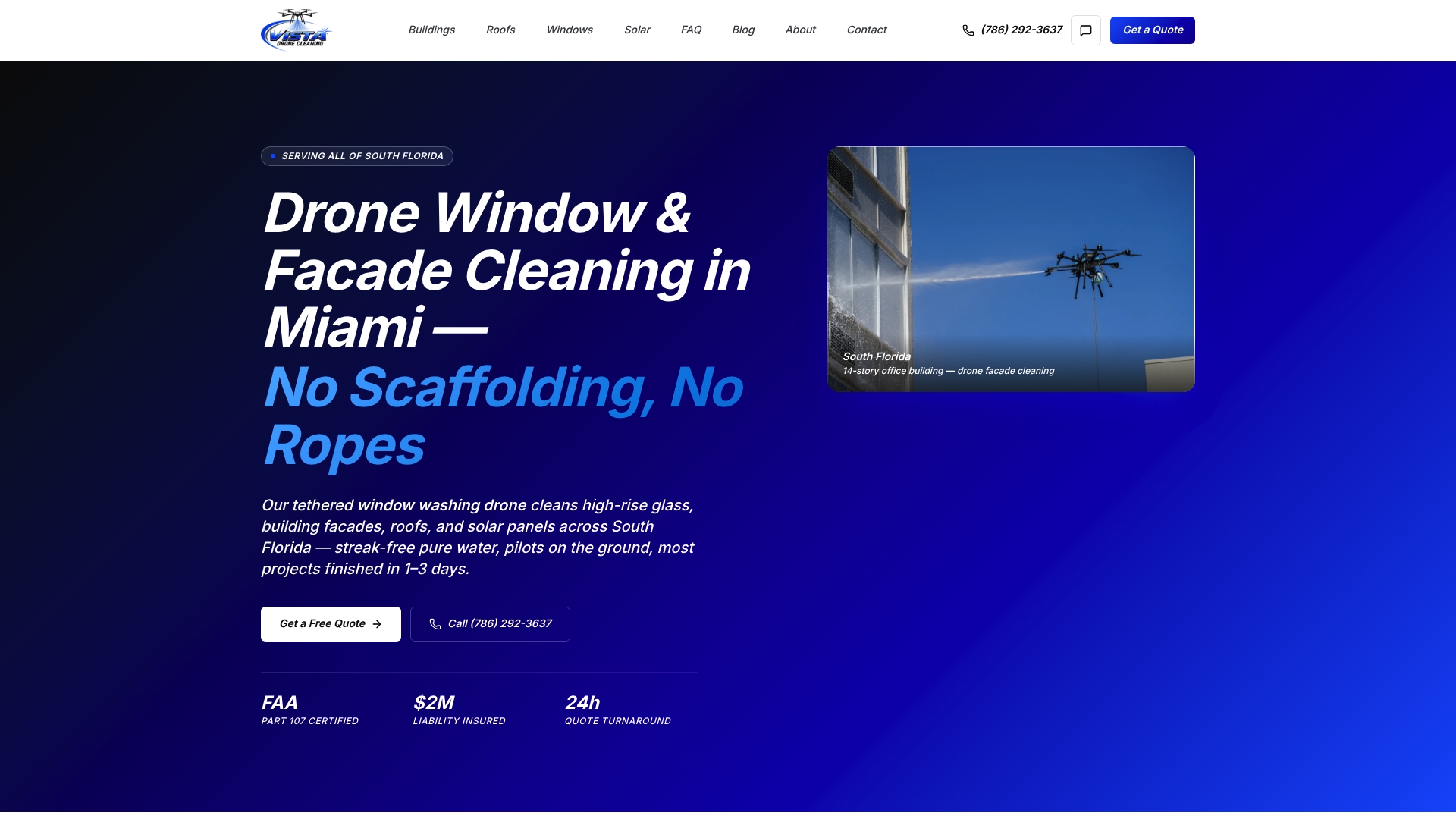
We carry liability insurance, complete projects relatively quickly, and use a pure deionized water rinse that leaves a streak-free finish without chemical runoff concerns. Our proof points on a given job include:
- Current Part 107 certification for every pilot on site.
- Tethered equipment rated for high-rise work.
- Liability coverage documented with a certificate of insurance.
- Free quotes delivered promptly after a site inquiry.
If you manage a commercial property, condominium, or solar array in Miami-Dade, Broward, or Palm Beach County, request a free quote through our drone facade and building cleaning service page to receive a proposal.
FAQ
What are the new drone rules for 2026?
Commercial drone operators still need an active FAA Part 107 Remote Pilot Certificate, registered aircraft, and Remote ID compliance as the regulatory baseline. Specific airspace and waiver requirements continue to run through LAANC and FAADroneZone, so operators should check current FAA guidance before each new job.
How much is a cleaning drone?
Published pricing varies by service type rather than by the drone itself: our drone facade and building cleaning and drone window cleaning services run $0.12 to $0.25 per square foot, while drone solar panel cleaning runs $1 to $3 per panel. Equipment cost itself is not publicly listed and depends heavily on the platform and payload.
What are the new drone laws in the USA?
Commercial drone operations in the United States remain governed by FAA Part 107, which requires certification, registration, Remote ID compliance, and airspace authorization where applicable. Local municipalities in Miami-Dade, Broward, and Palm Beach counties may add permit or notification requirements on top of federal rules.
Is it legal for my neighbor to fly a drone over my house?
Recreational and commercial drone flights are generally permitted over private property under FAA airspace rules, since the FAA regulates airspace rather than property rights below it. Concerns about low-altitude flights, harassment, or privacy are typically addressed through local ordinances or civil remedies rather than FAA enforcement.