South Florida Property Managers: 5 Part 107 Vetting Steps for Drone Cleaning
Concise Part 107 drone cleaning compliance checklist for South Florida property managers. Five vetting steps, Remote ID, airspace waivers, insurance, and...

Part 107 drone cleaning is a lawful, ready-to-hire option for South Florida commercial properties once an operator proves three things: an active FAA remote pilot certificate, Remote ID compliance for every drone on site, and current liability insurance. Ask for these documents before signing anything. Jobs near airports or requiring flight beyond visual line of sight may also need an FAA waiver, which adds lead time but does not make the work illegal.
TL; DR:
- Vendors must provide proof of FAA remote pilot certification, Remote ID registration, and current liability insurance before contract signing.
- South Florida drone crews may require FAA waivers for beyond visual line-of-sight flights or operations near airports, which can take several weeks to process.
- Site safety involves managing ground-based hazards, pedestrian exclusion zones, and coordination with building management for access and staging.
- Strict vetting of operators’ safety documentation, operational proof, and local experience is essential before accepting bids or signing agreements.
Table of Contents
- What Part 107 requires for exterior cleaning operations
- Remote ID, controlled airspace, and the waiver process in South Florida
- Safety and OSHA interactions on drone cleaning sites
- Services, pricing shapes, and realistic timelines for South Florida properties
- Vendor vetting checklist before you sign a contract
- What local crews actually run into in South Florida
- Vista Drone Cleaning: a Part 107 option built for South Florida buildings
- FAQ
- Sources
What Part 107 requires for exterior cleaning operations
Part 107 sets the operating rules that govern how a drone cleaning crew works your building, and understanding them helps you spot a vendor who is cutting corners. Every commercial flight must be conducted under a valid remote pilot certificate, and the pilot in command must present that certificate and identification to the FAA on request, a duty spelled out in the agency’s operations-over-people rule. Visual line-of-sight rules also shape how a crew sets up around your property.
- The remote pilot or a designated visual observer must keep the drone in sight throughout the job, following the visual line-of-sight standard that governs commercial operations.
- Every aircraft used on the project must carry valid FAA registration tied to the operator’s account.
- Altitude, daylight operation, and flight-over-people limits affect how a crew stages equipment and schedules work around tenants or pedestrians.
These rules are not paperwork for their own sake. They determine whether a crew can legally work your facade on a Tuesday afternoon with foot traffic below, or whether they need a different plan.
Remote ID, controlled airspace, and the waiver process in South Florida
Every commercial drone must broadcast Remote ID, either as a Standard Remote ID aircraft or through an approved broadcast module, with the device entered into the operator’s registered inventory, according to FAA Remote ID guidance. Ask a vendor to show that inventory record for the specific aircraft arriving at your site. This does not expose pilot identity to the public; it lets the FAA match flight activity to a registered operator, which is a safeguard for you as the client, not a privacy risk.
South Florida adds a layer most other markets skip. Proximity to Miami International, Fort Lauderdale-Hollywood International, and Palm Beach International airports commonly places commercial buildings inside controlled airspace that requires prior authorization.
- A vendor checks sectional charts for the property address before quoting a firm start date.
- Airspace authorization is requested through the standard FAA process for the applicable class.
- If the job needs something Part 107 does not allow outright, such as flight beyond visual line of sight, the operator files a waiver through the FAA Aviation Safety Hub, documenting mitigations like dedicated radio channels between pilot and observers.
- Reviews typically take several weeks to a few months, so experienced crews build that timeline into bids rather than promising next-week starts for complex sites.
An approved waiver is a sign of real risk planning, not a workaround.
Safety and OSHA interactions on drone cleaning sites
Rooftop and solar maintenance carries well-documented fall hazards. OSHA guidance on solar energy work flags skylights, roof edges, and unguarded openings as recurring injury sources, and the agency’s own inspection records include serious rooftop falls tied to panel cleaning without fall protection. Keeping a crew on the ground removes that exposure for the specific task of exterior washing.
That said, drone cleaning does not erase every site safety duty. Workers still need fall protection for roof access, edge work, or handling rooftop equipment unrelated to the cleaning itself. What changes is scope, not elimination.
- Ground crews manage hose runs, staging areas, and power or water hookups without anyone on the roof.
- Pedestrian exclusion zones around the building keep foot traffic clear during flight.
- Site control includes coordination with building management on access windows and parking.
Pro Tip: Ask for a written method statement and site-specific risk assessment before the crew arrives, not after.
Request crew training records too. A vendor who cannot produce them quickly is not ready for your property.
Services, pricing shapes, and realistic timelines for South Florida properties
Commercial drone cleaning typically covers four service lines: window washing, facade cleaning, roof soft-wash, and solar panel pure-water cleaning, each suited to different substrates including glass, stucco, EIFS, metal, tile, and photovoltaic surfaces.
- Window and facade work is commonly priced in the $0.12 to $0.25 per square foot range depending on glass coverage and surface complexity.
- Solar panel cleaning is typically quoted per panel, in the $1 to $3 range per unit.
- Roof soft-wash pricing is usually set after a site survey rather than published as a flat rate.
- Height, substrate type, access constraints, and whether the job is one-off or part of a maintenance schedule all move the final number.
A typical sequence runs from site survey to a proposal within 24 to 72 hours, then mobilization, with most single buildings finished in one to three days. Larger portfolios take longer and are usually scheduled in phases. A complete quote should spell out insurance coverage, exact scope, before-and-after documentation, and any staging requirements the property needs to prepare in advance.
Vendor vetting checklist before you sign a contract
Treat the bidding process like a compliance review, not just a price comparison. Start with documents, not sales pitches.
- Request the remote pilot certificate for every pilot assigned, proof of Remote ID registration for each aircraft, and current insurance declarations showing coverage limits and effective dates.
- Ask for any airspace authorizations or waivers tied to your building’s location, along with a site-specific method statement and risk assessment.
- Review operational proof: recent 4K before-and-after project media, an equipment list that specifies whether aircraft are tethered industrial units, and a written visual observer protocol.
- Walk the property together and confirm staging points, pedestrian control plans, water access, and any window or panel access needs.
- Treat an inability to produce certificates, references, or a clear safety protocol as a disqualifying red flag, and weigh compliance and demonstrated local experience ahead of the lowest bid.
A vendor who answers these questions without hesitation has done this work before.
What local crews actually run into in South Florida

I lead operations at Vista Drone Cleaning, working across Miami-Dade, Broward, and Palm Beach counties, where our FAA Part 107 pilots typically complete single-building projects in one to three days under a $2 million liability policy. The recurring constraints here are airport approach corridors near Miami and Fort Lauderdale, pedestrian-heavy streets in places like Brickell, and HOA scheduling requirements at condominium towers.
On a recent high-rise facade job, mobilization was timed around morning foot traffic, ground crews held a marked exclusion zone, and the client received full before-and-after documentation the same week. Planning around these specifics, rather than treating every site the same, is what keeps a schedule realistic.
, Eliot
Vista Drone Cleaning: a Part 107 option built for South Florida buildings
We run FAA Part 107 certified pilots and tethered industrial drones across South Florida, covering window washing, facade cleaning, roof soft-wash, and solar panel pure-water cleaning under liability insurance. A free site survey leads to a fixed-price proposal, usually within a few days, with no scaffolding, lifts, or road closures involved.
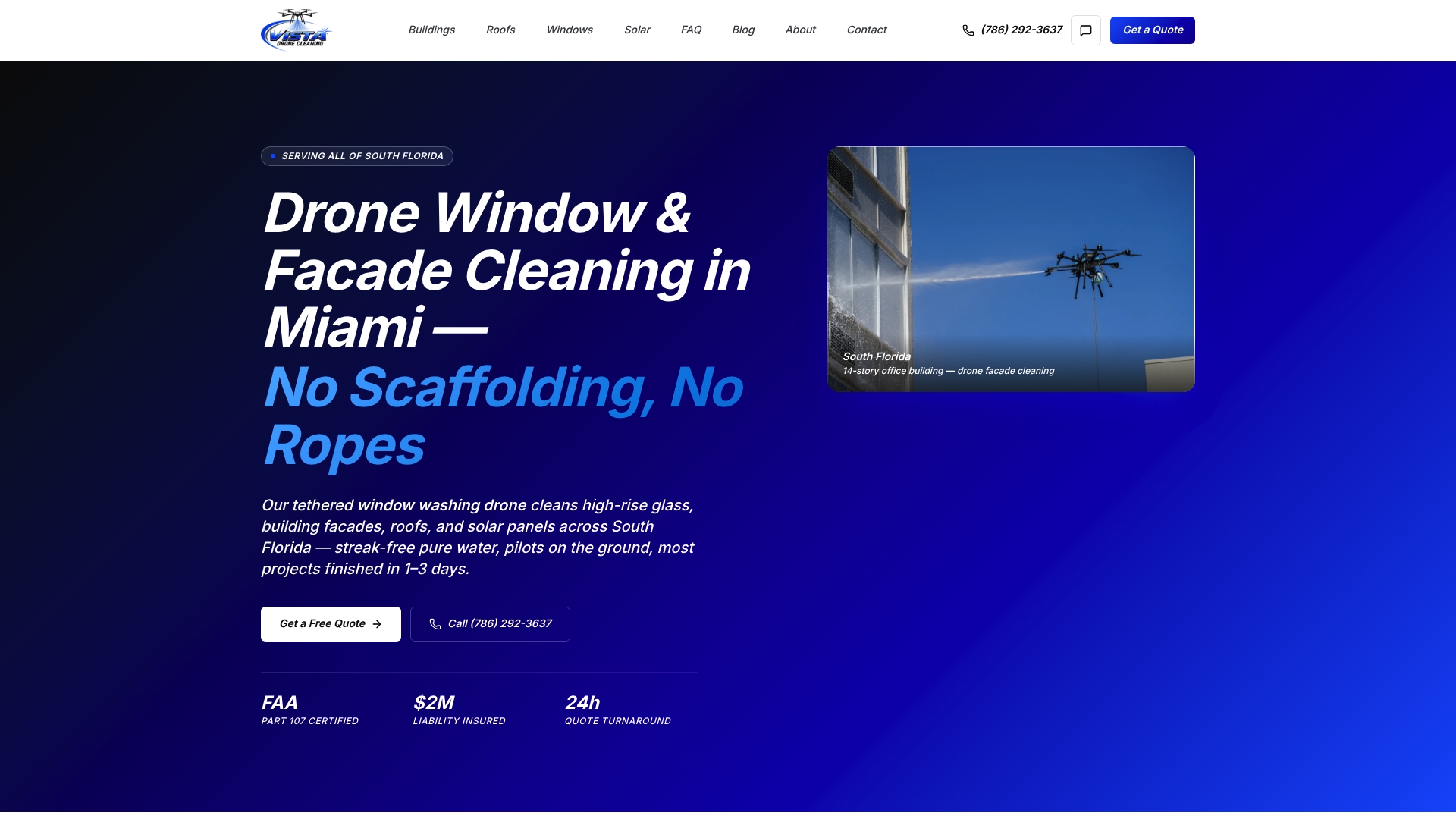
What that looks like in practice:
- A site visit to confirm access points, staging areas, and substrate types.
- A written proposal covering scope, insurance, and before-and-after documentation.
- Most single buildings completed in one to three days once scheduled.
If your property sits in our service area and you want pricing based on your actual building, request a quote on drone facade and building cleaning and we will follow up with a site survey window.
FAQ
How much does a Part 107 test cost?
The FAA’s initial aeronautical knowledge test for the remote pilot certificate typically costs about $175 at an approved testing center. That fee covers the knowledge exam itself, not any separate training materials a pilot may use to prepare.
Can the FAA know you flew a DJI drone?
Yes. Commercial drones must comply with Remote ID requirements, broadcasting identification that the FAA can match to a registered operator account. This applies regardless of manufacturer, including DJI aircraft used for commercial cleaning work.
Is it hard to pass the Part 107 exam?
Difficulty varies by how much a candidate studies airspace rules, weather, and regulations beforehand. The exam covers specific technical material, so most successful candidates treat it as a real test requiring dedicated preparation rather than something to take casually.
How many people fail the Part 107 exam?
Pass and fail rates are not published in a way this article can cite with a specific figure. What is clear is that the exam covers detailed regulatory and operational content, which is why experienced commercial operators invest real study time before testing.
Sources
- Operation of Small Unmanned Aircraft Systems Over People, FAA final rule
- Solar energy: Falls | Occupational Safety and Health Administration