400 ft vs 120–200 ft: Drone Cleaning Limits for South Florida Managers
FAA's 400 ft ceiling vs the 120–200 ft practical limit: what South Florida facility managers must require of vendors.

The legal ceiling for drone cleaning is 400 feet above ground level, or up to 400 feet above a structure’s uppermost point when flying within 400 feet of it, under FAA Part 107. The practical ceiling is much lower: hose-fed and tethered systems typically top out around 120 to 200 feet because of water pressure loss, hose drag, and wind instability. Waivers can push past these limits, but they take planning.
TL; DR:
- The FAA allows drone operations up to 400 feet above ground or structure, but practical limits for tethered systems are usually around 120 to 200 feet due to pressure loss and wind instability.
- Avoid exceeding altitude limits unless you obtain a waiver, as flying over 400 feet without authorization violates FAA Part 107 regulations.
- Controlled airspace near South Florida airports often requires prior authorization through LAANC or FAADroneZone, which can add time to project scheduling.
- Safety and compliance require verified pilot certification, insurance, safety plans, and proper documentation, including a clear safety perimeter and tenant notifications.
- Drones are best suited for mid-rise buildings and facade cleaning in the 120 to 200-foot range, with taller or wind-exposed sites favoring traditional access methods.
Table of Contents
- FAA Part 107 limits and how to interpret them for building cleaning
- Operational constraints that lower the usable cleaning height
- Airspace, LAANC and FAADroneZone: what approvals mean for your schedule
- Safety, OSHA overlap, and vendor documentation facility managers must require
- When drone cleaning is a good fit and when traditional methods win
- A facility manager’s planning checklist for a drone-cleaning engagement
- Eliot’s perspective: how we assess height and safety on South Florida projects
- Vista Drone Cleaning: how we handle height limits and how to request a quote
- FAQ
- Sources
FAA Part 107 limits and how to interpret them for building cleaning
The baseline rule under FAA Part 107 caps small unmanned aircraft at 400 feet above ground level. The exception that matters for building cleaning: when the aircraft operates within 400 feet of a structure, it may fly up to 400 feet above that structure’s uppermost limit, not above the ground beneath it. That distinction lets a crew legally work well above 400 feet AGL on a tall tower, provided the drone stays close to the facade.
Part 107 also sets operating conditions that shape how a cleaning flight runs. The FAA’s advisory circular lists a maximum groundspeed of 87 knots, a minimum visibility of 3 statute miles, and cloud clearance requirements, all of which affect scheduling around South Florida’s afternoon storm patterns. Pilots must keep the aircraft within visual line of sight at all times, which is one reason tethered systems rarely attempt true high-rise towers beyond a few hundred feet.
To determine altitude above a structure, pilots typically subtract the building’s MSL elevation from the aircraft’s reported MSL altitude, or use GPS devices that report mean sea level directly, a method described in the FAA’s advisory circular. Anything beyond these standard limits, including flights in restricted airspace or beyond visual line of sight, requires a waiver.
Operational constraints that lower the usable cleaning height
Regulatory headroom rarely matches what the hardware can actually do. Hose-fed cleaning systems lose water pressure as elevation increases, and a longer hose adds weight that the drone has to carry along with its cleaning payload. Past a certain point, pressure at the nozzle drops enough that cleaning quality suffers even if the aircraft can physically reach higher.
Tethered systems extend reach but introduce lateral forces that pull the aircraft off its flight path. Engineers manage this through controller tuning (PID adjustments) and mechanical stabilization hardware that counteracts oscillation from the tether. Without that tuning, a tethered drone at height becomes difficult to control precisely near glass and facade panels.

Battery life and pump capacity set the other boundary. A drone working at 150 or 180 feet burns through runtime faster than one working close to ground level, and crews need to plan battery swaps and water refills around that. Wind shear and gusts compound all of it: South Florida’s coastal wind patterns can turn a stable hover at 100 feet into an unstable one at 180 feet, which is why experienced operators treat wind as the deciding factor on any given day, not altitude alone.
Airspace, LAANC and FAADroneZone: what approvals mean for your schedule
Most South Florida commercial properties sit in or near controlled airspace because of the region’s airports, which means prior authorization is often required before a drone leaves the ground. The Low Altitude Authorization and Notification Capability system gives near-real-time approval for many sites at pre-approved altitudes, and it covers the bulk of routine commercial cleaning jobs.
Sites closer to major airports or in more complex controlled airspace often need manual processing through FAADroneZone instead, and waiver requests submitted that way can take 60 days or longer depending on complexity, according to the FAA’s waiver application instructions. The UAS facility maps that underlie LAANC also cap the altitude an operator may request at a given location, which is worth checking before committing to a project timeline.

Safety, OSHA overlap, and vendor documentation facility managers must require
Switching from scaffolding or rope access to a drone does not remove building-maintenance safety obligations. OSHA’s powered-platforms standard sets expectations for building-maintenance work and employer responsibility for emergency planning, and those expectations still apply conceptually even when a contractor replaces a suspended platform with a drone.
Before signing a contract, ask the vendor for:
- Part 107 pilot certification for every operator on site.
- A current insurance certificate, ideally showing liability coverage in the millions of dollars.
- A written emergency response plan and a site-specific risk assessment.
- Documentation of LAANC or FAADroneZone experience relevant to the property’s airspace.
On site, that translates into a marked safety perimeter, a plan for managing pedestrian traffic near the work zone, and advance notice to tenants. Afterward, request before-and-after documentation so the work can be verified without re-inspecting the facade in person. For more on vendor qualifications, see FAA certification and risk management for drone cleaning vendors.
When drone cleaning is a good fit and when traditional methods win
Drones work best on mid-rise buildings, properties with complex facade access, rooftop solar arrays, and parking structures, generally in the range where the practical ceiling of 120 to 200 feet comfortably covers the building. Condo facades, hotel exteriors, and low- to mid-rise office towers across Miami-Dade and Broward fall squarely in that zone.
Very tall towers, buildings that require facade-mounted anchor points for other maintenance work anyway, or sites with persistent strong wind are better suited to scaffolding, boom lifts, or rope access, at least for the upper floors. A detailed comparison of these methods is available in this guide to high-rise facade cleaning methods.
A facility manager’s planning checklist for a drone-cleaning engagement
Before soliciting bids, pull together the basics a vendor will need to quote accurately and the questions that reveal whether they can operate safely at your building’s height.
- Confirm the site’s elevation profile, exact GPS coordinates, and proximity to nearby airports or controlled airspace.
- Verify the vendor’s Part 107 pilot credentials, LAANC or FAADroneZone experience, insurance certificate, and written safety plan.
- Request the maximum planned working altitude, hose or tether specifications, and pump capacity for the proposed equipment.
- Ask for an estimated project duration and a weather contingency plan, given wind and visibility requirements.
- Build in lead time for LAANC or FAADroneZone processing, and specify preferred weather windows when scheduling.
For a more detailed version of this process, see how to vet a drone cleaning contractor, and consult a guide to airspace class maps if the property sits near a controlled zone.
Pro Tip: Ask for the vendor’s planned working altitude in writing before the quote is finalized, not after the crew arrives on site.
Eliot’s perspective: how we assess height and safety on South Florida projects
Every project starts with the same questions: what does the building’s geometry look like, what does the wind do at that height on a typical afternoon, what is the facade substrate, and how does a test hover behave before committing to a full run. On one Broward County condominium, that process settled on a practical ceiling for the tower’s upper sections well under the legal maximum but matched to equipment capabilities and local wind conditions, and well under the legal maximum but matched to what the hose and tether could handle reliably in coastal wind. Documentation and a written safety plan went with it, because a client should never have to guess what happened eighty feet up.
, Eliot
Vista Drone Cleaning: how we handle height limits and how to request a quote
We clean buildings using FAA Part 107 certified pilots and tethered industrial drones, with crews staying on the ground the entire time. No scaffolding, no boom lifts, no rope access, and no road closures to coordinate around your tenants.
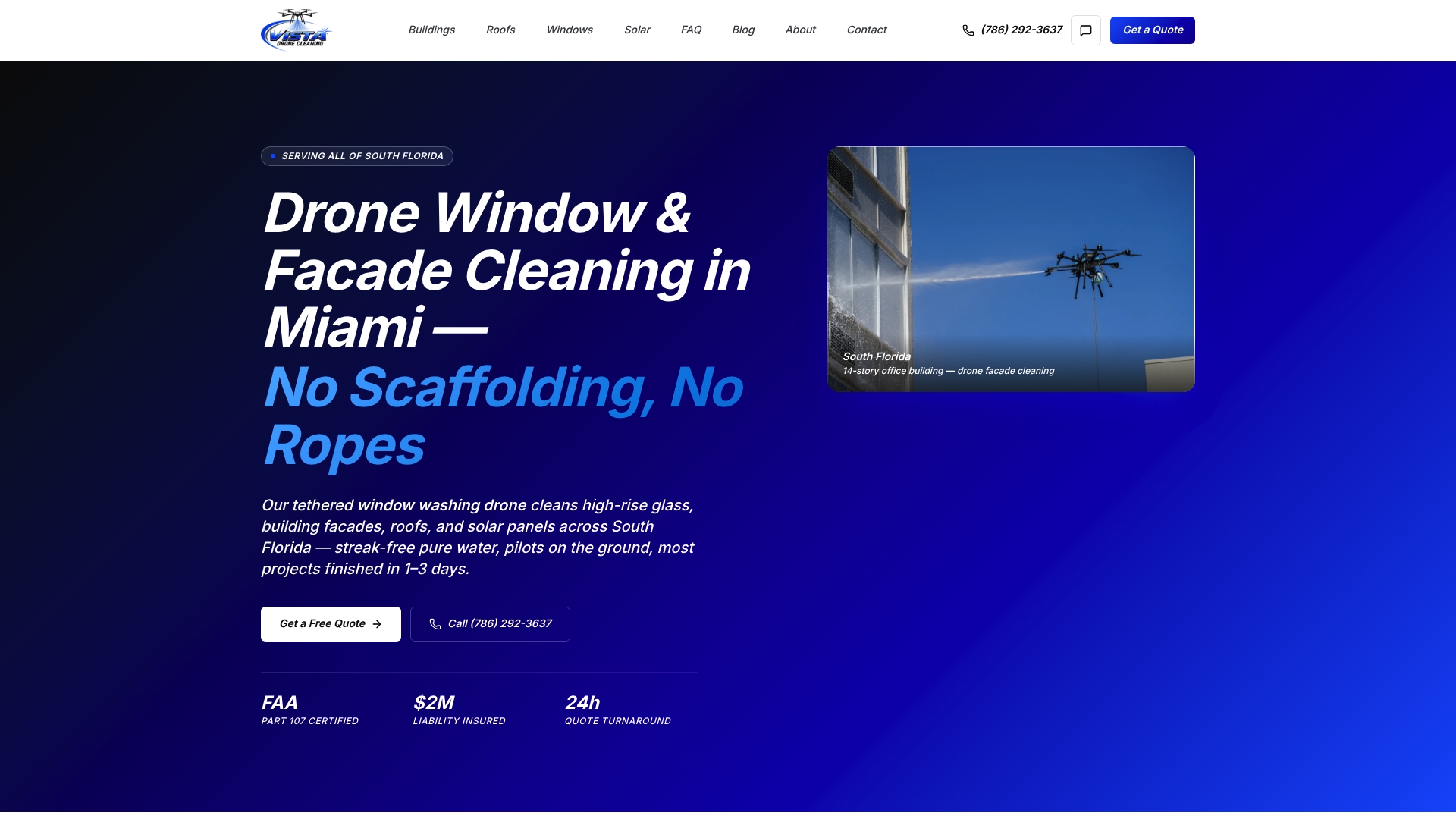
That matters most at the height ranges where the physics get harder: taller facades, rooftop solar arrays, and parking structures where traditional access methods slow a project down.
- FAA Part 107 certified pilots on the job.
- Liability insurance backing the work.
- Before-and-after documentation for projects.
- Pure de-ionized water rinse on glass and facade substrates.
Most projects finish in one to three days. If your building falls in Miami-Dade or Broward County and you want an assessment for your property, request a free quote on facade and window cleaning to learn what’s achievable before any equipment leaves the ground.
This article is general information, not a substitute for advice from a qualified lawyer. Consult a qualified legal professional about your own circumstances before acting on anything here.
FAQ
Is there a height limit for drones?
Yes. Under FAA Part 107, drones are limited to 400 feet above ground level, or up to 400 feet above a structure’s top when flown within 400 feet of it. Flying higher without a waiver is not permitted.
Can drones be used to clean high-rise buildings?
Drones clean mid-rise and many high-rise facades effectively, generally up to the 120 to 200 foot range where hose-fed and tethered systems perform reliably. Taller towers or sections with persistent high wind often still need scaffolding, boom lifts, or rope access for the upper floors.
Does the FAA know if you fly above 400 feet?
The FAA does not track every flight in real time, but operating above 400 feet AGL without the structure exception or an approved waiver violates Part 107 regardless of whether it gets noticed. Commercial operators are expected to stay compliant and keep records that show it.
Is it legal for a neighbor to fly a drone over a nearby property?
Part 107 governs airspace use but does not address every local property or privacy concern, which can vary by state and municipality. Anyone with a specific dispute should check local ordinances or consult an attorney rather than rely on the federal altitude rule alone.
Sources
- Small Unmanned Aircraft Systems (UAS) Regulations (Part 107) | Federal Aviation Administration
- OSHA standard 1910.66 – Powered platforms for building maintenance