High-Rise Facade Cleaning Methods Compared: 2026 Guide
Explore high-rise facade cleaning methods compared in our 2026 guide. Discover cost, safety, and efficiency to make informed choices for your building.
TL; DR:
- Drone cleaning is the safest and most cost-effective method for routine high-rise facade maintenance in South Florida. It reduces liability, deploys quickly, and tolerates higher wind speeds compared to traditional methods. Facility managers should prioritize drone systems while using BMUs or rope access for complex architectural features.
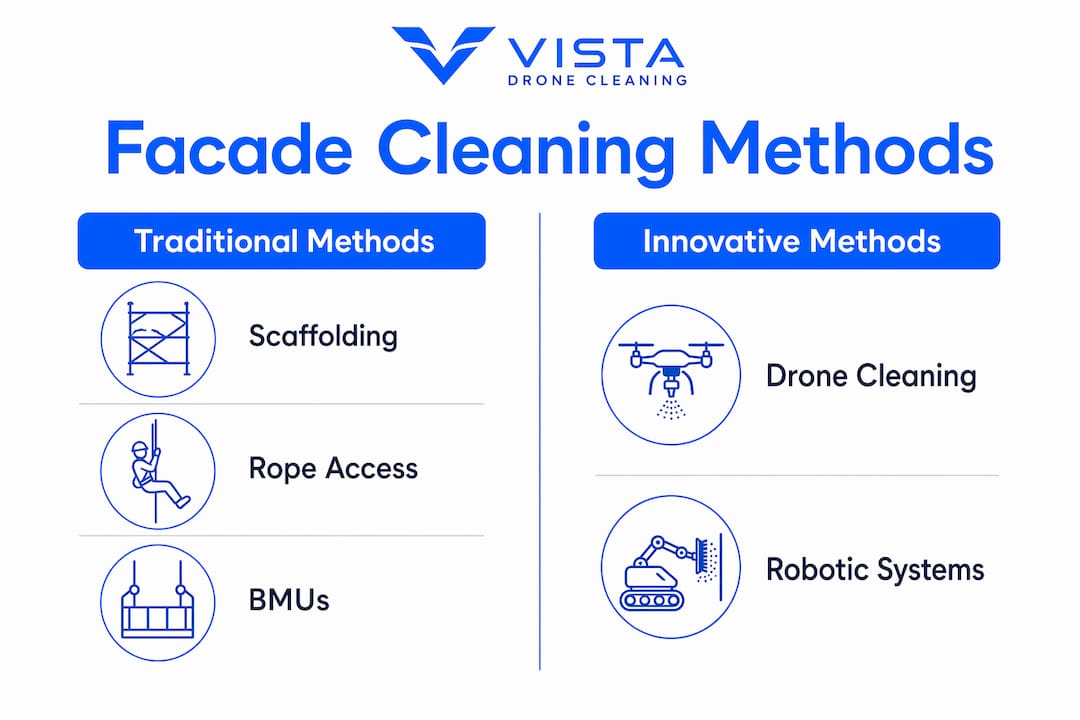
High-rise facade cleaning methods differ significantly in cost, safety, speed, and practical application, making a direct comparison essential for facility managers and property owners. The four primary methods are scaffolding, rope access, building maintenance units (BMUs), and drone cleaning. Each carries a distinct risk profile, regulatory footprint, and cost structure. In South Florida, where Brickell towers, Fort Lauderdale hotel corridors, and Boca Raton office parks demand regular exterior maintenance, choosing the wrong method costs time, money, and in the worst cases, lives. This guide breaks down every major option against 2026 safety standards so you can make a clear, informed decision.
What are the high-rise facade cleaning methods compared for safety and cost?
The industry term for this discipline is “exterior building maintenance, ” and it covers every method used to clean, inspect, and restore building facades above ground level. Scaffolding, rope access, BMUs, aerial lifts, and drone systems each occupy a different position on the cost-versus-risk spectrum.
Scaffolding projects for tall buildings cost $20,000 to $100,000+ and require 2–4 weeks of setup time. That timeline alone rules scaffolding out for occupied commercial towers in Miami-Dade where tenant disruption carries real financial consequences. Rope access, by contrast, can save 30–50% in costs compared to scaffolding and deploys in hours rather than weeks.
BMUs are permanent gondola systems built into a building’s roofline. They suit skyscrapers with 30–40+ stories and flat or gently curved facades. Drone cleaning is the newest category and the fastest growing in South Florida, where FAA Part 107 regulations and urban airspace rules have matured enough to make commercial drone operations routine.
Pro Tip: Before requesting quotes, document your building’s height, facade material, anchor system age, and any architectural overhangs. That single step cuts quote turnaround from days to hours and prevents scope surprises.
What are the safety and regulatory requirements for high-rise facade cleaning?
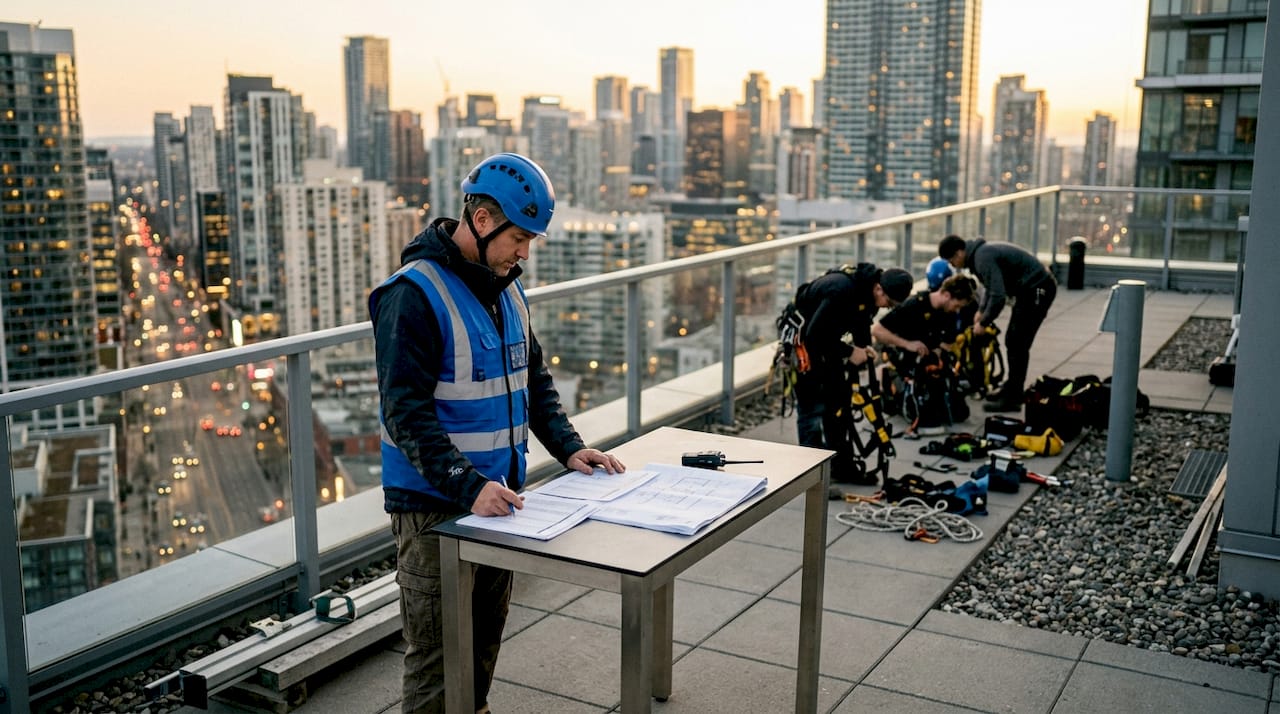
Compliance is not optional, and the liability exposure for building owners is larger than most property managers realize. OSHA 1910.27 and ANSI/IWCA I-14.1 require annual inspection of roof anchors by a competent person, and each anchor must support 5,000 lbs per worker. Adhesive anchors require proof-load testing every 5 years, a requirement that is frequently overlooked during routine maintenance planning.
Documentation is your primary defense against OSHA citations. Insurance carriers are increasingly denying claims when engineer-stamped inspection reports are absent. That means a single missing inspection record can void coverage on a multi-million-dollar liability claim.
Under OSHA’s multi-employer worksite doctrine, building owners remain liable for accidents if anchors are uncertified or inspections are undocumented, even when a third-party contractor performs the work. OSHA references ANSI standards as “recognized industry practice, ” and noncompliance is one of the most common causes of citations and fines issued directly to building owners in Florida.
Key compliance checkpoints for facility managers:
- Confirm annual anchor inspections with engineer-stamped reports on file
- Verify adhesive bolt proof-load test dates (required every 5 years)
- Require IRATA certification documentation from any rope access contractor
- Confirm $2M+ liability insurance coverage before any crew accesses the facade
- Keep a complete maintenance log accessible during any OSHA inspection
How do scaffolding, rope access, and BMUs compare for facade cleaning?
Each traditional method has a specific use case, and forcing the wrong method onto a building creates both cost overruns and safety gaps.
Scaffolding
Scaffolding delivers the most stable working platform but at the highest cost and longest lead time. Setup on a 20-story Brickell tower can take 2–4 weeks and require road closures, city permits, and sidewalk canopies. For occupied commercial properties in dense urban areas like downtown Fort Lauderdale or Coral Gables, that level of disruption is rarely acceptable. Scaffolding makes sense for new construction facade cleaning or major restoration projects where workers need extended, stationary access.
Rope access
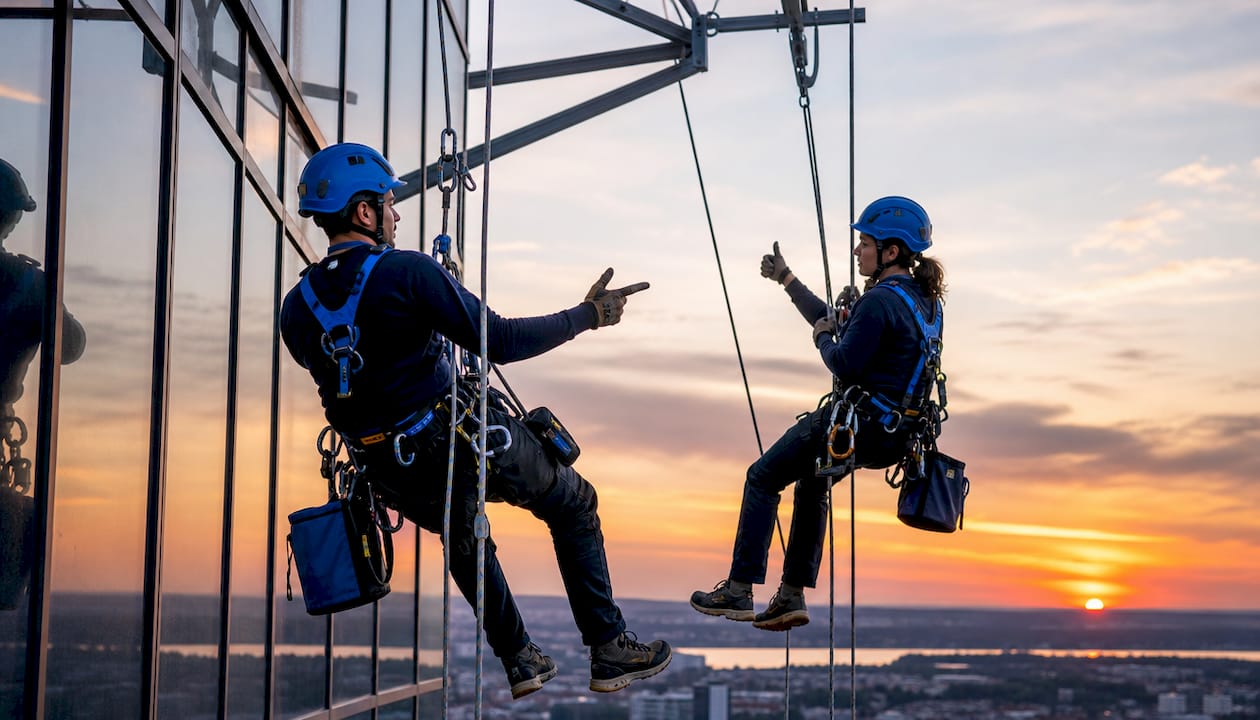
Rope access is the most flexible traditional method. IRATA-certified technicians descend from rooftop anchors using dual-rope systems, covering large facade areas quickly without ground-level infrastructure. The method suits complex architectural features, irregular geometries, and buildings where BMU tracks were never installed. The critical limitation is wind. Standard safety cutoffs for rope access are 20–25 mph, and South Florida’s afternoon sea breezes regularly exceed that threshold during summer months, creating scheduling delays that extend project timelines.
Choosing rope access without accounting for complex facade geometries also risks surface damage and higher liability compared to BMU or drone alternatives. A technician swinging against a glass curtain wall in 22 mph gusts can crack panels that cost thousands of dollars each to replace.
Building maintenance units (BMUs)
Permanent BMUs are most cost-effective for skyscrapers with 30–40+ stories. They provide consistent, repeatable access with lower per-cleaning labor costs once installed. The limitation is inflexibility. BMU tracks follow fixed paths, so architectural features like setbacks, fins, or angled glass panels often require supplemental rope access anyway. Tall skyscraper cleaning benefits from a hybrid approach that combines BMUs for standard facade runs and rope access for specialized architectural sections.
| Method | Setup time | Relative cost | Wind limitation | Best use case |
|---|---|---|---|---|
| Scaffolding | 2–4 weeks | Highest | None | New construction, major restoration |
| Rope access | Hours | Moderate | 20–25 mph | Complex facades, irregular geometry |
| BMU | Minutes (installed) | Low per cycle | Moderate | Tall towers, 30+ stories, flat facades |
| Drone | Under 1 hour | 30–60% lower | Higher tolerance | Routine cleaning, mid-rise to high-rise |
What do drone and robotic systems offer for high-rise facade maintenance?
Drone cleaning is the fastest-growing exterior maintenance method in South Florida, and the performance gap over traditional methods is widening. Drone cleaning technologies offer under 1 hour of setup and clean 3–5 times faster than manual methods, with minimal worker risk because crews remain on the ground throughout the entire operation.
Vistadronecleaning operates FAA Part 107-certified pilots using tethered industrial drones, specifically the Lucid Bots Sherpa, to clean facades on commercial properties up to 200 feet tall across Miami, Brickell, Fort Lauderdale, and Boca Raton. No scaffolding, boom lifts, or rope access rigging is required. That eliminates permit applications, road closures, and the anchor inspection liability chain entirely for routine cleaning cycles.
The safety advantage is structural, not incidental. Automated systems reduce human injury risk by removing workers from suspended positions at height. Mature robotic and drone systems use redundant tethers and obstacle avoidance to prevent falls and equipment loss. For facility managers in Miami-Dade and Broward counties, that translates directly to lower insurance exposure and fewer OSHA compliance touchpoints.
Drone systems also tolerate higher wind speeds than rope access gondolas, which matters in South Florida where afternoon gusts are routine from june through october. A cleaning cycle that would ground a rope access crew can often proceed safely with a properly tethered drone system.
Pro Tip: Ask any drone cleaning vendor for their FAA Part 107 certificate number and proof of $2M liability insurance before signing a contract. Both are verifiable and non-negotiable for commercial operations in South Florida airspace.
For a detailed look at how drone building cleaning works, the process from ground setup to rinse cycle takes a fraction of the time required by any traditional method.
What risk management framework should facility managers use to choose a method?
Facility managers often treat facade maintenance as a procurement task rather than a risk transfer decision. That framing is the single most expensive mistake in exterior building maintenance. The correct framework is the hierarchy of controls: eliminate the hazard first, then isolate it, then minimize it.
Applied to facade cleaning, the hierarchy looks like this:
- Eliminate: Use drone or robotic systems to remove workers from suspended positions entirely
- Isolate: Use BMUs with enclosed gondolas to separate workers from open-air fall exposure
- Minimize: Use rope access with IRATA-certified technicians and redundant anchor systems
- Last resort: Use scaffolding only when no other method provides adequate access
Risk profiles differ sharply across methods. Rope access places trained workers in sustained suspension, where fatigue, wind, and anchor condition all compound risk over a multi-day project. BMUs reduce suspension risk but introduce mechanical failure variables. Drone systems shift risk from human exposure to equipment reliability, which is a favorable trade when the drone carries redundant tethers and the operator holds FAA certification.
The question is not which method is cheapest. The question is which method transfers the most risk away from human bodies and away from your balance sheet. For most South Florida high-rises, that answer has changed in the last three years.
Heat is an underappreciated risk factor in Miami-Dade and Broward counties. Rope access technicians working on south-facing glass facades in july and august face heat stress that degrades judgment and reaction time. Drone systems eliminate that variable entirely. For high-rise cleaning without rope access, the risk reduction is measurable and the cost difference is significant.
Key Takeaways
Drone cleaning is the most cost-effective and lowest-risk method for routine high-rise facade maintenance in South Florida, while BMUs and rope access remain necessary for complex architectural features and restoration work.
| Point | Details |
|---|---|
| Scaffolding costs are prohibitive | Setup runs $20,000 to $100,000+ with 2–4 weeks of lead time, making it impractical for occupied towers. |
| Anchor compliance is owner liability | OSHA’s multi-employer doctrine holds building owners responsible for uncertified or undocumented anchor systems. |
| Wind limits traditional methods | Rope access and gondolas stop at 20–25 mph winds; drone systems tolerate higher wind speeds. |
| Drones cut setup and cost | Drone cleaning deploys in under 1 hour and costs 30–60% less than scaffold or lift methods. |
| Risk framework beats cost comparison | Evaluating methods by human exposure and liability transfer produces better long-term outcomes than price-only decisions. |
Why I think most facility managers are choosing methods for the wrong reasons
After years of watching exterior maintenance decisions get made in South Florida, the pattern is consistent. A property manager gets three quotes, picks the middle price, and moves on. The anchor inspection records sit in a filing cabinet no one has opened since 2019. The rope access crew shows up in august, works two hours, and gets rained out for three days.
The real cost of a facade cleaning project is not the invoice. It is the total exposure: worker injury risk, tenant disruption, permit delays, weather losses, and the liability that sits on the building owner’s balance sheet if something goes wrong. Drone cleaning does not win every scenario. A 50-story tower with a complex BMU system already installed should use that BMU for standard runs. But for the majority of mid-rise and high-rise commercial properties in Miami, Brickell, Fort Lauderdale, and Boca Raton, drone cleaning is now the most defensible choice on every dimension that matters.
The hybrid approach is where the industry is heading. BMUs handle the predictable facade runs. Rope access handles the architectural exceptions. Drones handle routine maintenance cycles between deep cleans. That combination keeps compliance documentation clean, keeps workers safer, and keeps costs predictable. The facility managers who figure that out first will spend less and sleep better.
, Eliot
Vistadronecleaning serves South Florida high-rises with ground-based drone cleaning
Vistadronecleaning provides commercial facade cleaning across Miami-Dade, Broward, and Palm Beach counties using FAA Part 107-certified pilots and tethered Lucid Bots Sherpa drones. No scaffolding, no road closures, no rigging permits. Most projects finish in 1–3 days at 30–60% lower cost than traditional methods.
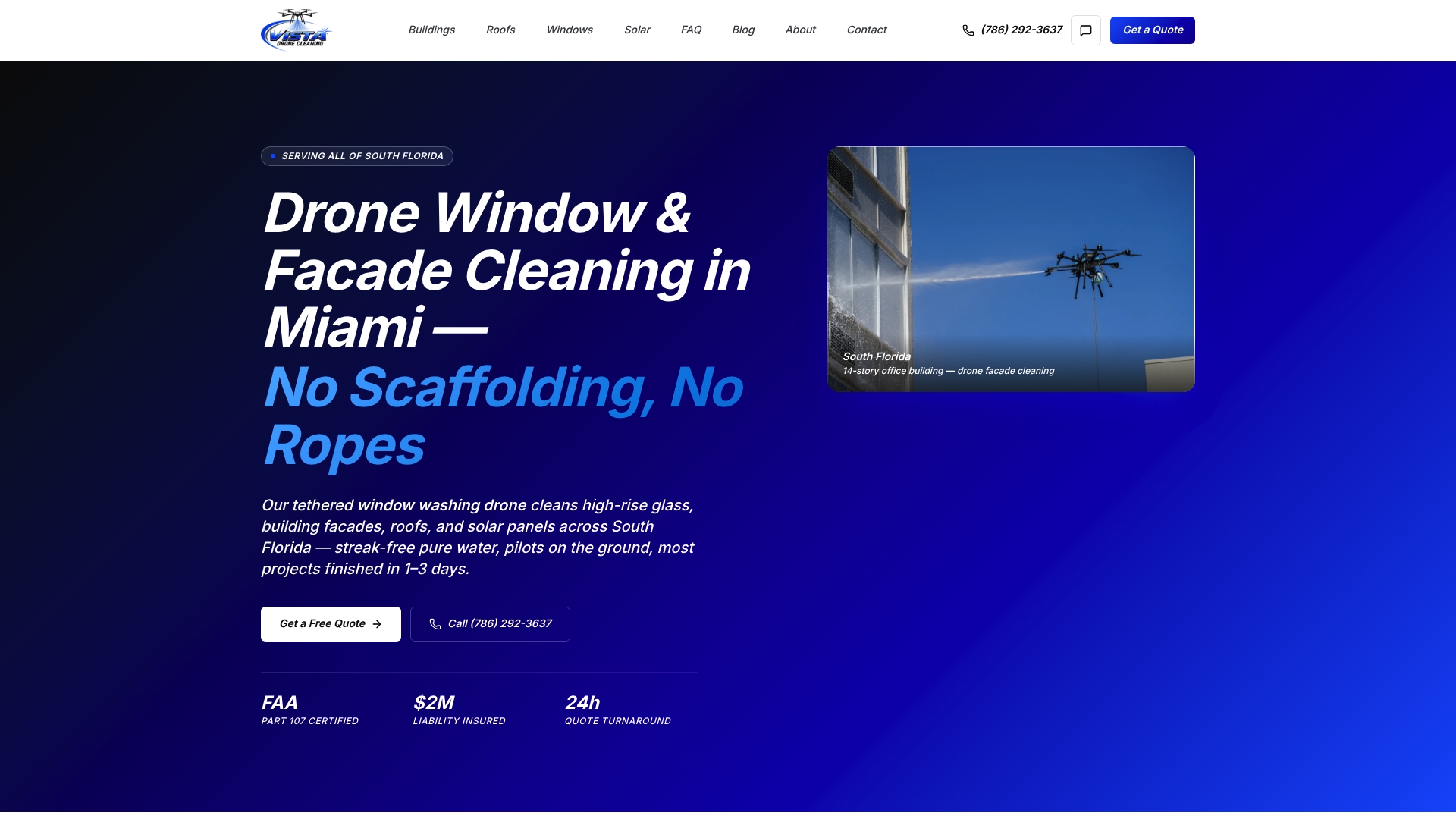
The service covers high-rise windows, building facades, roofs, and solar panels on commercial properties up to 200 feet tall. A streak-free, pure de-ionized water rinse leaves no chemical residue on glass or EIFS surfaces. For a full breakdown of cost, speed, and safety differences, the drone vs traditional cleaning comparison covers every major variable. Vistadronecleaning carries $2M liability insurance and delivers free quotes within 24 hours.
FAQ
What is the safest method for cleaning high-rise facades?
Drone cleaning is the safest method because crews remain on the ground throughout the operation, eliminating fall exposure entirely. Rope access with IRATA-certified technicians is the safest option when drone access is not feasible.
How often should high-rise building facades be cleaned in South Florida?
Most commercial high-rises in Miami-Dade and Broward counties require facade cleaning two to four times per year due to salt air, humidity, and algae growth accelerated by the subtropical climate.
What wind speed stops rope access facade cleaning?
Standard safety cutoffs for rope access and gondola systems are 20–25 mph. Drone systems can operate safely in higher wind conditions, making them more reliable during South Florida’s windy season.
Who is liable if a worker is injured during facade cleaning?
Under OSHA’s multi-employer worksite doctrine, building owners share liability if roof anchors are uncertified or inspection records are missing, even when a third-party contractor performs the work.
How does drone facade cleaning compare in cost to scaffolding?
Drone cleaning costs 30–60% less than scaffolding methods and deploys in under 1 hour versus the 2–4 week setup time scaffolding requires for tall buildings.