Facade Cleaning Without Scaffolding: A Property Manager's Guide
Explore what is facade cleaning without scaffolding. Discover efficient methods for maintaining high-rise buildings without disruption.
TL; DR:
- Facade cleaning without scaffolding uses drones, rope access, or water-fed poles to clean building exteriors safely without suspended workers. These methods reduce costs, eliminate fall risks, and minimize disruption compared to traditional scaffolding, especially in South Florida’s dense urban areas. Property managers should verify provider certifications and environmental considerations before adopting automated facade maintenance.
Facade cleaning without scaffolding is the practice of maintaining and washing a building’s exterior using ground-based or aerial methods that require no scaffold structure, boom lift, or rope rigging. The industry term for this category is “non-scaffold facade maintenance, ” and it covers three primary approaches: drone-based cleaning, rope access, and water-fed pole systems. For property managers in Miami, Brickell, Fort Lauderdale, and Boca Raton, these methods are not just a convenience. They are a direct response to the cost, safety, and disruption problems that traditional scaffolding creates on South Florida’s dense, high-rise corridors.
What is facade cleaning without scaffolding?
Non-scaffold facade maintenance is defined by one principle: no worker needs to be suspended on the building face to complete the job. Drone-based systems and water-fed poles reduce setup times from 2–5 days to under one hour. That single shift in timeline changes the entire economics of a cleaning project. Tenants stay undisturbed, parking remains open, and the building keeps operating normally from day one.
The phrase “no worker on facade cleaning” captures the same idea from a safety angle. When crews stay on the ground, the most serious risk in commercial exterior work, a fall from height, is removed entirely. Vistadronecleaning operates exactly on this model: FAA Part 107-certified pilots deploy tethered industrial drones from ground level, cleaning glass, stucco, EIFS, and metal panel facades on buildings up to 200 feet tall without a single worker leaving the pavement.
What are the main non-scaffolding methods for facade cleaning?
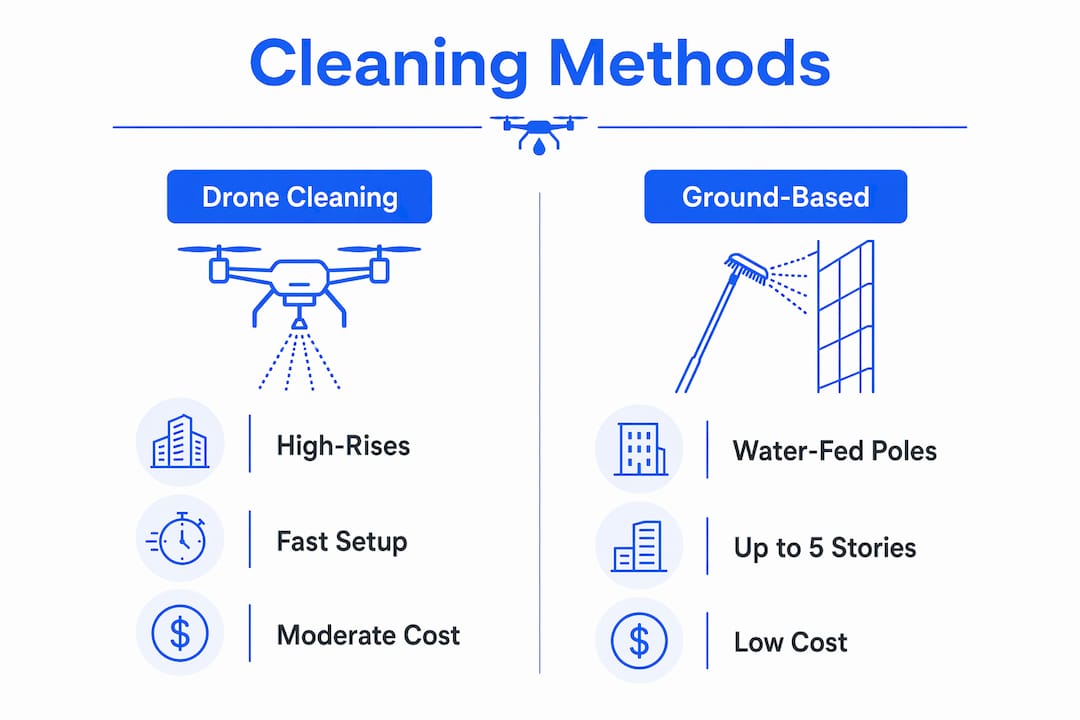
Three proven methods cover the full range of commercial buildings in South Florida.
Drone-based facade cleaning
Drones are the most capable option for high-rise buildings above six stories. RTK GPS positioning and radar obstacle avoidance allow drones to maintain a consistent distance from the facade and navigate around architectural features automatically. Vistadronecleaning uses the Lucid Bots Sherpa, a tethered industrial drone that delivers a continuous water supply from the ground. The tether eliminates battery limits and keeps the drone stable in South Florida’s coastal wind conditions.
Rope access cleaning
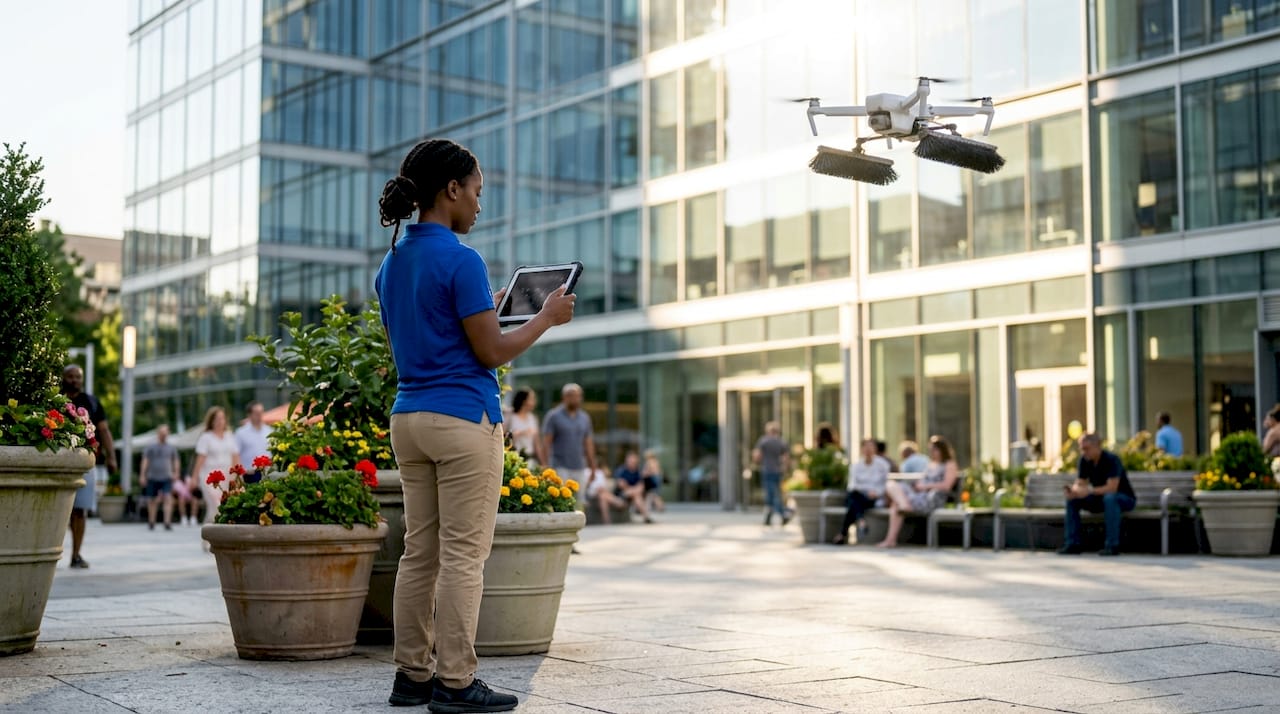
Rope access provides agility in tight architectural spaces where drones have limited clearance, such as recessed balconies or heavily ornamented facades. Technicians descend on certified rigging systems and can perform cleaning alongside minor repairs in the same visit. The scaffolding footprint disappears entirely, though workers are still on the building face, which means fall risk remains a factor.
Water-fed pole systems
Water-fed poles are ground-based tools that extend up to roughly four or five stories. They deliver purified water through a brush head, removing dirt without chemicals. This method suits low-rise retail centers, warehouses, and podium levels of taller buildings. Above five stories, reach and water pressure become limiting factors.
| Method | Best for | Setup time | Worker on facade | Relative cost |
|---|---|---|---|---|
| Drone cleaning | High-rises, 6+ stories | Under 1 hour | No | Low to medium |
| Rope access | Complex architecture, mid-rise | 2–4 hours | Yes | Medium |
| Water-fed pole | Low-rise, up to 5 stories | 30 minutes | No | Low |
Pro Tip: For mixed-use towers in Brickell or downtown Fort Lauderdale with both a glass curtain wall and a stucco podium, combine drone cleaning on the upper floors with water-fed poles on the base. You get full coverage without any scaffolding at any level.
How do non-scaffold methods compare to traditional scaffolding?
The cost difference is the first number that gets a property manager’s attention. Scaffolding rental and installation for a multi-story building runs $5,000 to $30,000 or more before a single window is touched. Drone cleaning clients report 30–50% total cost savings compared to scaffold or rope access projects. That gap comes from faster labor, lower equipment costs, and reduced insurance premiums.
Safety data reinforces the financial case. Workplace incident rates are approximately 80% lower for drone-based cleaning compared to traditional scaffolding. Facility managers should treat method selection as a risk management decision, not just a budget line. Automated ground-based methods eliminate falls from height entirely, which is the leading cause of fatality in commercial exterior work.
The hidden costs of scaffolding extend well beyond the rental invoice. A 2–5 day installation blocks sidewalks, eliminates parking spaces, generates noise complaints, and often requires city permits that add weeks to the project timeline. For a hotel in Miami Beach or a residential tower in Aventura, those disruptions translate directly into tenant dissatisfaction and lost revenue.
“Scaffolding’s true cost is not the rental fee. It’s the permits, the parking loss, the tenant complaints, and the two weeks you spend waiting for the crew to finish the install.”
Drone cleaning reduces permitting and street closure requirements significantly. In South Florida’s urban cores, where street closures require coordination with Miami-Dade or Broward county traffic management, that reduction alone can save weeks on a project schedule.
What should South Florida property managers consider when choosing a method?
South Florida’s building stock presents a specific set of material and environmental challenges that affect method selection.
Building materials and method compatibility:
- Glass curtain walls (common in Brickell and downtown Miami): respond well to drone cleaning with de-ionized water rinse, which leaves no mineral streaks.
- Stucco and EIFS (widespread across Miami-Dade and Broward): require soft-wash techniques with controlled pressure to avoid surface erosion or moisture intrusion.
- Metal panels: tolerate moderate pressure but need pH-neutral solutions to prevent oxidation.
- Historic masonry: demands the most caution. Improper pressure washing causes irreversible damage to historic or delicate facades, making a pre-cleaning survey non-negotiable.
South Florida’s coastal climate accelerates facade soiling faster than inland markets. Salt air deposits on glass and metal panels within weeks of cleaning, and high humidity promotes algae and mildew growth on stucco year-round. Cleaning schedules and chemical choices must account for these conditions. Hurricane season, june through november, also constrains outdoor work windows and affects when drone operations are safe to conduct.
Facade cleaning must be tailored to building materials and environmental conditions to avoid damage. A survey-led assessment before any project starts is the standard practice for responsible providers.
When vetting service providers, ask specifically about:
- FAA Part 107 certification for any drone operator
- Liability insurance coverage (Vistadronecleaning carries $2M)
- Emergency retrieval protocols if a drone malfunctions near the facade
- Experience with the specific substrate on your building
The risk profile shifts from human injury to equipment malfunction and property damage when you move to automated methods. That shift makes provider vetting more important, not less.
Pro Tip: Request a written method statement from any provider before signing a contract. It should specify the cleaning agent, water pressure, drone model, and what happens if equipment contacts the facade. Providers who cannot produce this document are not ready for your building.
How to implement facade cleaning without scaffolding in South Florida
A well-run non-scaffold cleaning project follows a clear sequence.
- Conduct a facade survey. Walk the building perimeter and photograph all substrate types, damaged areas, and access constraints. Note any areas where drone clearance may be limited by overhangs or signage.
- Define the scope and schedule. Identify which floors and elevations need cleaning. Schedule around hurricane season and peak occupancy periods. For hotels in Fort Lauderdale or Pompano Beach, avoid high-season months when guest disruption is most costly.
- Request detailed proposals from at least two providers. Each proposal should specify the method, equipment, cleaning agents, timeline, and insurance documentation. Compare line by line.
- Verify compliance. Confirm FAA Part 107 certification for drone operators, general liability coverage, and any local airspace authorization required for your building’s location.
- Coordinate with tenants and building management. Even without scaffolding, notify tenants of the cleaning dates. Drone operations produce some noise, and water runoff needs to be managed at ground level.
- Integrate with your maintenance calendar. Non-scaffold cleaning is fast enough to schedule quarterly or semi-annually without major disruption. Pair facade cleaning with high-rise building maintenance cycles for roof inspections or solar panel washing to consolidate vendor visits.
A Boca Raton office tower that switches from annual scaffold cleaning to semi-annual drone cleaning can maintain a cleaner facade year-round while spending less per cycle. The faster setup means the provider can return more often without the logistical burden of a full scaffold mobilization.
Pro Tip: Bundle facade cleaning with solar panel washing if your building has a rooftop array. Vistadronecleaning handles both in a single mobilization, which cuts per-service costs and reduces the number of vendor coordination days on your calendar.
Key Takeaways
Non-scaffold facade maintenance is the most cost-effective, safe, and operationally practical approach for South Florida commercial high-rises in 2026.
| Point | Details |
|---|---|
| Drone cleaning leads on cost | Clients save 30–50% versus scaffolding due to faster labor and lower equipment costs. |
| Safety improvement is measurable | Drone methods produce approximately 80% fewer workplace incidents than scaffold-based cleaning. |
| Setup time drops dramatically | Scaffold assembly takes 2–5 days; drone deployment takes under one hour. |
| Material matching is non-negotiable | Stucco, EIFS, glass, and metal panels each require a specific cleaning method to avoid damage. |
| Provider vetting protects your asset | Confirm FAA certification, $2M+ liability insurance, and a written method statement before any project starts. |
The case for committing to non-scaffold methods now
I have watched property managers in South Florida delay the switch to drone and ground-based cleaning for years, usually because scaffolding is what they know. The reasoning is understandable. Scaffolding feels tangible. You can see it, touch it, and point to it in a contract. Drone cleaning feels abstract until you watch a Lucid Bots Sherpa work a 30-story glass tower in Brickell from start to finish in a single day.
The real argument is not about technology preference. It is about what scaffolding actually costs when you add up the permit delays, the parking revenue lost during a five-day install, and the lease renewal conversation with a tenant who complained about the noise. Those costs are real and they recur every time you schedule a cleaning. Non-scaffold methods remove most of them permanently.
The one caution I would offer is this: not every provider offering “drone cleaning” has the equipment or the FAA credentials to do it safely on a 200-foot tower. The Lucid Bots Sherpa is a tethered industrial system built for this work. A consumer-grade drone with a spray attachment is not. Ask for the drone model, the pilot’s Part 107 certificate number, and proof of insurance before you sign anything. The technology works. The question is whether the provider behind it does too.
South Florida’s building owners who pilot non-scaffold cleaning this year will have two or three cycles of data before their competitors even start evaluating the option. That lead matters when you are managing a portfolio of towers in Miami-Dade and Broward and trying to hold maintenance costs flat against rising labor rates.
, Eliot
Vistadronecleaning serves South Florida’s high-rises without scaffolding
Vistadronecleaning is the Miami-based provider purpose-built for the non-scaffold cleaning model. FAA Part 107-certified pilots operate Lucid Bots Sherpa tethered industrial drones to clean facades, windows, roofs, and solar panels on commercial buildings up to 200 feet tall across Miami-Dade and Broward counties. No scaffolding, no boom lifts, no road closures.

Most projects finish in 1–3 days at 30–60% lower cost than traditional scaffold methods. The drone vs. traditional cleaning comparison breaks down the full cost and safety difference for commercial properties. Vistadronecleaning carries $2M liability insurance and delivers free quotes within 24 hours. If your building in Fort Lauderdale, Boca Raton, or anywhere in South Florida needs a cleaner facade without the scaffolding headache, request a commercial cleaning quote today.
FAQ
What is facade cleaning without scaffolding?
Facade cleaning without scaffolding uses methods like drones, rope access, and water-fed poles to clean a building’s exterior without erecting a scaffold structure. These methods keep crews on the ground or eliminate the need for suspended workers entirely.
How much does non-scaffold facade cleaning cost compared to scaffolding?
Scaffolding rental and installation costs $5,000 to $30,000 or more for multi-story buildings. Drone cleaning clients typically save 30–50% on total project cost compared to scaffold or rope access methods.
Is drone facade cleaning safe for all building materials?
Drones work well on glass, metal panels, and most stucco surfaces when the correct pressure and cleaning agents are used. Delicate or historic facades require a pre-cleaning survey to confirm method compatibility and avoid permanent damage.
Do drone operators need special permits to clean buildings in South Florida?
FAA Part 107 certification is required for commercial drone operations in the United States, including South Florida. Drone cleaning generally requires fewer local permits than scaffolding, which often needs city approval for sidewalk or street closures.
How often should a South Florida commercial building have its facade cleaned?
South Florida’s salt air and humidity accelerate soiling, so most commercial buildings benefit from cleaning at least twice per year. Non-scaffold methods make semi-annual or even quarterly schedules practical because setup time is under one hour rather than multiple days.