High-Rise Window Cleaning for South Florida Property Managers
Discover why professional high-rise window cleaning in South Florida ensures safety, efficiency, and compliance with industry standards.
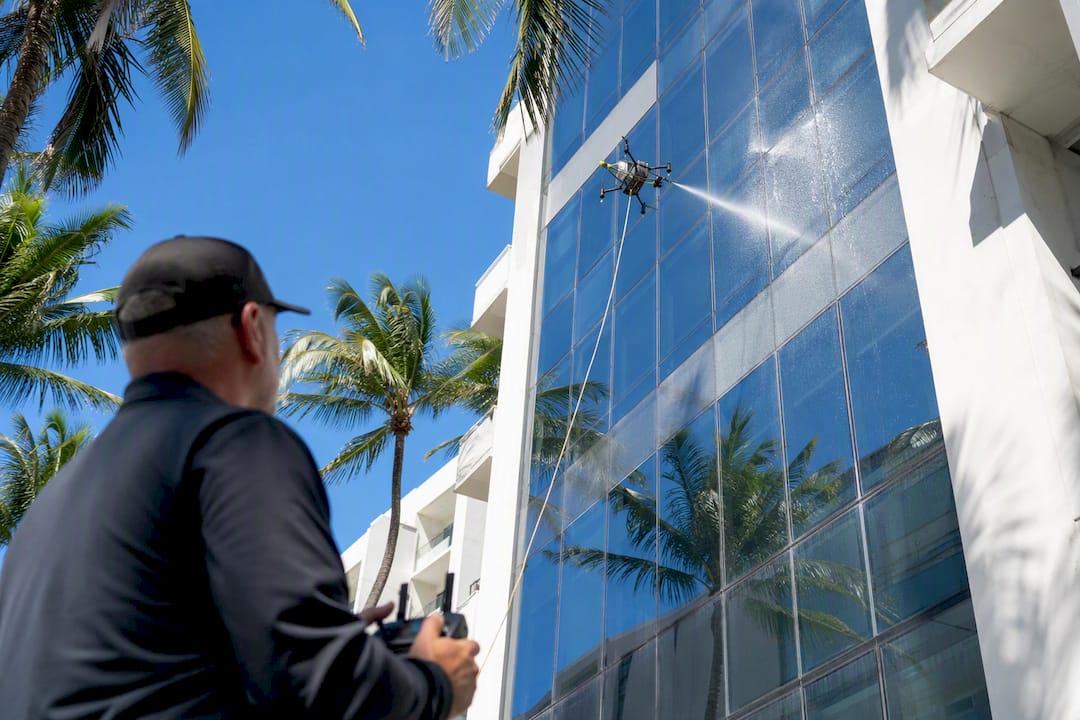
For most South Florida high-rises, hiring a professional crew beats any in-house or handyman approach on safety, speed, and cost, and for glass façades with moderate heights, a drone-first method now competes directly with traditional powered platforms. Contractors should follow OSHA powered-platform rules and the ANSI/IWCA I-14.1 standard, and Vistadronecleaning’s ground-based drone crews are one proof point of how that compliance looks in practice.
| Method | Best For | Access Type | Safety Credentials | Insurance | Price Method |
|---|---|---|---|---|---|
| Vista Drone Cleaning | Glass façades, delicate cladding, fast turnarounds | Tethered industrial drone | FAA Part 107, OSHA-aware ops | $2M general liability | Per façade area / per project |
| BMU / powered platform contractors | Towers with built-in permanent access systems | BMU, suspended platform | OSHA 1910.66, PE-signed designs | Varies by contractor | Per project |
| Rope access / RDS specialists | Spot repairs, sealant work, no BMU | Rope descent system | SPRAT/IRATA certification | Varies by contractor | Per project |
| Boom lift / aerial lift contractors | Low-rise sections, rooftop staging | Boom lift, mobile platform | OSHA aerial lift training | Varies by contractor | Per hour / per project |
Before signing anything, do three things: confirm insurance and bonding in writing, ask for a written safety plan, and request photos from a similar South Florida project. Then book a free site survey to get an actual estimate instead of a phone guess.
Key Takeaways
Professional high-rise window cleaning in South Florida works best when the access method (drone, BMU, rope, or lift) is matched to the building’s façade and safety requirements are verified before hiring.
| Point | Details |
|---|---|
| Verify safety documentation first | Require proof of insurance, a written safety plan, and OSHA/ANSI-IWCA alignment before any bid is accepted. |
| Match method to façade | Drones suit glass and fragile cladding; BMUs suit towers with permanent access systems already installed. |
| Budget around access complexity | Access method and façade surface area drive most of the total project cost. |
| Expect a five-stage timeline | Site survey, proposal, permitting, mobilization, and cleaning typically span one to two weeks. |
| Consider drone cleaning for speed | Vistadronecleaning completes most South Florida projects in one to three days without scaffolding or rooftop rigging. |
Table of Contents
- High Rise Window Cleaning Denver-Style Projects: How the Process Works in South Florida
- Which Access Method Fits Your Building?
- What Safety Standards Should Your Contractor Follow?
- Why Hire a Professional Instead of Cutting Corners?
- How to Evaluate and Hire a High-Rise Window Cleaning Contractor
- What Does High-Rise Window Cleaning Cost, and How Long Does It Take?
- Quick Screening Checklist Before You Hire
- Are Drones a Real Alternative for High-Rise Facades?
- A Note From the Field
- Get a Free Site Survey for Your Building
- Where to Verify Safety Standards
- Sources
- FAQ
High Rise Window Cleaning Denver-Style Projects: How the Process Works in South Florida
A typical high-rise cleaning job follows five stages, and skipping any of them is how budgets and timelines fall apart.
- Site survey. The contractor walks the property, documents façade material (glass, EIFS, stucco, metal), checks for an existing BMU, and notes roof staging options.
- Written proposal. You should receive a scoped, itemized quote naming the access method, timeline, and safety plan, not a verbal ballpark.
- Permitting and coordination. Rooftop access, tenant notices, and any required city permits get lined up before mobilization.
- Mobilization and cleaning. Equipment arrives, crews stage on the roof or ground, and work proceeds within approved wind and weather windows.
- Final inspection and handover. You walk the property with the crew lead and sign off, ideally with before/after photo documentation.
Site survey checklist: confirm the contractor checks façade substrate, counts and maps windows or panels, verifies BMU presence or absence, evaluates rooftop staging space, and flags any tenant-notice requirements before quoting.
Which Access Method Fits Your Building?
For most South Florida glass towers under 200 feet, tethered industrial drones eliminate rooftop rigging and cut the tenant disruption that comes with scaffolding or lift staging. Buildings with a factory-installed BMU or continuous mullion guide system typically benefit from using the permanent equipment, since it is engineered for the façade.
- Drone (tethered industrial drone): No rigging, minimal rooftop footprint, works well on glass and most claddings. Limited by high wind and very intricate façade geometry.
- BMU / permanent powered platform: Built for the building, handles tall continuous runs well. Requires professional-engineer-signed maintenance and periodic stabilization checks.
- Suspended platform (two-point): Flexible for buildings without a BMU. Needs certified anchors and strict stabilization intervals.
- Rope access / RDS: Efficient for spot repairs and sealant work. Not economical for whole-building window runs.
- Boom lift / aerial lift: Solid for low-rise sections or rooftop-level work. Limited reach on true high-rises.
| Façade Feature | Preferred Method |
|---|---|
| Continuous mullion guide rails | BMU / powered platform |
| Fragile or textured cladding | Drone or custom BMU procedure |
| No permanent access system | Drone or rope access |
| Isolated repair or resealing | Rope access / RDS |
| Roof-to-mid-level only | Boom lift |
Pro Tip: Ask any bidder which method they’d use on your specific façade and why. A contractor who defaults to one method regardless of building type is fitting your job to their equipment, not the other way around.
What Safety Standards Should Your Contractor Follow?
Insist on OSHA and ANSI/IWCA-aligned practices, plus a written emergency plan, before signing anything. OSHA’s powered platforms standard governs permanently installed equipment under 29 CFR 1910.66 and requires professional-engineer-designed supports. For suspended platforms without a BMU, OSHA’s building anchor guidance sets stabilization at intervals not exceeding three floors or a similar vertical spacing, and caps powered platform use at wind speeds above safe manufacturer thresholds. The ANSI/IWCA I-14.1 standard remains the industry benchmark that building owners and OSHA enforcement both reference for window cleaning safety.
Bid requirements checklist:
- Professional-engineer-signed anchor or BMU design where applicable
- Documented stabilization intervals matching OSHA spacing rules
- Fall protection equipment and a dedicated safety monitor
- Written wind limits and a weather-hold policy
- Training records for competent persons, or SPRAT/IRATA certification if rope access is used
Trust-signal checklist: proof of general liability and workers’ comp insurance, a written safety plan, a documented emergency rescue procedure, staff certifications, and photos from comparable South Florida projects.
| Requirement | Why It Matters |
|---|---|
| PE-signed designs | Confirms anchors and platforms meet load and structural standards |
| Stabilization intervals | OSHA caps intermittent stabilization at 3 floors |
| Wind limits | Prevents unsafe operation above manufacturer or OSHA thresholds |
| Rescue plan | Required for any suspended or rope-based access method |
Why Hire a Professional Instead of Cutting Corners?
A professional crew reduces liability, protects your façade finish, and often catches problems before they become expensive. Routine cleaning frequently surfaces early signs of water intrusion or failed sealant long before those issues show up as interior damage.
- Better curb appeal for tenants, buyers, and hotel guests
- Early detection of façade deterioration during routine service
- Documented compliance that protects you in an insurance claim
- Less staff time managing DIY equipment or unlicensed labor
- Lower long-term capital costs versus deferred maintenance
Pro Tip: Unqualified vendors that skip a written safety plan often cost more in downtime and liability exposure than they save on the invoice.
How to Evaluate and Hire a High-Rise Window Cleaning Contractor
Score every bid across five categories: safety documentation, method fit for your façade, insurance, references, and completeness of the written proposal.
- Request documents first. Certificate of insurance, written safety plan, emergency rescue plan, equipment list, and training certifications.
- Confirm method fit. Ask why they’re proposing drone, BMU, rope access, or lift work for your specific building.
- Check references. Ask for photos or contacts from a similar South Florida project, not just a portfolio link.
- Verify engineering sign-off. Any BMU or anchor-based design should carry a professional engineer’s stamp.
Questions to ask on the first call:
- What are your wind limits, and who decides when to hold work?
- How is anchor spacing determined for this building?
- What’s your emergency rescue plan if a technician needs assistance?
- Do you use an anemometer on-site to monitor real-time wind conditions?
Red flags: no written safety plan, no PE-signed engineering for BMU work, reluctance to share insurance certificates, or pressure to proceed despite unsafe wind conditions.
What Does High-Rise Window Cleaning Cost, and How Long Does It Take?
Three factors drive most of the price: access method, façade complexity, and building height. A façade access consultant’s assessment often accounts for roughly half the total project cost and complexity, so confirming the access plan before signing prevents scope creep later.
- Access method (drone typically runs lower than BMU or rope mobilization)
- Total façade surface area and window count
- Roof staging and mobilization requirements
- Permitting and any tenant coordination needs
- Environmental controls like bird netting
- Frequency (one-time versus scheduled maintenance)
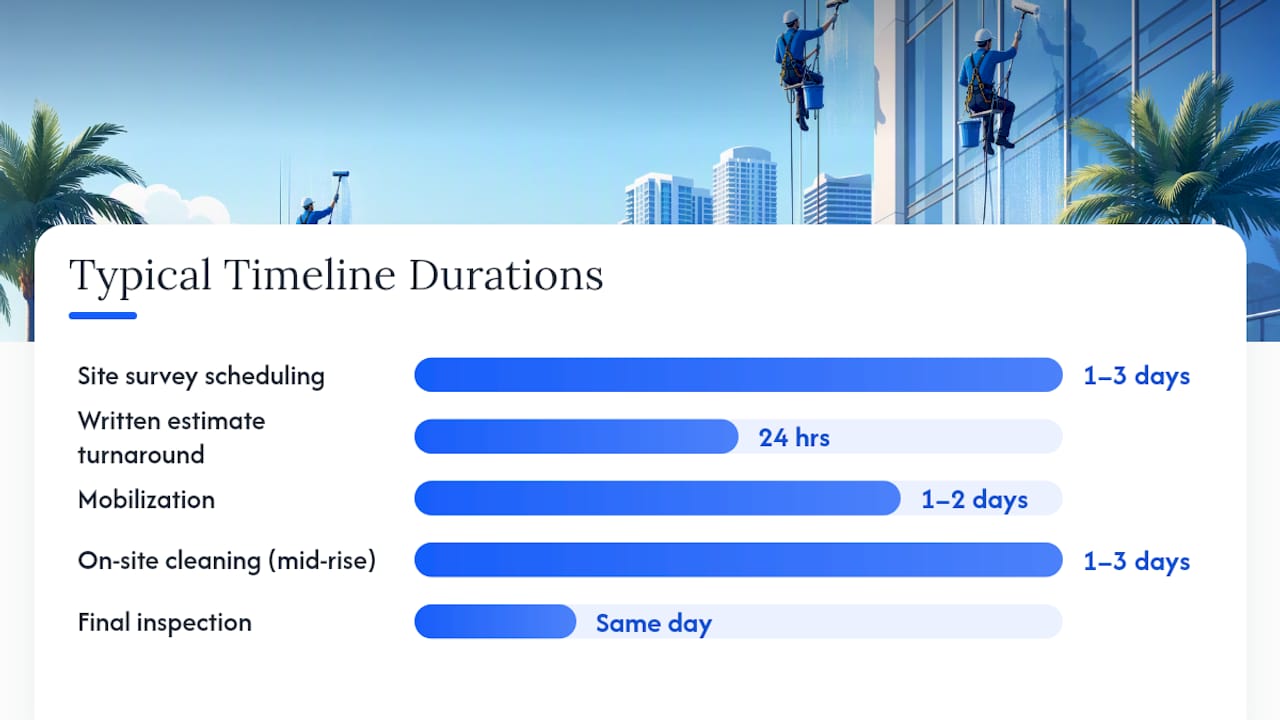
| Timeline Stage | Typical Duration |
|---|---|
| Site survey scheduling | 1 to 3 business days |
| Written estimate turnaround | 24 hours |
| Mobilization | 1 to 2 days |
| On-site cleaning (mid-rise) | 1 to 3 days |
| Final inspection | Same day as completion |
Weather windows matter more in South Florida than most regions: drone operations typically pause in higher wind and rain, while suspended platforms follow the OSHA 25 mph threshold and additional ANSI I-14 stabilization requirements above 130 feet.
Quick Screening Checklist Before You Hire
Ask for documentation before you even discuss site access. If a contractor hesitates on paperwork, that’s the answer right there.
Fast-call checklist: insurance certificate number, access method proposed, technician training records, anchor or tether details, and PE sign-off if BMU work is involved.
Red flags that should stop a hire:
- Evasive or slow to provide insurance proof
- No written emergency rescue plan
- No photos or references from local South Florida projects
- Unwilling to delay work for unsafe wind conditions
- Refuses to put the estimate in writing
Pro Tip: Ask for the actual certificate number on their insurance policy and call the carrier to confirm it’s active. It takes five minutes and eliminates most of the risk.
Are Drones a Real Alternative for High-Rise Facades?
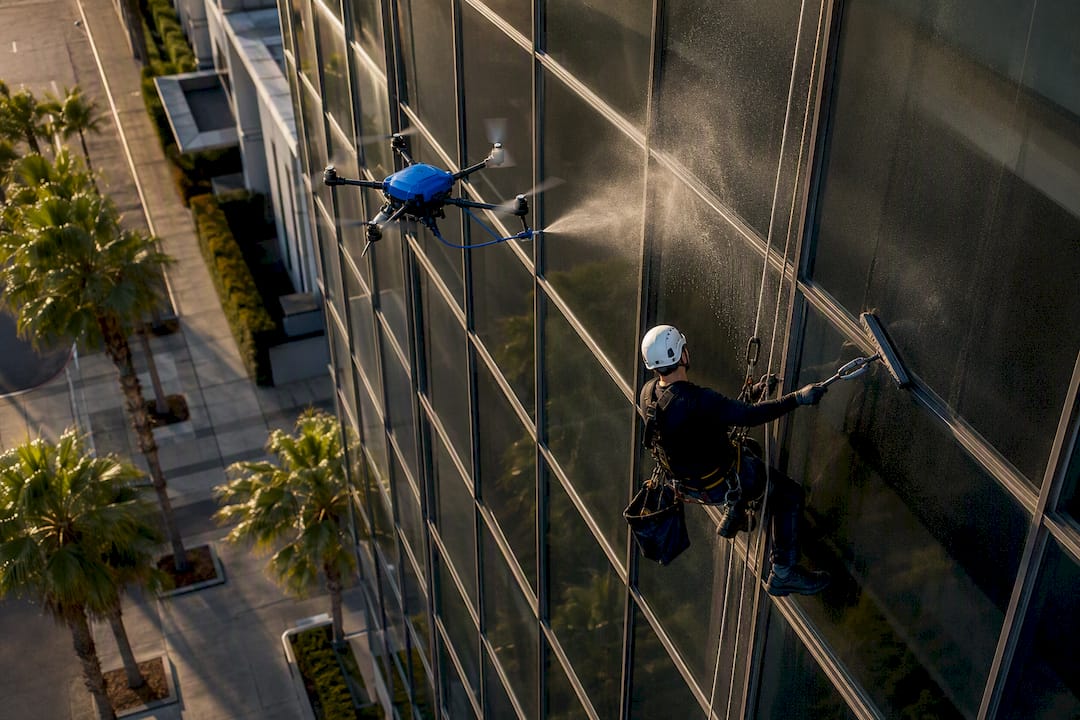
Drone cleaning is a genuinely capable option for many South Florida façades, but it isn’t a fit for every building. Tethered industrial drone systems excel on fragile cladding, buildings needing quick maintenance cycles, and façades that are expensive or slow to stage with traditional rigging. They’re less suited to complex BMU-only towers or jobs requiring heavy rigging and sealant replacement.
- Fragile or textured cladding where scaffolding risks damage
- Quick, repeatable maintenance cycles for glass towers
- Façades that are hard or costly to stage traditionally
Pilots must hold FAA Part 107 certification, and industrial-class systems still face real limits: wind, battery life, vertical reach, and tether requirements all shape which jobs a drone can safely handle.
A Note From the Field
Drone-based cleaning now handles the majority of glass façade work Vistadronecleaning sees across Miami-Dade and Broward, mainly because it skips the rigging delays that slow traditional jobs down. My standing recommendation to every property manager: always require a site survey and, for any BMU-based bid, insist on a professional-engineer-signed plan before you sign anything.
Get a Free Site Survey for Your Building
If you’re comparing BMU contractors, rope access crews, or boom lift operators for your South Florida property, there’s a faster route worth considering. Vistadronecleaning operates FAA Part 107 certified drones that clean glass, EIFS, stucco, and metal façades up to 200 feet without scaffolding, rooftop rigging, or road closures, and most projects wrap in one to three days at 30 to 60 percent lower cost than traditional scaffold or lift methods.
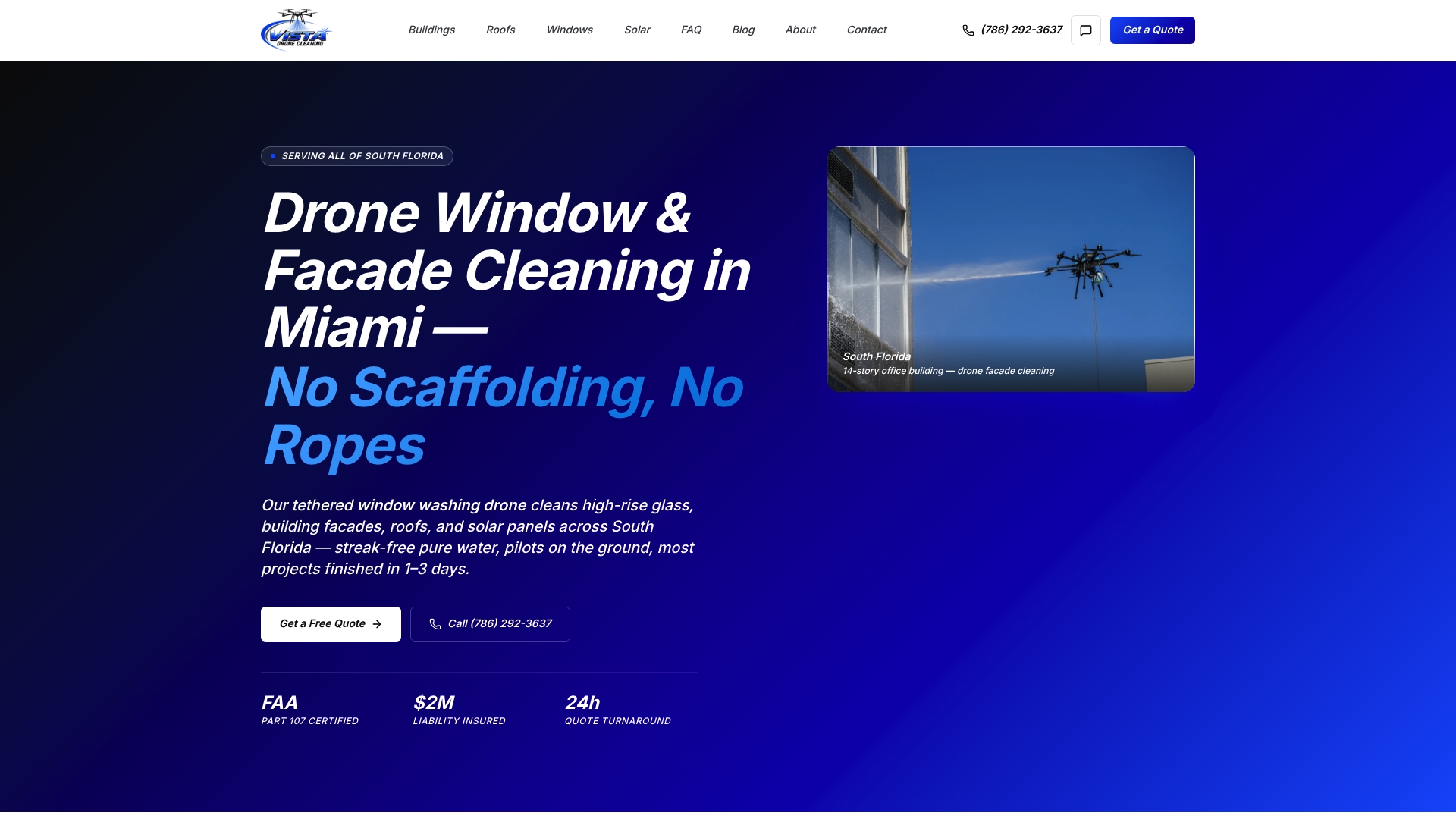
That cost and speed advantage comes directly from skipping mobilization: no crane rental, no multi-day rooftop staging, no permit delays tied to suspended platform rigging. Crews stay on the ground the entire job, backed by $2M liability insurance and streak-free pure de-ionized water rinses. Compare the trade-offs yourself on the drone versus traditional cleaning breakdown, or skip straight to requesting a quote through the Miami high-rise window cleaning page. Quotes typically come back within 24 hours of a site review.
Where to Verify Safety Standards
Consult OSHA’s powered platforms guidance and the ANSI/IWCA I-14.1 window cleaning safety standard directly before accepting any contractor’s safety claims.
Sources
FAQ
How Much Does High-Rise Window Cleaning Cost?
Pricing depends on access method, façade complexity, and building height, with drone-based cleaning often less expensive than traditional scaffold or lift methods for comparable South Florida projects.
How Do You Clean Windows That Are Too High to Reach Safely?
Contractors use BMUs, suspended platforms, rope access systems, boom lifts, or tethered industrial drones, choosing the method based on façade material, building height, and whether a permanent access system already exists.
What Are High-Rise Window Cleaners Called?
They’re typically called high-rise or commercial window cleaning technicians, and those using rope descent systems are often SPRAT or IRATA certified rope access technicians.
What Should I Ask Before Hiring a High-Rise Window Cleaning Contractor?
Ask for proof of insurance, a written safety plan, an emergency rescue plan, and photos from a comparable South Florida project before requesting a final quote.
Is Drone Window Cleaning Safe for Tall Buildings?
Yes, when performed by FAA Part 107 certified pilots using tethered industrial drones designed for façade work, drone cleaning avoids the rooftop rigging risks associated with traditional suspended platforms.