What Sustainable Commercial Building Maintenance Really Means
Discover how sustainable commercial building maintenance enhances efficiency, cuts costs, and protects occupant health while boosting asset value.
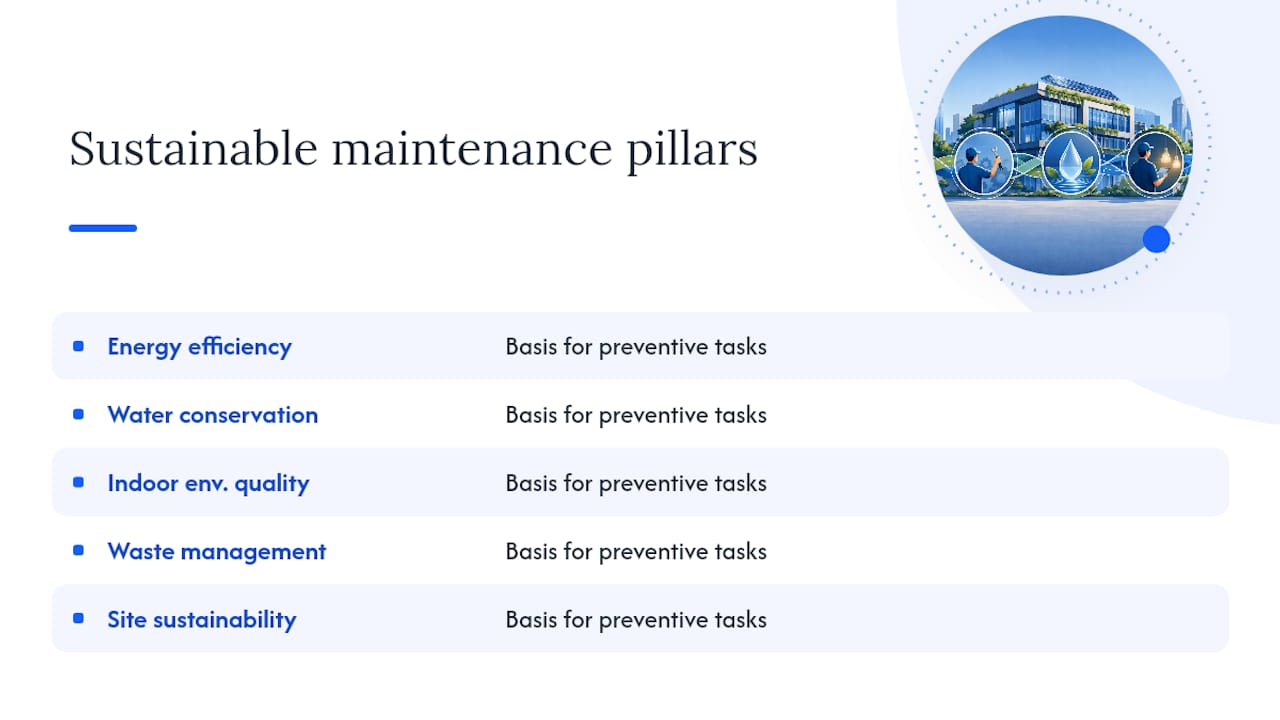
Sustainable commercial building maintenance is the ongoing practice of operating a property’s energy, water, indoor air, waste, and site systems in ways that cut resource use, protect occupant health, and preserve asset value over time. It rests on five pillars: energy efficiency, water conservation, indoor environmental quality (IEQ), waste diversion, and site stewardship. Get those five right, and operating costs drop while your building holds its value against tighter South Florida energy codes and insurance scrutiny.
Three moves start the shift immediately:
- Benchmark now. Register the property in ENERGY STAR Portfolio Manager to establish a baseline energy and water score.
- Walk the building. Schedule a preventive maintenance walkthrough this month, checking HVAC, envelope, and plumbing against a documented checklist.
- Meter what matters. Start a submetering plan for cooling towers, irrigation, and major HVAC loads so waste shows up in the data, not just the utility bill.
Frameworks like LEED O+M from USGBC and ASHRAE’s operational standards give this work a structure, rather than a pile of good intentions.
Key Takeaways
Sustainable commercial building maintenance works when energy, water, IEQ, waste, and site systems are measured, documented, and assigned to a specific owner rather than handled reactively.
| Point | Details |
|---|---|
| Start with benchmarking | Register the property in ENERGY STAR Portfolio Manager before setting any efficiency targets. |
| Fix cheap items first | LED retrofits and controls tune-ups typically pay back in under two years, before capital projects. |
| Meter water separately | Submeter cooling towers and irrigation to catch waste that a single utility bill hides. |
| Document preventive maintenance | Assign system owners and log completed work for auditability, per BOMA BEST and LEED guidance. |
| Consider drone exterior cleaning | Vistadronecleaning cleans facades, windows, and solar arrays without scaffolding, cutting water use and site disruption in South Florida. |
Table of Contents
- Energy Efficiency Maintenance: HVAC, Lighting, and Controls
- Water Efficiency Maintenance: Leaks, Fixtures, Irrigation, and Cooling Towers
- Indoor Environmental Quality: Ventilation, Filtration, and Occupant Comfort
- How Do You Run a Waste Stream Audit for a Commercial Building?
- Site Sustainability: Landscape, Stormwater, and Transportation
- Preventive Maintenance Governance: Who Owns What and When
- How Do You Measure and Benchmark Sustainable Maintenance Performance?
- Which Technologies Support Sustainable Facility Operations?
- Procurement Standards for Sustainable Cleaning Materials
- Sustainable Exterior Cleaning: A South Florida Case in Point
- Implementation Roadmap: What to Do First, Next, and Later
- The Bottom Line on Sustainable Maintenance
- Indoor Plants and Biophilic Design: Maintenance That Pays Off Twice
- Training Facility Staff to Actually Change Behavior
- Budgeting for Sustainable Maintenance Over the Building’s Life
- Sources
- FAQ
Energy Efficiency Maintenance: HVAC, Lighting, and Controls
Energy typically represents the largest controllable slice of a commercial building’s operating budget, and buildings account for a substantial share of U.S. energy consumption overall. HVAC maintenance moves the needle fastest. Replace filters on a fixed schedule rather than waiting for pressure alarms, verify economizers actually open during South Florida’s cooler months, clean condenser coils twice a year given the salt-laden air near the coast, and tune variable frequency drives so fans and pumps aren’t running full-speed for a half-load. Lighting comes next: LED retrofits paired with occupancy sensors in stairwells, garages, and back-of-house areas often pay for themselves faster than any other single upgrade. Controls round it out, meaning setpoint audits every quarter and schedule optimization so systems aren’t conditioning empty floors at 2 a.m.
Pro Tip: Do the cheap stuff first. Thermostat recalibration and sensor-based lighting usually deliver noticeable savings within a single billing cycle, while chiller replacement or envelope upgrades take years to pay back. Sequence your capital plan around that gap.
South Florida buildings fail in predictable ways:
- Corroded coils from salt air that go unnoticed until capacity drops
- Stuck or disconnected economizer dampers running full mechanical cooling year-round
- Controls sequences bypassed by a technician years ago and never restored
- Duct leakage in older buildings pushing conditioned air into ceiling plenums instead of occupied space
| Measure | Upfront cost | Energy/carbon reduction | Occupant disruption | Payback period |
|---|---|---|---|---|
| LED + occupancy sensors | Low | Moderate | Minimal | Under 2 years |
| Controls/setpoint tune-up | Low | Moderate to high | None | Under 1 year |
| Coil cleaning and VFD tuning | Low to moderate | Moderate | None | 1 to 2 years |
| Chiller or rooftop unit replacement | High | High | Moderate | 7 years |
| Envelope/window upgrades | High | High | High | 10 years |
Every fixed HVAC issue shows up in your ENERGY STAR score, which is exactly the kind of documented improvement that matters when a building goes up for sale or refinance.
Water Efficiency Maintenance: Leaks, Fixtures, Irrigation, and Cooling Towers
Water waste hides easily in a commercial building until the bill lands, and in South Florida the combination of irrigation demand, cooling tower evaporation, and aging pipe runs makes water auditing worth treating as its own discipline, not an afterthought bolted onto energy work.
Meter placement determines whether you can even see the problem:
- Main water meter with a data logger for trend tracking
- Cooling tower submeter to isolate makeup water and blowdown volumes
- Irrigation submeter, separated from domestic use
- Domestic hot water submeter in larger multi-tenant properties
Cooling towers and irrigation systems need their own maintenance rhythm:
- Test water treatment chemistry weekly to prevent scale and Legionella risk
- Inspect drift eliminators quarterly and optimize blowdown cycles to cut makeup water waste
- Install smart irrigation controllers tied to evapotranspiration data instead of fixed timers
- Audit sprinkler heads and drip lines for South Florida’s afternoon-storm patterns that make daytime irrigation wasteful
Humidity and salt air accelerate pipe corrosion, so quarterly leak inspections catch what an annual walk-through misses. The EPA’s commercial water assessment checklist offers a solid inspection framework, and federal water-resource data underscores why conservation carries more than a cost-savings argument in a region with documented water-supply pressures.
Indoor Environmental Quality: Ventilation, Filtration, and Occupant Comfort
Indoor air quality maintenance is where sustainability and tenant retention overlap most directly. ASHRAE’s ventilation and filtration guidance sets the technical baseline, and skipping it doesn’t just risk complaints. It risks lease renewals in a South Florida office and retail market where tenants increasingly ask property managers about air quality before signing.
Practical monitoring needs a defined cadence, not a reactive one:
- Replace filters on manufacturer schedule, tightened during pollen season and after major renovations
- Verify outdoor air ventilation rates annually against design specifications
- Monitor CO2 levels in conference rooms and high-occupancy areas with continuous sensors
- Schedule duct inspection and cleaning every 3 to 5 years, sooner in coastal buildings with higher mold risk from humidity infiltration
- Track relative humidity continuously; South Florida’s climate pushes systems toward the upper end of comfort ranges if dehumidification isn’t tuned correctly
Pro Tip: Energy-saving setpoints and occupant comfort pull in opposite directions if you’re not careful. Widening a temperature deadband to save energy in a mixed-use building can spike humidity complaints on the retail floor even while office tenants stay comfortable. Model setpoint changes by zone, not building-wide.
WBDG’s operational guidance recommends automated monitoring specifically because manual IAQ checks tend to happen only after someone complains, by which point the problem has usually been building for weeks.
How Do You Run a Waste Stream Audit for a Commercial Building?
A waste stream audit follows five steps: define scope, sample representative loads, measure by weight or volume, establish a baseline, and set a diversion target against that baseline. Skip the baseline step and every “improvement” claim afterward is just a guess.
- Define scope: which tenants, floors, or waste streams get audited
- Sample waste over a representative week, not a single low-volume day
- Measure and categorize by material type: paper, cardboard, food waste, glass, metal, hazardous
- Establish the baseline diversion rate as a percentage of total waste by weight
- Set a target and a review date, typically 12 months out
TRUE certification treats 90% diversion from landfill and incineration as the zero-waste threshold, which is an aggressive but increasingly common benchmark for commercial portfolios pursuing sustainability credentials.
Maintenance-specific waste reduction rarely gets the same attention as tenant recycling programs, but it should:
- Recycle spent lamps and ballasts through certified take-back programs rather than standard trash
- Reuse or donate furniture, fixtures, and equipment (FFE) during renovations instead of landfilling
- Store and dispose of hazardous maintenance materials, solvents, refrigerants, and used oils, through licensed handlers
Site Sustainability: Landscape, Stormwater, and Transportation
Site-level maintenance choices affect stormwater volume and chemical runoff more than most facility teams realize, especially on properties near canals or coastal waterways.
- Replace high-water turf with native or drought-tolerant plantings that need less irrigation
- Install permeable paving in low-traffic parking areas to reduce runoff volume
- Add bioswales along parking perimeters to filter runoff before it reaches storm drains
- Inspect storm drains quarterly, more often during hurricane season, to prevent debris blockage
Pro Tip: Schedule exterior cleaning and pressure washing away from rain events, and use containment mats plus biodegradable chemistries near drains. Uncontained runoff from a facade cleaning job can undo months of stormwater management work in one afternoon.
Preserve EV charger uptime and bicycle parking as maintenance line items, not afterthoughts, and look for opportunities to convert underused asphalt into permeable surface during any parking lot resurfacing project.
Preventive Maintenance Governance: Who Owns What and When
Sustainable maintenance fails when it depends on one person remembering to check something. It works when roles are assigned and documented. LEED’s operations guidance calls this the integrative team approach: owners, facility managers, tenants, and service vendors each hold a defined piece of the plan, with clear escalation when something gets missed.
| System | Maintenance frequency | Primary owner |
|---|---|---|
| HVAC (filters, coils, controls) | Monthly to quarterly | Facilities team / HVAC vendor |
| Lighting and sensors | Quarterly | Facilities team |
| Building envelope and facade | Semiannual | Facade vendor / property manager |
| Plumbing and water systems | Monthly | Facilities team / plumbing vendor |
| Roofing | Semiannual, plus post-storm | Roofing vendor / property manager |
Stakeholder responsibilities need to be written down, not assumed:
- Property owners approve capital budgets tied to maintenance findings
- Facility managers own the PM schedule and vendor coordination
- Tenants report comfort or air quality issues through a documented channel
- Vendors log completed work with dates, findings, and follow-up items for auditability
BOMA BEST guidance ties this cadence to ASHRAE Standard 180 for HVAC inspection specifically, which gives auditors and insurers a recognized reference point rather than an internal-only checklist.
How Do You Measure and Benchmark Sustainable Maintenance Performance?
Measurement turns maintenance from a cost center into a documented performance record. Start with the audit itself:
- Conduct a walk-through audit annually at minimum
- Escalate to an ASHRAE-level energy audit every 3 to 5 years, or after major system replacements
- Bring in a professional auditor for investment-grade analysis before large capital decisions, following DOE’s guidance on audit tiers
- Log findings against the prior baseline, not just against industry averages
Five KPIs cover most of what a sustainability-minded facility team needs to track:
- Energy use intensity (kBtu per square foot)
- Water use intensity (gallons per square foot)
- Waste diversion rate (percentage by weight)
- Equipment uptime (percentage of scheduled availability)
- Preventive maintenance completion rate (percentage of scheduled tasks closed on time)
ENERGY STAR Portfolio Manager remains the standard tool for tracking these figures across a portfolio, and it’s increasingly tied to municipal benchmarking ordinances that require public disclosure of building performance scores.
Which Technologies Support Sustainable Facility Operations?
Sensors only earn their cost when they’re pointed at the right failure points. Prioritize deployment in this order:
- Whole-building and submetering for energy and water
- HVAC vibration and temperature sensors on critical equipment
- Humidity and CO2 sensors in occupied zones
- Water flow sensors on cooling towers and major risers
- Production monitors on rooftop solar arrays to catch output drops early
A Building Management System (BMS) centralizes control of HVAC, lighting, and access systems. Fault detection and diagnostics (FDD) software layers on top, flagging abnormal equipment behavior before it becomes a service call. BIM and digital twin models extend this further, giving facility teams a live, spatial reference for every asset and its maintenance history.
Pro Tip: More sensors isn’t automatically better. Deploy the minimum telemetry needed to answer a specific operational question first. A building drowning in unreviewed sensor data is barely different from one with no sensors at all.
Procurement Standards for Sustainable Cleaning Materials
Green procurement language belongs in every service contract, not just the ones labeled “sustainable.” Require low-VOC formulations, biodegradability data, concentrate-based products to cut packaging waste, and documented disposal procedures for anything hazardous.
Ask vendors to show certifications rather than take claims at face value:
- EPA Safer Choice label or equivalent
- Green Seal certification
- Third-party safety data sheets on request, not just marketing claims
Pro Tip: Store hazardous maintenance materials in climate-controlled areas away from South Florida’s heat and humidity swings, which degrade many chemical formulations faster than manufacturer shelf-life estimates assume.
EPA’s green building resources note that cleaning product choices directly affect indoor air quality, connecting procurement decisions back to the IEQ maintenance work covered earlier.
Sustainable Exterior Cleaning: A South Florida Case in Point
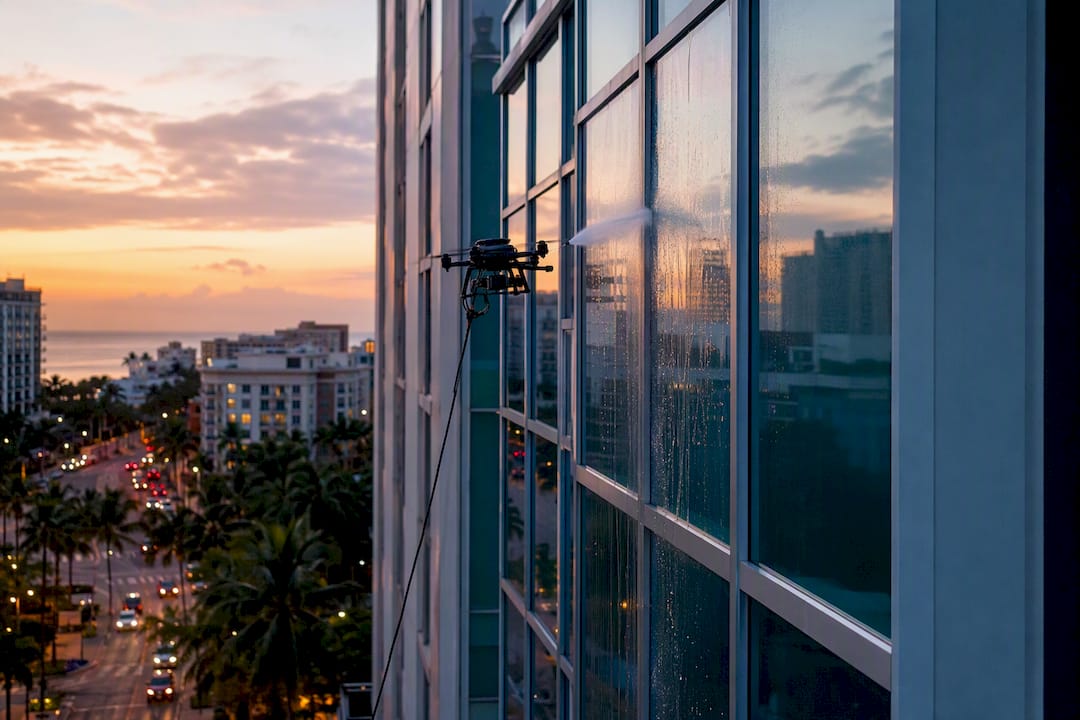
Traditional facade and window cleaning on a high-rise usually means scaffolding rigs, boom lifts, or rope-access technicians, plus road closures for street-level equipment staging. Vistadronecleaning has run drone-based cleaning on Miami and Fort Lauderdale properties using FAA Part 107 certified pilots and tethered industrial drones, cleaning facades, windows, and rooftop solar arrays without any of that ground infrastructure.
The operational difference shows up most on properties with tight setbacks or active retail at street level, where lift staging would otherwise shut down a sidewalk or loading zone for days. Pure de-ionized water rinsing also means no chemical runoff concern near storm drains, and salt-air corrosion on rope-access rigging simply isn’t a factor when the crew stays on the ground.
Vendor vetting for this category should include a specific checklist:
- FAA Part 107 pilot certification, not just drone ownership
- $2M liability insurance minimum
- Documented pure-water or de-ionized rinse chemistry
- Before-and-after 4K photo or video documentation
- Substrate-matched soft-wash chemistry for glass, EIFS, stucco, or metal
Implementation Roadmap: What to Do First, Next, and Later
Sustainable maintenance rolls out in phases, not all at once, and each phase has a different owner.
0 to 3 months: Benchmark the building in ENERGY STAR Portfolio Manager, run a walk-through audit, and fix low-cost items: filter schedules, setpoint corrections, lighting sensor gaps. Facility manager owns this phase directly.
3 to 12 months: Complete a professional energy audit if the building hasn’t had one in five years, install priority submeters, and launch a waste stream audit. Property owner approves audit budget; facility manager executes.
- Filter and coil maintenance program formalized
- Submetering installed on cooling towers and irrigation
- Waste audit baseline established
- Green cleaning procurement language added to vendor contracts
1 to 3 years: Tackle capital projects with longer paybacks: chiller replacement, envelope improvements, rooftop solar cleaning contracts to protect panel output. Owner and facility manager co-approve based on audit findings.
- LED retrofit: typically under 2 years payback
- Controls tune-up: typically under 1 year payback
- Cooling tower optimization: 1 to 3 years payback
- Rooftop solar cleaning: protects existing production, avoiding output losses that show up as reduced generation revenue
Check with your local utility for rebate programs before committing to capital equipment, and look into PACE financing options, which several South Florida counties support for qualifying efficiency upgrades.
The Bottom Line on Sustainable Maintenance
Get these three pillars right and the payoff compounds: lower operating costs, healthier occupants, and a building that holds its value against tightening energy codes.
- Run the ENERGY STAR audit this quarter
- Update your preventive maintenance plan with assigned owners
- Register the building in Portfolio Manager before your next capital budget cycle
Indoor Plants and Biophilic Design: Maintenance That Pays Off Twice
Biophilic design, incorporating living plants and natural materials into commercial interiors, has moved from lobby décor to a documented occupant wellness strategy, but it only works with a real maintenance plan behind it. Dead or poorly maintained plantings undercut the wellness message they’re supposed to send.
Living walls and interior plantscapes need watering schedules matched to each species, not a blanket weekly routine, since overwatering in humid South Florida buildings can trigger mold growth in planters faster than in drier climates. Drainage systems require quarterly inspection to prevent water pooling that damages flooring or subfloor materials. Pruning and pest management should follow a documented cadence, ideally handled by a horticultural vendor rather than general janitorial staff, since improper pruning stresses plants and shortens their lifespan.
Lighting matters as much as watering. Interior plantings positioned away from natural light need supplemental grow lighting, which adds a small but real energy line item that should get factored into the building’s overall energy intensity tracking rather than treated as a rounding error.
The maintenance payoff extends beyond aesthetics. Well-maintained biophilic elements support the same tenant retention and occupant satisfaction goals as IAQ programs, and several LEED and WELL certification pathways award credit for documented living plant maintenance programs. Treat it as a maintenance line item with a schedule and a budget, not a one-time installation.
Training Facility Staff to Actually Change Behavior
Sustainable maintenance systems fail more often from skipped steps than from bad equipment. A filter replacement schedule means nothing if the technician doesn’t follow it, and a smart irrigation controller delivers no savings if someone overrides it back to manual mode after the first complaint.
Training programs need to go beyond a one-time orientation. Effective ones include:
- Quarterly refreshers on updated equipment and control sequences, not just a single onboarding session
- Hands-on walkthroughs of BMS dashboards so staff can interpret alerts instead of ignoring them
- Clear escalation protocols so a technician who spots a problem knows exactly who to notify and how fast
- Incentive structures tied to documented preventive maintenance completion rates, not just emergency response speed
WBDG’s operational guidance specifically calls out staff training in sustainable principles as a distinct maintenance practice, separate from the technical work itself. That distinction matters in practice: a facility team that understands why a setpoint change saves energy is far less likely to quietly override it than one that was just handed a new number without context.
Behavior change sticks best when staff see the data. Posting monthly energy and water intensity trends where the maintenance team can see them, rather than burying that information in a manager’s spreadsheet, turns abstract sustainability goals into a number people actually track.
Budgeting for Sustainable Maintenance Over the Building’s Life
Lifecycle cost analysis compares the total cost of owning and maintaining a system, purchase price plus energy, water, repairs, and eventual replacement, rather than just the sticker price on a new unit. A cheaper HVAC unit with a lower purchase cost often loses that advantage within five years once elevated energy use and more frequent repairs are factored in.
Building a sustainable maintenance budget means separating three cost categories: routine preventive maintenance (predictable, recurring), reactive repairs (the cost of skipping preventive work), and capital replacement (long-term, planned around expected equipment life). Most facility budgets underfund the first category and overpay for the second as a direct result.
A useful budgeting practice is reserving a fixed percentage of a system’s replacement cost annually toward its eventual capital replacement, rather than treating replacement as a surprise expense when a chiller finally fails. Pair that with tracking actual maintenance costs per system against the preventive maintenance completion rate KPI covered earlier. Systems with high completion rates and lower reactive repair costs validate the budget; systems where the opposite is true flag where the maintenance plan itself needs revision, not just more money.
South Florida’s climate shortens the effective lifespan of exterior-facing equipment and building envelope components compared to drier regions, which means lifecycle assumptions borrowed from national averages tend to run optimistic here. Build in a shorter replacement cycle for coastal-facing HVAC condensers and facade coatings than a generic national lifecycle table would suggest.
Publisher Perspective: Why Drone Exterior Cleaning Belongs in Your O&M Plan
South Florida’s combination of salt air, storm season, and dense high-rise construction makes exterior maintenance riskier and more disruptive than in most markets. Drone-based cleaning removes the scaffolding and lift staging that used to shut down sidewalks and loading docks for days, and it does so using far less water than traditional pressure-washing rigs.
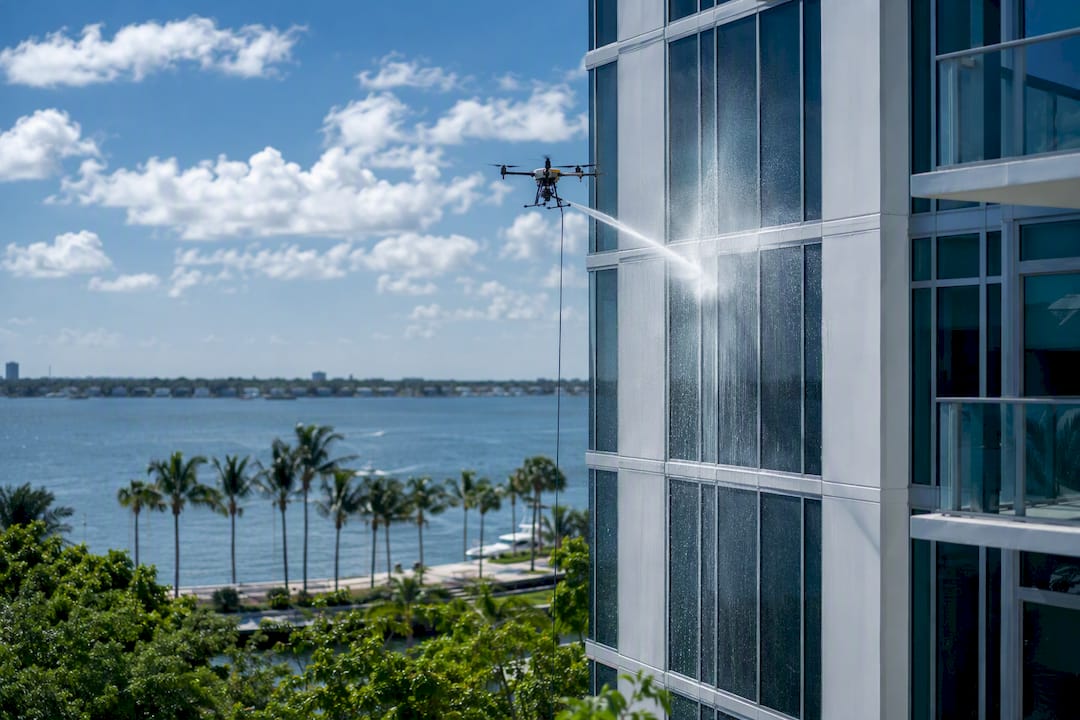
When you’re vetting any exterior cleaning vendor, ask for four things upfront: FAA Part 107 pilot certification, current liability insurance documentation, a description of their water chemistry (pure or de-ionized systems leave no streaking and no chemical runoff concern), and before-and-after photo documentation from a comparable job. A vendor who can’t produce all four on request isn’t ready for a commercial contract.
A Lower-Impact Way to Handle Facade and Solar Cleaning
Scaffolding crews and rope-access technicians work in ways this article has already covered in detail: they get the job done, but they close sidewalks, take longer, and use significantly more water. Vistadronecleaning offers a different route to the same clean facade, and for South Florida high-rises, that route usually wins on speed and disruption. Tethered industrial drones clean windows, facades, roofs, and rooftop solar arrays up to 200 feet without scaffolding or lifts, and most projects wrap in one to three days at 30 to 60% lower cost than traditional methods.

Every job runs on FAA Part 107 certified pilots, $2M liability insurance, and streak-free pure de-ionized water rinsing, backed by before-and-after 4K documentation you can hand straight to ownership or your board. Before hiring any exterior cleaning vendor, run them through this vetting checklist so you know exactly what to ask for.
If you manage a property in Miami-Dade or Broward County and want to see how drone cleaning compares to what you’re currently paying for scaffold or lift-based cleaning, request a free quote for your building and get a site review scheduled within 24 hours.
Sources
- Optimize Operational and Maintenance Practices | WBDG - Whole Building Design Guide
- ENERGY STAR® Portfolio Manager®
FAQ
What Is Commercial Building Maintenance?
Commercial building maintenance is the ongoing upkeep of a property’s mechanical, electrical, plumbing, and structural systems to keep it safe, functional, and operating efficiently. Sustainable maintenance adds resource conservation and occupant health outcomes to those same operational goals.
What Are the Five Key Elements of a Sustainable Building?
The five commonly cited elements are energy efficiency, water conservation, indoor environmental quality, waste management, and site sustainability. Sustainable maintenance programs organize preventive tasks around these five pillars rather than treating each system in isolation.
What Are the 7 Principles of Sustainable Construction?
Definitions vary across organizations, but commonly cited principles include energy efficiency, water conservation, material reuse, waste reduction, indoor environmental quality, sustainable site development, and lifecycle cost consideration. These overlap heavily with the maintenance pillars covered throughout this guide.
How Often Should a Commercial Building Get an Energy Audit?
A walk-through audit should happen annually, with a full ASHRAE-level audit every 3 to 5 years or after major system replacements. Buildings preparing for large capital decisions benefit from an investment-grade audit performed by a professional auditor.
Can Drone Cleaning Support a Sustainable Maintenance Program?
Yes. Vistadronecleaning’s pure de-ionized water rinsing uses less water and no chemical runoff compared to traditional pressure-washing methods, and eliminating scaffolding or lifts reduces site disruption on occupied South Florida properties.