Metal Facade Cleaning: A South Florida Maintenance Guide
Discover essential tips for effective metal facade cleaning in South Florida. Protect your building's exterior from coastal damage today!
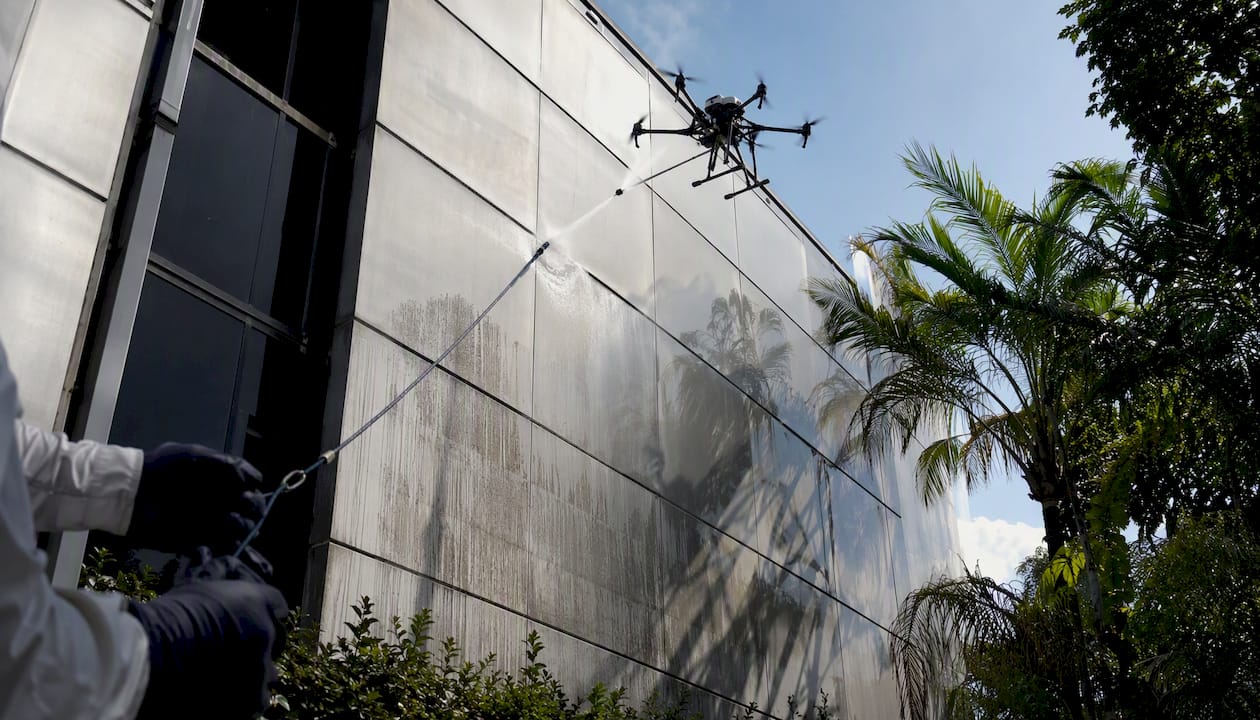
Clean your building’s metal facade with a pH-neutral detergent (pH 5 to 8) and a low-pressure rinse every three to six months if you’re near the coast. Schedule a close-up inspection the moment you spot rust streaking, loose panels, or white deposits around fasteners. That’s the baseline. Everything else in metal facade cleaning builds off that one decision: match the method to the metal, and never let salt air or standing moisture sit on the surface longer than your maintenance calendar allows.
South Florida punishes metal facades faster than almost anywhere else in the country. Salt aerosol drifting off Biscayne Bay, the Atlantic coastline, or the Intracoastal Waterway settles into panel seams and fastener holes, and the wet season plus hurricane season keeps surfaces damp for months at a stretch. Three things protect a metal facade here:
- Inspect twice a year, minimum. Industry guidance backs twice-yearly visual walkthroughs as the floor, not the ceiling, for coastal commercial buildings.
- Clean on an exposure-based schedule, not a calendar guess. Coastal and industrial-adjacent buildings need attention every three to six months, while lower-exposure sites can stretch to 12 to 18 months.
- Call a contractor immediately for loose panels, active corrosion, or any sign of water intrusion behind the cladding.
The standard worth knowing: coatings rated to AAMA 2605 are high-performance fluoropolymer finishes built for a longer outdoor service life than standard acrylic coatings, and that spec alone changes how often you need to touch up paint versus just wash the surface.
Key Takeaways
Metal facade cleaning works when the cleaning method matches the coating, the schedule matches South Florida’s salt and storm exposure, and warning signs get escalated to a professional immediately instead of deferred.
| Point | Details |
|---|---|
| Set an exposure-based schedule | Clean coastal buildings every three to six months, urban buildings every six to twelve months, and inspect visually twice a year regardless. |
| Use the checklist every walk-around | Watch for rust staining, white fastener deposits, cracked sealant, loose panels, and interior water stains. |
| Match chemistry to the metal | Stick to pH-neutral cleaners (pH 5 to 8) below 25°C, and spot-test before any full-elevation clean. |
| Treat corrosion signs immediately | White deposits and rust streaking often mean galvanic corrosion that requires fastener or separator replacement, not just cleaning. |
| Consider drone-assisted access | Vistadronecleaning’s FAA Part 107-certified tethered drone service cleans South Florida facades up to 200-plus feet without scaffolding or lifts, typically in 1 to 3 days. |
Table of Contents
- How Often Should You Clean a Metal Facade in South Florida?
- What Should a Routine Visual Inspection Cover?
- Which Cleaning Method Is Right for Your Facade?
- What Cleaners and Chemicals Are Safe for Metal Facades?
- How Do Coatings and Corrosion Risk Affect Maintenance?
- What Access Method Should You Use for Facade Cleaning?
- How Do You Choose a Facade Cleaning Contractor?
- What Does Metal Facade Cleaning Cost in South Florida?
- What’s a Simple Between-Cleanings Maintenance Routine?
- A Field Perspective on South Florida Facade Maintenance
- How Vista Drone Cleaning Handles Metal Facades in South Florida
- Standards and Guidance Worth Bookmarking
- Sources
- FAQ
How Often Should You Clean a Metal Facade in South Florida?
Exposure decides the schedule, not the calendar year. A high-rise three blocks from the Fort Lauderdale beach and a warehouse facade in inland Broward County are not on the same clock, even if both are clad in the same aluminum composite panel system.
The baseline bands are well established: coastal or industrial-adjacent buildings should get a full wash every three to six months, urban buildings with moderate exposure every six to 12 months, and lower-exposure sites can often go 12 to 18 months between full cleanings. But that’s a starting point, and South Florida has several local factors that push buildings toward the shorter end of every band.
- Direct salt spray: Buildings within a few blocks of the ocean or Intracoastal in Miami Beach, Fort Lauderdale, or Boca Raton accumulate chloride film faster than inland properties.
- Bird activity: Roof lines, ledges, and parapet caps near retail centers or waterfront properties in Aventura and Hollywood often need spot cleaning between full washes.
- Road and construction dust: Properties along heavily trafficked corridors in Miami-Dade collect grit that scratches finishes if it’s not rinsed off before a full clean.
- Landscaping drip lines: Irrigation overspray and sprinkler drift near ground-floor metal panels create localized mineral staining that looks like corrosion but often isn’t.
Tie your schedule to South Florida’s actual seasons instead of a generic quarterly cadence. Wet season, roughly June through October, means more standing moisture and organic growth on north-facing panels. Hurricane season overlaps almost exactly, and any named storm that brings wind-driven rain or debris impact should trigger an out-of-cycle inspection within a week or two, even if your next scheduled clean is months away.
Pro Tip: Keep a simple spreadsheet with the building’s exposure category, last clean date, and next due date. Facility teams that formalize this catch problems two or three cycles before an owner asks why the lobby entrance looks streaked.
What Should a Routine Visual Inspection Cover?
A five-minute walk-around twice a year catches most problems before they become five-figure repairs. You’re looking for specific, repeatable signs, not a general impression of “the building looks dirty.”
Run through this list during every scheduled walk-around:
- Rust staining at seams, fastener heads, or panel edges, even a faint orange tint.
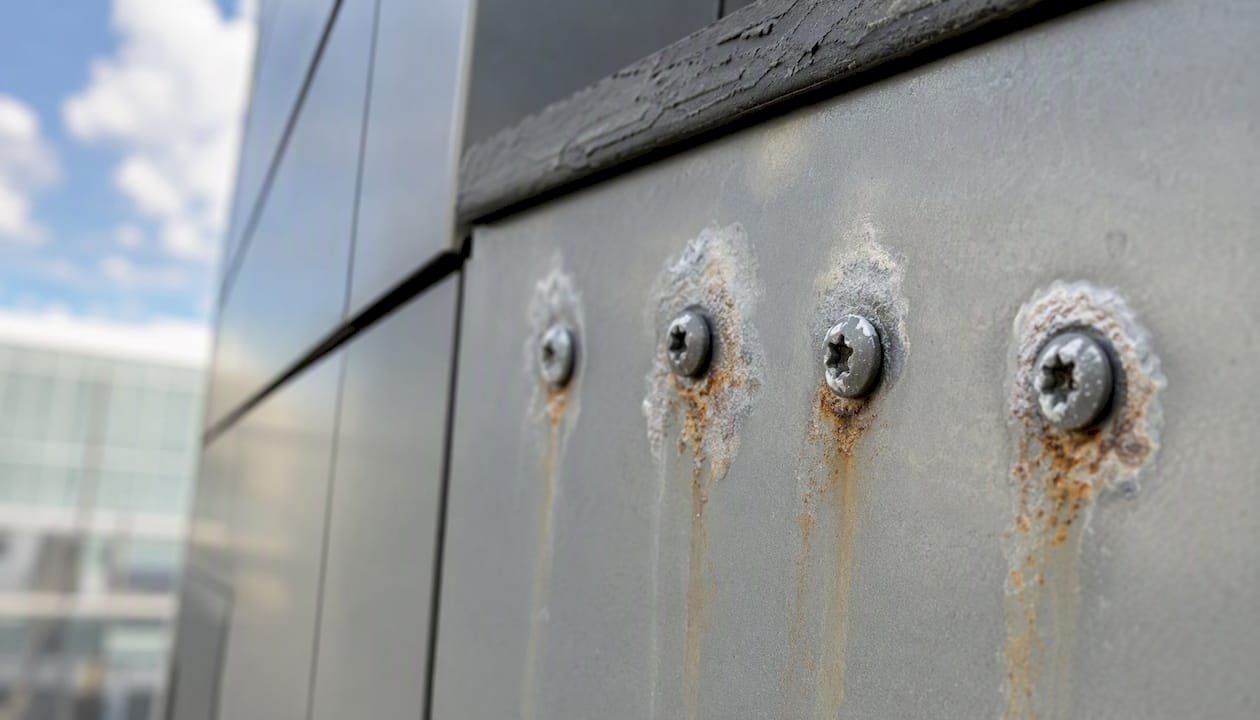
- White or chalky deposits around fastener holes, which often signal galvanic corrosion between dissimilar metals rather than simple dirt.
- Cracked, shrunken, or detached sealant at joints and expansion gaps.
- Loose or misaligned panels, visible as shadow lines that weren’t there in prior inspections.
- Interior water stains on ceiling tiles or wall finishes near the exterior wall, which point to facade penetration long before the outside shows obvious damage.
Some of these require action the same week, not the same quarter. Loose panels, active fastener corrosion, or any interior water staining tied to an exterior wall need a close-up professional assessment immediately. Waiting through a full wet season with a compromised seal is how a $2,000 sealant fix turns into a $40,000 panel replacement.
Photo-document every inspection, dated and labeled by elevation (north, south, east, west) and floor range. A simple folder structure on a shared drive is enough. Ruukki’s maintenance guidance for weathering steel facades makes the same point for a reason: preserving records of condition, cleaning materials, and weather conditions at the time of service protects your warranty position and gives the next contractor a real baseline instead of guesswork.
Pro Tip: Photograph fastener clusters up close, not just wide elevation shots. Early galvanic corrosion shows up as a dime-sized white ring around a screw head long before it’s visible from the ground.
Which Cleaning Method Is Right for Your Facade?
Not every metal facade responds well to the same cleaning approach, and picking the wrong one can do more damage than the dirt it removes. The core decision is pressure versus chemistry versus mechanical action, and South Florida’s mix of salt film, bird droppings, and algae growth makes that choice matter more than it would in a drier climate.
Soft-wash cleaning, meaning a pH-neutral detergent applied at low pressure followed by a thorough rinse, handles the majority of routine South Florida soiling: salt film, light algae, and general atmospheric grime. It’s the default for anodized aluminum, powder-coated panels, and PVDF-coated systems because it lifts contaminants without abrading the coating.
Low-pressure rinsing without detergent works for buildings that just need salt film knocked down between full cleanings. Directing water into joints, seams, or panel edges during any pressure-based method risks pushing moisture behind the cladding, which is exactly the condition that accelerates corrosion.
Steam and hot-water systems can loosen stubborn organic buildup like bird droppings or biofilm, but ENV 801b guidance is specific here: surface temperature during cleaning should not exceed 25°C (77°F), and steam that runs hotter than that on anodized finishes risks discoloration and coating stress.
Pure-water rinse systems, often deionized water applied with a soft brush or low-pressure nozzle, leave no mineral spotting and work well as a finishing rinse after chemical cleaning or as a standalone method for lighter soiling loads.
Gentle mechanical removal, a soft brush or non-abrasive pad, has a narrow but real use case: stubborn localized deposits that detergent alone won’t shift. It should never be a first resort, and it should never touch anodized or PVDF finishes without a spot test first.
| Method | Best for | Key risk | Coating compatibility |
|---|---|---|---|
| Soft-wash (neutral detergent, low pressure) | Routine salt film, algae, general grime | Minimal if diluted correctly | Safe for anodized, powder coat, PVDF |
| Low-pressure rinse (water only) | Light salt buildup between full cleans | Water intrusion if aimed at seams | Safe for all finishes |
| Steam / hot water | Stubborn organic buildup, bird droppings | Discoloration above 25°C on anodized surfaces | Use cautiously; verify temperature limit |
| Pure-water rinse | Finishing rinse, light soiling | Limited on heavy grime alone | Safe for all finishes |
| Gentle mechanical (soft brush) | Localized stubborn deposits | Scratching if pad is abrasive | Spot test before full application |
High-pressure washing and any abrasive pad or brush harder than a soft bristle should be off the table for anodized aluminum and most powder-coat systems. If a contractor proposes pressure washing above a low-pressure setting on a metal facade, ask why, and ask for a spot test on an inconspicuous panel before they touch the rest of the building.
What Cleaners and Chemicals Are Safe for Metal Facades?
The single most important number in metal facade cleaning is pH. ENV 801b’s cleaning recommendations for anodized elements call for neutral cleaners in the pH 5 to 8 range, and that guidance holds up as a practical rule across most powder-coated and PVDF-coated metal facades too. Strong acids and strong alkalis both attack anodized layers and clear coats, sometimes invisibly at first, then visibly months later as chalking or dulling spreads across a panel.
Avoid these on anodized aluminum, powder coat, and PVDF finishes:
- Strong acid-based cleaners (muriatic acid, undiluted vinegar concentrations, harsh rust removers).
- Strong alkaline degreasers not formulated for architectural metal.
- Solvent-based strippers, which can soften or lift powder-coat finishes.
- Abrasive scouring pads or brushes with metal bristles.
Temperature and dwell time matter as much as chemistry. Keep the surface at or below the 25°C limit ENV 801b specifies, never let a cleaner sit and dry on the surface, and always spot-test on a small, inconspicuous panel section before committing to a full elevation. Rinse thoroughly with clean water afterward, working from top to bottom so residue doesn’t streak lower panels.
Runoff control matters just as much as what’s in the bucket. South Florida’s storm drain systems connect directly to canals, the Intracoastal, and ultimately Biscayne Bay in many municipalities, so cleaning chemical runoff isn’t a minor compliance footnote. Contain wash water where possible, protect adjacent landscaping and storm drains, and use cleaners tested against a recognized classification framework rather than whatever is cheapest at the supply house. Quality-assured cleaning agent classifications exist for exactly this reason, giving facility managers a way to verify a product before it touches an expensive facade.
How Do Coatings and Corrosion Risk Affect Maintenance?
Metal facades fail in a handful of predictable ways, and knowing which one you’re looking at changes what you do about it. A comprehensive review of facade corrosion identifies atmospheric corrosion, galvanic corrosion, embedded corrosion, and cut-edge corrosion as the primary modes, and South Florida’s climate accelerates nearly all of them.
Atmospheric corrosion is the slow, general breakdown from constant humidity and salt exposure. Galvanic corrosion happens when two dissimilar metals touch in the presence of moisture, and it’s often the real story behind those white deposits around fastener holes: reliable field indicators of galvanic action include mineral streaking at joints, and simply wiping the deposit away without replacing the mismatched fastener or separator guarantees it comes back within a season or two.
| Corrosion type | Cause | Early warning sign | Fix |
|---|---|---|---|
| Atmospheric | Prolonged humidity and salt exposure | General dulling, chalking | Regular cleaning, coating touch-up |
| Galvanic | Dissimilar metals in contact with moisture | White deposits, rust streaking at joints | Replace fasteners/separators, not just clean |
| Cut-edge | Exposed raw metal at panel cuts | Rust bleeding from panel edges | Seal cut edges, monitor closely |
| Embedded | Trapped moisture behind cladding | Interior water stains, bulging | Improve ventilation, check drainage details |
Coating specification is your longest-lever decision. Facades finished to AAMA 2605 standards use high-performance fluoropolymer coatings engineered to outlast standard acrylic finishes by a meaningful margin, which translates into fewer repaint cycles and lower lifetime maintenance cost even though the upfront coating cost runs higher. If your building has standard-grade coating, budget touch-up work sooner and don’t expect the same interval between recoats that an AAMA 2605-rated system delivers.
Sealant and fastener maintenance is the cheapest insurance you’ll ever buy for a metal facade. Aluminum systems that get routine low-pressure cleaning paired with prompt sealant renewal are far less likely to develop the cut-edge or galvanic corrosion that eventually leads to panel detachment. And in South Florida specifically, checking drainage and ventilation details behind the cladding ranks among the highest-return maintenance items available, because repeated wet-dry cycling combined with salt aerosol is what turns a minor design flaw into a five-year corrosion problem. When you spot early cut-edge rust or coating failure beyond simple dirt, contact the coating supplier or panel manufacturer before attempting a touch-up. A mismatched paint system applied without their spec can void a warranty faster than the original damage would have cost to fix.
What Access Method Should You Use for Facade Cleaning?
Getting people and equipment to a facade 60, 120, or 200 feet up is often the most expensive and disruptive part of the whole job, and the access method you choose shapes cost, timeline, and risk more than the cleaning chemistry does.
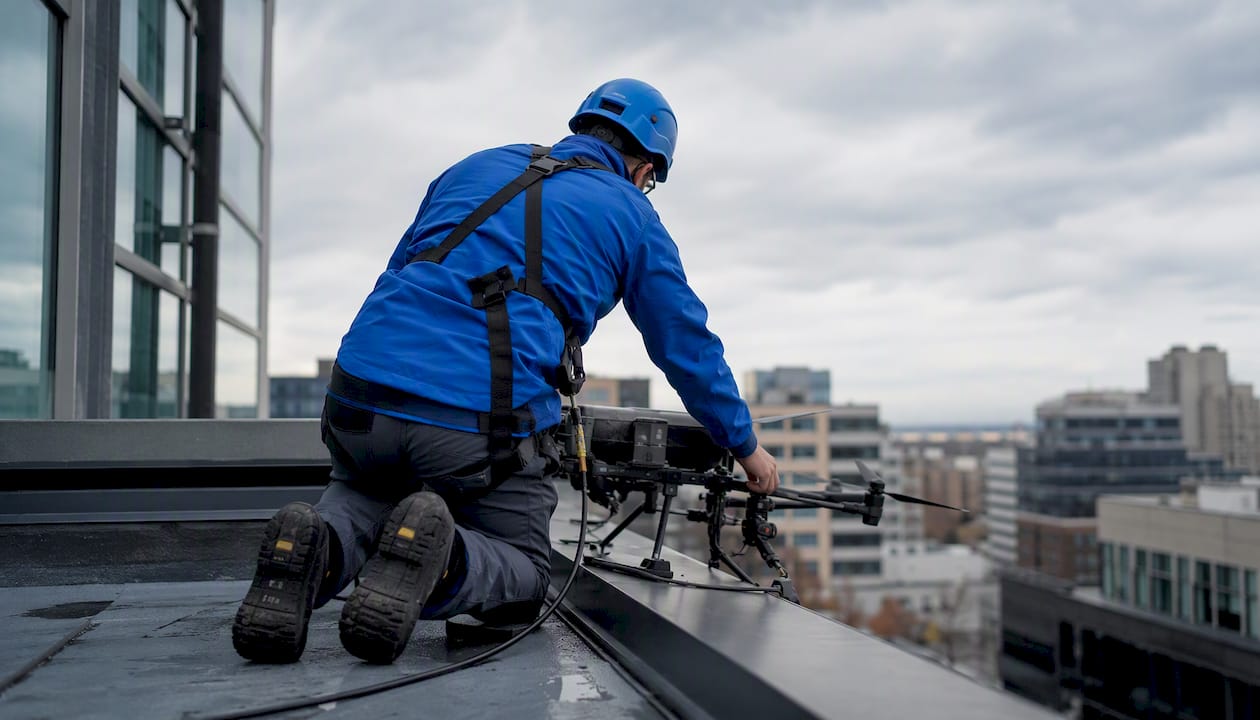
Scaffolding gives thorough, stable access but takes days to erect and strike, occupies sidewalk or parking space for the full project duration, and often requires permits and sometimes lane or road closures in dense areas like Brickell or downtown Fort Lauderdale. Boom lifts move faster than scaffolding but need ground clearance that many urban South Florida properties simply don’t have, especially condominiums with tight setbacks or retail centers that can’t lose parking spots for a week. Rope access is flexible and requires less ground footprint, but it’s technician-intensive, slower per square foot of facade, and carries its own fall-protection compliance burden.
Tethered industrial drones and free-flying systems operated under FAA Part 107 certification represent a genuinely different approach. Crews stay on the ground the entire time. There’s no scaffolding to permit, no boom lift blocking a loading dock, and no rope crew rigging anchor points on a roof that wasn’t designed for it. On buildings up to 200-plus feet tall across Miami-Dade, Broward, and Palm Beach counties, tethered drone operations under Part 107 certification can meaningfully cut work zone disruption and shrink project timelines, particularly on properties where lift access would otherwise shut down a retail entrance or a parking area for days.
Before hiring anyone for elevated facade work, confirm:
- The operator holds current FAA Part 107 certification if drones are involved.
- The company carries adequate liability insurance, ideally in the $2 million range for commercial-scale projects.
- A site risk assessment has been completed for wind conditions, nearby structures, and pedestrian traffic.
- Documentation practices include before-and-after photo or video evidence for every elevation cleaned.
A sun-shade louver system on a Miami-area commercial building illustrates the contrast well: traditional access would have meant a lift working around a busy entrance for the better part of a week, while a drone-assisted clean of metal louvers reached the same detail level in a fraction of the time, with the building’s ground-floor tenants never losing access.
Pro Tip: Ask any drone vendor for their FAA Part 107 certificate number and current insurance certificate before signing anything. Legitimate operators produce both without hesitation.
How Do You Choose a Facade Cleaning Contractor?
Hire a professional the moment an inspection turns up anything beyond surface dirt: active corrosion, sealant failure, loose panels, or any building over roughly three or four stories where DIY access isn’t realistic or safe. Below that threshold, the decision usually comes down to whether your in-house team has the equipment and training to do the job without damaging finishes or missing early warning signs.
Request these credentials before signing any contract:
- FAA Part 107 certification, if the proposal includes drone-based cleaning.
- $2 million liability insurance minimum for commercial-scale facade work.
- References from comparable South Florida projects, ideally similar building height and substrate type.
- Proof of substrate-appropriate chemistry, meaning cleaners matched to anodized, powder-coat, or PVDF finishes rather than a one-size-fits-all product.
- Wastewater containment plan, especially for buildings near storm drains or waterways.
Ask direct operational questions during the proposal stage:
- What method and pressure setting will you use on this specific coating?
- How do you contain or capture wash water runoff?
- Will you spot-test before cleaning the full elevation?
- What documentation do we receive after the job (photos, condition notes, chemicals used)?
- Is there a warranty or guarantee on the finish, and what voids it?
Insist on these contract items regardless of vendor: a clearly defined scope of work by elevation, explicit protection measures for existing finishes and landscaping, before-and-after photo documentation, and a proposed follow-up maintenance schedule rather than a one-time transaction. A contractor who won’t commit any of that to paper is telling you something about how the job will actually go.
What Does Metal Facade Cleaning Cost in South Florida?
Cost breaks down into a handful of variables that any facility manager can walk through before requesting quotes. Building height and access requirements usually drive the largest swing in price, since scaffolding or lift rental adds days of labor and equipment cost before a single panel gets cleaned. Total facade square footage matters, obviously, but so does the level of soiling: a building that’s gone 18 months without attention costs more to clean than one on a tight six-month cycle, because heavier buildup means more time and sometimes stronger (still compatible) chemistry.
Coating sensitivity plays into cost too. Anodized and PVDF finishes that require careful spot-testing and gentler methods take longer per square foot than a straightforward pressure-tolerant surface. Wastewater containment adds cost on properties near storm drains or waterways, and any project requiring permits or traffic control for scaffolding or lifts adds both time and fees that a drone-assisted approach typically avoids entirely.
Think in ranges rather than fixed numbers when comparing proposals, since building-specific factors shift pricing significantly. Drone-assisted cleaning generally restructures the cost equation by removing rigging, permit, and road-closure line items altogether, which is a meaningful part of why it tends to run lower than scaffold or lift-based methods on comparable jobs.
Budget for maintenance, not repair. A building that spends modestly on cleaning and inspection every six months almost always spends less over a five-year window than one that waits for visible failure and then pays for emergency repair plus lost tenant goodwill. Line-item periodic touch-up painting and sealant renewal into your annual facilities budget rather than treating them as surprise expenses.
Pro Tip: Get at least two proposals broken down by line item, not just a single total. A contractor who can’t separate access cost, cleaning cost, and containment cost from the total is either padding the number or hasn’t thought through the job.
What’s a Simple Between-Cleanings Maintenance Routine?
Facility staff can handle a lot between professional visits with a short, repeatable routine that takes less than an hour on most properties.
- Safety check first. Confirm ground conditions, weather, and whether any elevated access is genuinely needed for what you’re about to do.
- Pre-rinse with clean water. A garden hose or low-pressure attachment removes loose dust and light salt film without any chemical.
- Spot-clean isolated problem areas. Bird droppings, sap, or localized grime get a small amount of neutral detergent and a soft cloth, then a rinse.
- Photograph the area before and after, dated and labeled by location.
- Log the condition in your maintenance spreadsheet, noting anything that looked different from the last check.
In-house staff can reasonably handle ground-level or low-reach surface rinsing and small bird-dropping cleanup. Anything requiring elevated access, anything involving visible corrosion, or any full-elevation clean belongs with a licensed contractor. Trying to save a service call on a loose panel or active rust spot almost always costs more once it’s deferred into a bigger repair.
For photo documentation, a simple standard works: one wide shot of the full elevation, one medium shot of the specific area of concern, and one close-up if there’s any visible deposit or damage. That three-shot set, dated and stored with your inspection log, gives any contractor you eventually hire a real starting point instead of a verbal description of “it looked fine last time we checked.”
A Field Perspective on South Florida Facade Maintenance
Most facade maintenance advice gets written for buildings in climates that don’t punish metal the way South Florida does. A cleaning schedule built around a mid-Atlantic winter or a dry Southwest summer simply doesn’t translate to a facade that sits in salt aerosol and 85% humidity for half the year, then takes a direct hit from tropical storm rainfall for the other half.
What tends to get underestimated is how much access method affects maintenance discipline itself. When a facade clean requires scaffolding, permits, and a week of sidewalk closure, building managers put it off. It’s disruptive, it’s expensive to mobilize, and there’s a real temptation to stretch the interval past what the exposure actually calls for. That deferral is exactly how a $2,000 sealant fix turns into a $40,000 panel replacement, because the corrosion modes covered earlier don’t pause while a building waits for scaffolding season.
FAA Part 107-certified drone operations change that calculation because they remove the mobilization penalty. A tethered industrial drone can be on-site and cleaning within hours, not days, with no road closure and no lift blocking a lobby entrance. That makes it realistic to actually hit a three-to-six-month coastal cleaning interval instead of stretching it to once a year because scheduling traditional access felt like too much friction. Faster mobilization also means better documentation habits stick, since a crew that finishes in a day is more likely to hand over consistent before-and-after photo sets than one juggling a multi-week scaffold job around weather delays.
The honest caveat: drone-assisted cleaning isn’t the right tool for every situation. Deep mechanical removal of heavily encrusted deposits or hands-on sealant replacement still needs a technician at the surface. But for the routine soft-wash cycle that makes up the bulk of what a metal facade actually needs, removing the access barrier is often the single biggest lever a building can pull toward better long-term corrosion outcomes.
How Vista Drone Cleaning Handles Metal Facades in South Florida
If you’ve read this far, you already know the two things that make metal facade maintenance hard: getting safe access to a tall building without shutting down operations, and matching the right chemistry to your specific coating so you don’t trade dirt for damage. That’s the exact problem Vistadronecleaning was built to solve for commercial properties across Miami-Dade and Broward counties.

Vistadronecleaning uses FAA Part 107-certified pilots and tethered industrial drones to soft-wash metal facades on buildings up to 200-plus feet tall, with substrate-matched chemistry selected for anodized aluminum, powder-coat, and PVDF finishes specifically. Every job includes 4K before-and-after documentation, so you get the same photo record this guide recommends keeping, without having to organize it yourself. Crews stay on the ground the entire time, which means no scaffolding permits, no lift blocking a loading dock, and no road closures to coordinate with your municipality.
The service covers commercial high-rises, condominiums, hotels, office towers, and retail centers throughout Miami-Dade, Broward, and Palm Beach counties. If your last facade clean is more than six months behind schedule, or you’re comparing drone cleaning against traditional window and facade methods for an upcoming project, request a free quote and get a proposal back within 24 hours.
Standards and Guidance Worth Bookmarking
- AAMA 2605 coating specification sets the benchmark for high-performance fluoropolymer finishes and directly affects how long you can stretch between recoats.
- ENV 801b cleaning recommendations give the concrete pH range and temperature limit that any cleaning proposal should respect.
- Rimkus building-envelope guidance documents the inspection cadence and failure risks that inform when to escalate from cleaning to repair.
- Ruukki’s COR-TEN maintenance instructions cover weathering steel specifics, including ventilation and documentation practices worth adapting for other metals.
- The facade corrosion literature review breaks down atmospheric, galvanic, embedded, and cut-edge corrosion in more technical detail for teams specifying new coatings or investigating repeated failures.
Sources
- Corrosion of Reinforcement in Existing Concrete Façades. Building pathology and rehabilitation.
- Steel building façade: inspection and failure risks: Rimkus
- DATA SHEET ENV 801b – Cleaning recommendations for anodized facade elements
- Aluminium Facade Cleaning & Maintenance Guide | Valmond & Gibson
- RUUKKI COR‑TEN® facades: maintenance instructions
FAQ
What is the best cleaner for metal siding?
A pH-neutral detergent in the pH 5 to 8 range applied with a soft cloth or low-pressure rinse works best for anodized, powder-coat, and PVDF metal siding. Avoid strong acids, strong alkalis, and abrasive pads, which can strip or dull the finish.
How much does facade cleaning cost?
Cost depends on building height, access method, total facade area, and coating sensitivity, so it’s best evaluated as a range through itemized proposals rather than a flat number. Drone-assisted cleaning generally reduces cost compared with scaffolding or lift-based methods by eliminating rigging, permitting, and road-closure expenses.
How do you make old metal look new again?
A thorough soft-wash clean removes most surface dulling caused by salt film and atmospheric grime, and addressing early corrosion (fastener replacement, sealant renewal) prevents further degradation. For coatings that have genuinely faded or chalked beyond what cleaning fixes, a touch-up or recoat matched to the original specification, ideally AAMA 2605-rated, restores appearance and extends service life.
What removes grime from metal without damaging the finish?
Low-pressure water combined with a neutral detergent removes most South Florida grime, including salt film, light algae, and general atmospheric buildup, without harming anodized or powder-coat finishes. Stubborn localized deposits may need gentle mechanical removal with a soft brush, but only after a spot test confirms it won’t scratch the coating.
Can drones clean metal building facades safely?
Yes. FAA Part 107-certified operators using tethered industrial drones can apply the same soft-wash chemistry and low-pressure technique used in traditional methods, with crews remaining on the ground throughout the job. Vistadronecleaning uses this approach on South Florida buildings up to 200-plus feet tall, backed by $2 million liability insurance.
Recommended
- Commercial Facade Restoration Cleaning: A Property Manager’s Guide, Vista Drone Cleaning
- Facade Cleanliness and Tenant Attraction: 2026 Guide, Vista Drone Cleaning
- Post-Construction Facade Cleaning Checklist for South Florida, Vista Drone Cleaning
- Smart exterior maintenance strategies for South Florida buildings