
Post-Construction Facade Cleaning Checklist for South Florida
Ensure a pristine building with our post-construction facade cleaning checklist. It’s essential for successful inspections in South Florida.
TL; DR:
- Post-construction facade cleaning involves removing construction residue, overspray, and protective film before occupancy. It follows a three-phase model to ensure surface cleanliness, safety compliance, and quality verification for smooth inspections.
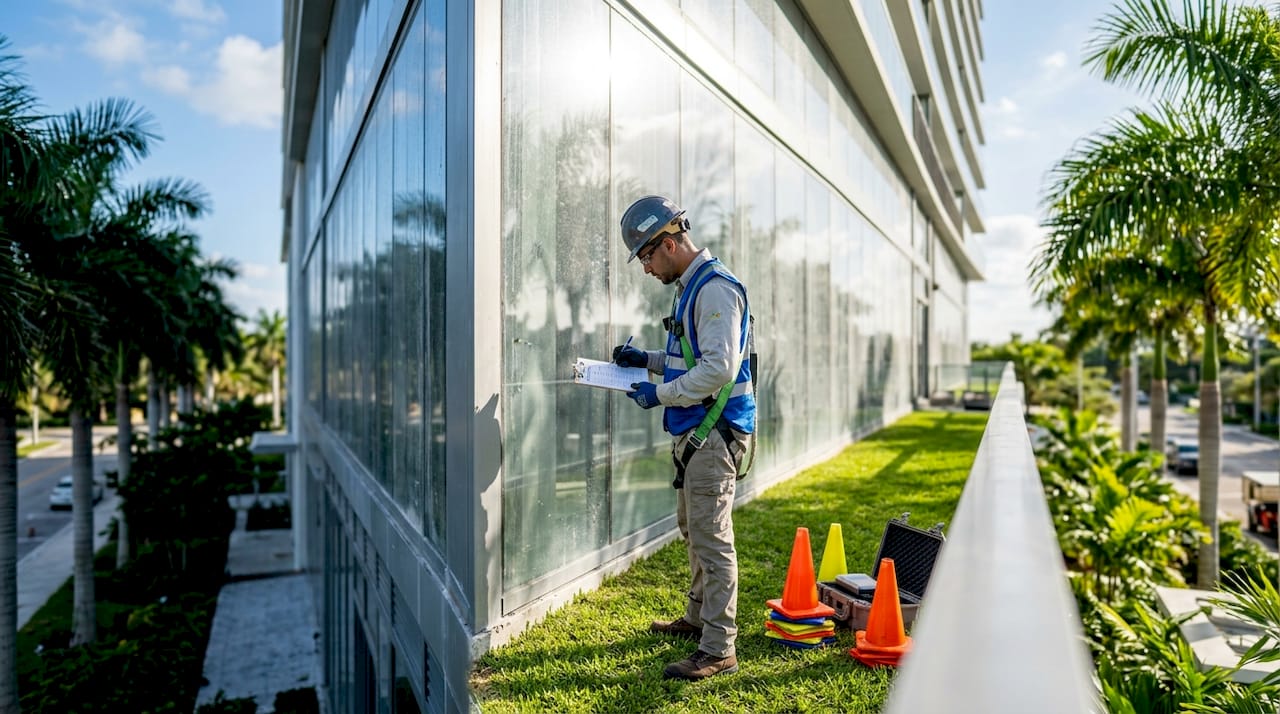
Post-construction facade cleaning is the specialized process of removing construction residue, chemical overspray, mortar haze, and protective film from a building’s exterior surfaces before tenant occupancy or final inspection. This process is distinct from routine maintenance cleaning and follows a three-phase model standardized across commercial construction. For property managers and contractors in Miami-Dade, Broward, and Palm Beach counties, a thorough post-construction facade cleaning checklist is the difference between passing your certificate of occupancy inspection and costly rework. Commercial projects in South Florida typically range from $15,000 to $200,000 for full exterior cleaning scope.
What does a post-construction facade cleaning checklist cover?
A post-construction exterior cleaning checklist covers every surface contamination type left after construction: mortar haze, silicone overspray, adhesive residue, construction dust, and protective film. The industry term for this work is “post-construction exterior cleaning, ” though contractors also call it post-renovation exterior cleaning or final clean. The scope goes far beyond wiping down windows. It requires chemical selection, safety compliance, sequencing with other trades, and documented quality verification.
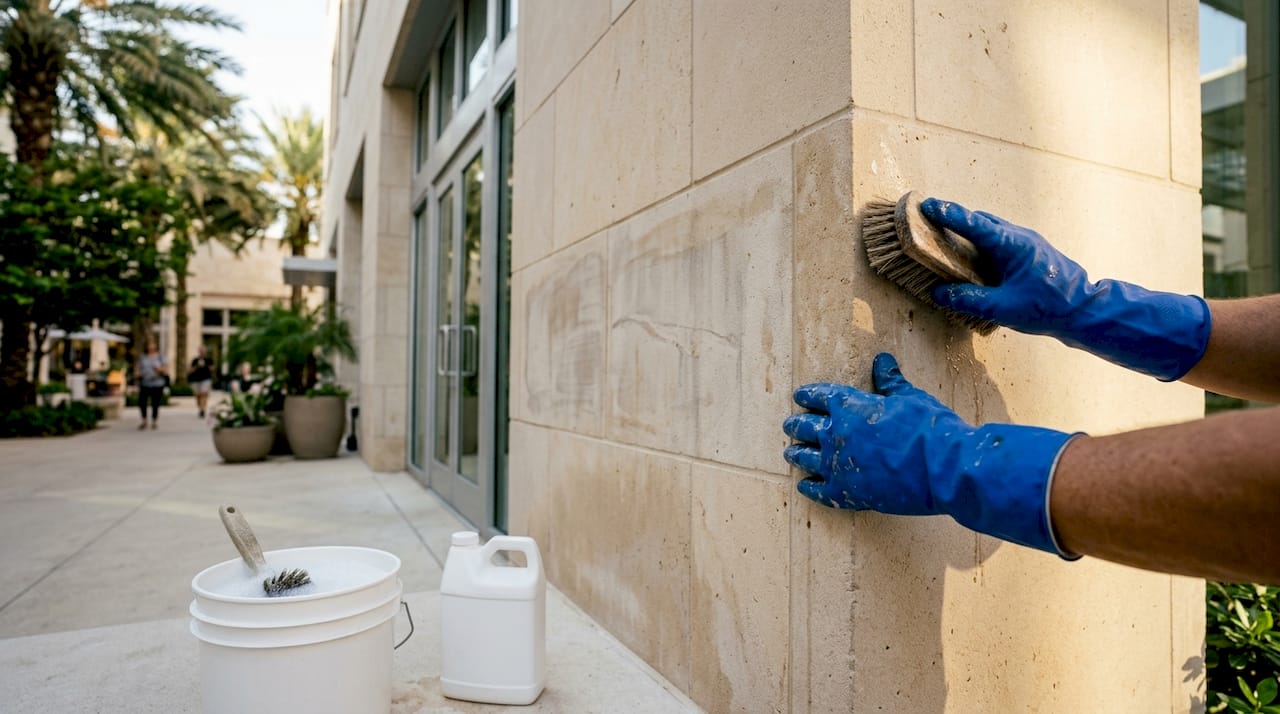
Facade cleanliness directly affects tenant attraction and lease cycles in South Florida commercial real estate. A dirty or streaked facade signals poor construction quality to prospective tenants and investors, regardless of what is happening inside the building. Getting the exterior right before handover protects both the contractor’s reputation and the property manager’s occupancy timeline.
What safety regulations apply to post-construction facade cleaning in South Florida?
Exterior post-construction cleaners in South Florida must comply with OSHA 29 CFR 1926, not the general industry standard OSHA 1910. This distinction matters because 1926 governs construction site environments, which carry different fall protection, silica dust, and chemical handling requirements. Misidentifying the applicable standard is the most frequent compliance error contractors make on exterior cleaning scopes.
Fall protection and respiratory safety
Any crew working at elevation must follow OSHA 1926 Subpart M fall protection requirements. That means guardrails, personal fall arrest systems, or safety nets depending on the height and access method. Silica dust generated during dry brushing or pressure washing of masonry requires respiratory protection under OSHA 1926.1153, including engineering controls and exposure monitoring.
- Use NIOSH-approved N95 or P100 respirators when dry-brushing masonry surfaces
- Require fall arrest harnesses for any crew above 6 feet on open-sided surfaces
- Document all chemical handling procedures with Safety Data Sheets on site
- Verify crew training records before starting exterior chemical applications
- Maintain a site safety log with daily hazard assessments
Environmental compliance: NPDES and chemical runoff
Florida’s National Pollutant Discharge Elimination System (NPDES) rules regulate how cleaning runoff reaches storm drains and waterways. Phosphoric acid solutions, silicone solvents, and alkaline degreasers all require containment and neutralization before discharge. Contractors working in Miami-Dade and Broward counties face active enforcement, particularly near coastal and canal-adjacent properties.
Permit and documentation requirements are not optional. NPDES compliance documentation, chemical batch records, and waste disposal manifests must accompany every post-construction exterior cleaning project in South Florida. Missing paperwork shifts liability to the general contractor at final inspection.
Pro Tip: Before mobilizing your cleaning crew, confirm that your chemical supplier has provided current Safety Data Sheets for every product on your list. Inspectors in Miami-Dade and Broward counties have requested these on-site during active cleaning operations.
What tools and chemicals are needed for post-construction facade cleaning?
Diluted acids at 5–10% phosphoric or citric acid are the standard treatment for mortar haze and calcium deposits on masonry. These must be neutralized immediately with a pH-balanced rinse to prevent etching glass coatings or staining stone. Standard water rinsing alone cannot remove chemically complex contaminants like silicone overspray or mortar haze.
Chemical and solvent selection
| Contaminant | Recommended Treatment | Neutralization Required |
|---|---|---|
| Mortar haze | 5–10% phosphoric acid | Yes, pH-balanced rinse |
| Silicone overspray | Specialized silicone solvent | Yes, water flush |
| Paint overspray | Solvent-based remover | Yes, water flush |
| Construction dust | HEPA vacuum, then water | No chemical needed |
| Protective film adhesive | Manufacturer-approved remover | Yes, water rinse |
Equipment checklist
- HEPA-filter vacuums for dry particulate removal before any wet application
- Microfiber cloths and squeegees rated for glass and coated surfaces
- Extension poles with swivel heads for mid-rise facade access
- pH test strips and TDS meters for rinse water verification
- Drone inspection equipment for high-rise facade access and documentation
- Protective film removal tools with manufacturer-specified solvents
Pro Tip: Never apply water directly to dry construction dust on a facade. Dry removal first via HEPA vacuum or soft brushes prevents the dust from forming an abrasive slurry that micro-scratches glass and coated surfaces.
For high-rise buildings in Brickell, Fort Lauderdale, and Boca Raton, drone-mounted cleaning systems like the Lucid Bots Sherpa provide access to surfaces up to 200 feet without scaffolding or boom lifts. This matters for both safety and scheduling, since traditional access equipment often requires road closures and permits that delay project timelines.
What is the step-by-step process for post-construction facade cleaning?
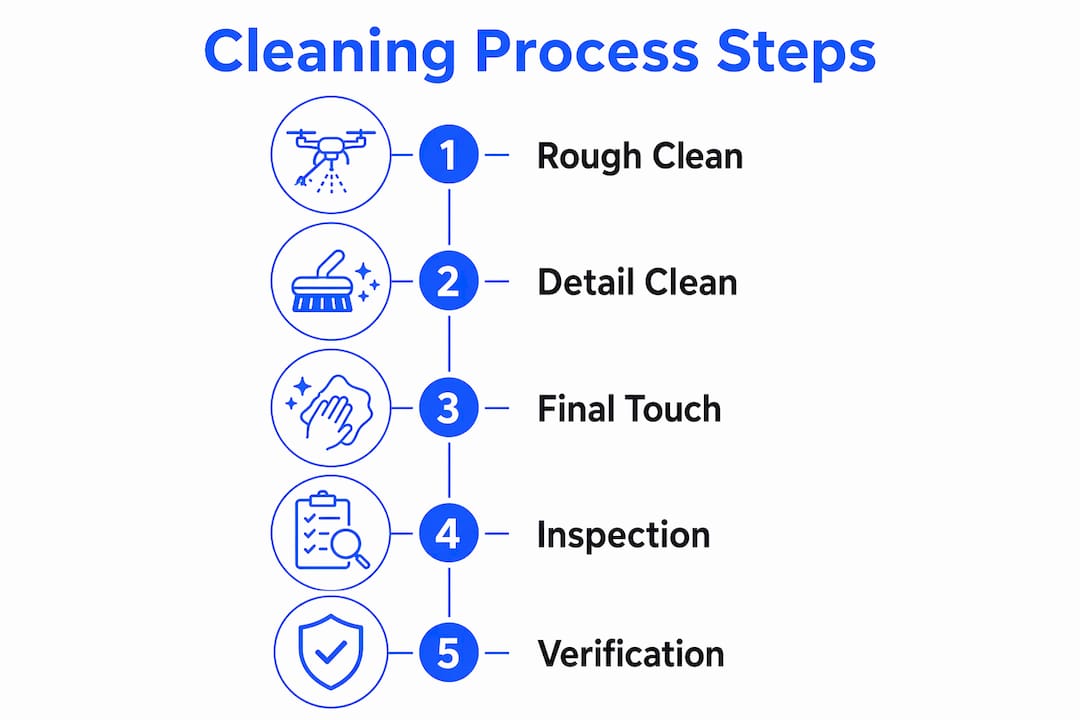
The three-phase cleaning model structures every commercial post-construction exterior cleaning project. Each phase has a specific scope, and skipping or compressing phases causes rework. The phases must also coordinate with other trades to prevent re-contamination.
Phase 1: Rough clean
- Remove all bulk debris, construction waste, and loose materials from the facade and surrounding ground
- Dry-brush or HEPA-vacuum all masonry, glass, and cladding surfaces before any wet application
- Identify and tag hazardous materials including adhesive containers, chemical drums, and silicone tubes for proper disposal
- Photograph all pre-existing surface damage with date-stamped images before cleaning begins
- Coordinate with the general contractor to confirm no active trades are working above the cleaning zone
Phase 2: Light and detail clean
- Apply diluted acid solutions to masonry residue, working in small sections and neutralizing immediately
- Clean glass surfaces using pre-wetted microfiber cloths before any razor blade application
- Use razor blades at a 30-degree angle on pre-wetted glass only, never on dry surfaces
- Remove silicone overspray with manufacturer-approved solvents, then flush thoroughly
- Schedule cleaning phases in coordination with flooring, painting, and glazing trades to avoid re-contamination
Phase 3: Final and touch-up clean
- Conduct a full facade walk-down using raking light inspection at 600–1,000 lux and a 30-degree angle
- Test all rinsed surfaces with a handheld TDS meter to confirm conductivity below 30 µS/cm
- Remove all protective films within the manufacturer’s specified window, typically 90 days from installation
- Document completed areas with dated photo logs and chemical batch numbers
- Submit the completed cleaning log to the general contractor and owner’s representative for sign-off
| Phase | Primary Task | Key Verification |
|---|---|---|
| Phase 1: Rough clean | Debris and hazardous waste removal | Photo log of pre-existing damage |
| Phase 2: Detail clean | Chemical treatment and surface prep | pH and rinse verification |
| Phase 3: Final clean | Inspection-ready finish | TDS meter reading, raking light check |
A building cleaning checklist adapted for South Florida high-rises accounts for the region’s salt air, humidity, and mixed facade materials, all of which affect chemical selection and drying times.
How do you verify quality and pass final inspections in South Florida?
Quality verification in post-construction facade cleaning relies on objective, measurable standards rather than visual judgment alone. Handheld TDS meters confirm that rinsed surfaces have a conductivity reading below 30 µS/cm, which indicates mineral-free, residue-free glass. A reading above that threshold means the rinse water left behind dissolved solids that will cause streaking or spotting after drying.
Raking light inspection
Raking light inspection uses 600–1,000 lux illumination at a 30-degree angle to reveal residues that flat lighting misses entirely. This technique exposes mortar haze, adhesive film, and water spots that would otherwise pass a casual visual check. It is the standard method for defensible quality acceptance on commercial glass and facade surfaces.
- Confirm TDS meter reads below 30 µS/cm on all rinsed glass panels
- Use raking light at 30 degrees to inspect every facade elevation
- Verify protective film removal within the manufacturer’s 90-day window
- Check razor blade technique records to confirm pre-wetting compliance
- Maintain a signed cleaning log for warranty and legal documentation
Glass cleaning is the highest liability zone in post-construction exterior cleaning. Improper razor blade technique or dry scraping shifts damage liability to the cleaning contractor, not the glazing subcontractor. Proper pre-wetting and angle documentation are your legal protection.
Pro Tip: Protective film removal delayed beyond the manufacturer’s 90-day window requires aggressive solvents that risk damaging coatings and substrates. Track batch installation dates in your project log and schedule removal proactively, not reactively.
What are the biggest challenges in high-rise facade cleaning in South Florida?
The most damaging mistake in post-construction facade cleaning is applying water to dry construction dust. This creates an abrasive slurry that micro-scratches glass and coated cladding. The fix is simple but frequently skipped under schedule pressure: always complete dry particulate removal before any wet application.
High-rise buildings in Miami Beach, Aventura, and Fort Lauderdale present additional challenges. Salt air accelerates adhesive cure on protective films, making delayed removal far more aggressive to treat. South Florida’s humidity also extends chemical dwell times unpredictably, which means contractors must test pH and conductivity more frequently than in drier climates.
- Complete dry removal before wet cleaning on every surface, every time
- Track protective film installation dates and schedule removal before the 90-day mark
- Integrate facade cleaning into the construction schedule, not as an afterthought after substantial completion
- Use drone inspection for high-rise facades to identify missed areas before the final walk-down
- Coordinate with glazing, caulking, and painting trades to prevent re-contamination after cleaning
Pro Tip: On high-rise projects in Miami-Dade and Broward counties, drone-mounted inspection cameras identify facade defects and missed cleaning zones at elevation without requiring a crew to ascend. This cuts re-inspection time and reduces fall exposure significantly.
Key Takeaways
A complete post-construction facade cleaning checklist requires three sequential phases, OSHA 1926 compliance, chemical neutralization, and objective quality verification using TDS meters and raking light inspection.
| Point | Details |
|---|---|
| Three-phase model is mandatory | Skipping phases causes rework; rough, detail, and final clean each have distinct scopes. |
| OSHA 1926 governs exterior cleaning | Misapplying OSHA 1910 creates compliance gaps in fall protection and chemical handling. |
| Dry before wet, always | HEPA vacuum or brush all surfaces before wet application to prevent abrasive slurry damage. |
| TDS meters verify rinse quality | Conductivity below 30 µS/cm confirms residue-free glass ready for final inspection. |
| Film removal has a hard deadline | Protective films must come off within the manufacturer’s 90-day window or risk substrate damage. |
South Florida facade cleaning: what I’ve learned from the field
The most underestimated variable in South Florida post-construction exterior cleaning is the climate itself. Salt air from Biscayne Bay and the Atlantic accelerates adhesive cure on protective films faster than any manufacturer’s timeline assumes. I have seen projects in Brickell and Miami Beach where a 60-day-old film required the same aggressive solvent treatment as a 120-day-old film in a drier market. That is not a product failure. That is a local condition that your checklist must account for explicitly.
The second issue I see repeatedly is the misclassification of exterior cleaning under OSHA 1910 instead of 1926. This is not a paperwork technicality. It changes your fall protection requirements, your silica dust protocols, and your chemical waste handling obligations. Contractors who get this wrong do not just face fines. They face liability exposure when a crew member gets hurt or a discharge complaint reaches the county.
Drone technology changes the math on high-rise facade cleaning in a meaningful way. When a crew does not need to ascend to inspect or clean above 100 feet, you eliminate the most dangerous part of the job and the most expensive access equipment. For property managers in Fort Lauderdale and Boca Raton managing towers above 20 stories, that is a real operational advantage, not a novelty. The quality of the inspection data also improves because a camera at the right angle sees what a human eye at the wrong angle misses.
My advice to property managers and contractors: treat facade cleaning as a scheduled trade, not a cleanup task. Build it into your construction sequence with the same rigor you apply to glazing or mechanical. The cost of getting it right the first time is a fraction of the cost of re-cleaning after occupancy.
, Eliot
Vistadronecleaning’s post-construction facade cleaning services in South Florida
Vistadronecleaning serves commercial properties across Miami-Dade, Broward, and Palm Beach counties using FAA Part 107-certified pilots and tethered Lucid Bots Sherpa drones. For post-construction projects on high-rises and mixed-use towers, the drone-based approach eliminates scaffolding, boom lifts, and road closures while delivering a streak-free, de-ionized water rinse verified by TDS testing.

Projects typically complete in 1–3 days at 30–60% lower cost than traditional scaffold methods. Services cover drone facade cleaning, high-rise window washing, roof soft-wash, and EIFS soft-wash cleaning for synthetic stucco exteriors. Vistadronecleaning carries $2M liability insurance and provides free quotes within 24 hours. Contact the team to schedule your post-construction exterior cleaning assessment before your certificate of occupancy walk-through.
FAQ
What is post-construction facade cleaning?
Post-construction facade cleaning is the specialized removal of construction residue, mortar haze, silicone overspray, and protective film from a building’s exterior surfaces before occupancy. It follows a three-phase model distinct from routine maintenance cleaning.
Which OSHA standard applies to exterior post-construction cleaning?
OSHA 29 CFR 1926 governs post-construction exterior cleaning, not the general industry standard 1910. This affects fall protection requirements, silica dust controls, and chemical waste handling obligations on construction sites.
How do you verify a facade is clean enough to pass final inspection?
Use a handheld TDS meter to confirm rinsed glass surfaces read below 30 µS/cm, and conduct a raking light inspection at 600–1,000 lux and a 30-degree angle to detect residues invisible under flat lighting.
When should protective films be removed from facade surfaces?
Protective films must be removed within the manufacturer’s specified window, typically 90 days from installation. Delayed removal in South Florida’s salt air and humidity often requires aggressive solvents that risk damaging coatings and substrates.
Why should dry cleaning always come before wet cleaning on a facade?
Applying water to dry construction dust creates an abrasive slurry that micro-scratches glass and coated cladding. HEPA vacuuming or dry brushing all surfaces before any wet application prevents this damage entirely.
Recommended
- Complete building cleaning checklist for South Florida high-rises
- Facade Cleanliness and Tenant Attraction: 2026 Guide, Vista Drone Cleaning
- Shopping Center Facade Maintenance Checklist for Property Managers, Vista Drone Cleaning
- Facade Cleaning Without Scaffolding: A Property Manager’s Guide, Vista Drone Cleaning