
Step-by-step facade cleaning that minimizes disruption
Discover effective step by step facade cleaning methods that minimize disruption to tenants and enhance your commercial property’s appearance.
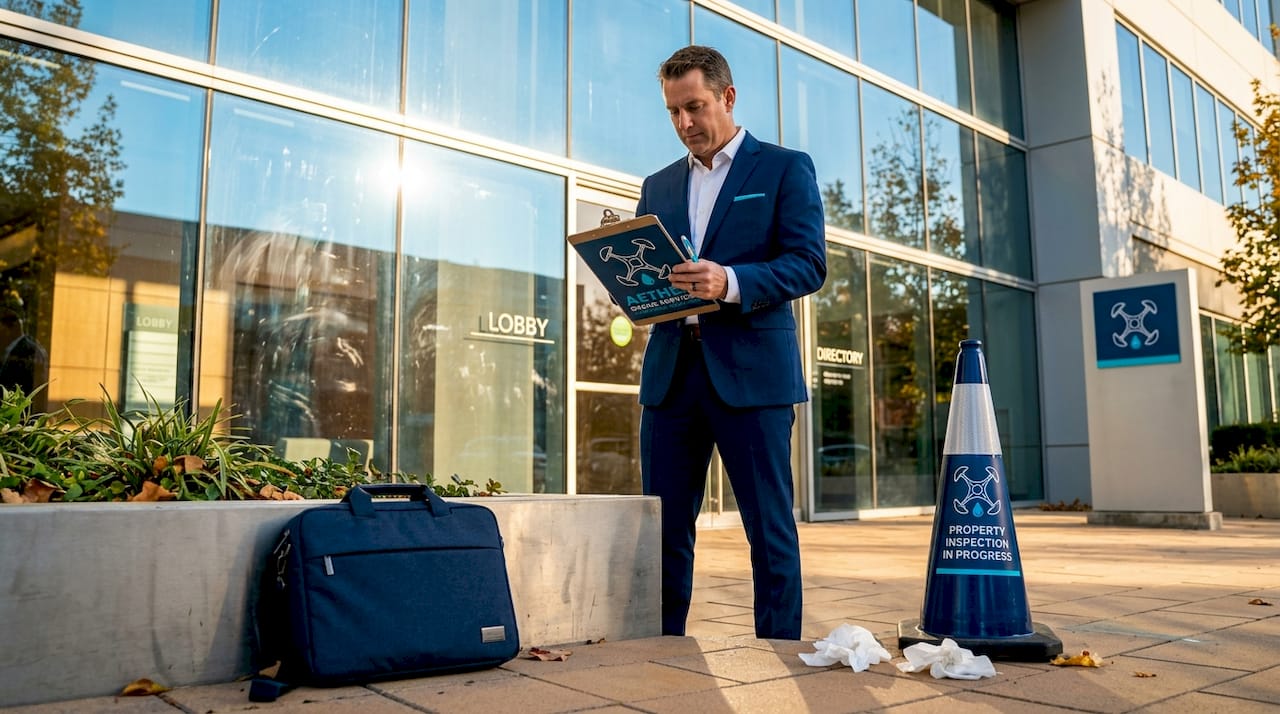
Imagine this: a Brickell property manager receives four tenant complaints before 9 a.m. The glass is streaked, algae is climbing the lower panels, and the lobby looks neglected. The usual vendor arrives with a boom lift, blocks the main entrance for three days, and sends an expensive bill. There is a better way. This guide covers a structured, low-disruption facade cleaning process for South Florida commercial properties to keep your building sharp without blocking traffic.
Table of Contents
- Assessing your building and requirements
- Essential tools, systems, and safety gear
- Step-by-step facade cleaning process
- Verifying results and maintaining a clean facade
- What most facade cleaning guides miss about disruption and innovation
- Ready to transform your building's facade with less disruption?
- Frequently asked questions
Key Takeaways
| Point | Details |
|---|---|
| Assess before starting | Evaluate your facade and surroundings to choose the safest approach. |
| Use the right systems | Modern water-fed pole and drone systems speed up cleaning and lower tenant disruption. |
| Safety is non-negotiable | Strict work-zone management and protective gear prevent accidents and complaints. |
| Clear process, clear results | Follow a structured workflow and maintenance schedule to keep exteriors spotless and costs predictable. |
Assessing your building and requirements
Every building presents unique challenges. A 20-story glass curtain wall in downtown Miami faces different conditions than a four-story concrete retail strip in Coral Gables. Before scheduling, identify your facade material, height, environmental exposure, and access constraints.
Key factors to assess:
- Facade material: Glass, concrete, aluminum, and stucco respond differently to pressure and chemicals.
- Building height: Heights above 40 feet usually require rope access, boom lifts, or drones.
- Environmental exposure: South Florida facades collect salt, algae, and exhaust quickly. Proximity to Biscayne Bay or heavy traffic accelerates buildup.
- Access constraints: Landscaping, parking garages, and public sidewalks affect where you stage equipment.
- Regulatory compliance: Miami-Dade and Broward Counties have specific rules for water runoff and lane closures.
Review this building cleaning checklist to cover all site-specific variables.
| Building type | Common challenges | Best cleaning approach |
|---|---|---|
| High-rise glass tower (15+ floors) | Height, tenant access, glare inspection | Drone-based or rope access soft-wash |
| Mid-rise concrete office (5-14 floors) | Algae, runoff, cladding sensitivity | Water-fed pole or boom lift with soft-wash |
| Retail strip or low-rise commercial (1-4 floors) | High foot traffic, continuous hours | Ground-based water-fed pole systems |
| Hotel or condo with rooftop amenities | Guest experience, noise, schedule windows | After-hours drone or phased pole wash |
| Industrial or warehouse facade | Heavy grime, large surface areas | High-pressure ground wash or drone sweep |
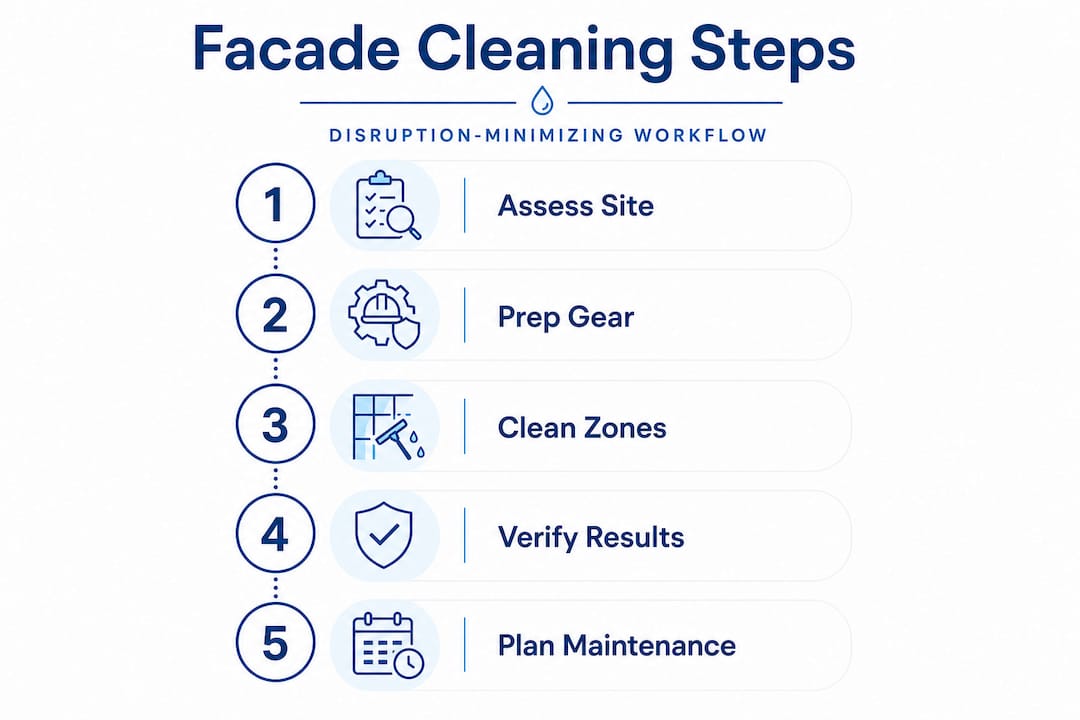
Ground-based approaches reduce disruption and improve safety in high-traffic areas.
Pro Tip: Involve your facility engineer early. They know utility access points and irrigation systems that could interfere with runoff.
Essential tools, systems, and safety gear
The tools you choose determine how long the job takes and how much space you occupy. Aim for maximum effectiveness with the smallest footprint.
Core equipment for ground-based cleaning:
- Water-fed pole system with purified water supply
- Switching nozzles for low-pressure chemicals and high-pressure rinses
- Trolley-mounted chemical applicator for cleaning solutions
- Traffic management: cones, stanchions, and barrier tape
- Hose management sleeves and cable ramps
Review this window cleaning safety guide to match gear with your chosen system.
| Method | Ground footprint | Avg. time per floor | Safety profile | Tenant disruption |
|---|---|---|---|---|
| Water-fed pole | Small (1-2 meters) | 30-60 min | High (ground-based) | Low |
| Boom lift | Large (6-10 meters) | 45-90 min | Moderate (at height) | High |
| Rope access | Minimal at ground | 45-90 min | Lower (at height) | Moderate |
| FAA-registered drone | Very small | 15-40 min | Highest (no worker at height) | Very low |
Pure-water pole systems keep personnel on the ground. This is vital in Brickell or Aventura, where lane closures are expensive. For taller properties, drone facade cleaning eliminates height risks entirely.
Warning: Hoses are a major slip-and-fall liability. Use cable ramps, secure all lines, and never leave them unattended across pedestrian paths.
Workers must wear non-slip boots, waterproof gloves, eye protection, and high-visibility vests.
Pro Tip: Use a pole system with an integrated ground valve to toggle between chemicals and rinsing. This saves up to 25% of setup time.
Step-by-step facade cleaning process
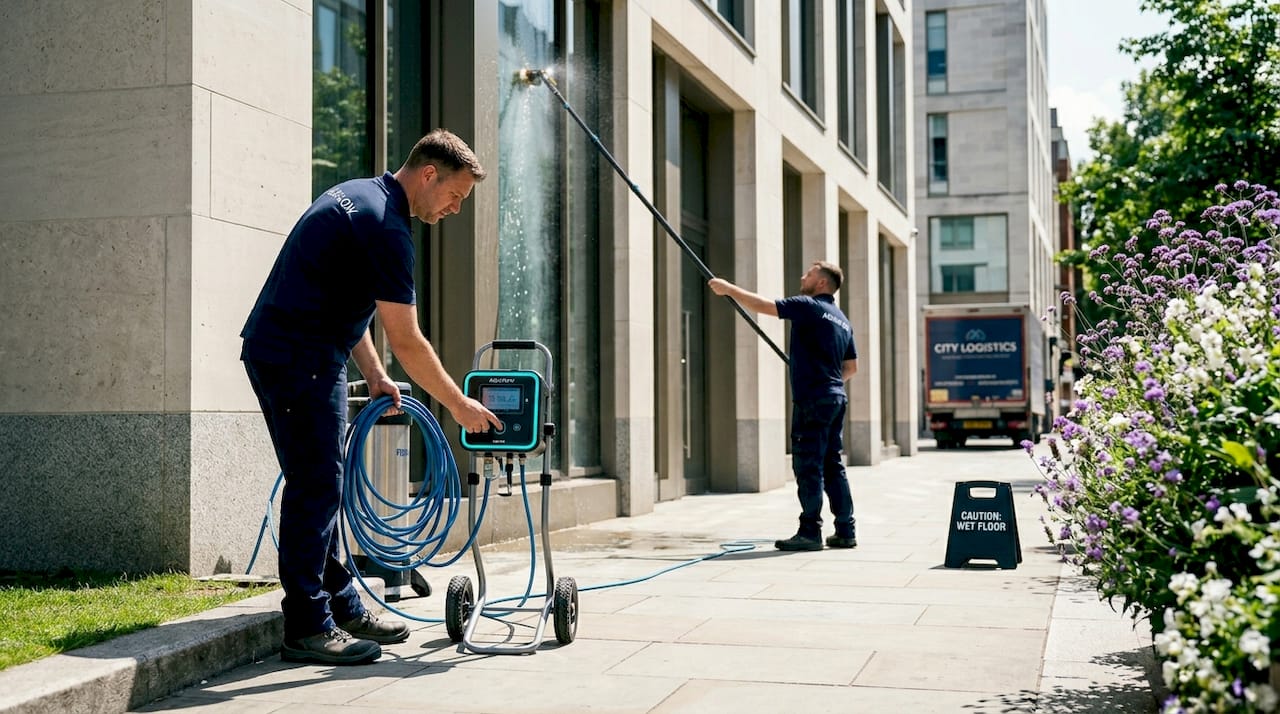
Disorganized crews create more disruption than the cleaning itself. A structured approach prevents surprise closures and noise complaints.
Minimally disruptive workflow:
- Notify stakeholders 72 hours in advance. Send notices to tenants and post signage at entrances. Include dates and emergency contacts.
- Stage during off-peak hours. Arrive before 7 a.m. Set up cones and ramps before traffic builds.
- Divide the facade into zones. Work from the top down to prevent contamination.
- Apply pre-treatment. Use low-pressure chemicals. Let them dwell for 5-10 minutes. Switching between pressures safely removes grime without damaging surfaces.
- Rinse top to bottom. Use high-pressure pure water. Collect and redirect runoff.
- Inspect and spot-treat. Check for missed spots, especially around window frames.
- Clear equipment zone by zone. Reopen areas progressively rather than keeping the entire perimeter closed.
- Final site walk. Rinse pavement and remove all residue.
- Notify tenants of completion. Confirm all areas are reopened.
Buildings cleaned without scaffolding reduce on-site time by 40-60%. Drones can often finish in a single day what a boom lift takes a week to complete.
Pro Tip: Batch zones by building wing. This concentrates disruption and shortens the notification window for residents.
Verifying results and maintaining a clean facade
Verification separates proactive managers from reactive ones. Don't assume the job is done based on a street-level glance.
Post-cleaning inspection:
- Visual inspection: Use binoculars to check upper floors for streaks or missed sections.
- Documentation: Take timestamped photos from the same angles as your "before" shots.
- Tenant feedback: Ask if residents noticed any disruption or visible results.
- Log the report: Document dates, methods, and chemicals for future planning.
- Schedule the next wash: South Florida’s climate requires attention every two to three months.
| Cleaning frequency | Estimated annual cost | Expected facade condition |
|---|---|---|
| Once per year | Low | Visible buildup, complaints likely |
| Twice per year | Moderate | Acceptable, some staining |
| 3-4 times per year | Moderate-high | Consistently clean |
| Monthly maintenance | Higher | Pristine condition |
Pro Tip: After a cleaning, email "before-and-after" photos to tenants. This builds goodwill and reduces future complaints.
What most facade cleaning guides miss about disruption and innovation
The method matters less than the execution. A building can use advanced drones, but if it blocks the entrance at 8 a.m. without notice, tenants will complain. Reliable maintenance is about the tenant experience.
The real advantage is operational discipline. Noise and blocked parking are the primary pain points. Innovation only works if communication is strong.
"The best system is forgotten if you fail to stage or notify tenants properly."
Scale your program starting with a pilot wing. Collect feedback before cleaning the entire property. Consistent schedules and proactive crews treat your building like the business it is.
Ready to transform your building's facade with less disruption?
Modern technology and local expertise deliver results with less hassle. Whether you manage a Brickell tower or an Aventura condo, the right method ensures tenants notice your building for the right reasons.
Our FAA-registered drone systems serve South Florida commercial properties with a smaller footprint and shorter timeline. From Brickell building cleaning to high-rises cleaned without scaffolding, we solve your specific challenges. View high-rise cleaning pricing and request a site assessment today.
Frequently asked questions
How do ground-based cleaning systems reduce tenant disruption?
They keep technicians at street level, minimizing overhead activity and keeping the work zone predictable.
Can chemicals be safely used during facade cleaning?
Yes. Systems switch between low-pressure application and high-pressure rinsing to minimize drift.
What's the main safety risk during ground-level cleaning?
Unsecured hoses across walkways. Always use cable ramps and dedicated spotters.
How often should commercial facades be cleaned in South Florida?
Two to four times per year, especially near the coast or high-traffic corridors.