
Building Envelope Maintenance: A Facility Manager's Guide
Discover what is building envelope maintenance and how it protects your property in Miami-Dade. Ensure structural integrity and energy efficiency!
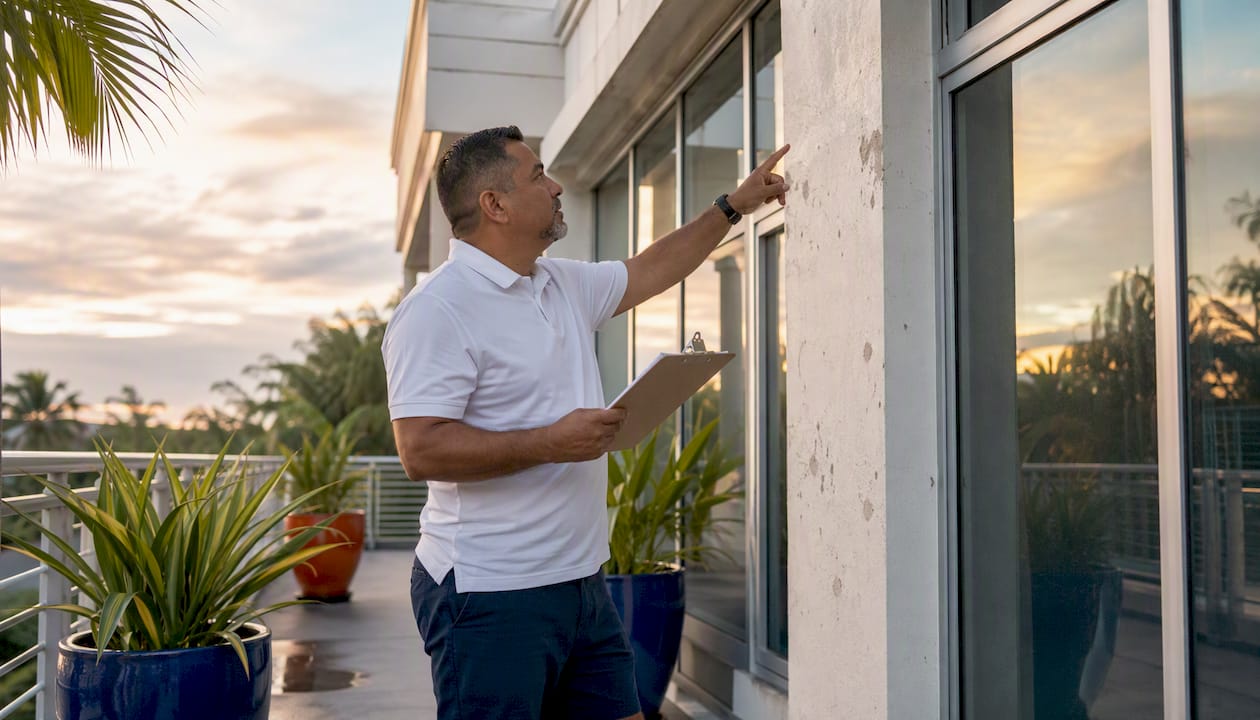

Building envelope maintenance is a scheduled program of visual inspections, diagnostic testing, and preventive repairs that protects a commercial building’s roof, exterior walls, windows, doors, foundations, and all transitions between them, keeping moisture out, energy in, and structural integrity intact. For properties in Miami-Dade, Broward, and Palm Beach counties, this is not a background task. Salt air, relentless UV exposure, hurricane-force winds, and year-round humidity put every component under stress that most national maintenance guides simply do not account for.
The building envelope is the physical skin separating a conditioned interior from the exterior environment. Its core components are:
- Roof system: membrane, insulation, drains, flashings, and penetrations
- Exterior walls and cladding: concrete, stucco, EIFS, curtain wall, metal panel, tile
- Windows, doors, and fenestration: frames, glazing, gaskets, and sealant perimeters
- Foundations and slab edges: below-grade waterproofing and exposed concrete edges
- Flashing and sealants: all transitions, joints, and penetrations between assemblies
- Junctions and penetrations: roof-to-parapet, deck expansion joints, mechanical curbs
Three goals drive every maintenance decision: prevent water intrusion before it reaches structural steel, preserve the building’s load-bearing integrity, and protect lifecycle value for insurance, financing, and local recertification programs. In South Florida, each of those goals carries a tighter deadline than anywhere else in the continental U.S.
Table of Contents
- What the building envelope actually includes, component by component
- Why regular assessments protect your budget and your building
- Routine inspection tasks and a practical checklist by asset
- Which diagnostic tools actually help, and where each one falls short
- How to build a reserve plan that reflects South Florida exposure
- How to build and run a building-envelope maintenance program
- Red flags that require a specialist, not a work order
- South Florida operational notes: what the climate changes about everything
- Key Takeaways
- The case for condition-based maintenance over calendar-only programs
- Drone-enabled exterior cleaning and inspection for South Florida commercial properties
- Useful sources and standards for your RFP and scope language
- FAQ
What the building envelope actually includes, component by component
Each component in the envelope has a distinct failure mode, and knowing them is what separates a reactive facilities team from a proactive one.

Roof systems in South Florida are almost always low-slope or flat, covered by TPO, modified bitumen, or built-up membranes. Their primary enemies are UV degradation, ponding water, and flashing separation at parapets and mechanical curbs. A roof that drains poorly in a Miami afternoon storm is already failing.
Exterior walls and cladding vary widely across the region’s commercial stock. Concrete and stucco dominate older high-rises in Brickell and Fort Lauderdale. EIFS (synthetic stucco) is common on mid-rise office and retail. Curtain wall glass systems define newer towers in Boca Raton and West Palm Beach. Metal panel cladding appears on warehouses and industrial buildings throughout Broward. Each substrate has a different chloride tolerance, UV response, and maintenance interval.

Windows and doors are the most frequently overlooked component until a tenant calls about a leak. Sealant at the window-to-wall junction is the single most common failure point on South Florida high-rises. That joint is exposed to thermal cycling every day, and in a marine environment, even a hairline gap becomes a chloride pathway.
Sealants and flashing are the connective tissue of the envelope. Roof-to-parapet flashing, deck expansion joints, and penetration collars all concentrate stress at transitions. A failed sealant joint costs a few hundred dollars to replace. The water damage behind it can cost tens of thousands.
Foundations and slab edges are easy to ignore because they are at grade or below it. Exposed slab edges on balconies and parking decks are among the first places chloride ingress shows up as rust staining, and by the time it is visible, internal corrosion is usually already underway.
Rooftop systems and solar arrays add penetrations, mounting hardware, and electrical conduit runs that all require their own sealing and periodic inspection. As more commercial properties in Miami-Dade and Broward add solar, these become envelope components that need to be in every asset register.
Pro Tip: Build a digital asset inventory before your next inspection cycle. Record component type, installation date, material, and known warranty terms for every sealant joint, facade bay, roof zone, and rooftop solar string. That database is what turns a vague reserve estimate into a defensible capital plan.
Why regular assessments protect your budget and your building
Proactive envelope assessments detect deterioration before it becomes a structural event. Failed sealants, aging membranes, and facade cracking are all visible long before water reaches embedded steel. Once it does, the repair scope multiplies.
In South Florida, the specific risks are chloride ingress and corrosion, hygrothermal degradation from sustained heat and humidity, wind-driven rain penetration, and UV-accelerated coating breakdown. These are not theoretical. Rust-colored streaks on a concrete facade, blistered coatings, or interior staining are signs that the envelope has already been breached.
The cost argument is straightforward. A planned sealant replacement on a 20-story building in Coral Gables runs a fraction of the cost of emergency waterproofing after a leak has tracked through three floors of interior finishes. Deferred maintenance does not save money; it converts small, predictable costs into large, unpredictable ones.
Documented condition data also matters for insurance and local recertification. Miami-Dade and Broward both have milestone inspection programs for older buildings. Facilities teams that maintain organized condition histories move through those processes faster and with fewer surprises. Preventive maintenance extends service life, prevents catastrophic water damage, and gives you real numbers for insurance conversations.
Routine inspection tasks and a practical checklist by asset
Coastal commercial roofs should be inspected at least twice per year and after every major storm. Use the checklist below as a starting template. Adapt severity ratings to your building’s age, exposure, and warranty requirements.
Inspection frequency baseline for South Florida:
- Quarterly visual checks for high-exposure elements (balconies, slab edges, roof drains, exposed sealant joints)
- Biannual full exterior surveys (all facade elevations, roof, windows, doors)
- Post-storm rapid assessments within 48–72 hours of any named storm or significant wind event
Checklist by asset:
- Roof zones: Check drains and scuppers for debris and standing water. Inspect membrane for blistering, splitting, or open seams. Examine all flashings at parapets, curbs, and penetrations for separation or cracking. Note any ponding areas exceeding 48 hours after rain.
- Exterior walls and cladding: Look for cracking, delamination, efflorescence, staining, and rust streaks. On EIFS, probe for soft spots indicating moisture behind the system. On concrete, note any spalling or exposed aggregate.
- Windows and doors: Check perimeter sealant for shrinkage, cracking, or adhesion failure. Test gaskets for compression loss. Look for water infiltration staining at sills and jambs.
- Balconies and slab edges: Inspect for rust staining, spalling, and cracking at slab edges and underside of balcony slabs. These are the highest-priority zones for chloride damage.
- Rooftop solar arrays and mechanical penetrations: Verify mounting hardware seals are intact. Check conduit penetration collars. Inspect panel surfaces for soiling, cracking, or delamination that affects output.
Severity ratings for each finding:
- Critical: Active leak, exposed rebar, structural cracking, or failed primary waterproofing. Requires immediate action and specialist notification.
- Schedule: Sealant shrinkage, minor cracking, drainage restriction. Repair within 4–12 weeks.
- Monitor: Surface staining, minor efflorescence, early coating chalking. Recheck at next inspection cycle.
Work-order fields to capture per finding: date, inspector name, asset ID, elevation and zone, photo/video reference number, severity rating, recommended action, estimated cost range, and follow-up date.
A detailed building exterior maintenance checklist can help property teams standardize these records across multiple buildings.
Which diagnostic tools actually help, and where each one falls short
Visual inspection finds what is already visible. Diagnostic tools find what is not.
| Tool | Primary Use | Limitations |
|---|---|---|
| Thermal imaging (infrared) | Detect moisture behind cladding, insulation gaps, air leakage | Requires temperature differential; best at dawn or dusk; not definitive without moisture meter confirmation |
| Drone / 4K aerial imaging | High-elevation facade survey, micro-crack detection, corrosion indicators | Cannot penetrate surfaces; requires FAA Part 107 certification and airspace clearance |
| Moisture meters | Confirm wet areas identified by thermal scan; quantify moisture content | Surface-contact only; invasive probes needed for deeper readings |
| Borescope / inspection camera | Inspect cavities, wall assemblies, and concealed joints without demolition | Limited field of view; requires access hole |
| Ultrasound / impact echo | Detect delamination in concrete and tile cladding | Requires trained operator; slow for large areas |
| 3D laser scanning / LiDAR | Measure deflection, settlement, and facade geometry over time | High cost; data processing requires specialist software |
| Water infiltration testing (ASTM E1105) | Confirm window and curtain wall leak paths under controlled pressure | Destructive if improperly applied; requires temporary water supply |
| Lab chloride testing | Quantify chloride concentration in concrete cores | Requires core extraction; results take days; used to confirm corrosion risk |
Pro Tip: Combine drone 4K imaging with a thermal scan pass and selective moisture metering. The drone survey identifies suspect zones across the full facade; thermal confirms moisture presence; moisture meters verify the readings before you open a wall. That sequence reduces invasive testing costs significantly and keeps tenant disruption to a minimum.
For buildings above six stories in Miami or Fort Lauderdale, drone-captured 4K imagery is the most practical way to survey micro-cracking, chalking, and early corrosion indicators at elevation without swing-stage scaffolding. Confirm that any drone operator holds FAA Part 107 certification and carries adequate liability coverage before they fly near your building.
How to build a reserve plan that reflects South Florida exposure
Generic service-life tables are a liability in this climate. Local exposure can reduce the service life of materials by 30–50% compared to national averages. A sealant joint rated for 20 years in a temperate inland climate may need replacement in 10–12 years on a Brickell high-rise facing Biscayne Bay.
Treat envelope components as individual assets in your reserve study. Mapping condition data per component produces accurate forecasts and avoids lump-sum emergency funding.
Sample reserve data fields per component:
| Component | Install Date | National Service Life | Local Adjustment | Remaining Useful Life | Estimated Replacement Cost |
|---|---|---|---|---|---|
| TPO roof membrane | , | 20 years | Reduce 30–40% | , | Contact roofing contractor |
| Perimeter sealant joints | , | 15 years | Reduce 30–50% | 3–5 years | Per linear foot; varies by substrate |
| Curtain wall glazing seals | , | 20 years | Reduce 30–40% | 2–4 years | Per bay; varies by system |
| Balcony slab edge coating | , | 10 years | Reduce 40–50% | 1–2 years | Per linear foot of edge |
| EIFS cladding system | , | , | Reduce 30–40% | , | Per square foot |
Prioritization order:
- Safety and compliance items (exposed rebar, active leaks, failed primary waterproofing)
- Leak-critical elements (roof membrane, window sealants, flashing)
- Energy and comfort drivers (insulation, air sealing, glazing performance)
- Aesthetic and tenant attraction items (coatings, cladding appearance)
Timing benchmarks: annual minor maintenance (drain clearing, spot sealant repairs), 3–5 year medium projects (full sealant replacement, localized cladding repairs), 10–20 year major renewals (roof replacement, curtain wall overhaul). South Florida exposure typically shortens each of those maintenance intervals. Integrating envelope repairs into a long-term asset management plan keeps capital spending predictable and avoids the panic-funding cycle that hits buildings with no reserve data.
How to build and run a building-envelope maintenance program
A maintenance program without a schedule is just a list of good intentions. Structure it around four inspection tiers.
Inspection schedule matrix:
| Frequency | Scope |
|---|---|
| Quarterly | Balconies, slab edges, roof drains, exposed sealant joints, solar array penetrations |
| Biannual | Full exterior facade survey, roof membrane, all windows and doors, drainage systems |
| Annual | Comprehensive condition report with severity ratings, cost estimates, and reserve update |
| Post-storm | Rapid visual assessment of all elevations, roof, and drainage within 72 hours |
Recordkeeping practices that actually hold up under scrutiny:
Keep digital logs with geotagged photos, asset IDs, and versioned condition reports. A photo baseline from 2022 is worth more than any verbal description when an insurer or recertification engineer asks what changed. Store reports in a format your successor can open without calling you.
Contractor selection checklist:
When hiring for an envelope survey or repair scope, ask for: proof of general liability and workers’ compensation insurance, licensed engineer involvement for any structural findings, documented experience with coastal materials (EIFS, concrete, curtain wall), thermal and moisture testing capabilities, and a clear deliverables list. That list should include annotated 4K imagery, a prioritized repair schedule, cost estimates per finding, and a remaining useful life estimate for each major component.
RFP scope language worth including:
For surveys: “Provide annotated 4K imagery, thermal maps, moisture readings, and a remaining useful life estimate with cost ranges for each envelope component.” For repairs: “Specify permit coordination, warranty terms by trade, and inspection sign-off requirements per Florida Building Code.” Understanding how building regulations apply to maintenance works helps you write tighter scopes and avoid scope gaps that become change orders.
For retail and mixed-use properties, a shopping center facade maintenance checklist covers the cladding and drainage considerations specific to lower-rise commercial buildings.
Red flags that require a specialist, not a work order
Some findings are not maintenance items. They are emergencies. Know the difference before you send a handyman.
Escalate immediately when you see:
- Rust-colored streaks running down a concrete or stucco facade (internal rebar corrosion already underway)
- Active leaks at multiple elevations simultaneously (systemic waterproofing failure, not a single joint)
- Visible spalling with exposed rebar on balconies or slab edges (structural integrity at risk)
- Large deflections or progressive cracking in structural members or facade panels
- Rapid interior mold growth that returns within weeks of remediation (moisture source not resolved)
- Water intrusion into electrical or mechanical rooms (immediate life-safety concern)
- Failed primary waterproofing at plaza decks or roof drains with standing water
Emergency action sequence:
- Isolate the affected area and restrict access
- Document with 4K photos and video, noting exact location by asset ID and elevation
- Notify building ownership, property management, and insurance carrier
- Install temporary weather protection (poly sheeting, temporary roofing, vapor barriers) to limit further exposure
- Commission a forensic engineer or registered architect for a specialist assessment before any permanent repair begins
In South Florida, balconies and slab edges are the most common early-warning zones. Treat them as higher priority than any other inspection target, and do not defer findings there to the next annual cycle.
South Florida operational notes: what the climate changes about everything
Salt air is not just a corrosion risk. It is the primary degradation mechanism for coastal reinforced concrete, and it operates invisibly. Small surface cracks in stucco or concrete coatings are routinely dismissed as cosmetic. In a marine environment, they are chloride entry points. By the time rust streaks appear on the facade, internal spalling is often already underway. That sequence, from hairline crack to structural remediation, can unfold in as few as five years on a building within a mile of the coast.
South Florida’s hygrothermal environment adds a second layer of stress. High humidity and sustained heat drive moisture vapor through assemblies that would perform adequately in a drier climate. Materials need to be selected for corrosion resistance and UV stability, not just structural performance. Fixatives, anchors, and fasteners in coastal applications should be stainless steel or hot-dip galvanized at minimum.
Operationally, this means increasing inspection frequency for high-exposure elements, maintaining aggressive drainage schedules to prevent ponding, and planning sealant and coating renewals on shorter cycles than national guidelines suggest.
For recertification purposes in Miami-Dade and Broward, documented condition histories are not optional. Buildings approaching 40-year or subsequent milestone inspections with organized, dated inspection records move through the process with fewer engineer-flagged items and lower remediation costs. Facilities teams that have been documenting quarterly since the last cycle have a measurable advantage.
Pro Tip: Drone 4K imagery is the most practical tool for building a documented condition baseline on a South Florida high-rise. A single drone survey covers all elevations in a fraction of the time a swing-stage inspection requires, with no road closures, no permits, and no disruption to tenants. Use it to establish your baseline, then update it annually.
Key Takeaways
Proactive building envelope maintenance, grounded in asset-level condition data and adjusted for South Florida’s coastal exposure, is the single most effective way to control long-term repair costs and reduce recertification risk.
| Point | Details |
|---|---|
| Build an asset inventory first | Record installation dates, materials, and warranty terms for every envelope component before your next inspection cycle. |
| Adjust service-life estimates locally | South Florida exposure significantly reduces national service-life benchmarks; use local adjustment factors in every reserve study. |
| Inspect quarterly for high-risk zones | Balconies, slab edges, roof drains, and exposed sealant joints need eyes on them every quarter, not just annually. |
| Document for insurance and recertification | Dated condition reports and geotagged photo logs are the evidence that protects you during milestone inspections and insurance claims. |
| Vistadronecleaning for baseline documentation | Vistadronecleaning’s FAA-certified drone surveys cover all elevations with 4K imagery, no scaffolding, and minimal tenant disruption across Miami-Dade and Broward. |
The case for condition-based maintenance over calendar-only programs
Most facilities teams run on a calendar. Inspect in March, inspect in September, repeat. That rhythm is better than nothing, but it misses the point. A building that had a hard hurricane season in August needs a post-storm assessment in September, not a routine biannual check. A sealant joint installed in 2015 on a Brickell tower facing east needs replacement based on its observed condition and chloride exposure, not because a national standard says sealants last 15 years.
Condition-based maintenance means the inspection data drives the schedule, not the other way around. It requires better recordkeeping, more specific asset inventories, and a willingness to act on findings before they become emergencies. The payoff is predictable capital spending, fewer insurance claims, and a building that performs through recertification without a crisis.
At Vistadronecleaning, our FAA Part 107-certified pilots and tethered industrial drones provide the 4K exterior documentation that makes condition-based programs practical for high-rises across South Florida. We cover what a ground-level walk cannot, without the cost or disruption of traditional access methods.
Drone-enabled exterior cleaning and inspection for South Florida commercial properties
For facilities teams managing high-rises in Miami, Fort Lauderdale, Boca Raton, or anywhere across Miami-Dade and Broward, exterior access is one of the biggest friction points in envelope maintenance. Scaffolding takes weeks to permit and install. Boom lifts require road closures. Rope access carries significant liability.

Vistadronecleaning offers a direct alternative. Using FAA Part 107-certified pilots and tethered Lucid Bots Sherpa industrial drones, the team delivers drone window washing, facade cleaning, roof soft-wash, and solar panel pure-water cleaning on commercial buildings up to 200 feet tall, with crews staying safely on the ground throughout. Most projects finish in 1–3 days at 30–60% lower cost than traditional scaffold or lift methods.
Every service includes before-and-after 4K documentation, substrate-matched soft-wash chemistry for glass, stucco, concrete, EIFS, metal, tile, and solar panels, and asset-tagged photo reports you can use directly in your condition records. Thermal imaging add-ons are available for facilities teams building a diagnostic baseline.
Drone cleaning and documentation complement your engineering and repair program. They do not replace licensed engineers for structural findings or invasive testing. What they do replace is the access cost and delay that keeps many facilities teams from documenting their buildings as often as they should.
Compare drone versus traditional window cleaning to see the access, cost, and timeline differences in detail, or request a free quote for your South Florida property at vistadronecleaning.com/high-rise-window-cleaning.
Useful sources and standards for your RFP and scope language
When writing scopes for envelope surveys or repair work, referencing specific standards and organizations signals to contractors that you know what you are asking for.
- FEMA Building Science: Guidance on wind and flood resistance for commercial structures; useful for post-storm assessment protocols and resilience planning.
- Florida Building Commission (floridabuilding.org): The Florida Building Code governs envelope performance requirements, testing standards, and permit requirements for all repair and replacement work statewide.
- ASTM E1105: Standard test method for field determination of water penetration of installed exterior windows, skylights, doors, and curtain walls. Reference this in any window or curtain wall survey scope.
- ASTM C1601: Standard test method for field determination of water penetration of masonry wall surfaces. Relevant for stucco and concrete cladding scopes.
- ASTM E1186: Standard practices for air leakage site detection in building envelopes. Useful for thermal and pressure-based diagnostic scopes.
- Rimkus Building Envelope Consulting: Forensic and consulting services for commercial envelope failures; relevant for post-storm or litigation-adjacent assessments.
- Biller Reinhart Engineering: Building envelope consulting with lifecycle estimates and Florida Building Code alignment; relevant for reserve planning and performance testing scopes.
- Miami-Dade and Broward milestone/recertification programs: Both counties require structural and electrical inspections at 40 years and every 10 years thereafter. Documented envelope condition histories directly support these inspections.
Standard RFP deliverable language: “Provide annotated 4K imagery, thermal maps, moisture readings per ASTM standards, and a remaining useful life estimate with cost ranges for each envelope component inspected.”
FAQ
What does “building envelope” mean in construction?
The building envelope is the physical barrier separating a building’s conditioned interior from the outdoor environment, including the roof, exterior walls, windows, doors, foundations, and all transitions between them. It manages moisture, air infiltration, thermal flow, and structural loads.
How often should a commercial building envelope be inspected?
Coastal commercial properties in South Florida should receive at least two full exterior surveys per year, quarterly visual checks for high-exposure elements like balconies and roof drains, and a rapid assessment within 72 hours after any major storm event.
Is HVAC part of the building envelope?
HVAC equipment is not part of the building envelope itself, but rooftop HVAC units create penetrations through the envelope that require their own sealing, flashing, and periodic inspection. The penetration collar and curb are envelope components; the mechanical unit is not.
When should a facility manager hire a building envelope consultant?
Hire a licensed engineer or registered building envelope consultant when you see active leaks at multiple elevations, visible spalling with exposed rebar, progressive structural cracking, or when preparing for a milestone recertification inspection. Routine surveys can be handled by qualified inspectors, but structural findings require a licensed professional.
What is a maintenance envelope in property management?
In property management, “maintenance envelope” typically refers to the scope and budget allocated for ongoing upkeep of a building’s physical systems. In building science, the term “building envelope” specifically describes the physical shell of the structure, and maintaining it is the focus of a formal envelope maintenance program.