What Is No-Barrier Exterior Cleaning for High-Rises?
Discover how no-barrier exterior cleaning uses drones for high-rise washing, eliminating scaffolding and traffic disruptions while ensuring a pristine shine.
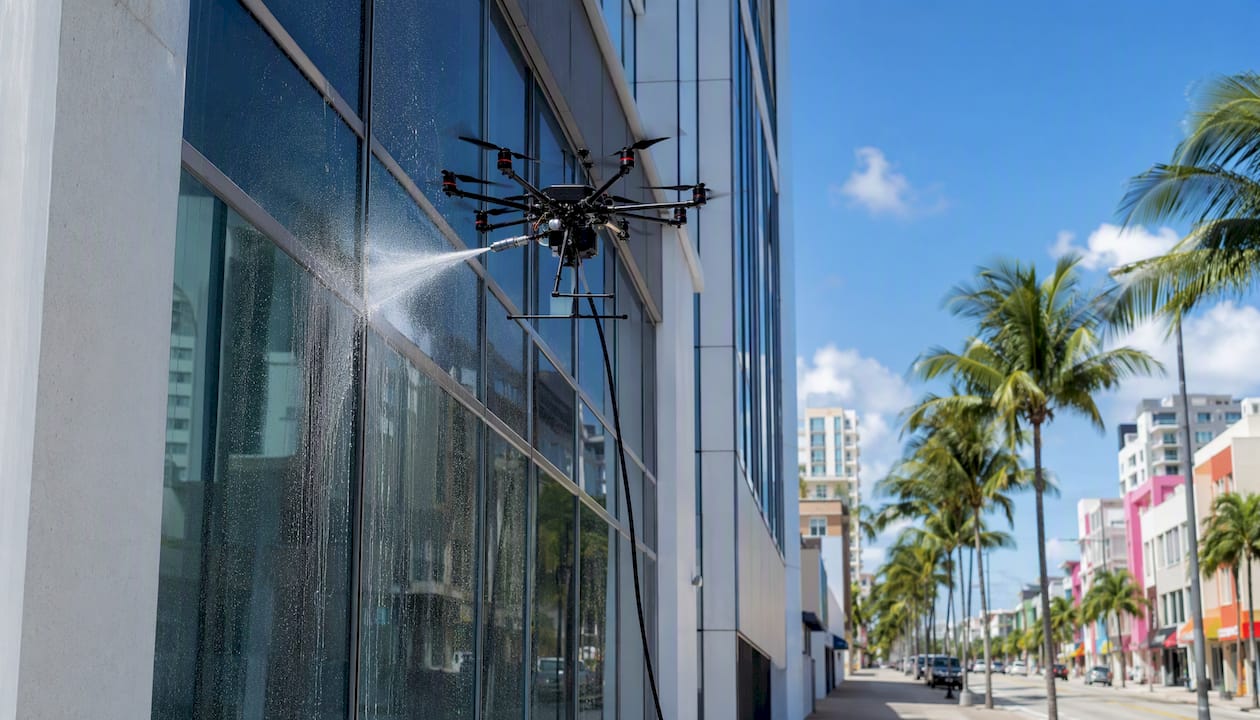
No-barrier exterior cleaning is drone-based high-rise washing that skips scaffolding, boom lifts, rope access, road closures, and ground rigging entirely. FAA Part 107-certified pilots fly tethered industrial drones from street level, rinsing glass, facades, roofs, and solar arrays with pure de-ionized water. If your South Florida property needs its windows or facade cleaned without shutting down a lane of traffic or renting a lift for a week, this is worth a call. Vista Drone Cleaning runs this exact model on buildings up to 200 feet across Miami-Dade, Broward, and Palm Beach counties.
- No scaffolding, lifts, or rope access required
- Crews and pilots stay on the ground the entire time
- Works on buildings up to 200 feet tall
Key Takeaways
No-barrier exterior cleaning replaces scaffolding and lifts with FAA Part 107-certified drone pilots and pure de-ionized water, cutting both project time and safety risk on South Florida high-rises.
| Point | Details |
|---|---|
| Core definition | Drone-based high-rise cleaning without scaffolding, lifts, rope access, or road closures. |
| Certification is non-negotiable | Confirm FAA Part 107 status for every pilot before signing a contract. |
| Insurance minimum | Require at least $2 million in general liability coverage with a named certificate. |
| Best-fit buildings | Glass curtain walls, EIFS, solar arrays, and metal panels up to 200 feet suit drones best. |
| Vista Drone Cleaning | Serves Miami-Dade and Broward with 1 to 3 day projects, 4K documentation, and free 24-hour quotes. |
Table of Contents
- How Does No-Barrier Drone Cleaning Actually Work?
- What Benefits Does No-Barrier Cleaning Offer Over Scaffolding?
- Is Your Building a Good Fit for Drone Cleaning?
- What Safety and Insurance Credentials Should You Verify?
- How Long Does a Drone Cleaning Project Take and Cost?
- How Do You Vet a No-Barrier Cleaning Provider?
- A South Florida High-Rise Case in Practice
- Are Drone Cleaning Chemicals Safe for the Environment?
- How Does Drone Cleaning Compare to Robotic Cleaning Systems?
- What Permits and Privacy Rules Apply to Drone Cleaning?
- How Should You Maintain a Drone-Cleaned Facade?
- What Field Crews Wish Every Building Manager Knew
- Ready to Get a Quote for Your South Florida Building?
- Useful Sources for Further Reading
- FAQ
How Does No-Barrier Drone Cleaning Actually Work?
The process starts before a drone ever leaves the ground. A site survey checks wind conditions, nearby airspace, and where the crew can hook into a water source, since pure water systems need a steady supply to run efficiently.
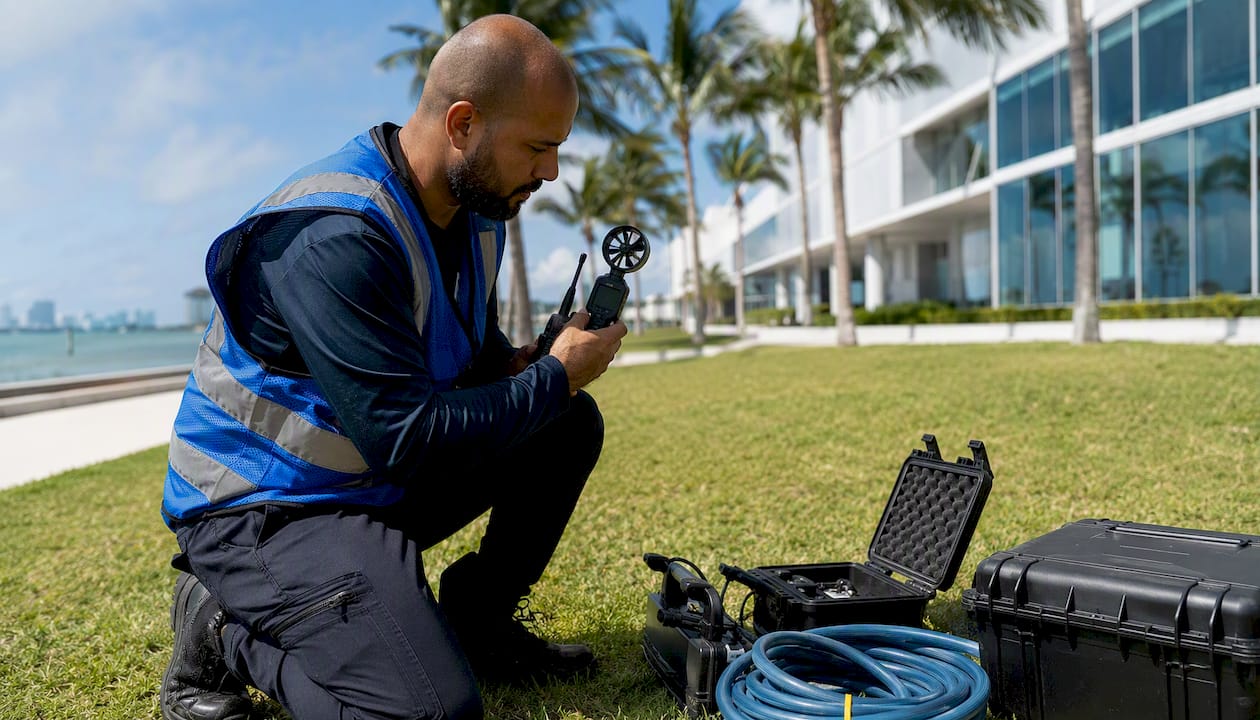
Once cleared, the crew sets up a ground control station and a safety perimeter around the building’s base. The pilot, certified under FAA Part 107, launches a tethered industrial drone, the kind of platform Lucid Bots Sherpa represents in the commercial market, connected to a continuous power and water line. That tether matters: it lets the drone hover and work for extended stretches instead of cycling back to refill a water tank.
RTK/GPS positioning keeps the flight path precise across a glass curtain wall or a stucco facade, while a live camera feed lets the pilot monitor the rinse pattern in real time. The drone cleaning process generally follows this order:
- Mobilize equipment and crew to site
- Survey conditions and confirm access
- Establish safety perimeter and water hookup
- Run cleaning passes with pure de-ionized water
- Quality-check the rinse and document results
- Demobilize and deliver 4K before/after photos
Pro Tip: Schedule your site survey for early morning. South Florida’s afternoon thunderstorms and gusty sea breezes are the biggest cause of rescheduled drone jobs from June through September.
What Benefits Does No-Barrier Cleaning Offer Over Scaffolding?
Removing workers from height changes the entire risk profile of a facade cleaning job. Drone cleaning eliminates the need for scaffold erection and the fall-risk exposure that comes with it, which also strips out the permitting and road-closure overhead that scaffolding and boom lifts typically require.
For a Brickell office tower or a Fort Lauderdale beachfront condo, the practical advantages usually break down like this:
- Faster mobilization since there’s no rigging to build or inspect
- Lower direct costs without scaffold rental or lift fees
- No road closures or lane permits needed
- Reduced liability exposure since crews never leave ground level
- Minimal disruption to tenants, guests, and pedestrians below
Vista Drone Cleaning typically finishes most South Florida projects in 1 to 3 days at 30 to 60 percent lower cost than traditional scaffold or lift methods, especially on recurring maintenance contracts.
Drones tend to outperform traditional access on buildings with large, continuous glass surfaces, think curtain-wall hotels along Miami Beach, where a lift would need to reposition dozens of times to cover the same square footage a drone clears in one pass.
Is Your Building a Good Fit for Drone Cleaning?
Not every property is a candidate, and a five-minute screening usually settles it. Buildings with broad, uninterrupted facades, glass curtain walls, stucco, EIFS, concrete, metal panels, or rooftop solar arrays tend to work best, especially when there’s reliable water access nearby and clear airspace overhead.
Industrial tethered systems operate effectively up to 200 feet, though tight urban canyons or unusually gusty rooftop conditions can limit certain passes. A nine-factor suitability check covering facade type, obstructions, wind, and pedestrian density is a smart first filter before requesting a quote.
- Good fit: glass towers, EIFS facades, solar arrays, metal panel systems
- Poor fit: fragile historic stone, heavy structural repair zones, dense ornamentation
Pro Tip: If your building has deep architectural recesses or balconies stacked tightly together, ask your provider whether a hybrid approach, drone for the flat runs, spot work for tight corners, makes more sense than an all-drone job.
What Safety and Insurance Credentials Should You Verify?
Before signing anything, confirm the provider’s pilots hold active FAA Part 107 certification and that the company can produce a written safety management procedure, not just a verbal assurance. Tethering system specifications should be available on request, since that’s what keeps the drone supplied and stable through an entire pass.
Insurance is where corners get cut. A property manager should never accept less than $2 million in general liability coverage, backed by a certificate of insurance naming your property, plus clear indemnity language in the contract.
| Document to Request | What It Confirms |
|---|---|
| FAA Part 107 pilot certificates | Pilots are legally licensed to fly commercially |
| Certificate of insurance ($2M+) | Liability coverage protects your property |
| Method statement | Written process for the specific job scope |
| MSDS for cleaning chemistries | Safety data on any soft-wash agents used |
Pro Tip: Ask for pilot certification copies before the site visit, not after the contract is signed. A provider that hesitates here is a red flag worth noting.
How Long Does a Drone Cleaning Project Take and Cost?
Most South Florida jobs start with a site review and quote turnaround of 24 to 72 hours. Mobilization on the actual job day takes hours, not days, and the cleaning itself typically wraps in 1 to 3 days for common mid-rise and high-rise scopes.
You should walk away with more than clean windows. Expect 4K before/after photo documentation, a completion report, and substrate-specific maintenance recommendations for your facade type.
- Facade area and surface complexity
- Water access on site
- Chemistry required for the substrate
- Traffic control needs, if any
- Whether it’s a one-time job or an annual contract
Pricing scales with these factors, but recurring annual contracts consistently land 30 to 60 percent lower in total cost over a scaffolding contract’s lifetime, largely because there’s no repeated rigging expense every cycle.
How Do You Vet a No-Barrier Cleaning Provider?
Procurement moves faster when you know exactly what to ask. Start with the basics and work down to specifics before you request a formal proposal.
- Confirm local South Florida project experience, not just general drone credentials
- Verify FAA Part 107 certification for every pilot who will work your site
- Request the $2 million certificate of insurance by name
- Ask what equipment they run and whether it’s tethered for continuous operation
- Confirm they use pure de-ionized water and can explain their substrate-matched chemistry approach
Sample questions worth asking on a vendor call:
- How many jobs like mine have you completed in the last year?
- What’s your typical timeline for a building this size?
- Who’s liable if a window seal or panel is damaged during cleaning?
- What documentation do you deliver when the job’s done?
Watch for red flags: vague answers about insurance limits, no 4K documentation offered, or reluctance to share pilot certifications or a written method statement. A detailed comparison of access methods can help frame these questions if you’re presenting options to a board or ownership group.
A South Florida High-Rise Case in Practice
A Miami-area office tower needed its glass facade and rooftop solar array cleaned without disrupting tenants or blocking the loading zone below. Vista Drone Cleaning sent FAA Part 107-certified pilots with a tethered industrial drone system, running a pure de-ionized water rinse across the entire building.
- Full facade and solar array completed within the company’s standard 1 to 3 day window
- No lane closures, no lift rental, no tenant relocation
- 4K before/after documentation delivered as part of the completion report
The building’s management team avoided the scheduling headache of coordinating a boom lift around tenant parking, and the solar array came back online at full output the same week.
Are Drone Cleaning Chemicals Safe for the Environment?
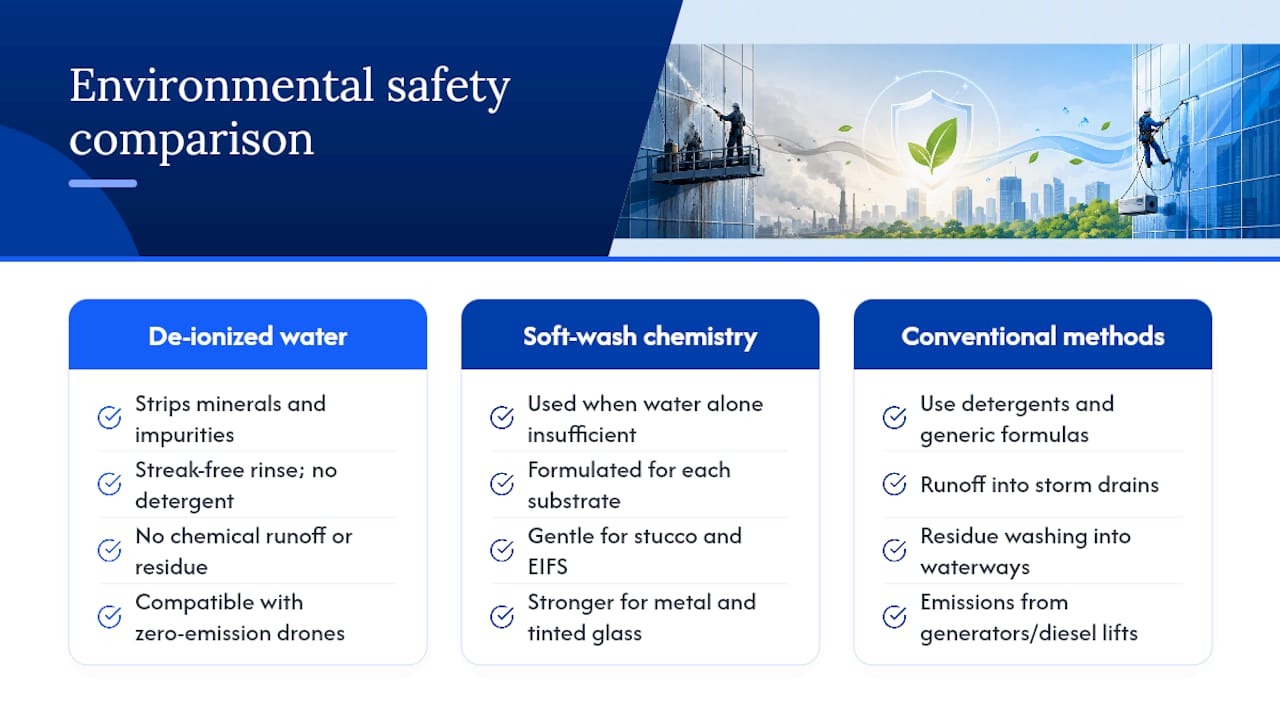
Pure de-ionized water is the backbone of a no-barrier clean. It strips minerals and impurities from tap water, which means glass and solar panels rinse streak-free without any detergent at all. No runoff chemicals, no residue washing into storm drains, no emissions from generators or diesel-powered lifts.
Where a facade needs more than water alone, substrate-matched soft-wash chemistry comes into play, formulated specifically for the material it’s touching. Stucco and EIFS need a gentler approach than sealed metal panels or tinted glass, and a provider worth hiring will adjust the mix rather than run one generic formula across every surface.
This matters more in South Florida than most places. Coastal properties sit close to canals, bays, and stormwater systems that feed directly into sensitive waterways. A zero-emission drone platform running on electric power, paired with a water-based rinse system, keeps a facade cleaning job from becoming a runoff problem for the building next door or the canal behind it.
For HOA boards weighing environmental disclosures or sustainability reporting, this is a detail worth documenting. Buildings pursuing LEED credits or green certification standards can point to non-toxic cleaning methods as part of their maintenance record, something a sustainability-focused approach to building upkeep increasingly requires.
How Does Drone Cleaning Compare to Robotic Cleaning Systems?
Automated robotic window-cleaning systems, the kind mounted permanently on a building’s roofline and running on tracks down the facade, solve a narrower problem than drones do. They work well on new-construction towers designed around them from day one, gliding along a fixed rail system across flat glass.
The catch is flexibility. Robotic systems are typically installed once during construction and can’t easily adapt to older buildings, irregular facade shapes, or one-off jobs like a roof or solar array that sits outside their rail path. Retrofitting an existing South Florida high-rise with a robotic rail system means significant capital investment and construction disruption most property managers aren’t looking to take on.
Tethered industrial drones go anywhere the pilot can fly them, glass, stucco, metal, tile roofs, solar arrays, without a fixed installation. That makes drones the more practical choice for the vast majority of existing commercial buildings across Miami-Dade, Broward, and Palm Beach counties, where retrofitting a permanent robotic system simply isn’t on the table. Robotic rail systems still have a place in new-build design, but for the buildings standing today, drone-based cleaning covers more ground with far less upfront cost.
What Permits and Privacy Rules Apply to Drone Cleaning?
FAA Part 107 certification covers the pilot’s authority to fly commercially, but it doesn’t automatically clear every local requirement. Some South Florida municipalities require notice or coordination when commercial drone work happens near flight paths or over public sidewalks, particularly in dense areas like downtown Miami or Fort Lauderdale’s waterfront district.
Building codes matter too. Local codes may specify how facade cleaning chemistries get disposed of, especially near canals and drainage systems common throughout coastal Miami-Dade and Broward. A provider using pure de-ionized water with minimal runoff typically sidesteps most of these concerns, but it’s worth confirming during procurement.
Privacy is the other consideration boards ask about. A drone flying past residential balconies or office windows raises reasonable questions. Reputable operators fly a planned route focused on the facade surface itself, not building interiors, and keep camera feeds limited to documenting the cleaning work rather than recording occupants. If your HOA or building management has tenants who’ve raised privacy concerns before, it’s worth asking your provider directly how they handle flight paths near occupied units and whether they can schedule work during hours when fewer residents are near windows.
How Should You Maintain a Drone-Cleaned Facade?
A pure de-ionized water rinse leaves glass and solar panels streak-free without any chemical residue sitting on the surface, which actually helps maintenance in the weeks after a job. Because there’s no detergent film left behind, dust and pollutants take longer to reaccumulate compared to surfaces cleaned with standard tap water or generic sprays.
For solar arrays specifically, a clean pure-water rinse restores output efficiency immediately, and South Florida’s pollen season and occasional Saharan dust events mean panels benefit from a maintenance cleaning cycle every few months rather than a single annual pass. EIFS and stucco facades treated with substrate-matched soft-wash chemistry hold up better against mildew regrowth, a real concern given South Florida’s humidity, but only if the initial treatment matched the material correctly.
Most providers will hand over substrate-specific recommendations as part of the completion report. Following those notes, rather than defaulting to a generic annual cleaning schedule, is what actually extends the interval between jobs. Buildings on the coast, exposed to more salt spray and airborne grit, generally need shorter cycles than inland properties in West Palm Beach or Coral Springs.
What Field Crews Wish Every Building Manager Knew
Getting a tethered drone set up on a busy Brickell sidewalk during morning rush hour is a different job than doing it in a quiet Boca Raton office park at 7 AM. The building managers who make scheduling easiest are the ones who flag delivery zones, resident foot traffic patterns, and water hookup locations before the crew shows up.
One thing worth passing along: book your water access confirmation a day ahead, not the morning of. FAA Part 107-certified crews move fast once they’re set up, but a missing hose bib connection can stall an entire morning.
Ready to Get a Quote for Your South Florida Building?
If your building fits the profile, broad facade, reliable water access, and you’re tired of coordinating lift rentals and lane closures, requesting a quote takes less effort than most managers expect. Vista Drone Cleaning offers free site reviews with a response within 24 hours, covering Miami-Dade and Broward properties from high-rise condos to hotel towers and rooftop solar arrays.
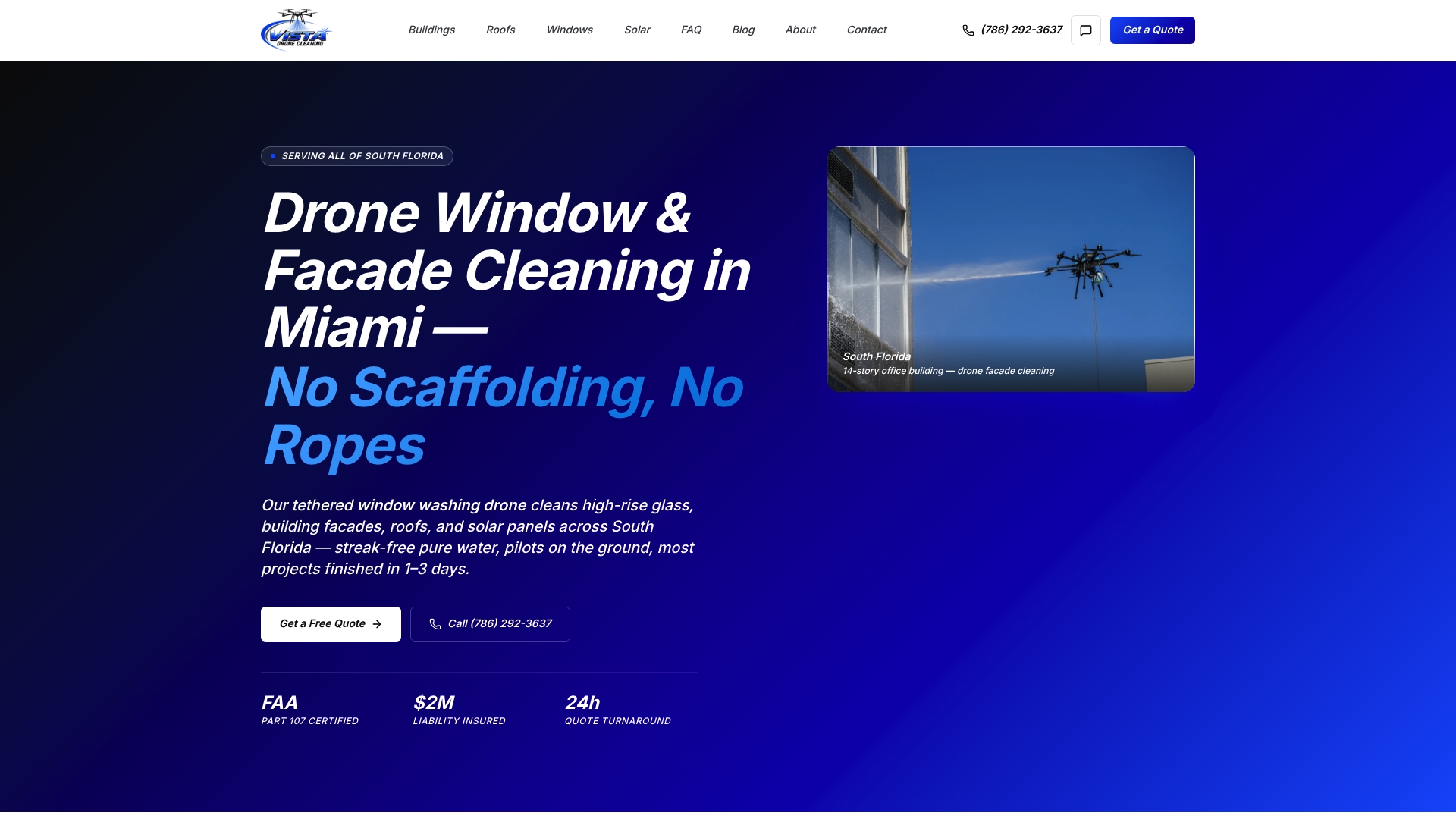
To get started, send over a few basic details: recent photos of the facade or roof, the building’s address, approximate height, and your preferred service window. From there, a site review confirms scope and access before you receive a fixed-price proposal, no obligation attached. If you want to see the full breakdown of how drone cleaning stacks up against scaffolding or lifts for your specific building type, the drone versus traditional cleaning comparison walks through the numbers in more detail. When you’re ready, request your free quote for Miami high-rise window washing and get a scheduled site visit on the calendar this week.
Useful Sources for Further Reading
- How drone window cleaning works: equipment and pure-water process explained
- Drone facade cleaning Miami: local high-rise soft-wash services
- Commercial building cleaning Miami: building types and deliverables
- High-rise facade cleaning methods compared: access method comparison guide
- Drone Cleaning vs Traditional Methods: cost, safety, and efficiency data
- Building suitability screening factors: nine-point checklist for facade candidates
FAQ
What Is No-Barrier Exterior Cleaning?
It’s drone-based high-rise exterior cleaning that removes the need for scaffolding, boom lifts, rope access, or road closures, with FAA Part 107-certified pilots operating tethered drones from the ground.
How High Can Drone Cleaning Reach?
Tethered industrial drone systems like the one Vista Drone Cleaning uses effectively clean buildings up to 200 feet tall.
Is Drone Cleaning Cheaper Than Scaffolding?
Recurring drone cleaning contracts typically run 30 to 60 percent lower in total cost than scaffolding over a contract’s lifetime, mainly because there’s no rigging expense each cycle.
What Insurance Should a Provider Carry?
Look for at least $2 million in general liability coverage backed by a certificate naming your property, along with clear indemnity terms in the contract.
Can Drones Clean Solar Panels Safely?
Yes. Pure de-ionized water rinses solar arrays streak-free without detergents, and Vista Drone Cleaning offers this as a dedicated service across South Florida.
How Long Does a Typical Job Take?
Most mid-rise and high-rise jobs finish in 1 to 3 days, with site review and quote turnaround typically taking 24 to 72 hours beforehand.