Fivefold Faster: Tethered Drone Cleaning for South Florida High Rises
Facility managers in Miami Dade, Broward, and Palm Beach: see how tethered drone cleaning cuts façade time fivefold, saves over 60% water, and meets Part...
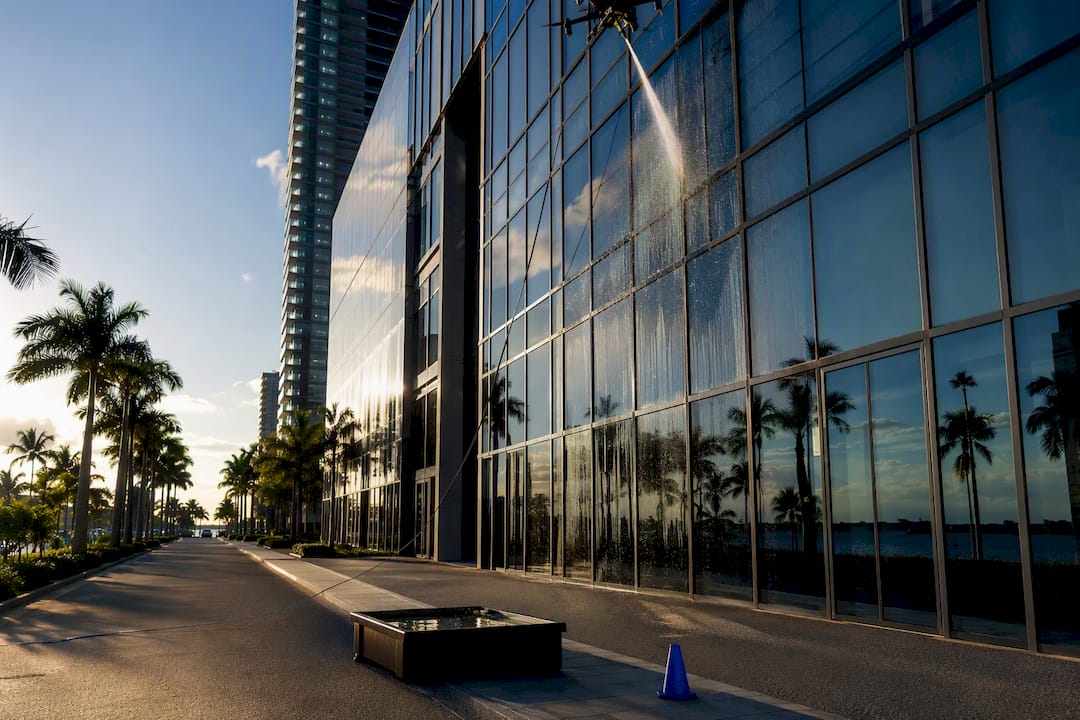
It still operates under FAA Part 107, so certification and insurance checks matter before any building owner signs a contract.
TL; DR:
- Tethered drones provide continuous operation by linking to ground water in a way that battery-powered drones cannot, especially on high-rise buildings.
- They achieve water savings of over 60% through precision nozzles and closed-loop flow control, reducing runoff and cleaning passes.
- Tethered drone jobs can cover approximately 500 square meters per hour, five times faster than manual crews, significantly lowering labor and staging costs.
- FAA Part 107 certification and insurance requirements still apply, and proper preflight planning is essential to comply with regulations.
- Limitations include ground space needs, wind sensitivity, and hose drag at high elevations, making them unsuitable for sites with restricted staging or no ground-level access.
Table of Contents
- What Are the Main Benefits of Tethered Drone Cleaning?
- How Do Tethered Drones Clean Without Stopping to Refill a Tank?
- What Do Tethered Drones Save on Labor, Time, and Cost?
- Does FAA Part 107 Apply to Tethered Drones?
- Where Tethered Systems Run Into Trouble
- Which Buildings Get the Most Value From Tethered Cleaning?
- Vista Drone Cleaning’s Track Record in South Florida
- What Facility Managers Should Check Before Hiring a Vendor
- Get a Free Quote for Your Building
- Sources
- FAQ
What Are the Main Benefits of Tethered Drone Cleaning?
A tethered cleaning drone connects to a ground unit by a hose and power line instead of running on a battery and an onboard tank. That single design choice changes almost everything about how a façade job gets done.
- Safety: pilots and technicians stay on the ground the entire time, cutting the fall exposure that comes with rope access or boom lifts.
- Productivity: continuous water and power mean longer uninterrupted passes and fewer stops per shift.
- Sustainability: closed-loop flow control and precision nozzles cut water use by more than 60% compared with traditional pressure washing.
- Quality: steady positioning lets the drone hold a consistent stand-off distance, so glass and metal panels get even coverage instead of streaky, rushed passes.
- Operational simplicity: many jobs skip the permitting and road closures that scaffolding and lift rentals often require in dense commercial corridors like Brickell or downtown Fort Lauderdale.
Facility managers weighing bids should treat this list as a baseline, not a marketing claim. Ask any vendor to show how each point plays out on a building similar to yours.
How Do Tethered Drones Clean Without Stopping to Refill a Tank?
The tether does two jobs at once: it feeds pressurized water from a ground reservoir, and it helps anchor the drone’s position in the air. That’s a meaningfully different setup than a battery-and-tank drone, which has to land, recharge, and refill every 15 to 40 minutes before it can keep working, according to comparisons of tethered and battery-powered systems.
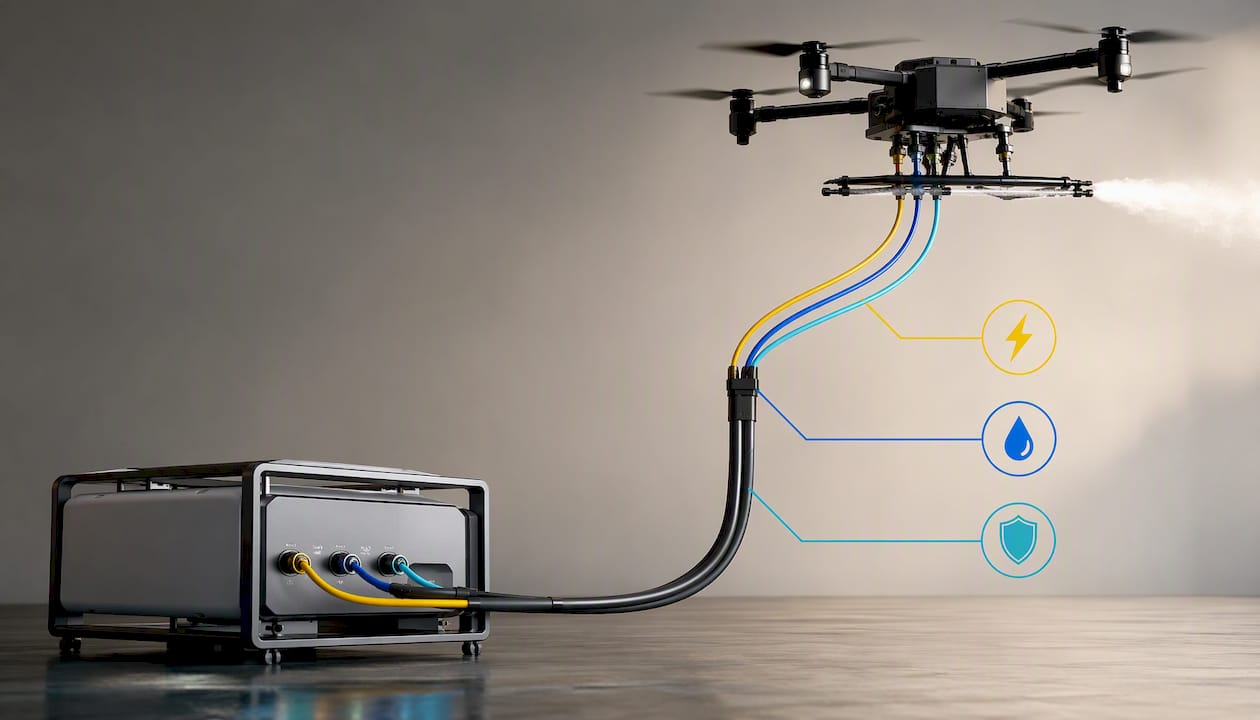
Closed-loop flow control is the piece that actually drives the water savings. Instead of blasting a surface at a fixed rate, the system meters water through precision nozzles calibrated to the substrate, whether that’s glass curtain wall, stucco, or EIFS. Less overspray means less runoff and a cleaner finish in fewer passes.
The tether also acts as a stabilizing line, which helps the drone hold position against gusts, though it introduces its own engineering trade-offs:
- Hose weight and drag increase as flight distance from the ground unit grows.
- Pump sizing has to match the building height, since taller runs need more pressure to maintain consistent flow.
- Payload limits shrink slightly compared to a completely untethered rig, since the drone is managing tension as well as thrust.
Pro Tip: Ask a vendor how they size pump pressure for buildings over 150 feet. If they can’t explain how they compensate for hose drag at height, that’s a sign they haven’t run enough tall-building jobs to know the difference.
What Do Tethered Drones Save on Labor, Time, and Cost?
Numbers make the case better than adjectives. Field case studies put tethered drone throughput at roughly 500 square meters per hour, versus about 100 square meters per hour for a manual crew. That’s not a marginal edge, it’s a five-fold difference that reshapes project timelines.
One documented case cleaned over 10,000 square meters of façade in about 18 hours using two tethered drones, a job that would typically demand a much larger crew working multiple days with rope access or lift equipment.
That throughput advantage cascades into three cost categories:
- Labor: a two-person drone crew can replace a much larger rope-access or lift team for the same square footage.
- Staging: no scaffold erection, no lift mobilization, no multi-day rigging setup before cleaning even starts.
- Soft costs: fewer permits, less need for road or sidewalk closures, and a smaller insurance exposure window since nobody is working at height.
Treat any specific percentage a contractor quotes as building-specific, not universal, and ask them to show the math for your property type.
Does FAA Part 107 Apply to Tethered Drones?
Yes. Tethering a drone to a ground station does not exempt it from federal rules. The FAA’s guidance on small unmanned aircraft systems treats actively tethered UAS the same as free-flying drones for certification purposes, and federal statute defines actively tethered aircraft without carving out a blanket exemption from pilot licensing.
Before authorizing a job, facility managers should confirm a few things directly with the vendor:
- The pilot holds an active Part 107 remote pilot certificate.
- The operator maintains liability insurance appropriate for high-rise work, commonly in the $2 million range.
- Preflight planning accounts for nearby airspace restrictions, pedestrian zones, and any over-people flight considerations specific to the site.
- The vendor keeps flight and maintenance records available for review if a building’s risk management team asks.
None of this is optional paperwork. It’s the difference between a contractor who understands the regulatory environment and one who’s improvising.
Where Tethered Systems Run Into Trouble
Tethered drones aren’t the right tool for every job. A few limitations show up consistently:
- Ground footprint. Pumps, hose reels, and water tanks need staging space, which can be tight on downtown lots with limited curb access.
- Wind sensitivity. Coastal wind common in South Florida during afternoon storms adds drag to the tether line, forcing operators to adjust stand-off distance and flight paths to keep the finish consistent.
- Hose drag at height. Longer vertical runs on very tall towers increase resistance, which affects flow pressure and requires careful pump calibration.
- Access constraints. Buildings with no usable ground-level staging area, such as those built to the property line with no setback, may suit battery-powered drones or traditional lift access better.
If a site can’t accommodate a ground unit safely, that’s a real constraint worth flagging early, not something to work around mid-project.
Which Buildings Get the Most Value From Tethered Cleaning?
Tethered systems shine on large, continuous surfaces where sustained runtime pays off. Comparisons of tethered versus onboard water-supply drones consistently point to the same pattern: tethered setups fit high-rise and large-façade work best, while onboard tank systems suit smaller, frequently relocated jobs.
The strongest fits in South Florida include:
- High-rise curtain-wall towers in Brickell, downtown Miami, and along Fort Lauderdale’s waterfront corridor.
- Hotels and resort properties with large glass frontage in Miami Beach, Aventura, and Boca Raton.
- Retail centers with expansive storefront glass.
- Rooftop solar arrays needing pure-water rinses without foot traffic on the roof surface.
Before requesting a proposal, check ground access, any HOA or condo board approval requirements, and whether nearby airspace has restrictions that could affect flight planning.
Vista Drone Cleaning’s Track Record in South Florida
Vistadronecleaning operates exclusively across Miami-Dade, Broward, and Palm Beach counties, using FAA Part 107 certified pilots and industrial tethered drones capable of reaching buildings 200 feet and taller. The company carries $2 million in liability insurance and documents every job with before-and-after 4K footage.
Services cover the full exterior envelope of a commercial property:
- Drone window washing for high-rise curtain walls
- Commercial façade cleaning across glass, stucco, EIFS, concrete, and metal substrates
- Roof soft-wash cleaning
- Solar panel pure-water cleaning for rooftop arrays
Most projects finish in one to three days, without scaffolding, rope access, or lane closures.
What Facility Managers Should Check Before Hiring a Vendor
Verify pilot certification and insurance first, then ask for real throughput and water-savings numbers tied to a comparable building, not just marketing figures. Request a small pilot section of façade before committing to the full project, and confirm the crew can document results with before-and-after imagery.
A short site survey and a sample section of a rope access versus drone cleaning comparison will tell you more about fit than any sales call. Ask specific questions, get specific answers, and treat vague responses as a red flag.
, Eliot
Get a Free Quote for Your Building
Vistadronecleaning is the direct alternative to scaffolding, boom lifts, and rope-access crews for commercial buildings across Miami-Dade, Broward, and Palm Beach counties. Instead of weeks of rigging and road closures, most façade, window, roof, and solar projects wrap in one to three days, with FAA Part 107 certified pilots, $2 million in liability coverage, and streak-free results using pure de-ionized water.
A free quote starts with a short site review: building height, façade material, ground access for staging, and any HOA or property manager requirements. From there, Vistadronecleaning provides a fixed-price proposal, usually within 24 hours. If you manage a high-rise, hotel, retail center, or rooftop solar array anywhere in South Florida, compare the numbers yourself on the drone versus traditional window cleaning breakdown, or go straight to scheduling a quote for your Miami property.
Sources
- Drone Facade Cleaning: Tethered High-Pressure + Tactile AI, Redefining Urban “Face” Maintenance
- Tethered vs Battery-Powered Cleaning Drones: Which Is Better for Commercial Facade Cleaning
- FAA: Small unmanned aircraft systems regulations (Part 107)
FAQ
Is drone cleaning worth it for commercial buildings?
For large, tall façades, the throughput advantage (roughly 500 square meters per hour versus 100 for manual crews) usually translates into lower labor costs and faster project completion, making it worth evaluating for most mid-rise and high-rise properties.
What are the disadvantages of a tethered drone?
The main drawbacks are the ground footprint needed for pumps and hose reels, increased hose drag on very tall buildings, and reduced flexibility on sites with limited staging space or strong coastal winds.
Is drone window cleaning profitable for contractors?
Given the throughput gains and smaller crew requirements documented in field case studies, drone window cleaning can be more profitable per job than traditional methods, though margins depend on building height and local labor costs.
Does a tethered drone still count as a drone under FAA rules?
Yes. The FAA classifies actively tethered unmanned aircraft as UAS, meaning Part 107 pilot certification and operational rules still apply regardless of the tether.