Drone Cleaning Safety Record vs Traditional Methods
Discover the drone cleaning safety record vs traditional methods. Learn how drones minimize risks and reshape building maintenance strategies.
TL; DR:
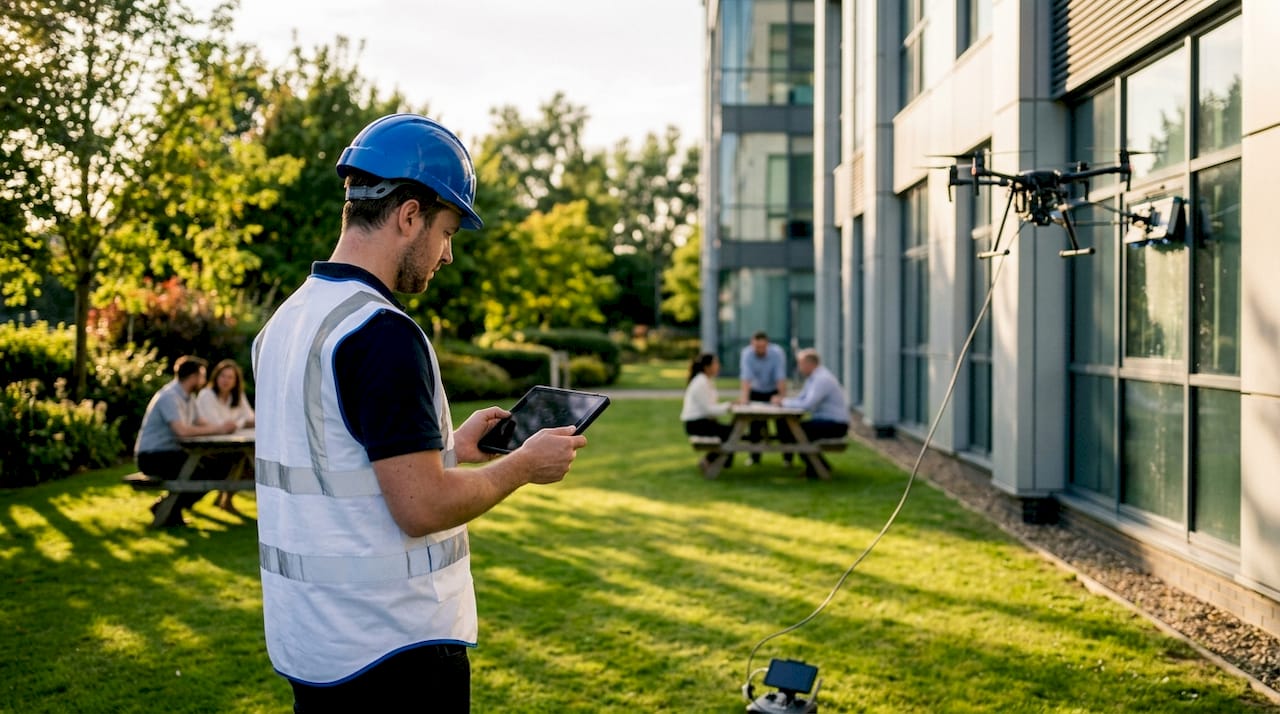
- Drone cleaning uses unmanned aerial vehicles to perform exterior maintenance safely at heights. It eliminates fall risks, reduces cycle times to under an hour, and lowers total costs compared to scaffolding. However, for structural repairs and detailed inspections, traditional methods still remain necessary.
Drone cleaning is defined as the use of unmanned aerial vehicles to perform exterior building maintenance tasks that would otherwise require workers to operate at dangerous heights. The drone cleaning safety record vs traditional methods comparison is not close: work at height accounts for 37% of all construction-related fatalities, and drone operations eliminate that exposure entirely by keeping every crew member on the ground. For property managers overseeing high-rise buildings in Miami-Dade and Broward counties, that single fact reshapes every maintenance budget conversation. Vistadronecleaning operates FAA Part 107-certified pilots with tethered industrial drones, serving commercial towers across Miami, Fort Lauderdale, Boca Raton, and surrounding South Florida markets.
How does the drone cleaning safety record compare to traditional methods?
Falls from height are the single largest cause of preventable death in building maintenance. OSHA classifies work above six feet as a fall hazard, and high-rise facade cleaning routinely places workers at 100, 150, or 200 feet. Traditional methods, including scaffolding, boom lifts, and rope access, all require at least some personnel to operate at those elevations.
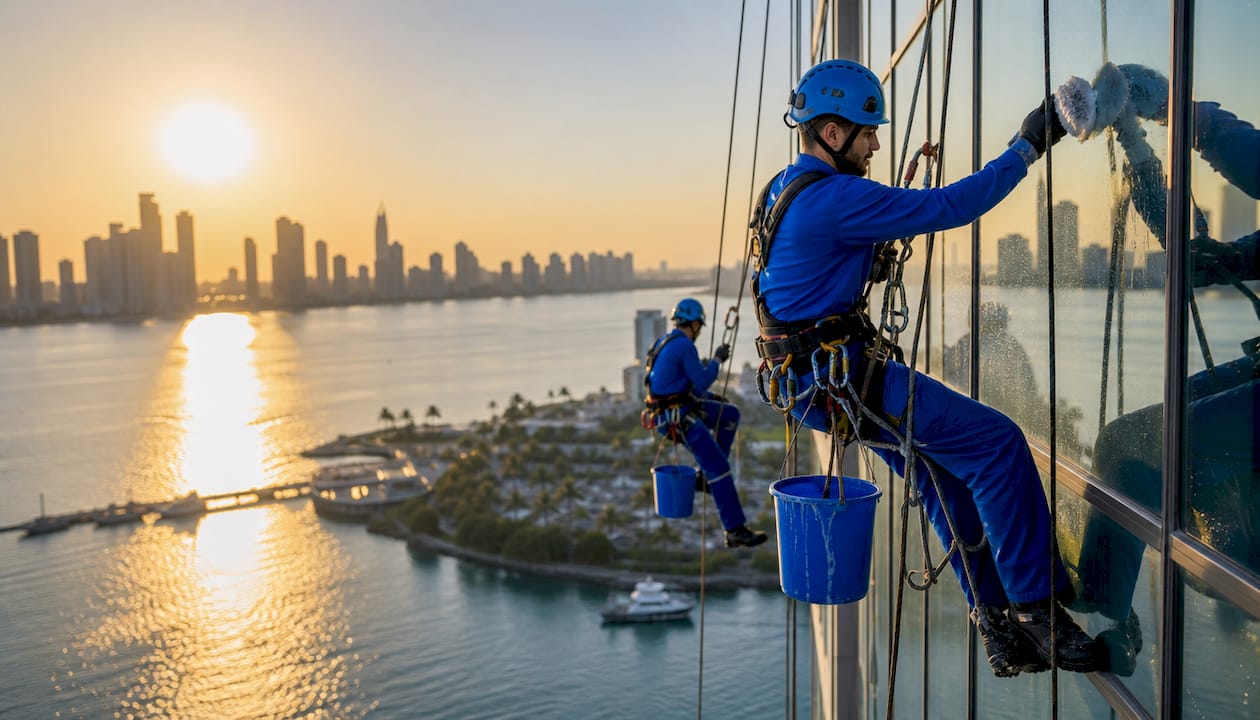
Drone cleaning removes that exposure entirely. The pilot and ground crew stay at street level throughout the entire job. No harnesses, no rigging, no suspended platforms, and no risk of a single misstep ending a career or a life.
The safety advantages translate directly into liability and insurance outcomes for property managers:
- No fall risk: Ground-based crews face zero exposure to height-related incidents during cleaning operations.
- No road closures or permits: Traditional scaffolding in dense Miami-Dade corridors often requires lane closures and city permits, each of which creates additional liability windows.
- Reduced third-party risk: Boom lifts and scaffolding near pedestrian areas create hazards for passersby. Drones operate above, not alongside, foot traffic.
- FAA Part 107 compliance: Certified drone pilots operate under a federal regulatory framework that mandates pre-flight safety checks, airspace authorization, and documented flight logs.
Pro Tip: Ask any drone cleaning vendor for their FAA Part 107 certificate and proof of liability insurance before signing a contract. Vistadronecleaning carries $2M in liability coverage, which is the benchmark you should require from any provider.
The rope access vs. drone comparison is particularly stark for South Florida towers. Rope access specialists are skilled, but a single equipment failure at 180 feet has catastrophic consequences. Drone motor failures, by contrast, are mitigated by tethering systems that catch the aircraft before it can fall onto personnel or property below.
What are the cost and efficiency differences between drones and scaffolding?
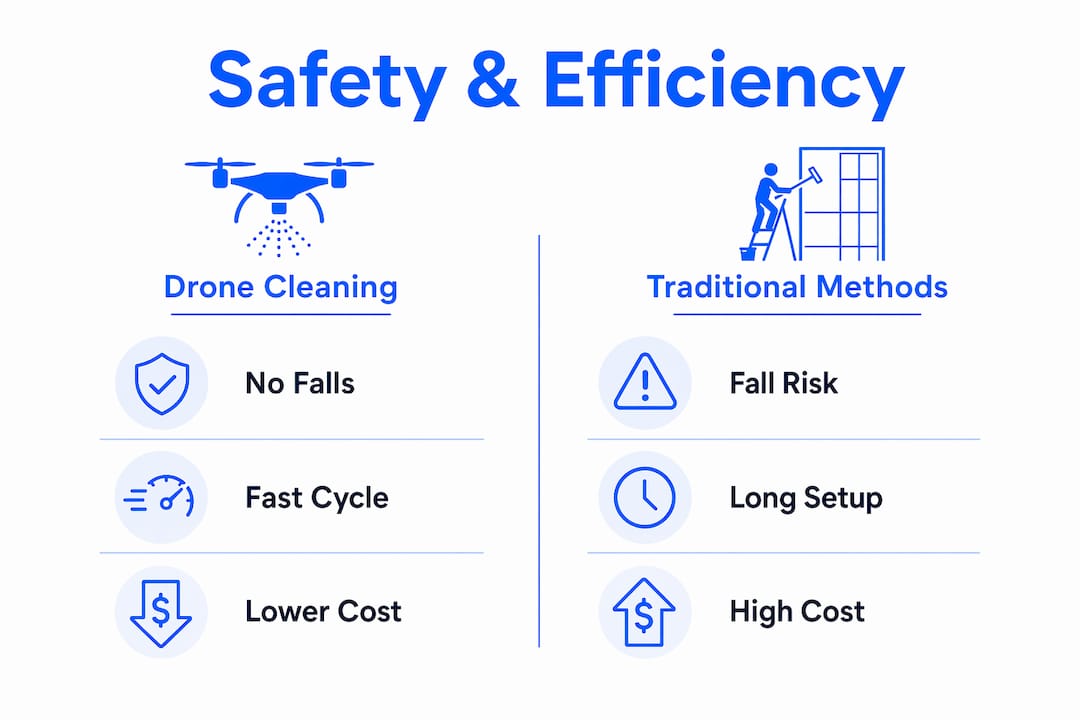
Operational efficiency is where the drone cleaning advantage becomes undeniable for decision-makers managing maintenance budgets. Drone cleaning reduces a typical industrial cleaning cycle from 3–4 days with scaffolding to 30–40 minutes per session. That compression in cycle time directly reduces labor hours, equipment rental periods, and site disruption.
The cost differential is equally significant. Amortized equipment cost runs $300–$700 per drone cleaning session compared to $2,000–$3,000 for scaffolding. That means a property manager running quarterly facade cleaning on a 20-story Brickell tower can realistically cut annual cleaning costs by 30–60% by switching to drone-based methods.
| Factor | Drone cleaning | Scaffolding |
|---|---|---|
| Typical cycle time | 30–40 minutes per session | 3–4 days |
| Equipment cost per session | $300–$700 | $2,000–$3,000 |
| Crew size required | 2–3 ground personnel | 6–10 workers |
| Road closures needed | None | Often required |
| Permit requirements | FAA airspace authorization | City scaffolding permits |
| Fall risk exposure | Zero | High |
For South Florida properties specifically, the permit and road closure issue carries extra weight. Fort Lauderdale and Miami Beach have dense pedestrian and vehicle traffic corridors. Scaffolding permits in those areas can add days to project timelines and thousands of dollars in administrative costs. Drone operations require FAA airspace authorization, but that process is managed by the operator and does not require road closures or city construction permits.
Vistadronecleaning completes most South Florida projects within 1–3 days, with no scaffolding, no boom lifts, and no lane closures. The scaffolding vs. drone cleaning comparison for Miami properties consistently shows drone methods delivering faster turnaround at lower total cost.
Where do traditional methods still outperform drones?
Drone cleaning is not a universal replacement for every traditional maintenance task. Drones excel at routine, high-risk cleaning tasks, but rope access remains the right tool when physical contact, fine manipulation, or structural assessment is required. Property managers who understand this distinction get better outcomes from both methods.
The tasks where traditional methods retain an advantage include:
- Targeted stain removal: Drones lack the fine motor control and tactile feedback needed to address individual stubborn stains or mineral deposits that require manual scrubbing.
- Structural inspections and repairs: Caulking replacement, sealant application, and crack assessment all require a technician’s hands and eyes at close range.
- Regulatory flight restrictions: Drone operations in South Florida must account for proximity to Miami International Airport, Fort Lauderdale-Hollywood International Airport, and other controlled airspace zones. Daily flight approvals, geofencing, and altitude caps around 140 feet apply in many jurisdictions, requiring careful pre-job planning.
- Severe weather windows: South Florida’s hurricane season and frequent afternoon thunderstorms create flight restriction periods that scaffolding crews can sometimes work through.
The practical answer for most high-rise buildings in Miami-Dade and Broward is a hybrid maintenance program. Drones handle routine facade washing, window cleaning, roof soft-washing, and solar panel cleaning on a regular schedule. Rope access or lift crews handle targeted repairs and inspections on a less frequent basis. This split reduces total personnel exposure to height hazards while keeping the building in compliance with facade inspection requirements.
Pro Tip: Schedule drone cleaning passes before any rope access inspection. Clean glass and facades give inspectors a clearer view of surface conditions, which means fewer follow-up visits and lower total inspection costs.
What technology makes drone cleaning safer and more effective?
Modern drone cleaning systems have solved the engineering problems that limited early commercial deployments. The most significant advance is hose management. Lighter hose materials and top-down feeding systems reduce the drone’s weight load by over 50%, which extends flight time and improves maneuverability around complex facade geometries like the curved glass towers common in Brickell and downtown Fort Lauderdale.
Secondary safety tethering is the other major development. A tether system catches the drone in the event of a total motor failure, preventing a free-fall incident over occupied areas. This is the equivalent of a safety net for rope access workers, and it addresses the primary liability concern property managers raise about drone operations near pedestrian zones.
GPS-logged flight paths and pre/post-clean video documentation transform cleaning from a service transaction into a verifiable asset management activity. Property managers gain a timestamped record of every cleaning pass, which supports insurance audits, facade inspection compliance, and capital planning decisions.
Automated documentation is an underused advantage that most property managers do not factor into their vendor evaluation. A cleaning contractor who delivers GPS logs and before-and-after video gives you evidence of work performed, a baseline for surface condition tracking, and documentation that satisfies insurer requests without additional site visits.
Vistadronecleaning uses the Lucid Bots Sherpa, a tethered industrial drone purpose-built for commercial exterior cleaning. The system’s ground-based water supply means the drone carries only the hose weight rather than a full water tank.
The aging workforce and labor shortages in rope access specialties make this technology adoption more urgent than most property managers realize. Fewer qualified rope access technicians means longer scheduling lead times and higher labor costs for traditional methods. Drone cleaning sidesteps that supply constraint entirely.
Key Takeaways
Drone cleaning delivers a measurably safer and more cost-effective alternative to traditional high-rise cleaning methods, with the strongest advantages in fall risk elimination, cycle time reduction, and operational documentation.
| Point | Details |
|---|---|
| Fall risk elimination | Drone cleaning keeps all crew on the ground, removing the 37% fatality risk tied to height work. |
| Cost advantage | Drone sessions cost $300–$700 versus $2,000–$3,000 for scaffolding, a savings of 30–60%. |
| Cycle time reduction | Drone cleaning compresses a 3–4 day scaffolding job to 30–40 minutes per session. |
| Hybrid approach | Drones handle routine cleaning; rope access handles repairs requiring physical contact. |
| Documentation value | GPS logs and video records support audits, inspections, and capital planning decisions. |
What I’ve learned after watching South Florida buildings switch to drones
The safety argument for drone cleaning is airtight on paper. What surprised me after observing multiple South Florida properties make the switch is how quickly the operational culture shifts. Maintenance teams that spent years managing scaffolding logistics, permit timelines, and worker safety briefings suddenly have that bandwidth back. They redirect it toward actual building condition monitoring rather than cleaning administration.
The liability conversation also changes. Property managers who previously absorbed the risk of rope access incidents near occupied lobbies or pool decks now have a documented, ground-based operation with GPS logs and video. That paper trail matters when an insurer asks how you maintain a 30-story facade in hurricane country.
The challenge I consistently see is integration. Existing maintenance contracts often include traditional cleaning as a bundled line item. Switching to drone cleaning requires renegotiating those contracts, which creates short-term friction with incumbent vendors. The property managers who handle this best treat it as a procurement decision, not a relationship decision. They evaluate the high-rise building maintenance data, compare total costs including permits and downtime, and make the call on numbers.
My expectation for Miami-Dade and Broward is that FAA airspace coordination will get faster as drone operations become routine in South Florida’s urban corridors. That will remove the last meaningful friction point in drone cleaning adoption. The property managers who build drone cleaning into their maintenance programs now will have the operational experience and vendor relationships in place when that happens.
, Eliot
Vistadronecleaning serves South Florida’s high-rise cleaning needs
South Florida property managers evaluating their next facade or window cleaning cycle have a clear path to lower costs and a stronger safety record. Vistadronecleaning operates FAA Part 107-certified pilots with tethered Lucid Bots Sherpa drones across Miami-Dade, Broward, and Palm Beach counties, covering commercial towers, condominiums, hotels, and office buildings up to 200 feet tall.

Every project runs without scaffolding, road closures, or city construction permits. The crew stays on the ground. Most jobs finish within 1–3 days. The full drone vs. traditional window cleaning comparison breaks down costs, cycle times, and safety outcomes in detail. Vistadronecleaning carries $2M in liability insurance and delivers free quotes within 24 hours. Contact the team to schedule a site assessment for your South Florida property.
FAQ
How safe is drone cleaning compared to rope access?
Drone cleaning eliminates all worker exposure to height-related fall risk, which accounts for 37% of construction and maintenance fatalities. Rope access keeps workers suspended at height throughout the job, creating continuous fall exposure that drone operations remove entirely.
Can drones clean high-rise windows above 140 feet in Miami?
FAA airspace regulations and local geofencing rules set altitude caps that vary by location, with many jurisdictions capping operations around 140 feet. Vistadronecleaning’s FAA Part 107-certified pilots manage airspace authorization for each project and can address taller structures through coordinated flight planning.
How much cheaper is drone cleaning than scaffolding?
Drone cleaning sessions cost $300–$700 in amortized equipment costs compared to $2,000–$3,000 for scaffolding, delivering 30–60% lower total project costs when labor, permits, and cycle time are included.
Do drones replace rope access for all building maintenance tasks?
Drones handle routine cleaning tasks effectively but cannot replace rope access for physical repairs, sealant application, or detailed structural inspections that require direct tactile contact with the building surface.
What documentation does drone cleaning provide for property managers?
Drone cleaning generates GPS-logged flight paths and pre/post-clean video for every session, giving property managers verifiable records that support insurance audits, facade inspection compliance, and long-term capital planning.