How drone cleaning transforms high-rise building maintenance
Discover how drone cleaning technology transforms maintenance in high-rises. Get insights on speeding up and lowering costs with building cleaning...
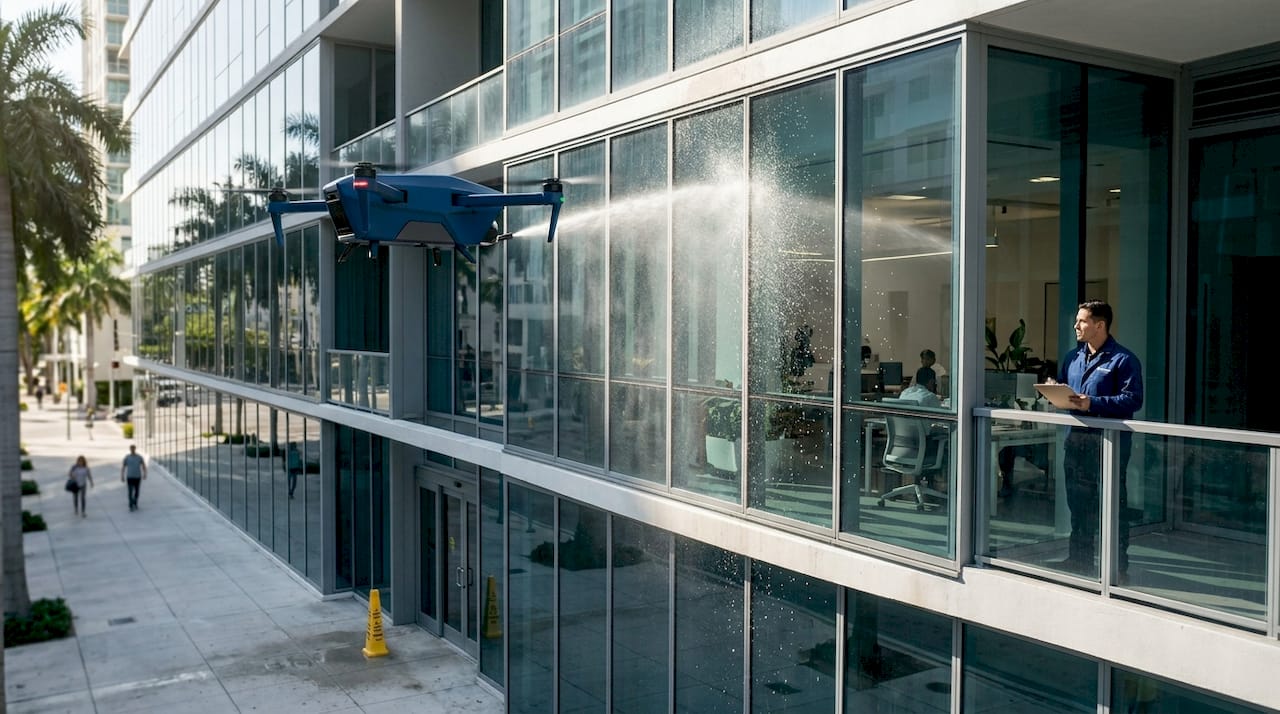
Cleaning a 40-story glass tower in Miami used to mean weeks of scaffolding, rope crews, and traffic disruptions. Today, drone cleaning covers 500 m² per hour compared to 100 m² per hour with manual methods, making the process up to 10 times faster and 30 to 50% cheaper. South Florida's humidity, salt air, and sun create harsh building conditions. Property managers need an edge. This guide breaks down drone technology, its advantages over traditional methods, and how to use it for your portfolio.
Table of Contents
- What is drone building cleaning and how does it work?
- Comparing drone cleaning to manual and traditional methods
- Special applications: Solar panels, facades, and high-rise exteriors
- Limitations, edge cases, and expert best practices
- Expert perspective: Why embracing the hybrid cleaning model is the future
- Explore drone cleaning solutions for your property
- Frequently asked questions
Key Takeaways
| Point | Details |
|---|---|
| Drones boost efficiency | Drone cleaning covers up to 500 square meters per hour—ten times faster than manual methods. |
| Lower water and costs | Save 40-60% on water and 30-50% on cleaning expenses. |
| Best for Florida challenges | Drones tackle humidity and salt, especially for solar panels and large facades. |
| Hybrid is optimal | Blending drone and manual cleaning ensures efficiency and quality where needed. |
| Choose wisely | Understand edge cases to pick the right approach for your property. |
What is drone building cleaning and how does it work?
Industrial drones fitted with water delivery systems and precision nozzles fly alongside a building's exterior, cleaning without workers onto ropes or scaffolds. This technology has matured into a legitimate commercial service with proven results across South Florida's high-rise corridor.
Drone facade cleaning uses high-pressure nozzles and soft-wash systems to treat glass, stone, metal cladding, and solar panels at heights exceeding 200 feet. Operators guide the drones from the ground using GPS-assisted controls. AI stabilization holds precise distances from the building surface even in light wind. This precision prevents cracked seals on glass curtain walls while avoiding streaks.
Two main drone types dominate commercial use:
- Tethered drones: Connected to a ground unit by a physical cable for continuous power and water. These offer stable operation for tall buildings where battery life limits coverage.
- Free-flying drones: Battery-powered units that offer agility for complex shapes, angled rooflines, or architectural variation. These suit shorter structures or targeted spot cleaning.
"In practice, it's a precision instrument that can be dialed in for anything from delicate historic stone to modern high-reflectivity glass." — Industry observation from facade cleaning specialists
For South Florida, adaptability is key. Salt deposits from Biscayne Bay accumulate on facades within days. Humidity encourages mold and algae. Drones allow for frequent, shorter cleaning cycles without the cost of scaffold mobilization. Learn more by exploring cleaning buildings without scaffolding and rope access vs drone cleaning.
Pro Tip: For coastal buildings within a mile of the ocean, schedule drone cleaning every 60 to 90 days. Frequent cleaning prevents corrosive salt deposits from bonding to metal and glass.
Comparing drone cleaning to manual and traditional methods
Drones clean 500 m² per hour versus 100 m² for manual crews, use 40 to 60% less water, and cost between $0.50 and $2 per square meter compared to $2 to $8 for traditional methods. For a 20,000 m² facade, this saves $30,000 to $120,000 per project.
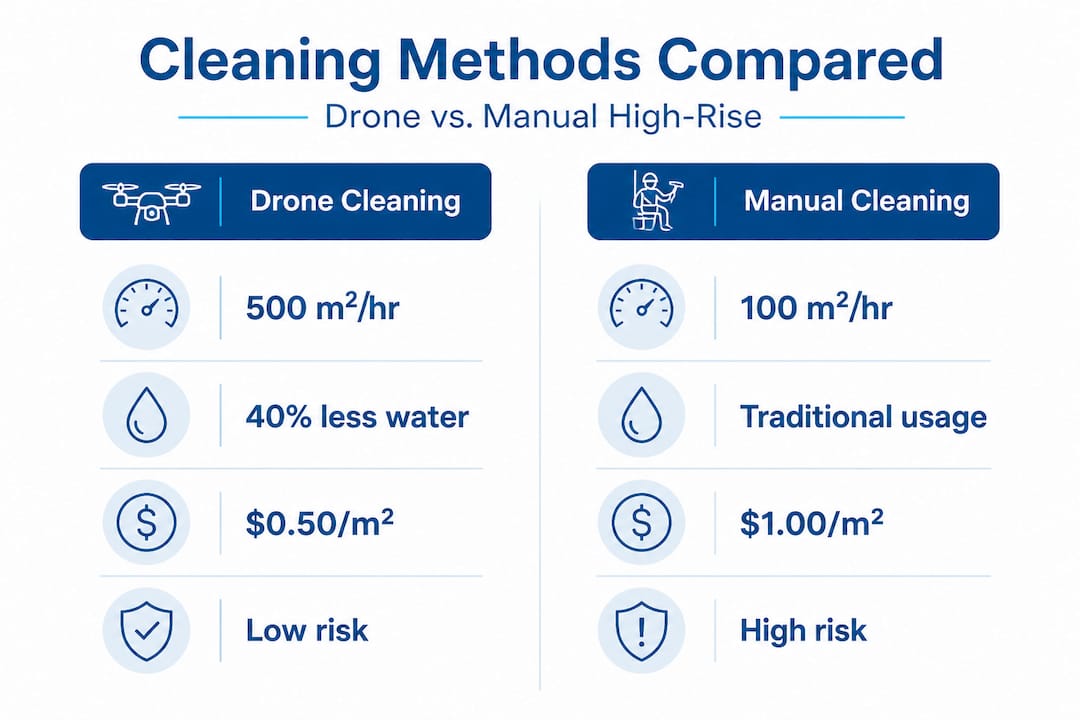
| Method | Speed | Cost per m² | Water usage | At-height risk |
|---|---|---|---|---|
| Drone cleaning | 500 m²/hr | $0.50 to $2 | Low (40-60% less) | None |
| Manual rope access | 100 m²/hr | $2 to $8 | High | Very high |
| Scaffold system | 80 to 120 m²/hr | $3 to $10+ | High | Moderate |
| Aerial lift (boom) | 150 m²/hr | $2 to $6 | High | Moderate |
Drones eliminate at-height safety risks, lowering liability. This impacts your planning:
- Project timeline: A three-day scaffold job often takes one day with drones.
- Permit requirements: Drones require less ground-level coordination than street-closing scaffold deployments.
- Insurance costs: Lower liability exposure can improve rates over time.
- Scheduling flexibility: Drones mobilize quickly and can work early morning hours to avoid traffic.
Review scaffolding vs drone cleaning and drone cleaning vs pressure washing for more cost data.
Special applications: Solar panels, facades, and high-rise exteriors
Solar panels are a top use case. Dirty solar panels in Florida lose 20 to 30% efficiency due to salt and debris. Drones restore output using contact-free rinsing or soft brush attachments. For a 500 kW array, a 25% loss is a significant financial drain.
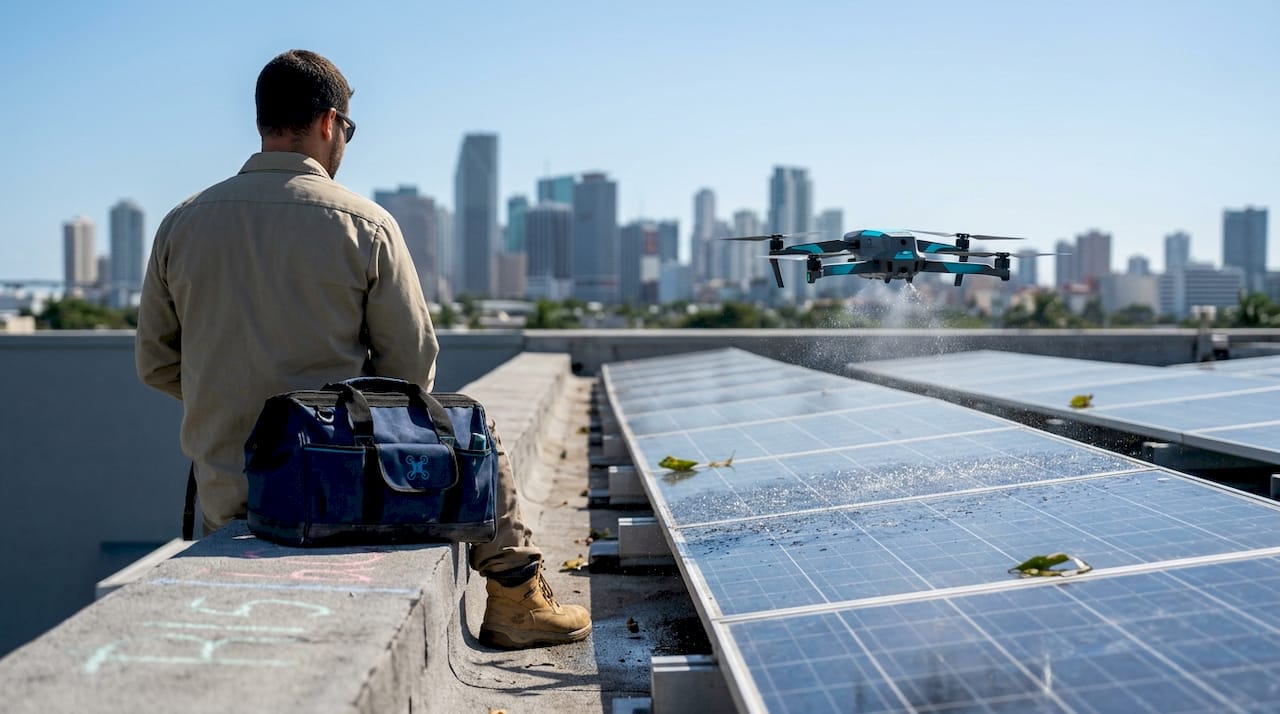
The ROI is clear. If an array saves $8,000 monthly but loses 20% to soiling, you lose $1,600 per month. Quarterly drone cleaning pays for itself. STRATOCLEAN offers a 23% efficiency guarantee, proving industry confidence.
For building facades, drones make regular maintenance affordable, ensuring compliance with condo association or commercial lease requirements.
| Surface type | Drone suitability | Recommended method | Frequency (South Florida) |
|---|---|---|---|
| Glass curtain wall | Excellent | Soft wash, de-ionized water | Every 60 to 90 days |
| Metal cladding | Excellent | Low-pressure rinse | Every 90 days |
| Concrete or stone | Good | Soft wash with detergent | Every 6 months |
| Solar panels | Excellent | Contact-free or soft brush | Every 90 to 120 days |
| Painted stucco | Good | Low-pressure only | Every 6 months |
- Drones excel on large, flat, or curved surfaces.
- Porous surfaces may need manual inspection after washing.
- Historic facades require low-pressure settings and individual evaluation.
Pro Tip: Request before-and-after efficiency data when hiring for solar panel cleaning. Reliable providers document actual output recovery.
Brickell building cleaning examples show how drones navigate tight airspace and high urban traffic.
Limitations, edge cases, and expert best practices
Drones have limitations. Wind turbulence and pressure loss at height can affect performance. Even tethered drones struggle in winds above 25 mph.
Drones lack the physical scrubbing ability and detailed inspection capability of manual crews. Heavy biological staining, oxidation, or graffiti require a hybrid approach.
Use hybrid or manual methods for:
- Heavy biological growth: Algae or mold in porous surfaces needs dwell time and manual monitoring.
- Post-storm debris: Check for structural damage after hurricanes before cleaning.
- Intricate details: Ornamental stone or narrow window gaps need hands-on attention.
- Graffiti removal: Requires chemical agitation and scrubbing.
"What combination of tools gets the best result at the best cost? That mindset leads to better outcomes."
Checklist for choosing your approach:
- Assess surface type and soil severity first.
- Schedule drone operations during calm morning windows.
- Require before-and-after documentation.
- Confirm FAA certification and insurance.
- Plan a follow-up inspection 30 days after the first drone clean.
Consult the commercial building cleaning guide for contract questions.
Expert perspective: Why embracing the hybrid cleaning model is the future
The best results come from hybrid drone and manual approaches. Modern maintenance programs use drones for routine cycles and manual labor for inspections and deep treatments. This cuts annual budgets by 30 to 40% while improving building appearance.
In Brickell, buildings that used to schedule two major cleanings per year now run four to six drone cycles with one annual manual inspection. The facades look better, and teams catch problems earlier at a lower cost. Integration is the next step for smart property management.
Explore drone cleaning solutions for your property
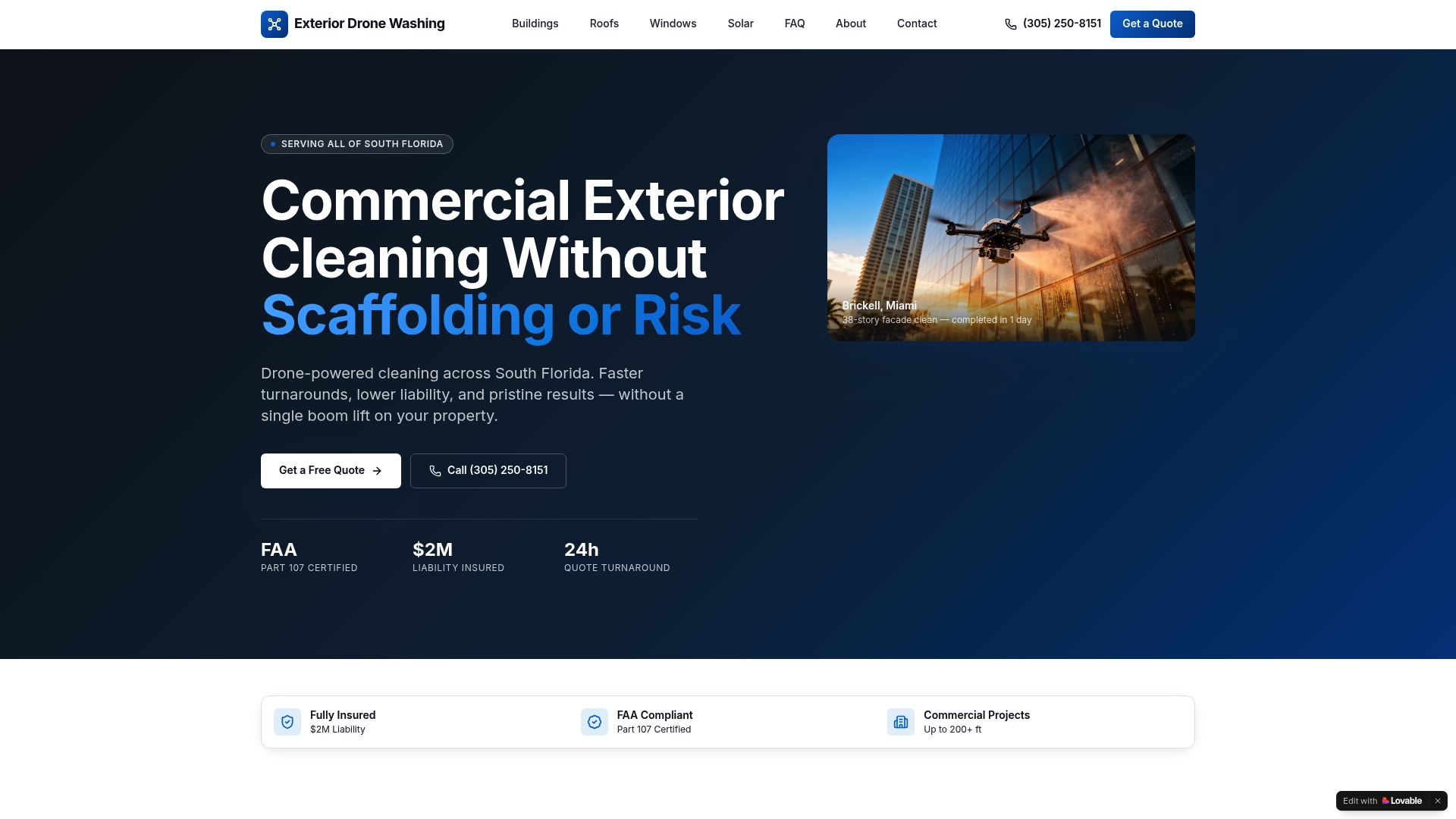
At Exterior Drone Washing, we design cleaning programs for South Florida's specific surfaces and budgets. From Brickell office towers to beachfront condos, we provide drone-based solutions with clear cost expectations. Explore our solar panel cleaning, commercial facade programs, or Brickell project results. Contact us for a property-specific quote.
Frequently asked questions
How much does drone cleaning actually save compared to traditional methods?
Drone cleaning typically saves 30 to 50% on costs and uses 40 to 60% less water. Rates average $0.50 to $2 per square meter versus $2 to $8 for traditional methods.
Can drones clean all types of stains or surfaces?
Drones are best for broad surface washes. Heavy stains or surfaces requiring physical scrubbing benefit from a hybrid approach.
How often should solar panels in Florida be cleaned with drones?
Due to salt and humidity, commercial installations benefit from cleaning every 90 to 120 days to maintain peak energy output.
Are drone cleaning services safe for historic or delicate facades?
Yes, using low-pressure nozzles. However, fragile ornamental details may still require manual attention.
Recommended
- Brickell Building Cleaning | High-Rise Drone Cleaning Miami
- High-Rise Cleaning Without Rope Access Miami | Drone Facade Washing
- Clean Buildings Without Scaffolding | Drone Facade Washing
- Cleaning Without Scaffolding in Miami | Drone Cleaning FAQ
- What’s Changing in Property Maintenance in 2025? – UpKeep UK