
Drone Cleaning for New High-Rise Construction in Miami
Discover the benefits of drone cleaning for new high-rise construction in Miami. Save time and costs while ensuring safe, efficient maintenance.
TL; DR:
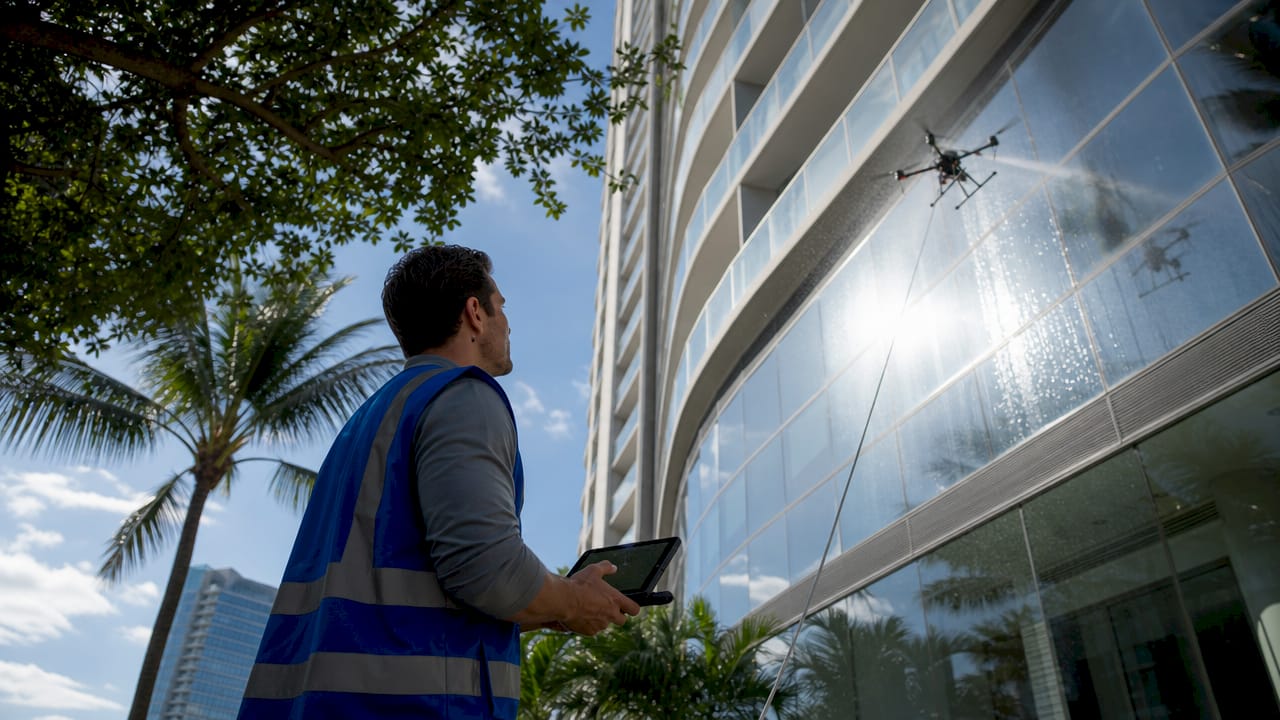
- Drone cleaning uses tethered drones to wash high-rise building exteriors without scaffolding, improving safety and speed. A two-person crew equipped with ground-fed water can complete projects in one to three days, complying with FAA regulations through prior authorization. This method reduces construction downtime and provides verifiable documentation, making it a cost-effective and safer alternative for South Florida’s rapid skyline growth.
Drone cleaning for new high-rise construction is defined as the use of tethered, remotely piloted UAVs to wash building facades, windows, and exterior surfaces without scaffolding, rope access, or boom lifts. South Florida’s construction boom across Brickell, Fort Lauderdale, and Boca Raton has created a direct need for faster, safer exterior maintenance. Traditional scaffolding shifts fall risk onto workers at height, and fall exposure remains a leading cause of fatalities in construction. Vistadronecleaning deploys FAA Part 107-certified pilots and Lucid Bots Sherpa tethered drones to clean commercial properties up to 200 feet tall, finishing most projects in 1–3 days at 30–60% lower cost than conventional methods.
What does drone cleaning for new high-rise construction require?
Successful drone cleaning on a new high-rise build starts with the right equipment and a two-person crew. High-rise drone cleaning requires one FAA Part 107-certified remote pilot and one battery-swap technician working in rotation to sustain continuous facade cleaning for up to 8 hours. That crew structure is far leaner than the 4–6 workers a scaffolding setup demands.
Equipment needed on site
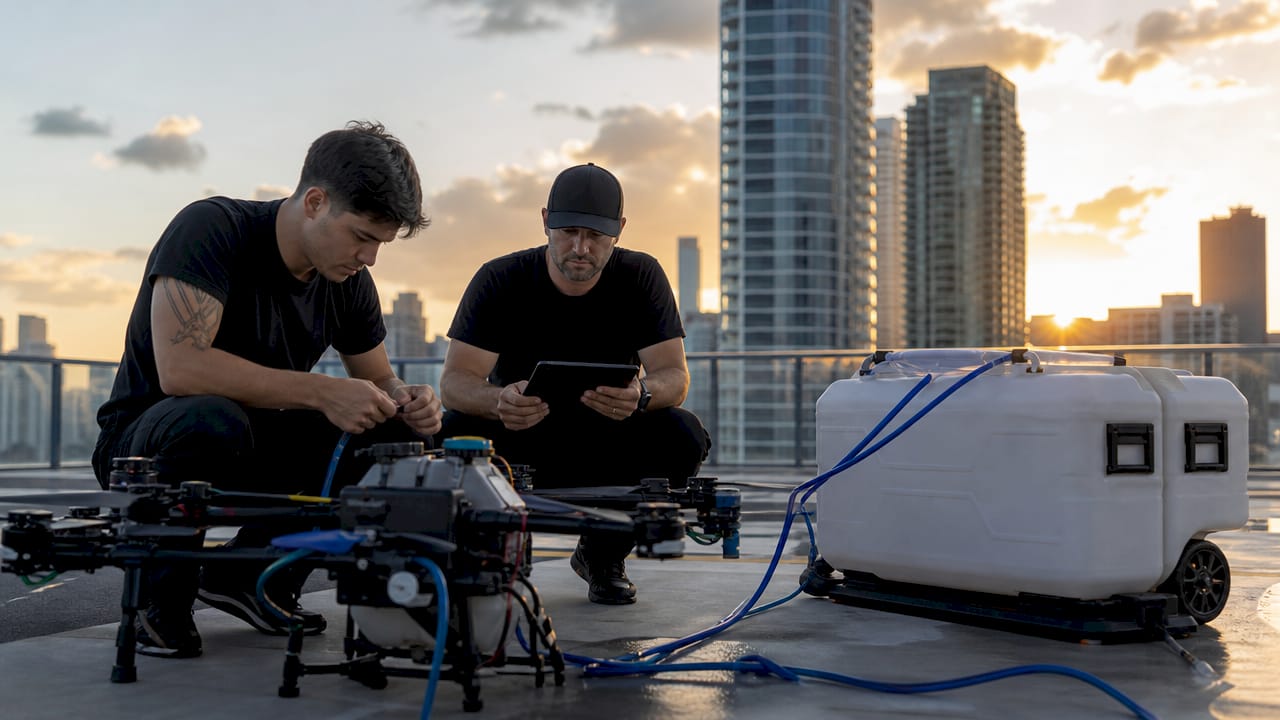
The core platform for this work is a tethered industrial drone fitted with a soft-wash or pressure-wash head and a ground-fed water supply line. Tethered configurations solve the water-supply problem directly: the drone draws water from a ground unit, so it never lands to refill a tank. Vistadronecleaning uses the Lucid Bots Sherpa, which is purpose-built for this application. You also need a de-ionized water tank, a ground power source, and a clear staging area at the building’s base.
Key equipment checklist:
- Tethered industrial drone with wash attachment (e.g. Lucid Bots Sherpa)
- De-ionized or pure-water tank and supply hose
- Ground power unit or generator
- Spare battery packs
- FAA Part 107 pilot certificate and current drone registration
- $2M liability insurance documentation
Drone cleaning platforms cost roughly $16,150 upfront, but that capital cost amortizes quickly against scaffolding rental, which can run thousands per session before a single worker reaches the facade. For a new construction project in Miami-Dade, where scaffolding setup alone takes 1–5 days, the time savings compound fast.
Pro Tip: Confirm that the staging area has both a water connection and a 240V power outlet before the crew arrives. Missing either one on day one costs you a full morning of billable time.
How to execute a drone cleaning operation on a new high-rise
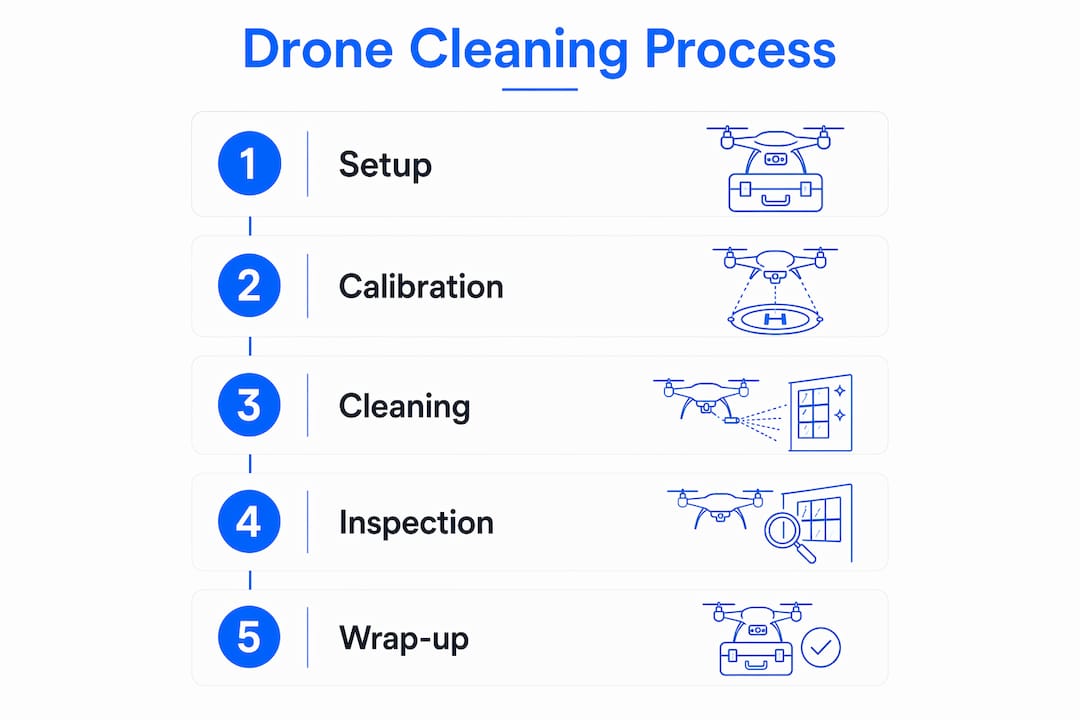
A drone cleaning mission on a new high-rise follows a defined sequence. Skipping any step creates compliance gaps or cleaning inconsistencies that show up on the final walkthrough.
- Pre-flight site survey (Day 1, 60–90 minutes). Walk the perimeter and identify obstructions, power lines, and antenna arrays. Note the building’s height, facade material (glass, EIFS, stucco, or metal panel), and any areas with restricted access.
- Flight path planning (60 minutes). Map GPS waypoints for each facade section. Plan cleaning passes from top to bottom to prevent dirty water from contaminating already-cleaned glass. File any required airspace authorizations before this step is complete.
- Equipment setup and water connection (30–45 minutes). Position the ground unit, connect the tether, fill the de-ionized water tank, and run a test flight at low altitude to confirm signal integrity and water flow.
- Cleaning cycles (30–40 minutes per cycle). The drone works each facade section in overlapping vertical passes. Tethered drones never stop to refill a tank.
- Ground team coordination (continuous). The battery technician monitors the tether, manages water pressure, and keeps the landing zone clear. The pilot maintains visual line of sight at all times per FAA Part 107 rules.
- Data logging and video documentation (end of each session). GPS-logged flight paths and automated video records create a verifiable audit trail for property managers. This documentation supports EHS audits and maintenance records required by South Florida commercial developments.
- Post-operation review (30 minutes). Inspect cleaned sections from ground level and from drone footage. Flag any areas for a second pass. Deliver the video log and flight record to the project manager.
Drone cleaning achieves rates near 1,200 square meters per hour, which means a large commercial tower in Brickell or Fort Lauderdale that would take a scaffolding crew multiple days can be completed in a single day. That speed directly protects your construction schedule.
What are the FAA and airspace rules for drone cleaning in Miami-Dade?
FAA Part 107 is the federal framework that governs all commercial drone operations in the United States. FAA Part 107 restricts commercial drone flight to 400 feet AGL, or within a 400-foot radius of a structure, not exceeding 400 feet above that structure’s highest point. That rule is what makes high-rise drone cleaning legally viable: a 600-foot tower in Brickell can be serviced by a drone operating within its 400-foot structural envelope.
Miami-Dade and Broward counties sit under some of the most complex airspace in the country, with Miami International Airport, Fort Lauderdale-Hollywood International Airport, and Opa-locka Executive Airport all generating controlled airspace that overlaps urban high-rise corridors. Operations in controlled airspace require prior authorization through LAANC, the FAA’s Low Altitude Authorization and Notification Capability system, which processes approvals in near real time for most locations.
Key compliance steps for South Florida high-rise drone cleaning:
- Hold a current FAA Part 107 remote pilot certificate
- Register the drone with the FAA and display the registration number
- Obtain LAANC authorization before any flight in Class B, C, D, or E controlled airspace
- File a NOTAM at least 24 hours before cleaning buildings over 200 feet
- Conduct a radio frequency interference survey for dense urban sites
- Carry proof of $2M liability insurance on site at all times
Strict FAA compliance and insurance verification are critical. Failure to meet these requirements may void your property insurance and invoke federal penalties. Vetting your drone cleaning contractor for current Part 107 certification and adequate coverage is not optional. It is a legal and financial necessity.
Industry best practices recommend retaining flight and maintenance logs for 3–5 years for audit and insurance purposes, even though FAA Part 107 does not mandate it for routine operations. For a commercial development in Miami-Dade, that documentation protects both the property owner and the cleaning contractor if a claim arises.
How does drone cleaning reduce downtime during construction?
Drone cleaning cuts project downtime in ways that scaffolding physically cannot match. Scaffolding setup takes 1–5 days and requires road closures, permits, and heavy equipment staging. A drone crew arrives, sets up in under an hour, and begins cleaning the same morning.
The operational advantages are direct:
- No road closures or sidewalk permits required
- No heavy lift equipment blocking site access for other trades
- Cleaning runs concurrently with interior finishing work, not after it
- Hotel and retail tenants in mixed-use towers experience no lobby disruption
- Noise output from a drone is a fraction of a generator-powered scaffold rig
For a new hotel tower in Fort Lauderdale or a retail center in Boca Raton, the ability to clean the exterior while other contractors work inside is a genuine schedule advantage. Drone cleaning for large building footprints is especially effective because the drone covers horizontal distance quickly, moving across wide facades without repositioning a lift or rebuilding a scaffold bay.
Pro Tip: Schedule drone cleaning during the final two weeks of construction, after exterior cladding is complete but before the certificate of occupancy inspection. A clean facade on inspection day makes a strong impression and avoids last-minute scrambles.
What challenges should you expect when using drones on South Florida high-rises?
South Florida’s environment creates specific operational challenges that project managers need to plan for before the crew arrives.
Wind and weather. Miami’s coastal winds regularly exceed safe drone operating limits, particularly in the afternoon. Morning operations between 7:00 AM and 11:00 AM offer the calmest conditions. Hurricane season from june through november requires flexible scheduling and clear cancellation protocols in your service agreement.
Radio frequency interference. Glass and steel skyscrapers in urban South Florida generate RF interference that can disrupt drone control signals. Signal disruptions near skyscrapers have caused flight control losses, which is why a pre-operation RF survey is a non-negotiable step on dense urban sites like Brickell or downtown Fort Lauderdale.
Tether and battery management. Tethered drones with ground-fed water hoses avoid the tank refills that slow untethered platforms. Tether management requires a clear ground path free of foot traffic, construction debris, and vehicle movement.
Privacy and HOA considerations. Mixed-use towers in Aventura, Coral Gables, and Coconut Grove often have residential components with active HOA boards. Notify building management and residential tenants at least 48 hours before operations begin. Drone cameras used for documentation should have defined data retention policies to address privacy concerns.
Contingency planning. Always build a weather buffer day into the project schedule. Confirm that the service agreement includes a clear rescheduling policy at no additional cost for weather-related delays.
Key Takeaways
Drone cleaning is the most efficient and safest method for maintaining new high-rise exteriors in South Florida, delivering faster turnaround, lower costs, and full FAA compliance when executed correctly.
| Point | Details |
|---|---|
| Two-person crew is sufficient | One FAA Part 107 pilot and one technician can clean a full high-rise facade in a single day. |
| Tethered drones solve the water-supply problem | Ground-fed water lines allow continuous operation without stopping to refill a tank. |
| LAANC authorization is mandatory | Miami-Dade and Broward controlled airspace requires FAA approval before any commercial drone flight. |
| Documentation protects all parties | GPS flight logs and video records support EHS audits and insurance claims for up to 3–5 years. |
| Schedule cleaning before occupancy inspection | Cleaning during the final construction phase avoids delays and delivers a clean facade on inspection day. |
Why I think drone cleaning is the right call for South Florida’s new builds
I’ve watched South Florida’s skyline change faster than almost any other market in the country. Brickell alone has added dozens of towers in the past decade, and the pace is not slowing. What strikes me is how many project managers still default to scaffolding out of habit, not because it’s the better option.
The safety argument alone should close the debate. Shifting height-related risk from workers on scaffolding to ground-based pilots is not a minor improvement. It is a fundamental change in how we think about who bears the physical risk of building maintenance. The construction industry’s fall fatality numbers are well documented, and every project manager I’ve spoken with knows someone affected by a height-related incident.
The cost and schedule argument is equally clear. A drone crew that sets up in an hour and cleans 1,200 square meters per hour does not compete with scaffolding on price. It wins by a margin that changes project economics. For a hotel in Fort Lauderdale trying to hit an opening date, or a retail center in Boca Raton preparing for a grand opening, that margin is the difference between hitting the deadline and missing it.
What I find most underappreciated is the documentation value. GPS-logged audit-quality flight records give property managers something traditional cleaning never could: proof. Proof that the work was done, where it was done, and when. In a market where liability exposure is real and insurance requirements are strict, that paper trail has genuine financial value.
South Florida’s new high-rise market is moving toward drone cleaning. The project managers who build it into their standard maintenance schedules now will spend less, work safer, and hand over cleaner buildings at certificate of occupancy.
, Eliot
Vistadronecleaning serves South Florida’s high-rise construction market
Vistadronecleaning operates across Miami-Dade, Broward, and Palm Beach counties with FAA Part 107-certified pilots and a fleet of Lucid Bots Sherpa tethered drones. Every project is covered by $2M liability insurance, and most jobs finish in 1–3 days with no scaffolding, road closures, or permits required.

For construction project managers and property developers preparing a new tower for occupancy, Vistadronecleaning delivers high-rise window cleaning and full facade washing at 30–60% below the cost of traditional methods. The team provides free quotes within 24 hours. Compare the full cost and speed breakdown on the drone vs. traditional cleaning page, or contact Vistadronecleaning directly to schedule a site assessment for your South Florida development.
FAQ
What is drone cleaning for new high-rise construction?
Drone cleaning for new high-rise construction uses tethered, remotely piloted UAVs to wash building facades and windows without scaffolding or rope access. FAA Part 107-certified pilots operate the system from the ground, eliminating fall risk for workers.
Does drone cleaning require FAA authorization in Miami-Dade?
Yes. Operations in Miami-Dade and Broward controlled airspace require LAANC authorization before flight. Buildings over 200 feet also require a NOTAM filed at least 24 hours in advance.
How long does drone cleaning take on a new high-rise?
Most commercial high-rise projects in South Florida finish in 1–3 days. Drone cleaning achieves rates near 1,200 square meters per hour, which is significantly faster than multi-day scaffolding cycles.
How many workers does a drone cleaning crew need?
A standard high-rise drone cleaning operation requires two people: one FAA Part 107-certified remote pilot and one battery or tether technician. That crew can sustain continuous cleaning for up to 8 hours per day.
Is drone cleaning safe near glass and steel skyscrapers?
Drone cleaning is safe when operators conduct a pre-flight RF interference survey. Glass and steel structures in dense urban areas like Brickell can disrupt control signals, so proactive RF planning is a required step before operations begin.