Why Avoid Scaffolding for Cleaning Commercial Buildings
Discover why avoid scaffolding for cleaning commercial buildings. Learn safer, cost-effective alternatives that enhance safety and efficiency.
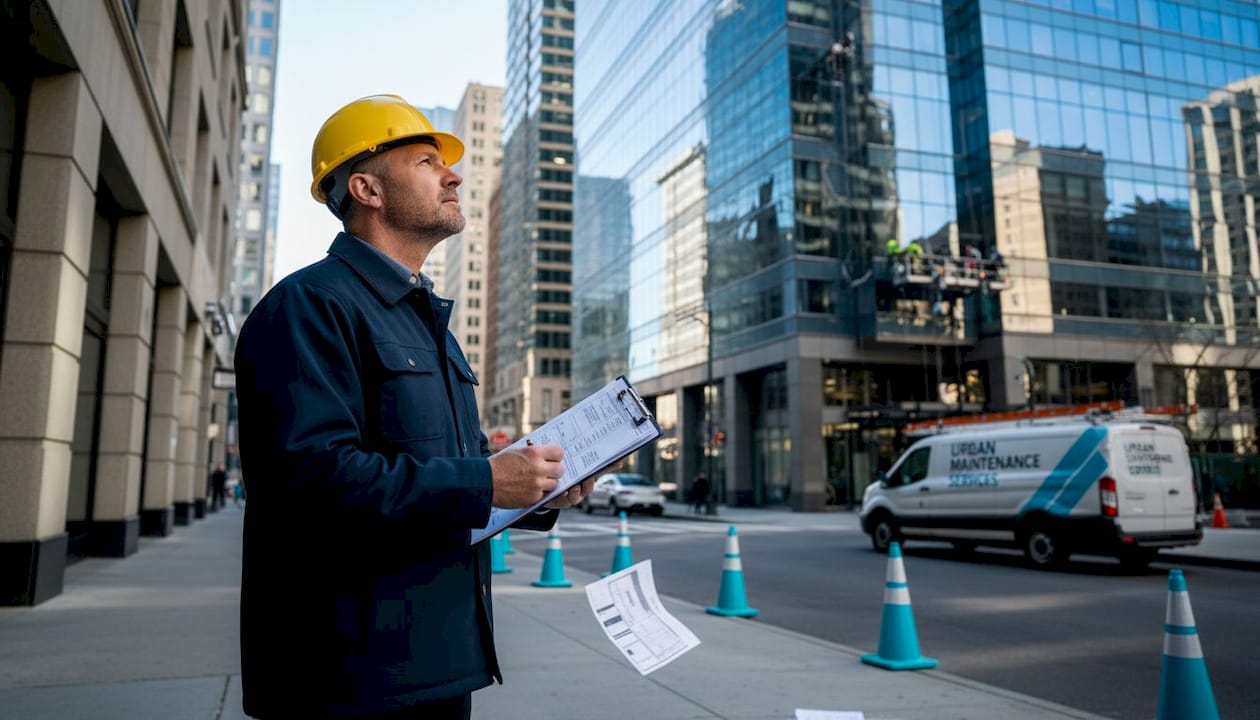
Scaffolding is often the default choice for cleaning commercial building exteriors, but the assumption that it is the safest or most cost-effective method is flawed. Avoiding scaffolding involves addressing documented safety hazards, legal liability, and inefficient workflows. Modern alternatives provide better results with far less risk. This guide breaks down the data behind these risks and your practical alternatives.
Table of Contents
- Key Takeaways
- Why avoid scaffolding for cleaning: the safety case
- Legal and financial liability you may not have accounted for
- Scaffolding alternatives for cleaning: what actually works
- Transitioning away from scaffolding in your maintenance program
- My take: scaffolding’s risk profile has never been acceptable
- See what scaffold-free cleaning looks like for your building
- FAQ
Key Takeaways
| Point | Details |
|---|---|
| Scaffolding has serious injury risks | Over 4,500 workers are injured annually in the U.S. from scaffolding accidents, with 60-80 fatalities per year. |
| Legal liability can be absolute | Property owners in states like New York face full liability for scaffold injuries regardless of worker fault. |
| Alternatives reduce exposure | Rope access and drone cleaning minimize worker-at-height risks and site downtime. |
| Cost savings are significant | Drone and scaffold-based methods can reduce cleaning costs by 30-60% compared to traditional scaffolding. |
| Planning is critical | Success depends on vendor vetting, compliance checks, and workflow integration. |
Why avoid scaffolding for cleaning: the safety case
While facility professionals recognize that scaffolding carries risk, many underestimate the scale. Scaffolding accidents in the U.S. cause approximately 4,500 injuries and 60 to 80 fatalities annually. Statistics show 72% of incidents result from equipment failure, slips, or falling objects. Cleaning operations, which involve hoses, high-pressure water, and chemicals, increase these risks significantly compared to general construction.
The three most common causes of scaffold accidents in cleaning
- Equipment failure: Corroded or poorly assembled components fail under load. Water and chemical exposure during cleaning accelerate this wear.
- Slips and trips: Wet platforms are inevitable during exterior cleaning. OSHA mandates guardrails, but they do not eliminate the slip hazard on a saturated platform.
- Falling objects: Tools and debris falling from scaffolds threaten pedestrians and vehicles. Large-scale setups amplify this exposure.
Dismantling scaffolding is statistically more dangerous than the initial assembly. Progressive collapse can occur if components aren't removed in the correct order. On large commercial projects requiring repeated assembly across different sections, the cumulative risk is high.
Regulatory compliance adds weight to the burden. HSE and OSHA regulations require inspections before every use, weekly, and after high-wind events. These requirements increase the administrative cost and project duration.
Pro Tip: Keep a dedicated scaffold safety log. Fines often result from missing inspection records rather than the physical equipment.
Legal and financial liability you may not have accounted for
Legal implications can be catastrophic for property owners.

Labor laws, such as New York’s Scaffold Law, impose absolute liability on property owners. Owners are held responsible for elevation injuries even if the contractor managed the site and the worker acted negligently. Liability also applies if the equipment is deemed inappropriate for the task, meaning you cannot contract away your responsibility.
Consider the typical scenario:
- A cleaning contractor manages their own crew and scaffolding.
- A worker is injured due to a part failure or slip.
- The property owner faces the lawsuit, damages, and insurance spikes.
Even outside of specific scaffold laws, general premises liability creates exposure. Poor planning often leads to heavy fines. Regulators penalize organizations for failing to ensure safe lifting or access operations, regardless of internal safety policies.
“Property owners often underestimate financial exposure. Initial savings from low-cost scaffolding can be erased by one liability claim.”, Common Misconceptions About New York’s Scaffold Law
Pro Tip: Have legal counsel review vendor insurance and local liability standards for elevation work before every project.
Scaffolding alternatives for cleaning: what actually works
Rope access and drone cleaning minimize worker exposure and site congestion. The best choice depends on your specific building height and facade material.
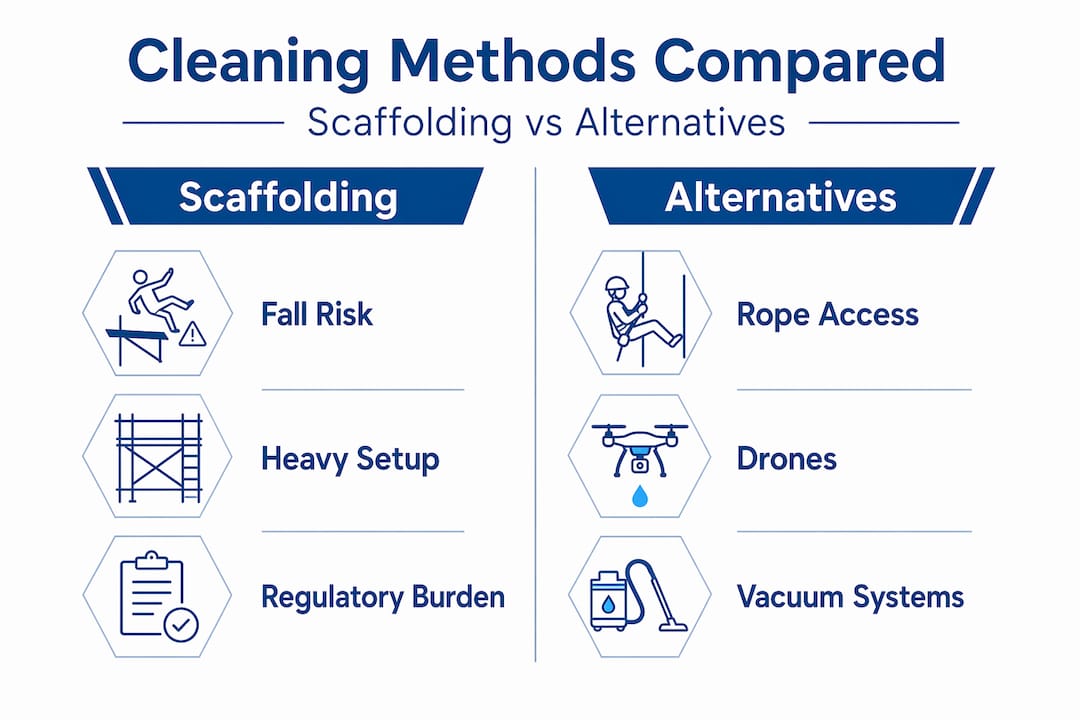
| Method | Safety profile | Cost vs. scaffolding | Disruption level | Best suited for |
|---|---|---|---|---|
| Scaffolding | High risk | Baseline | High (weeks) | Complex multi-trade construction |
| Rope access | Moderate risk | 20-40% lower | Moderate | Irregular facades, spot cleaning |
| Drone cleaning | Very low risk | 30-60% lower | Minimal | Facades, windows, roofs, solar |
| Aerial lifts | Moderate risk | 10-25% lower | Moderate | Low to mid-rise structures |
| Vacuum systems | Low risk | Significantly lower | Very low | Ground-based gutter maintenance |
For gutters, vacuum systems reach high elevations from the ground, removing ladder risks entirely.
Drone cleaning offers the most safety by keeping workers on the ground. FAA-registered drones use soft-wash systems and de-ionized water to clean facades and windows on high-rises. This eliminates the need for permits, traffic redirection, and tenant disruption. You can see how building cleaning without scaffolding works for South Florida commercials.
Rope access provides a middle ground. Certified technicians use roof anchors to descend facades. This method has a smaller footprint than scaffolding and is effective for detailed inspections or irregular architecture.
Transitioning away from scaffolding in your maintenance program
- Audit the scope: Document all exterior surfaces, heights, and access points. This identifies where you can switch methods.
- Select method by surface: Use drones for large glass or facade areas; use rope access for hardware-heavy sections or specific spot treatments.
- Vet vendors: For drones, check FAA Part 107 certification and commercial liability insurance. For rope access, verify SPRAT or IRATA credentials.
- Confirm compliance: Ensure drones have airspace authorization for urban clusters and verify that roof anchors for rope access are certified.
- Measure ROI: Savings usually scale by the second service cycle. Set ownership expectations on long-term liability reduction.
- Use drone documentation: High-res imagery from drones provides a digital record for insurance and warranty compliance.
Pro Tip: Run a pilot on one building section first to collect data on cost and quality before a full rollout.
Review this scaffolding vs. drone cleaning comparison to refine your budget projections.
My take: scaffolding’s risk profile has never been acceptable
Property managers often accept scaffolding out of familiarity, not safety. But familiarity isn't security. One liability review involving scaffold accident case law is usually enough to change a manager's mind. What looked like a standard budget item becomes an uncapped financial exposure.
The quoted costs for scaffolding rarely tell the whole story. You aren't just paying for the rental; you're paying for weeks of disruption, permit fees, inspector visits, and the legal risk if a worker slips.
Modern alternatives are proven. Drone technology is mature and FAA-regulated. Scaffolding should be the last resort, only used when a massive working platform for construction is strictly required. For cleaning alone, the risk isn't worth the reward.
, Eliot
See what scaffold-free cleaning looks like for your building
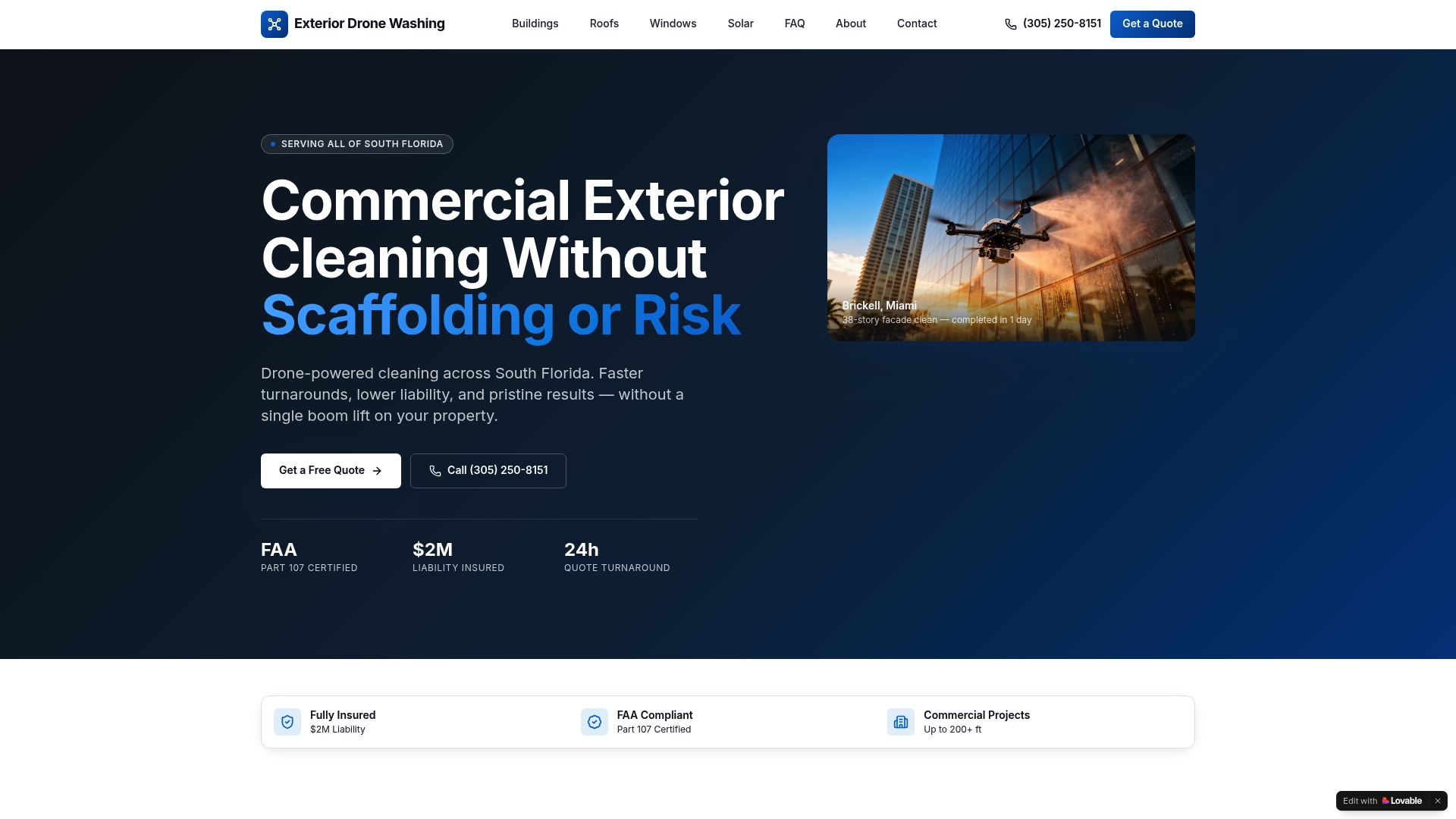
If you manage South Florida commercial property, compare your current scaffolding costs to drone washing. Vista Drone Cleaning uses FAA-registered industrial drones to clean high-rises, hotels, and office towers without placing workers at height.
Our drone facade cleaning and drone window washing services finish projects in a fraction of the time. We eliminate traffic blocks and tenant complaints. Contact Vista Drone Cleaning for a project assessment and cost comparison.
FAQ
What are the main dangers of using scaffolding for cleaning?
Dangers include falls, slips on wet platforms, mechanical failure, and falling equipment. Cleaning adds the hazards of high-pressure water and chemical runoff to an already unstable environment.
Is scaffolding safe for cleaning commercial buildings?
It is statistically high-risk. Thousands of injuries occur annually. Drone systems and rope access provide much safer outcomes by reducing worker exposure.
Can property owners be held liable for scaffold accidents they did not cause?
Yes. Absolute liability laws in several jurisdictions hold property owners responsible for elevation injuries even if the contractor was at fault.
What are the best practices for cleaning without scaffolding?
Audit your facade, choose drone or rope access based on the material, vet credentials, and document the work with aerial photos.
How much can you save by replacing scaffolding with drone cleaning?
Switching to drones can save 30% to 60% due to lower labor costs, zero rental fees, and faster project completion.