Drone Cleaning Insurance: South Florida Managers, Check Endorsements
South Florida managers can verify drone cleaning insurance through the COI and attached endorsements, then confirm pilot credentials and contract terms.

Before authorizing any drone exterior cleaning work, require proof of commercial general liability insurance at appropriate per occurrence and aggregate limits known in the industry. with Additional Insured, Primary and Noncontributory, and Waiver of Subrogation endorsements attached and not just referenced. Collect the ACORD certificate of insurance alongside those endorsement forms, confirm the contractor’s DBPR license number appears on the COI when applicable, and request FAA Part 107 pilot credentials plus a sample of 4K project documentation before granting site access.
TL; DR:
- Obtain actual Additional Insured, Primary and Noncontributory, and Waiver of Subrogation endorsements; a Certificate of Insurance alone grants no coverage rights.
- Confirm effective dates span the project, limits match the certificate, and an insurer or broker verifies the forms; log the date and contact.
- Check exclusions for aircraft operations, cleaning runoff, and building height; general liability may omit drone or pollution claims, while faulty workmanship belongs in warranty terms.
- Before granting site access, collect the Florida license number when applicable, FAA Part 107 credentials, a flight or safety plan, and 4K before and after records.
Table of Contents
- Checklist: exact insurance items and endorsements to require
- How to verify a certificate of insurance and endorsements
- Contract clauses and sample wording to include
- South Florida considerations: limits, litigation, and permitting
- Documentation and recordkeeping: what to collect before, during, and after the job
- What happens if there’s a claim
- Common insurance exclusions and what they mean for drone work
- Insuring the equipment and payload, not just the liability
- Beyond general liability: hull, pilot, and inland marine coverage
- How insurance ties into your contract’s indemnification clause
- How a properly insured South Florida drone operator approaches this
- How Vista Drone Cleaning meets these requirements
- FAQ
- Sources
Checklist: exact insurance items and endorsements to require
A drone cleaning vendor working on your building should carry more than a single liability policy. Start with the right policy types, then confirm the limits and endorsements that actually protect your property.
Commercial general liability is the primary policy to request, and it should be the contractor’s own coverage, not a borrowed certificate. If the vendor uses vehicles to transport equipment, ask for commercial auto coverage too. Workers’ compensation matters when the crew includes ground support staff, and an umbrella or excess policy is worth requiring on taller buildings or properties with heavier foot traffic.
On limits, appropriate per occurrence and aggregate limits known in the industry. is the figure most Florida property managers and condominium associations request from exterior cleaning contractors, and it lines up with what’s typically written for this class of work in Florida, according to Bright Coast’s breakdown of exterior cleaning coverage. Buildings with higher public exposure, such as hotels or retail centers with ground-level foot traffic, often ask for umbrella coverage on top.
- Commercial general liability with appropriate per occurrence and aggregate limits known in the industry. limits
- Additional Insured endorsement naming your property, using ISO forms such as CG 20 10 or CG 20 37
- Primary and Noncontributory wording so the contractor’s policy pays first
- Waiver of Subrogation so the insurer cannot pursue your association after a payout
- DBPR license number listed directly on the certificate for Florida-licensed contractors
Carriers classify exterior building cleaning under ISO general liability class code 91523, which covers cleaning the outside surfaces of buildings and similar exterior work. That code is useful shorthand when you’re comparing quotes or asking a broker whether a vendor’s policy actually fits the work being performed, as Bright Coast notes in its class code reference.
Pro Tip: Ask for the endorsement forms as separate PDF attachments, not just a line item on the COI. A certificate alone doesn’t prove the endorsement exists.
How to verify a certificate of insurance and endorsements
A Certificate of Insurance tells you a policy exists on the date it was issued. It does not, by itself, grant you any legal rights under that policy, and treating a COI as sufficient proof is one of the most common mistakes property managers make. Being listed as a “certificate holder” carries no coverage rights at all, according to Butler Legal’s analysis of certificates of insurance. Real protection comes only from the actual endorsement, properly issued and attached to the policy.
Follow these steps before signing off on any drone cleaning vendor:
- Request the COI and ask, separately, for the Additional Insured endorsement itself, not just the certificate referencing it.
- Check the endorsement form number, such as CG 20 10 or CG 20 37, and confirm it covers both ongoing and completed operations.
- Verify the effective and expiration dates match your project window, with no gaps.
- Confirm the policy limits on the endorsement match what was quoted on the COI.
- Get the insurer’s or broker’s direct contact information and keep it on file.
- Log the verification date and the name of the person who confirmed it.
Keeping an insurer contact on record, rather than relying only on the vendor’s paperwork, is standard procurement practice and prevents last-minute holds before a scheduled project, a point Comegys makes in its guide to construction liability insurance.
Pro Tip: If a vendor hesitates to provide the actual endorsement form, or the insurer doesn’t respond within a few business days, loop in your legal or risk management team before scheduling the job.
Contract clauses and sample wording to include
Insurance requirements belong in the contract itself, not just in a side email asking for a COI. A clause that spells out limits and endorsements in writing gives you something to enforce if a vendor’s coverage lapses mid-project.
Consider language along these lines in your purchase order or vendor agreement:
- “Contractor shall maintain commercial general liability insurance with limits of not less than appropriate per occurrence and aggregate limits known in the industry…”
- “Contractor shall name [property/association name] as Additional Insured via ISO endorsement CG 20 10 or CG 20 37, or equivalent.”
- “Coverage shall be Primary and Noncontributory, with a Waiver of Subrogation in favor of [property/association name].”
- “Contractor shall provide its DBPR license number on the Certificate of Insurance prior to any site access.”
- “No work shall commence until all required endorsements have been received and verified in writing.”
Placing this language in the vendor obligations section, ahead of the indemnification clause, matters because it establishes the insurance requirement as a condition of access rather than an afterthought. The endorsements then do the actual work of transferring risk away from your property, while the contract clause gives you the right to enforce it if the paperwork falls short.
South Florida considerations: limits, litigation, and permitting
South Florida properties face a few local realities that affect how much insurance to require. The appropriate per occurrence and aggregate limits known in the industry. standard remains the common baseline, but many Miami-Dade and Broward associations push vendors toward umbrella coverage given the region’s litigation activity.
- Confirm the DBPR license number is printed on the COI for any licensed Florida contractor.
- Ask whether your building’s local permitting office sets its own minimum insurance thresholds for exterior work.
- Factor in that South Florida’s high-litigation environment makes endorsement verification a primary defense against being pulled into third-party claims after an incident.
- Florida’s 2023 tort reform adjusted how negligence is apportioned in civil cases, but it did not reduce the overall frequency of liability claims in dense coastal markets like Miami-Dade, Broward, and Palm Beach counties.
$1,000,000/$2,000,000 is the per-occurrence and aggregate limit most commonly requested for exterior building cleaning contractors in Florida, and it’s a reasonable floor rather than a ceiling for taller or higher-traffic properties.
Documentation and recordkeeping: what to collect before, during, and after the job
Good documentation protects both sides if a dispute or claim arises later. Build a simple folder for every drone cleaning project and keep it past the job’s completion date.
- ACORD Certificate of Insurance, plus the attached Additional Insured, Primary and Noncontributory, and Waiver of Subrogation endorsements
- Insurer or broker contact information for follow-up verification
- FAA Part 107 pilot credentials and pilot identification
- Signed proposal or purchase order referencing the insurance clause
- Before and after 4K photos or video documenting the completed scope
Retain these files by property name, date, and scope of work, and keep them for several years beyond the statute of limitations your association’s policy specifies, often in the 3 to 7 year range depending on your own coverage terms. Also ask for a written flight plan or site safety plan and a brief incident reporting procedure before work begins.
Pro Tip: Store the verification packet in the same folder as your building’s own insurance renewal documents, so risk reviews catch gaps in both at once.
What happens if there’s a claim
A drone cleaning incident, whether it’s water intrusion through a window seal, minor facade damage, or an equipment malfunction near a walkway, follows the same basic claims sequence as any contractor liability claim. The property manager notifies the vendor in writing, the vendor’s insurer is notified next, and an adjuster typically requests documentation: the COI, the endorsements, the signed proposal, and whatever photo or video record exists of the work performed.

This is where your documentation habits pay off. A clear before-and-after photo set and a dated verification log of the Additional Insured and Waiver of Subrogation endorsements give the adjuster what’s needed to process the claim without delay. Without that record, the claim can stall while the insurer confirms coverage actually applied on the date of the incident.
Primary and Noncontributory wording matters most at this stage. It means the contractor’s policy responds first, rather than your association’s own property insurance absorbing the loss and then trying to recover costs after the fact. The Waiver of Subrogation closes the loop by preventing the contractor’s insurer from turning around and suing your association once it has paid out.
If a vendor’s insurer is slow to respond or disputes coverage, having the insurer’s direct contact already on file from your verification step shortens that back-and-forth considerably. Keep your risk or legal contact informed as soon as an incident occurs, rather than waiting until the claim stalls.
Common insurance exclusions and what they mean for drone work
Not every liability policy covers every scenario, and drone cleaning carries a few exclusions worth checking specifically. Aviation or aircraft exclusions are the most important one to flag. Some general liability policies exclude damage arising from the operation of an aircraft, and insurers have at times classified drones under that definition. Confirm with the vendor’s broker that the policy either carves out an exception for small unmanned aircraft used in cleaning operations, or that a separate aviation or drone liability policy fills that gap.
Pollution exclusions can also apply if cleaning solutions runoff into stormwater drains or landscaping. Ask whether the policy addresses contractors pollution liability or whether the soft-wash chemistry used is covered under the general liability form.
Faulty workmanship exclusions are standard across most general liability policies and mean the insurance won’t pay to redo work that simply wasn’t done well. That’s a quality issue to handle through the contract’s warranty language, not through insurance.
Finally, check for an exclusion tied to work at heights beyond a stated limit. A handful of policies cap coverage at a certain building height, which matters if your property exceeds 100 or 150 feet. Confirm the policy’s height limit matches or exceeds your building before work begins, rather than assuming a standard GL policy applies uniformly regardless of elevation.

Insuring the equipment and payload, not just the liability
General liability protects your property and third parties if something goes wrong. It does not cover the vendor’s own equipment, which for drone cleaning includes the aircraft itself and the cleaning system attached to it, such as pressurized water lines, pumps, and specialized nozzles.
That equipment typically falls under the contractor’s own property or inland marine policy, not yours, but it’s worth understanding why it matters to you as the property owner. A vendor without equipment coverage has a financial incentive to rush a job or cut corners on safety checks if a breakdown mid-project would come entirely out of pocket. Vendors carrying inland marine or equipment coverage for the drone and its attached payload are better positioned to replace a damaged unit quickly and finish the job on schedule rather than stalling a multi-day project.
This also ties back to the Additional Insured and Waiver of Subrogation endorsements on the liability side. If equipment failure causes property damage, the equipment coverage pays to replace the vendor’s drone, while the liability coverage, with the right endorsements, is what responds to any damage done to your building or grounds. The two coverages work together, and a vendor who only carries one leaves a gap somewhere.
Beyond general liability: hull, pilot, and inland marine coverage
General liability is the floor, not the complete picture. A few additional coverage types are worth asking about when vetting a drone cleaning vendor, even though they primarily protect the vendor rather than your property directly.
Drone hull coverage insures the physical aircraft against damage or loss, similar to how auto physical damage coverage works for a vehicle. Pilot liability, sometimes bundled into a broader aviation liability policy, covers claims tied specifically to the operation of the aircraft itself, separate from the general liability policy that covers the cleaning work and any property damage. Inland marine coverage, as noted above, typically covers the equipment and attachments, including the cleaning payload, while in transit or in use at a job site.
None of these replace general liability. They supplement it, and a vendor carrying all four, general liability, hull, pilot liability, and inland marine, presents a more complete risk picture than one relying on general liability alone. When you’re comparing quotes from multiple vendors, asking whether hull and pilot liability coverage exist at all is a reasonable screening question, even if you never see the actual policy documents.
How insurance ties into your contract’s indemnification clause
Insurance and contract language work as a pair. The insurance endorsements, Additional Insured, Primary and Noncontributory, and Waiver of Subrogation, are what actually transfer financial risk away from your property. The indemnification clause in your contract is what obligates the vendor to defend and cover your association if a third party sues over the vendor’s work.
These two mechanisms reinforce each other. An indemnification clause without matching insurance endorsements is a promise with no funding behind it. If the vendor’s own finances can’t cover a claim, you’re left pursuing a judgment against a contractor who may not have the assets to pay it. Endorsements without a clear indemnification clause, on the other hand, leave ambiguity about who is responsible for defense costs versus the underlying damages.
Draft the contract so the insurance requirement appears before the indemnification clause, and reference the specific endorsements by name within the indemnification language itself. That way, if a dispute ever reaches a courtroom, the contract itself points directly to the policy documents that back it up, rather than leaving the connection to be argued after the fact.
How a properly insured South Florida drone operator approaches this
Operating as FAA Part 107-certified pilots flying tethered drones up to 200 feet, carrying $2,000,000 in liability coverage, we’ve found that most procurement delays come from paperwork gaps, not coverage gaps. A vendor ready to email a complete packet, COI, endorsements, FAA credentials, a sample flight plan, and 4K before-and-after photos, removes most of the back-and-forth that otherwise stretches approval timelines on a 1 to 3 day project.
, Eliot
How Vista Drone Cleaning meets these requirements
We built our insurance and documentation practices around exactly the checklist above, because we’d rather hand property managers a complete packet upfront than field insurance questions mid-project. Our pilots hold FAA Part 107 certification, we carry $2,000,000 in liability coverage, and we provide the Certificate of Insurance along with Additional Insured, Primary and Noncontributory, and Waiver of Subrogation endorsements on request.
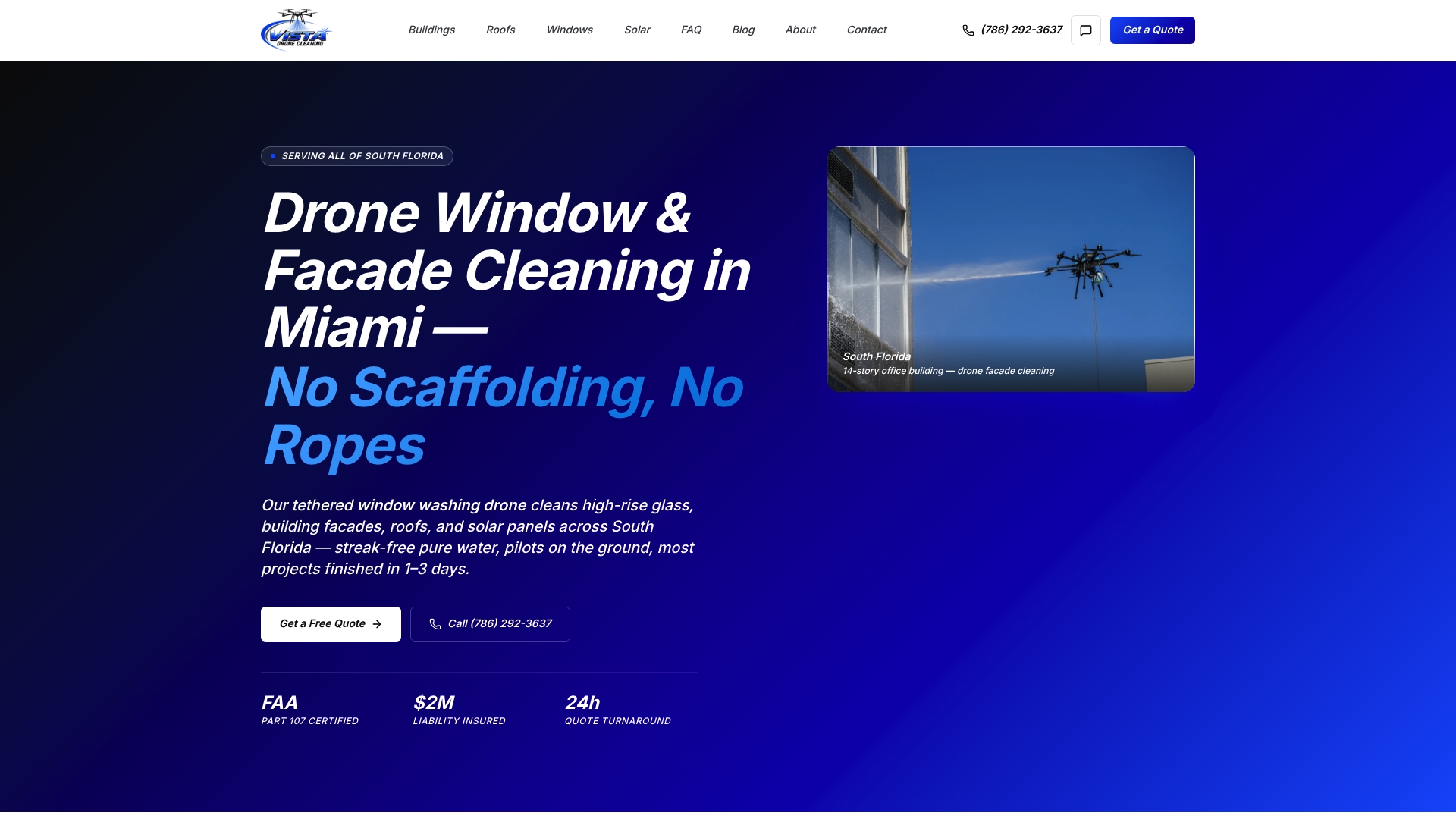
- FAA Part 107-certified pilots operating tethered industrial drones on buildings up to 200 feet
- $2,000,000 liability coverage with endorsement packets available before work begins
- 4K before-and-after documentation included on every project
If your building needs facade cleaning, window washing, roof soft-washing, or solar panel service, request a free quote on our drone facade and building cleaning page and ask for the insurance verification packet in the same message. We typically turn quotes around within 24 hours, and the same packet that speeds your insurance review also gets your project scheduled faster. For buildings with rooftop solar arrays, our solar panel cleaning page outlines the service directly.
Before scheduling, some property managers also bring in an independent site review. A commercial property inspection ahead of exterior cleaning work can document existing conditions, which pairs well with the before-and-after photo record we provide on every job.
FAQ
What’s the minimum liability insurance a drone cleaning contractor should carry?
Most Florida property managers and condominium associations require commercial general liability insurance with appropriate per occurrence and aggregate limits known in the industry. limits for exterior building cleaning work. Higher-exposure properties, such as hotels or buildings over a few hundred feet, often ask for umbrella coverage on top of that baseline.
Does a Certificate of Insurance prove I’m covered as Additional Insured?
No. A Certificate of Insurance only confirms a policy exists on the date issued, and being listed as a certificate holder grants no legal coverage rights. You need the actual Additional Insured endorsement, such as ISO form CG 20 10 or CG 20 37, attached and verified separately.
What does Primary and Noncontributory mean on a contractor’s policy?
It means the contractor’s insurance pays first on a covered claim, rather than your property’s own insurance absorbing the loss first. Requiring this wording keeps your association’s own policy and premium history out of a contractor’s claim.
Do Florida drone cleaning contractors need to list a DBPR license number?
Florida-licensed contractors are commonly expected to list their DBPR license number directly on the Certificate of Insurance when a license applies to the work performed. Ask your contractor for this before signing any agreement.
How much does drone exterior cleaning typically cost in South Florida?
Pricing varies by service and building size. Drone facade and window cleaning generally run $0.12 to $0.25 per square foot, while solar panel cleaning runs $1 to $3 per panel, with most projects completing in one to three days.
Sources
- General liability insurance for construction | Comegys
- Building Exterior Cleaning General Liability Insurance | Bright Coast
- Do certificates of insurance grant insured status? | Butler Legal