Contractor Insurance Checklist for South Florida Property Managers
Ensure your contractors are covered before work starts. Follow these essential steps to evaluate contractor insurance coverage in South Florida.
Before any contractor sets foot on your Miami-Dade, Broward, or Palm Beach property, request three documents immediately: the ACORD 25 certificate of insurance, a copy of the additional-insured endorsement on insurer letterhead, and the policy declarations page. Then spend five minutes confirming the insurer exists in the NAIC carrier database and call the carrier directly to verify the policy number and dates. That single workflow, done before mobilization, blocks the most common insurance gaps property teams face when hiring commercial exterior-cleaning contractors.
Minimum items to confirm before work starts:
- Insurer name and NAIC number (confirms the carrier is real and licensed)
- Policy number and effective/expiration dates (coverage must run through your project end date)
- General liability limits: $1,000,000 per occurrence / $2,000,000 aggregate at minimum
- Workers’ compensation coverage or a verified Florida exemption
- Additional-insured endorsement and waiver of subrogation in writing
- FAA Part 107 pilot certification and aviation liability coverage for any drone operations (relevant for vendors like Vistadronecleaning)
Key Takeaways
Evaluating contractor insurance coverage requires verifying documents, limits, endorsements, and carrier legitimacy before mobilization, not after a claim.
| Point | Details |
|---|---|
| Request three documents first | ACORD 25, additional-insured endorsement form, and policy declarations page before any work begins. |
| Verify the carrier directly | Call the insurer with the policy number; a 5–10 minute call reveals cancellations and missing endorsements a COI will not show. |
| GL minimums for exterior cleaning | Require $1,000,000 per occurrence / $2,000,000 aggregate; push higher for high-rise, drone, or chemical work. |
| Drone ops need aviation liability | Standard GL excludes aircraft; confirm a separate aviation policy covers commercial UAS operations over structures. |
| Store and track renewals | Retain COIs and endorsements beyond project completion; set 30-day expiration reminders to catch lapses before they matter. |
| Vistadronecleaning | Carries $2M liability and FAA Part 107 certification; documentation available on request for Miami-Dade, Broward, and Palm Beach projects. |
Table of Contents
- What to confirm in 10 minutes: your contractor insurance checklist
- Step 1: What documents should you request from a contractor?
- Step 2: How do you read and verify the ACORD 25?
- Step 3: What coverage types and limits should you require?
- Step 4: Which endorsements and contract clauses protect you?
- Step 5: How do you handle workers’ comp and subcontractors in Florida?
- Step 6: What specialized coverage do drone and exterior-cleaning contractors need?
- Step 7: How do you verify insurer credibility and certificate authenticity?
- Step 8: Red flags to watch for and what to do when coverage looks wrong
- Step 9: How should you store and track contractor insurance documents?
- Step 10: How long does the full verification process take?
- What South Florida property teams consistently miss
- Vistadronecleaning: a pre-vetted exterior-cleaning option for South Florida properties
- Sources
- FAQ
What to confirm in 10 minutes: your contractor insurance checklist
Documents to request immediately:
- [ ] ACORD 25 certificate of insurance (COI)
- [ ] Additional-insured endorsement (endorsement form or insurer-signed letter, not just a COI notation)
- [ ] Policy declarations page when available
- [ ] FAA Part 107 pilot certificate for any drone operator
- [ ] Aviation/aircraft liability policy page for drone work
Quick verification items:
- [ ] Insurer name matches NAIC lookup
- [ ] Policy number present and legible
- [ ] Effective and expiration dates cover your full project window
- [ ] GL per-occurrence and aggregate limits meet your property’s minimums
- [ ] Workers’ comp confirmed active or exemption verified via Florida DFS lookup
- [ ] Additional-insured endorsement names your entity specifically
- [ ] Waiver of subrogation noted on GL and WC
Pro Tip: Write the insurer’s main verification phone number and the policy number directly on your printed checklist before you call. The carrier’s rep will ask for both in the first 30 seconds.
Step 1: What documents should you request from a contractor?
The ACORD 25 is the standard starting point. Every field matters: producer name and contact, named insured (must match the contractor’s legal entity), insurer with NAIC number, policy number, effective and expiration dates, coverage types and limits, description of operations, and certificate holder. Think of it as a map, not proof.
Beyond the COI, request:
- Additional-insured endorsement: The COI may note “additional insured included, ” but that notation alone does not create coverage. Ask for the actual endorsement form (CG 20 10, CG 20 37, or equivalent) or an insurer-signed letter confirming your entity is named.
- Policy declarations page: The dec page lists covered operations, exclusions, and endorsements in force. For high-rise or roof cleaning work, the dec page will show whether work-at-height operations are included or excluded.
- FAA Part 107 pilot certificate: Any contractor using drones must hold current FAA Part 107 certification. Ask for a copy of the certificate and confirm the pilot name matches the person who will be on site.
- Aviation/aircraft liability policy page: Standard GL policies typically exclude aircraft. Drone operators need a separate aviation liability policy covering operations over structures and people.
Step 2: How do you read and verify the ACORD 25?
Start with the named insured field. It must match the contractor’s registered legal entity exactly. Cross-reference it against the Florida Division of Corporations (SunBiz) if you have any doubt. A mismatch there is a serious red flag.
Check policy dates next. Coverage must be active from before your project starts through the day work is complete. A policy that expires mid-project leaves you exposed for the final days.
Then confirm coverage types and limits:
- General liability: Look for “each occurrence” and “general aggregate” figures. The industry baseline for exterior cleaning contractors is $1,000,000 per occurrence / $2,000,000 aggregate.
- Commercial auto: If the contractor’s vehicles will enter your property or parking structure, commercial auto coverage must appear on the COI.
- Workers’ compensation: Look for “statutory” in the WC limits column. If the field is blank or shows “exempt, ” verify the exemption independently.
- Description of operations box: This is where job-specific notes appear. Your property address, endorsement references, and additional-insured language should be listed here.
Pro Tip: Per Florida Statute 626.572, a COI is informational only and cannot by itself create or extend coverage. Treat it as a roadmap to the actual policy, then verify with the carrier.
Step 3: What coverage types and limits should you require?
A compliant vendor insurance stack for commercial exterior cleaning typically includes:
| Coverage Type | Suggested Minimum | When to Require Higher |
|---|---|---|
| Commercial general liability | $1M per occurrence / $2M aggregate | High-rise, rope access, chemical work |
| Workers’ compensation | Statutory (Florida) | Always; verify exemptions independently |
| Commercial auto | $1M combined single limit | Any vehicles on site |
| Umbrella / excess liability | $2M–$5M | High-rise, drone ops, large properties |
| Aviation / aircraft liability | Ask for limits; confirm ops over structures | Any drone work |
| Pollution / environmental | Per project scope | Industrial cleaners, mold, biohazard |
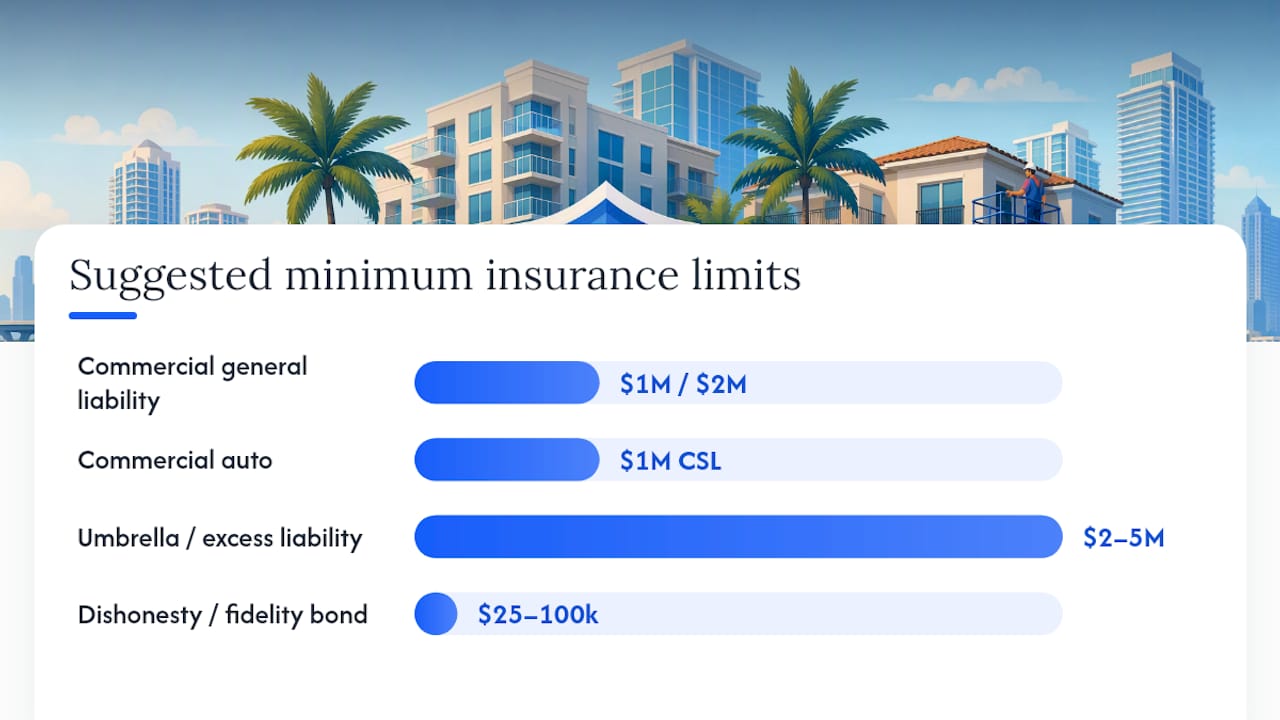
For cleaning firms that access tenant spaces daily, also require a dishonesty/fidelity bond ($25,000–$100,000) to cover employee theft risk. High-rise window washing, drone operations over occupied buildings, and chemical remediation all justify pushing limits toward the upper end of the umbrella range.
Step 4: Which endorsements and contract clauses protect you?
Three endorsements matter most, and all three should appear in writing before you sign anything:
- Additional insured: The endorsement must name your property-owning entity and management company. A COI notation is not enough. Request the endorsement form number and confirm it with the carrier.
- Primary and non-contributory: This wording requires the contractor’s policy to respond first. Without it, a carrier may argue your property policy should share the loss.
- Waiver of subrogation: Prevents the contractor’s insurer from suing you after paying a claim. Require it on both GL and workers’ comp.
Your contract should also include a clause specifying minimum insurance requirements, naming your entity as additional insured, and stating that a lapse in coverage triggers an automatic stop-work order. For recurring exterior cleaning contracts, add a renewal-verification requirement so you receive updated COIs automatically each policy year.
Step 5: How do you handle workers’ comp and subcontractors in Florida?
Under Florida Statute §440.10, a property owner or manager can be treated as a statutory employer if a worker is injured on site and the contractor lacks workers’ comp coverage. That exposure is real and worth taking seriously.
Florida guidance recommends verifying both GL and workers’ comp before work begins, and using the state’s online system rather than accepting a COI at face value. The Florida Division of Financial Services maintains a public workers’ comp coverage lookup at apps8.fldfs.com/wcCoverage/ that returns policy number, insurer, and effective/expiration dates.
For subcontractors:
- Require the prime contractor to provide COIs for every sub who will access your property.
- Confirm each sub’s WC coverage or exemption independently.
- Add a contract clause requiring the prime to ensure all subs carry identical insurance and to deliver COIs before any sub mobilizes.
Step 6: What specialized coverage do drone and exterior-cleaning contractors need?
Standard GL policies exclude aircraft. When a contractor uses drones, that exclusion matters immediately.
Drone-specific checklist:
- [ ] FAA Part 107 pilot certificate (current, matching the on-site pilot)
- [ ] Aviation/aircraft liability policy covering operations over structures and people
- [ ] Confirmation that the policy covers dense urban environments (Miami, Fort Lauderdale, Boca Raton)
- [ ] No blanket exclusion for tethered or commercial UAS operations
For solar panel cleaning and rooftop work, also check whether the contractor’s policy covers equipment damage to rooftop arrays and whether chemical use triggers a pollution exclusion.
Pro Tip: Ask the contractor’s insurer directly: “Does this policy cover commercial drone operations over occupied structures?” A hesitant or vague answer means the coverage is likely absent or ambiguous.
Coastal exposure in South Florida adds another layer. Salt-air corrosion and equipment damage claims are common. Confirm the contractor’s inland marine or equipment policy does not exclude outdoor coastal operations.
Step 7: How do you verify insurer credibility and certificate authenticity?
Follow this workflow in order:
- Look up the insurer’s NAIC number on NAIC.org to confirm it is licensed in Florida.
- Check the carrier’s AM Best rating. An “A” or better rating signals financial strength adequate for commercial claims.
- Call the insurer’s main certificate-verification line with the policy number in hand. Ask the rep to confirm: policy number, named insured spelling, effective and expiration dates, covered operations, and whether your entity is listed as additional insured.
- For workers’ comp, run the contractor through the Florida DFS lookup at apps8.fldfs.com/wcCoverage/ and supplement with a direct carrier call for time-sensitive projects.
Script lines that work: “I’m verifying policy number [X] for [Contractor Name]. Can you confirm the named insured, effective and expiration dates, and whether [Your Entity Name] is listed as an additional insured?”
A direct carrier verification call typically takes 5–10 minutes and will surface cancellations, mismatches, or absent endorsements that a COI alone would never reveal.
Step 8: Red flags to watch for and what to do when coverage looks wrong
Red flags on a COI:
- Policy number is missing or partially obscured
- Named insured does not match the contractor’s SunBiz registration
- Insurer NAIC number returns no result or a non-Florida-licensed carrier
- Agent contact information cannot be independently verified
- Effective dates have already expired
- Description of operations is blank or generic (“general contractor work”)
- Cancellation language reads only “endeavor to notify” with no endorsement backing it
Questions to ask when something looks off:
- “Can you spell the named insured exactly as it appears on the policy?”
- “What is the policy number and when does it expire?”
- “Is there an additional-insured endorsement in effect for [Your Entity], and what is its effective date?”
Immediate actions if coverage is insufficient: Stop work. Remove any subcontractors whose coverage cannot be verified. Request that the carrier or agent send the COI and endorsement directly to you by email, bypassing the contractor. Document every communication with timestamps. Do not allow mobilization to resume until you hold verified documents.
Step 9: How should you store and track contractor insurance documents?
Retain every COI, endorsement, and dec page for the life of the project plus the completed-operations exposure period. Completed-operations claims can arise months or years after a job finishes, and a COI you cannot produce is a gap in your defense.
Tracking table fields to maintain:
| Field | What to Record |
|---|---|
| Contractor name | Legal entity name as on policy |
| Insurer | Carrier name and NAIC number |
| Policy number | Full policy number as verified |
| Effective / expiration dates | Both dates; flag 30 days before expiry |
| GL limits | Per occurrence and aggregate |
| Endorsements on file | AI, waiver of subrogation, P&NC |
| Agent contact | Name, phone, and email |
Pro Tip: Set a calendar reminder 30 days before each policy expiration. For large vendor portfolios, a basic certificate-tracking spreadsheet or a service-business quoting platform like QuoteLock can automate certificate requests and flag gaps before they become claims.
Step 10: How long does the full verification process take?
Here is a realistic timeline for a routine exterior-cleaning contract:
- Day 1: Request ACORD 25, endorsement, and dec page from the contractor. Most vendors deliver the COI the same day or within 24 hours.
- Day 1–2: Run NAIC and AM Best lookups (under 10 minutes combined). Call the carrier to verify policy details (5–10 minutes).
- Day 2–4: Endorsement or dec page arrives. Insurer workload affects turnaround; 1–3 business days is typical.
- Before mobilization: All documents verified and stored. Contractor cleared to begin.
For recurring vendors, set an annual verification date tied to their policy renewal. If verification drags past day four without explanation, treat the delay as a red flag and pause the project until documents arrive.
What South Florida property teams consistently miss
The most common gap we see across Miami-Dade, Broward, and Palm Beach properties is not a missing COI. It is a COI that looks fine but has no actual endorsement behind it. A property manager accepts the certificate, files it, and assumes the job is done. Then a worker is injured, and the carrier denies the additional-insured claim because the endorsement was never issued.
Drone operations add a second blind spot. Expired COIs and missing drone insurance are the two issues that surface most often when property teams call us after a near-miss or a vendor dispute. A contractor who hesitates to provide an aviation liability policy page is almost certainly operating without one. For high-rise work in Fort Lauderdale or Brickell, that gap is not a technicality. It is a direct liability exposure for your property.
The fix is straightforward: require the endorsement form, not just the COI notation, and ask the drone operator’s insurer directly whether the policy covers commercial UAS operations over occupied structures. Those two questions, asked before mobilization, close the gaps that cause the most expensive claims.
Vistadronecleaning: a pre-vetted exterior-cleaning option for South Florida properties
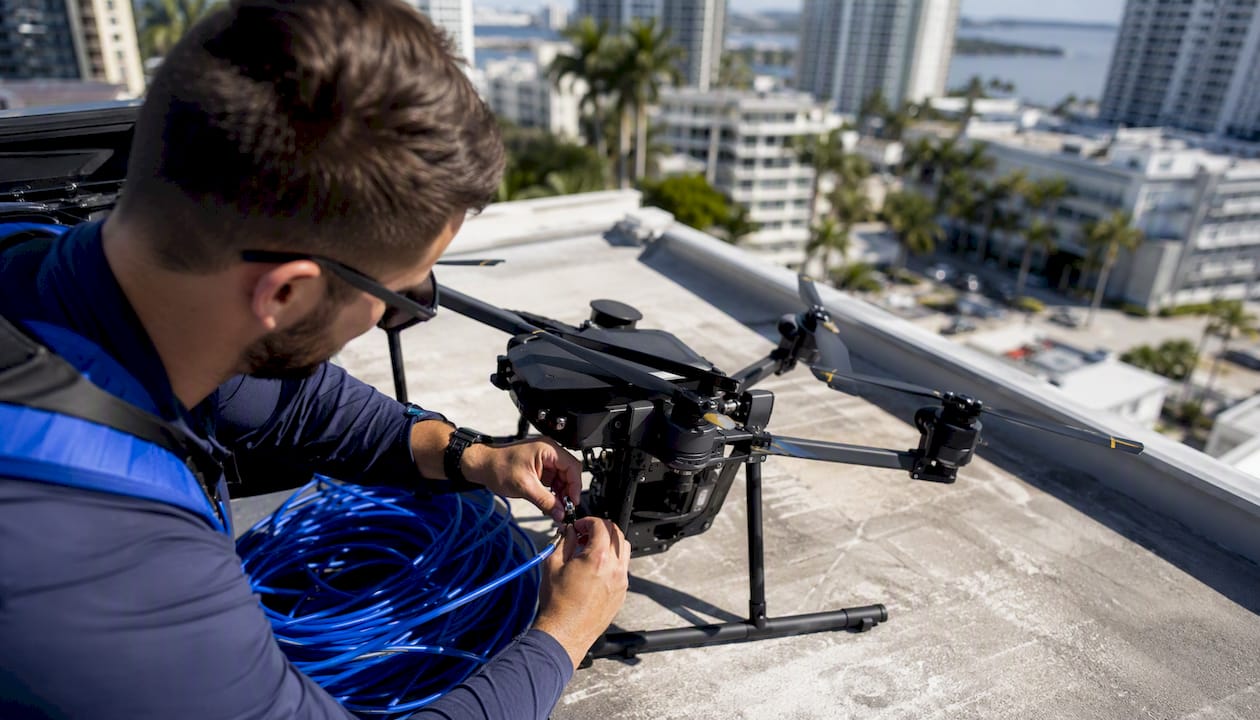
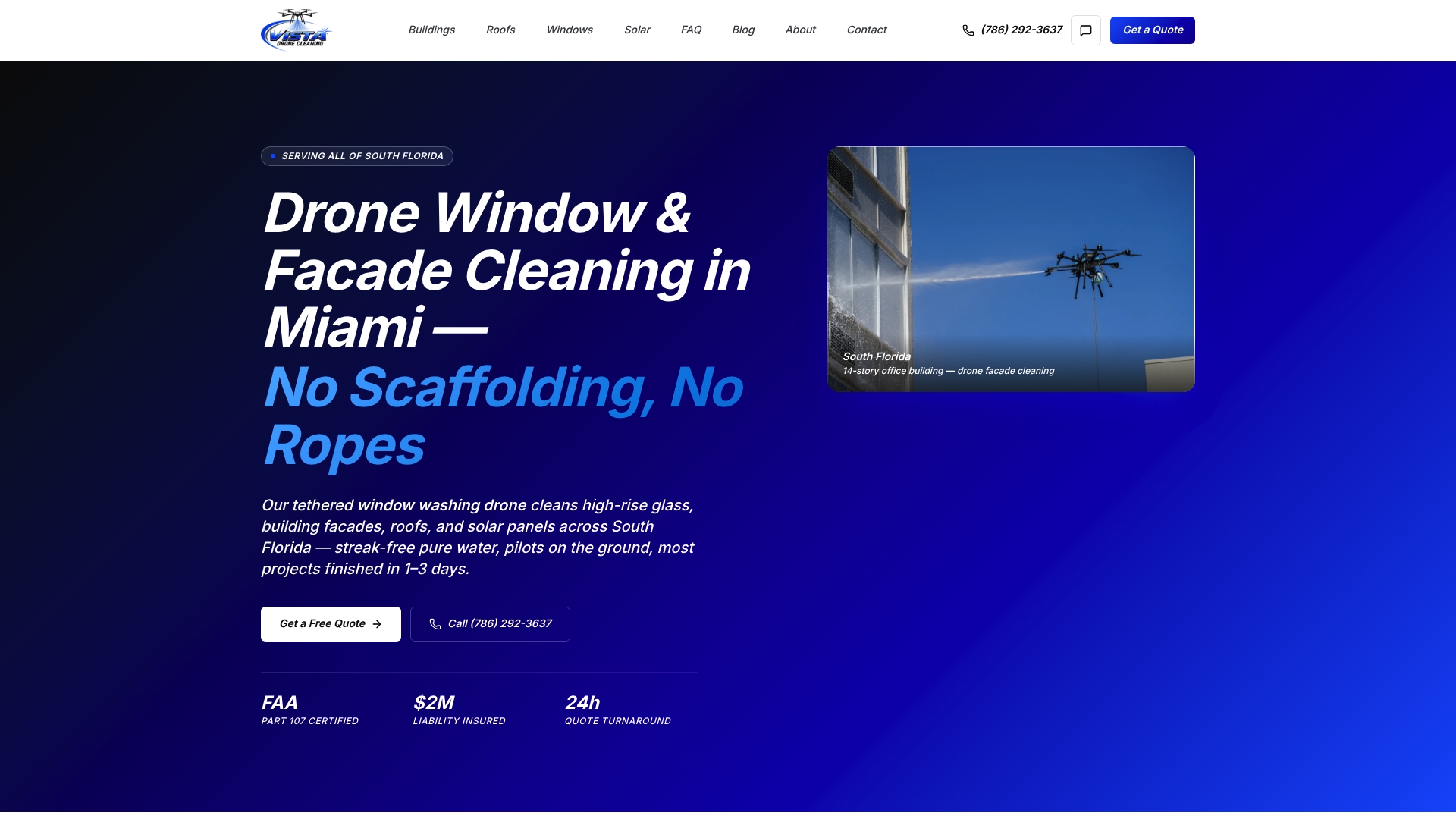
Property managers who complete this verification process and still need a contractor can skip several steps with Vistadronecleaning. The company carries $2M liability insurance, uses FAA Part 107-certified pilots, and operates tethered industrial drones (Lucid Bots Sherpa) for high-rise window washing, facade cleaning, roof soft-wash, and solar panel cleaning on buildings up to 200 feet tall across Miami-Dade, Broward, and Palm Beach counties. No scaffolding, no road closures, and most projects finish in 1–3 days.
COI, endorsements, and aviation liability documentation are available on request before mobilization. To see how drone cleaning compares to traditional scaffold or lift methods, visit the drone vs. traditional cleaning comparison. For a free quote on high-rise window washing or facade work in South Florida, request one at Vistadronecleaning and receive a response within 24 hours.
Sources
- Commercial Cleaning Compliance: A Guide to Safety, Insurance, and Vendor Requirements
- Floridacontractorcheck
- How to Verify a Workers’ Comp Certificate in Florida (2026) | GarrettRichard
This article is general information, not a substitute for advice from a qualified lawyer. Consult a qualified legal professional about your own circumstances before acting on anything here.
FAQ
What is the minimum general liability coverage for a cleaning contractor in South Florida?
Industry guidance sets the baseline at $1,000,000 per occurrence and $2,000,000 aggregate for janitorial and exterior-cleaning contractors. High-rise, drone, or chemical work typically warrants higher limits or an umbrella policy.
Can I rely on an ACORD 25 certificate alone to confirm coverage?
No. Per Florida Statute 626.572, a COI is informational only and can be forged. Always verify the policy number and named insured directly with the carrier and request the actual additional-insured endorsement form.
How do I verify a contractor’s workers’ comp in Florida?
Use the Florida DFS public lookup at apps8.fldfs.com/wcCoverage/ to confirm active coverage or a valid exemption, then supplement with a direct call to the carrier for time-sensitive projects.
Does a standard GL policy cover drone operations?
Typically no. Most commercial GL policies exclude aircraft. Drone operators need a separate aviation or aircraft liability policy that specifically covers commercial UAS operations over structures and people.
Does Vistadronecleaning carry the required insurance for high-rise work?
Yes. Vistadronecleaning carries $2M liability insurance and uses FAA Part 107-certified pilots. COI, endorsements, and aviation liability documentation are available on request before any project begins.