
Recurring Exterior Cleaning Contract Tips for Property Managers
Discover essential recurring exterior cleaning contract tips for property managers. Avoid disputes with our checklist to ensure smooth hiring!

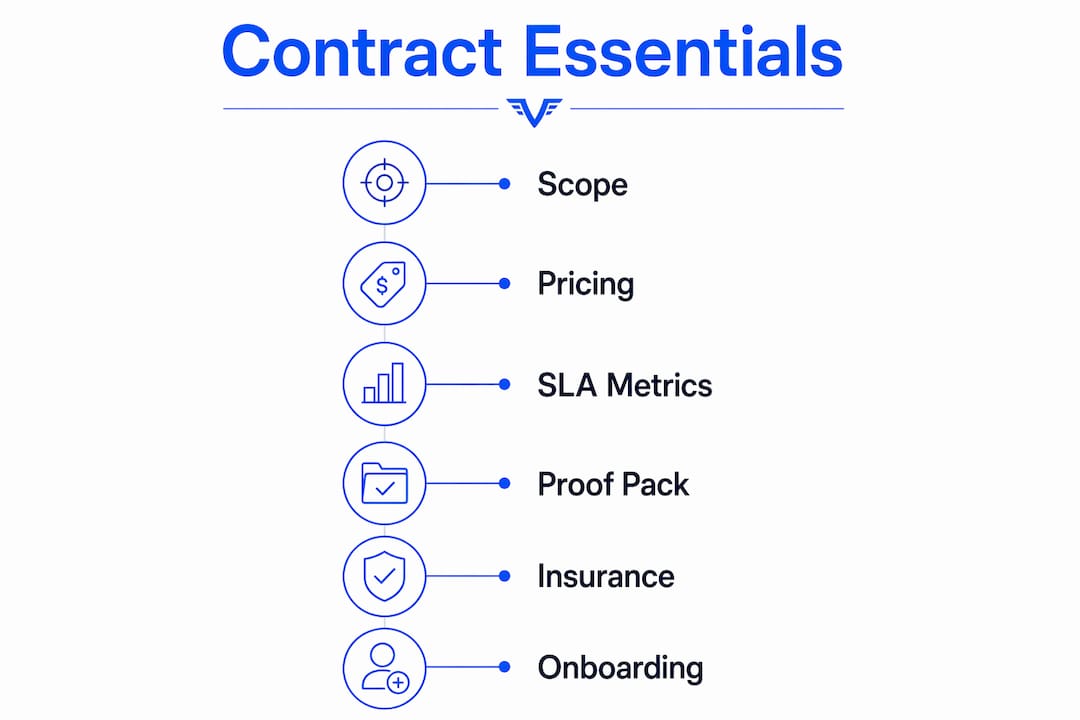
Every recurring exterior cleaning contract worth signing covers nine non-negotiable elements. Copy this checklist into your next RFP before you send it out:
- Grid-style SOW: List every facade section, task, cleaning method, and frequency in a table: vague language like “exterior cleaning, quarterly” is the single most common cause of payment disputes.
- Frequency matrix: Specify cadence per surface (monthly, quarterly, semiannual) rather than one blanket schedule.
- SLA/KPIs: Require arrival windows, completion confirmation, callback response time, and a re-treatment warranty period.
- Pricing model and billing cadence: State whether billing is fixed monthly, per visit, or per square foot, and require line-item pricing so you can compare bids on an equal basis.
- Proof-of-service (Proof Pack): Mandate timestamped before/after photos, a short video walkthrough, and a completed SOW checklist delivered within 24 hours of each visit.
- Insurance minimums: $1M general liability at minimum; $2M for multi-story or high-risk work; workers’ comp and an additional-insured endorsement.
- Term and cancellation: Include a 30-day convenience termination clause so you are never locked in if performance drops.
- Change-order process: Require written approval before any out-of-scope work is performed and priced.
- Onboarding/deep-clean baseline: Start with a documented deep clean and punch-list walkthrough before steady-state visits begin.
Each item above maps to a section below with sample language, pricing math, and South Florida–specific guidance you can use immediately.
Table of Contents
- Why do recurring exterior contracts make sense for South Florida properties?
- How do you build a grid-style SOW that prevents disputes?
- What pricing models work best for recurring exterior cleaning contracts?
- What SLA metrics and scheduling standards should you require?
- What documentation should you collect after every service visit?
- What insurance and safety language does every South Florida contract need?
- What does a solid onboarding plan look like for the first 60–90 days?
- How should you handle change orders, termination, and disputes?
- What quoting templates and contract clauses can you use right now?
- How do drone-based recurring contracts differ from traditional agreements?
- Key Takeaways
- What most property managers get wrong about recurring contracts
- Vistadronecleaning serves South Florida properties with recurring exterior cleaning
- Useful sources and templates
- FAQ
Why do recurring exterior contracts make sense for South Florida properties?
Salt air, humidity, and a hurricane season that runs June through November make South Florida one of the most demanding exterior-cleaning environments in the country. A Brickell high-rise or a Boca Raton retail center left on a reactive cleaning schedule will accumulate algae, mildew, and salt-air staining faster than almost any inland market. High-traffic or shaded areas in humid coastal climates can regrow algae and mildew in as little as 4–6 weeks, which means a “clean it when it looks bad” approach often costs more in aggressive remediation than a routine program would have.
Recurring contracts solve three operational problems at once: predictable budgeting, scheduling priority with your vendor, and documented accountability. When a vendor knows they have a 12-month agreement, they schedule your property into their crew calendar rather than fitting you in between higher-margin one-off jobs. That matters most right after a storm, when every property manager in Miami-Dade is calling for emergency washes at the same time.
One caveat: a long-term contract is not always the right move. A standalone storefront with low foot traffic and minimal facade exposure may not justify a 12-month commitment with a vendor you have not tested. Start with a 60–90 day trial period or a single ad-hoc job before signing anything multi-year. That trial period is the best due-diligence tool available, and it costs nothing to require it.
How do you build a grid-style SOW that prevents disputes?
The scope of work is the most important document in any cleaning agreement. 60% of contract disputes stem from vague or missing contract terms, and the fix is straightforward: a grid that leaves no surface, task, or frequency open to interpretation.

Require the SOW to be structured as a table with at least six columns:
| Location | Task | Method | Frequency | Approx. SF | Notes/Exclusions |
|---|---|---|---|---|---|
| North facade, floors 1–10 | Window washing | De-ionized pure-water rinse | Monthly | , | Excludes interior glass; no work during active rain |
| Rooftop deck | Soft-wash algae treatment | Low-pressure soft wash | Quarterly | , | Excludes HVAC units and roofing membrane |
| Parking garage entry | Pressure wash, concrete | High-pressure hot water | Monthly | , | Excludes painted striping |
Every row in that grid should name the exact cleaning method. “Soft wash, ” “pressure wash, ” and “de-ionized rinse” are not interchangeable; using the wrong method on EIFS stucco or painted concrete can void a substrate warranty. For a practical breakdown of method selection by surface type, review the method-specific guidance before writing your SOW.
The SOW must also be attached as a named exhibit in the contract itself. Any work performed outside the exhibit is a billable change order, full stop. Require an on-site walkthrough before the vendor finalizes the SOW, and document the baseline condition with photos on day zero. That baseline photo record is what resolves “you missed a spot” disputes six months later.
Pro Tip: Mark the SOW exhibit as “Exhibit A” in the contract body and add a single sentence: “Any service not listed in Exhibit A requires a written change order signed by both parties before work begins.” That one sentence eliminates most scope-creep arguments.
What pricing models work best for recurring exterior cleaning contracts?
Convert every bid to the same unit before you compare them. A vendor quoting a flat monthly fee and a vendor quoting per-visit pricing look completely different on paper but may be nearly identical in practice. The only way to know is to reduce both to dollars per visit and dollars per square foot.

Commercial exterior cleaning prices vary depending on building height, surface type, access complexity, and frequency. A ground-level retail facade at the low end; a 15-story glass curtain wall at the high end.
Three common pricing models:
- Fixed monthly: One flat fee covers all scheduled visits in the month. Predictable for budgeting; works well when visit frequency is consistent.
- Per square foot per visit: Pricing scales with the actual area cleaned each visit. Better for properties with seasonal frequency changes.
- Hybrid: Flat rate for routine surfaces (sidewalks, dumpster pads), itemized per-visit pricing for facade and roof work. The most transparent model for complex properties.
Sample pricing calculation:
- Vendor quotes $1,800/month for a 12,000 SF facade cleaned twice monthly.
- Per-visit cost: $1,800 ÷ 2 = $900/visit.
- Per-sqft cost: $900 ÷ 12,000 = $0.075/sqft per visit.
- Compare that to an ad-hoc rate of $1,200/visit for the same scope.
- The recurring discount is roughly 25%, worth locking in if the vendor’s performance holds.
Recurring discounts of 10–20% off ad-hoc rates are standard in the South Florida market, with typical pricing in the $0.05–$0.25 per square foot per visit range depending on property specifics. The incentive structure that actually moves vendors to honor those discounts: scheduling priority for post-storm response, bundled dumpster-pad maintenance added to the scope, and seasonal frequency increases for coastal-facing surfaces in summer. Offer the vendor a predictable workload and they will price it accordingly.
What SLA metrics and scheduling standards should you require?
Start with the metrics that are actually enforceable. An SLA that says “timely service” is worthless; one that says “arrival within one hour of the scheduled window, with written completion confirmation within four hours” gives you something to measure.
Minimum SLA metrics for a South Florida exterior cleaning contract:
- Arrival window: vendor must arrive within one hour of the scheduled start time.
- Completion confirmation: written or digital confirmation (with Proof Pack) delivered within four hours of job completion.
- Callback response: 24–48 hours for non-emergency service issues.
- Re-treatment warranty: 30–90 days depending on surface type; shorter windows for regrowth-prone coastal surfaces.
- Routine inspection cadence: joint walkthrough monthly or quarterly, tied to the SOW checklist.
Scheduling cadence for South Florida properties should reflect actual surface conditions, not a generic national template. Coastal-facing facades in Miami Beach or Hollywood can need monthly attention in summer; the same building’s north-facing wall may hold clean for a full quarter. Building exterior maintenance checklists that map inspection items to SLA checkpoints make this easier to manage.
Enforcement is where most contracts fall apart. Build in three mechanisms: an inspection score threshold (95% or higher on a standardized checklist is a reasonable target), a credit or price adjustment for missed SLAs, and a documented cure period (typically 10–14 days) before you can trigger termination. Without a cure period, you cannot legally terminate for cause in most cases anyway, so writing it in explicitly protects both parties.
What documentation should you collect after every service visit?
Require a digital Proof Pack for every single visit, no exceptions. The Proof Pack is the deciding evidence in most onsite performance disputes, and vendors who resist providing it are telling you something important about how they handle accountability.
Minimum Proof Pack contents:
- Timestamped before/after photos for each SOW section completed.
- Short video walkthrough of the cleaned area (30–90 seconds is sufficient).
- Completed SOW checklist with each line item marked done, partial, or skipped with a reason.
- Technician name and crew ID.
- Equipment and chemistry used (relevant for warranty and substrate protection).
- Safety notes: any pre-existing damage observed, hazards flagged, or access issues encountered.
Retain service records for a minimum of 90 days; for high-risk assets like high-rises or properties with rooftop solar arrays, keep records for 1–3 years. That retention window matters when an insurance claim, a tenant dispute, or a property sale surfaces months after the fact.
Pro Tip: Require automated delivery of the Proof Pack within 24 hours of service and specify a naming convention in the contract: [PropertyName][Date][SOWSection]. A folder of consistently named files is usable evidence; a folder of “IMG_4872.jpg” files is not.
For a detailed look at what before/after cleaning documentation should include and how to store it, that resource covers the full delivery workflow.
What insurance and safety language does every South Florida contract need?
Require a certificate of insurance before the vendor sets foot on your property, and name your entity as an additional insured on their policy. That additional-insured endorsement is what gives you direct coverage under their policy if a claim arises from their work.
Insurance minimums to write into the contract:
- Commercial general liability: $1M minimum; $2M recommended for multi-story or high-risk properties.
- Workers’ compensation: required for any vendor with employees on-site.
- Commercial auto: required if the vendor’s vehicles access your property.
- Additional-insured endorsement: your entity named on the vendor’s CGL policy.
- COI timing: certificate dated within 90 days before first service, renewed annually.
When drone or tethered aerial operations are part of the scope, add explicit FAA language. Require proof of FAA Part 107 pilot certification for every pilot operating on your property, a site-specific flight safety plan submitted before mobilization, and a tethered drone addendum if applicable. This is not optional paperwork: an uninsured or uncertified drone incident on your property creates direct liability exposure.
Safety language checklist for the contract body:
- Equipment inspection records available on request.
- Fall-protection coordination plan for any elevated work.
- Signage and cone placement requirements for pedestrian areas.
- Secure access and key-control protocol.
- Documented risk assessment for post-storm or hurricane-recovery service.
Post-storm service is a specific risk in South Florida. Require vendors to submit a written risk assessment before performing any hurricane-recovery wash, since debris, compromised surfaces, and standing water create hazards that a standard safety plan does not cover.
What does a solid onboarding plan look like for the first 60–90 days?
Never start steady-state recurring visits without a baseline deep clean first. The deep clean establishes the condition the vendor is responsible for maintaining, and it produces the baseline Proof Pack that every future visit is measured against.
Sample onboarding timeline:
- Day 0: On-site walkthrough, baseline photos, finalize SOW exhibit, sign contract.
- Days 1–14: Initial deep clean completed; baseline Proof Pack delivered within 24 hours of completion.
- Day 15: Joint punch-list walkthrough with property manager and vendor supervisor; document any missed items and set a cure deadline.
- Day 30: Steady-state recurring schedule begins per the frequency matrix in the SOW.
- Days 60–90: First formal performance review; compare Proof Packs against baseline, review SLA metrics, and decide whether to extend to a full 12-month term.
The 60–90 day trial period is the right structure for most South Florida commercial properties. Testing a vendor with a short trial before committing to a long-term agreement lets you evaluate actual performance, not just the proposal. Reserve the 12-month initial commitment for properties with complex access requirements or multi-building portfolios where vendor continuity has real operational value.
Onboarding deliverables to require in writing: baseline Proof Pack, access and key log, emergency contact list, recurring calendar entries for the full contract term, and the trial period terms spelled out with explicit conversion language (what triggers the move from trial to full term).
How should you handle change orders, termination, and disputes?
Scope creep is the most common way a fixed-price recurring contract turns into a surprise invoice. The fix is a written change-order process that is specific enough to be enforced.
Change-order clause essentials:
- Definition of billable extras: any task, surface, or frequency not listed in Exhibit A (the SOW grid).
- Approval workflow: written approval from a named property manager required before work begins; verbal approvals are not binding.
- Pricing formula: change-order work billed at the contract’s stated per-sqft or per-visit rate, or at a not-to-exceed rate agreed in writing.
- Emergency work pricing: pre-agreed rate for post-storm or urgent response work, stated in the contract so there is no negotiation during a crisis.
Termination language should cover three scenarios. First, 30-day convenience termination: either party can exit with 30 days’ written notice, no penalty, no explanation required. Second, immediate termination for cause: insurance lapse, safety violation, or repeated SLA failures after a documented cure period. Third, early-termination fee cap: if the contract includes a fee for early exit, cap it at one or two months’ service value and state it explicitly.
Dispute resolution works best when it follows a documented escalation path: informal notice first, then written notice citing the specific contract clause and a cure deadline, then mediation before any litigation. Proof Packs feed directly into this process. A timestamped photo showing the condition of a surface on a specific date is far more persuasive than a property manager’s recollection of what the building looked like.
What quoting templates and contract clauses can you use right now?
Require every vendor to complete a standardized quoting template before you evaluate their bid. This is the fastest way to make bids comparable.
Quoting template fields to require:
- Total bid price (monthly and annual).
- Price per visit and price per square foot per visit.
- Included tasks (reference Exhibit A).
- Excluded tasks (explicitly listed).
- Onboarding/deep-clean fee (one-time).
- Projected visits per year by surface type.
- Ad-hoc rate for out-of-scope work.
Four copy-paste contract clauses:
- SOW exhibit clause: “All services are governed by Exhibit A (Scope of Work Grid), attached hereto. Any service not listed in Exhibit A requires a written change order executed by both parties prior to performance.”
- Proof-of-service clause: “Vendor shall deliver a digital Proof Pack, including timestamped before/after photos and a completed SOW checklist, within 24 hours of each service visit.”
- SLA clause: “Vendor shall arrive within one hour of the scheduled service window. Failure to meet this standard on two or more consecutive visits constitutes a material SLA breach subject to the cure and credit provisions in Section [X].”
- Insurance clause: “Vendor shall maintain commercial general liability insurance of no less than $2,000,000 per occurrence and shall name [Property Owner Entity] as an additional insured. A certificate of insurance dated within 90 days of service commencement shall be provided prior to first service and annually thereafter.”
Three negotiation levers worth using: Shift low-frequency areas from monthly billing to per-visit billing so you only pay for actual service. Require a not-to-exceed rate for all ad-hoc and change-order work. Add an annual CPI-linked review clause so price increases are tied to a published index rather than the vendor’s discretion.
How do drone-based recurring contracts differ from traditional agreements?
Drone-enabled exterior cleaning changes the SOW, the pricing structure, and the compliance language in ways a standard cleaning contract template does not anticipate. The core difference: access costs drop significantly when crews stay on the ground, which compresses the per-visit cost for high-rise and multi-story work.
For a South Florida mid-rise, a traditional facade wash requiring a boom lift might take five days and require road-closure coordination, operator certification documentation, and lift rental line items. The same scope with a tethered industrial drone, like the Lucid Bots Sherpa units Vistadronecleaning operates, typically completes in one to two days with no lift, no rigging, and no road closure. That time compression reduces both the direct cost and the tenant disruption cost, which matters for occupied office towers in Brickell or hotel properties in Fort Lauderdale.
Contract edits specific to drone operations:
- Site flight-safety plan: require submission and approval before mobilization.
- FAA Part 107 pilot certification: require proof for every pilot on-site, not just the crew lead.
- Tethered drone addendum: specify the tethered vs. free-flight distinction, since tethered operations have different FAA requirements.
- Reduced lift/scaffold line items: remove boom-lift rental and operator-certification costs from the pricing template; replace with drone mobilization fee.
- Drone incident reporting: require written notification within 24 hours of any equipment incident, even minor ones.
Pro Tip: Schedule drone operations during South Florida’s morning weather window (before 10 AM) or late afternoon (after 4 PM) to avoid the sea-breeze gusts that develop midday along coastal properties in Miami Beach, Aventura, and Hollywood. Write this into the scheduling addendum so the vendor is not making that call unilaterally.
Vistadronecleaning carries $2M liability insurance and operates with FAA Part 107-certified pilots on every job. For a side-by-side look at how drone and traditional window cleaning compare on cost and access, that comparison covers the unit economics in detail.
Key Takeaways
A well-structured recurring exterior cleaning contract protects your asset, controls costs, and gives you enforceable remedies when performance falls short.
| Point | Details |
|---|---|
| Grid-style SOW is non-negotiable | Require a table listing every facade section, task, method, frequency, and exclusion to prevent scope disputes. |
| Price comparison requires a common unit | Convert all bids to $/visit and $/sqft; commercial exterior work typically runs $0.05–$0.25/sqft per visit. |
| Proof Packs within 24 hours | Mandate timestamped photos, video, and a completed SOW checklist delivered within one day of each visit. |
| Trial before long-term commitment | A 60–90 day trial period lets you evaluate real performance before signing a 12-month agreement. |
| Vistadronecleaning for South Florida high-rises | FAA Part 107-certified drone operations reduce access costs and project timelines for Miami-Dade and Broward properties. |
What most property managers get wrong about recurring contracts
The most common mistake is treating the SOW as a formality rather than the contract’s load-bearing wall. Property managers sign agreements with a single line of scope description, then spend the next 12 months arguing about what was and was not included. The vendor is rarely acting in bad faith; the contract simply never told them what “clean the building” meant.
The second mistake is skipping the Proof Pack requirement because it feels like extra paperwork. It is not extra paperwork. It is the only objective record of what happened on your property on a specific date. When a tenant complains that the windows were not cleaned last month, or when an insurance adjuster asks whether the facade was inspected after a storm, a timestamped photo with a GPS tag is the answer. A verbal assurance from a crew member is not.
Drone-based recurring contracts introduce a third mistake: applying a standard cleaning contract template to a fundamentally different operational model. The FAA language, the flight-safety plan, the tethered-drone addendum. These are not bureaucratic additions. They are the clauses that define liability when something goes wrong 15 stories up. A contract that does not address drone operations specifically leaves both parties exposed.
The property managers who get recurring contracts right treat the SOW, the Proof Pack requirement, and the insurance language as the three documents that actually run the relationship. Everything else (pricing, scheduling, termination) flows from how clearly those three are written.
Vistadronecleaning serves South Florida properties with recurring exterior cleaning
Commercial properties in Miami-Dade and Broward counties deal with salt air, humidity, and storm recovery demands that most exterior cleaning vendors are not equipped to handle at height. Vistadronecleaning uses FAA Part 107-certified pilots and tethered industrial drones to clean high-rise facades, windows, roofs, and solar panels without scaffolding, boom lifts, or road closures, finishing most projects in 1–3 days at 30–60% lower cost than traditional lift methods.
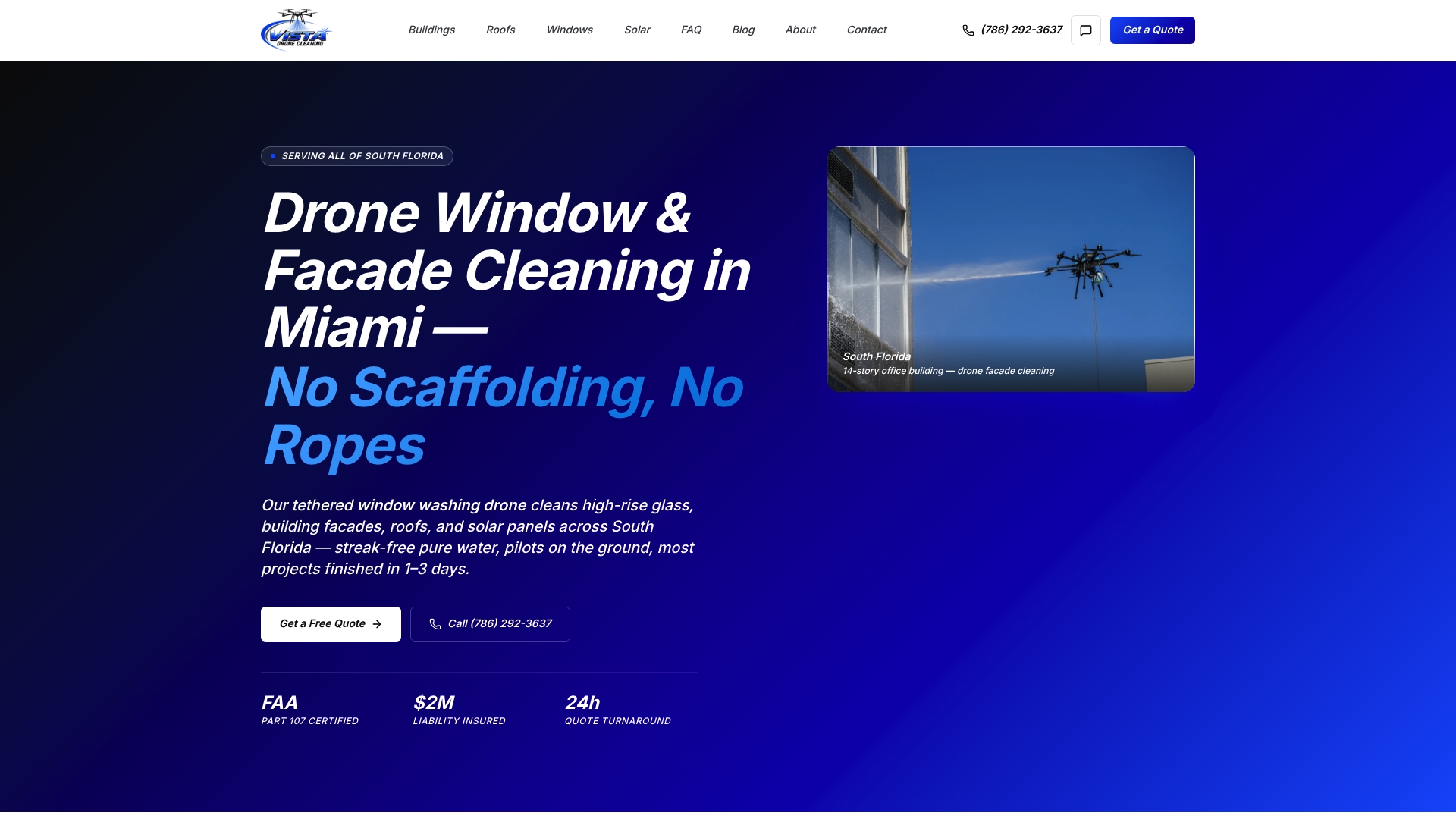
Recurring contract clients get $2M liability coverage, a site-specific safety plan before every mobilization, and a digital Proof Pack within 24 hours of each visit. Services relevant to recurring agreements include drone window washing, roof soft-wash cleaning, solar panel pure-water cleaning, and full building facade maintenance across Miami, Brickell, Fort Lauderdale, Boca Raton, and surrounding areas.
Request a free quote within 24 hours and ask for a sample SOW exhibit tailored to your property at vistadronecleaning.com.
Useful sources and templates
The resources below are worth bookmarking before you draft or renegotiate a recurring exterior cleaning contract.
| Resource | What It Covers | Best Used For |
|---|---|---|
| BSCAI Bidding Guide | How to evaluate and structure commercial cleaning bids | Comparing vendor proposals and pricing models |
| XIRI Facility Solutions Contract Guide | SOW structure, dispute prevention, and red-flag checklist | Writing or reviewing SOW language |
| Facility Management Insights Contract Template | Full contract template with KPI, SLA, and termination clauses | Drafting a new recurring agreement from scratch |
| CleanerHQ Sample Contract | Insurance minimums, COI timing, and additional-insured language | Insurance and compliance sections |
| Vistadronecleaning Building Cleaning Checklist | South Florida high-rise cleaning checklist usable as Exhibit A | SOW starting template for multi-story properties |
| Vistadronecleaning Before/After Documentation Guide | Proof Pack contents, delivery expectations, and storage | Writing proof-of-service contract language |
| Vistadronecleaning HOA Exterior Cleaning Guide | South Florida frequency, coastal exposure, and hurricane-season scheduling | Frequency matrix and seasonal cadence planning |
FAQ
What should every recurring exterior cleaning contract include?
At minimum: a grid-style SOW, SLA metrics with specific response times, a Proof Pack requirement within 24 hours of each visit, $1M–$2M general liability insurance with an additional-insured endorsement, and a 30-day convenience termination clause.
How much does commercial exterior cleaning cost per square foot?
Commercial exterior cleaning typically runs $0.05–$0.25 per square foot per visit, depending on building height, surface type, access complexity, and service frequency. Recurring contracts usually carry a 10–20% discount versus ad-hoc rates.
How often should South Florida commercial buildings be cleaned?
Coastal-facing surfaces in Miami-Dade and Broward may need monthly service in summer; inland or shaded surfaces often hold clean for a full quarter. High-traffic areas like dumpster pads and parking entries typically need monthly pressure washing regardless of location.
Does a drone cleaning contract need different language than a standard agreement?
Yes. Drone operations require FAA Part 107 pilot certification proof, a site-specific flight-safety plan, a tethered drone addendum, and drone incident reporting language. Standard cleaning contract templates do not cover these requirements.
How long should a trial period be before signing a long-term contract?
A 60–90 day trial period is the standard recommendation. It gives you enough service cycles to evaluate Proof Pack quality, SLA adherence, and communication before committing to a 12-month or longer agreement.