
Building Exterior Maintenance Checklist for Property Managers
Ensure your property remains safe and attractive with our comprehensive building exterior maintenance checklist designed for South Florida property managers.

TL; DR:
- A building exterior maintenance checklist is a zone-based inspection framework essential for maintaining safety and compliance in high-risk climates like South Florida. Regular inspections, classification of defects, and digital documentation enable effective repair planning and prevent costly failures, especially after storms. Drone technology provides safe, efficient access to hard-to-reach areas, enhancing inspection accuracy and repair response.
A building exterior maintenance checklist is a structured, zone-based inspection framework that keeps commercial properties safe, attractive, and compliant with local codes. For property managers in Miami-Dade, Broward, and Palm Beach counties, this framework is not optional. South Florida’s salt air, hurricane exposure, and year-round humidity accelerate material deterioration faster than nearly any other climate in the country. A well-built property exterior checklist covers facades, roofs, drainage systems, exterior lighting, and walkways, and it integrates inspection findings directly into documented repair workflows. Programs like the Facade Inspection Safety Program (FISP) and industry best practices for annual professional inspections set the compliance baseline every property manager here must meet.
1. What does a building exterior maintenance checklist cover?
The checklist divides a building into inspection zones, each with specific tasks and failure modes. Treating the building as one undifferentiated surface is the fastest way to miss critical defects.
Facade zone:
- Cladding panels, masonry, and EIFS (Exterior Insulation and Finish System) for cracks, delamination, and staining
- Sealant joints and expansion joints for shrinkage, cracking, or missing material
- Glazing, curtain wall frames, and window seals for water infiltration signs
- Spandrel panels and anchoring hardware for corrosion or movement
Roof and parapet zone:
- Roof membrane for blistering, ponding water, or punctures
- Flashings, copings, and parapet walls for separation or rust staining
- Roof penetrations (HVAC curbs, pipe boots) for sealant failure
Drainage zone:
- Gutters, scuppers, and downspouts for blockages and corrosion
- Overflow drains for proper clearance and function
- Grade-level drainage for standing water near the foundation
Lighting, signage, and walkways:
- Exterior fixtures for burned-out lamps, corrosion, and loose mounting
- Signage for fading, structural integrity, and electrical connections
- Walkways, ramps, and entry surfaces for trip hazards, spalling, or slip risk
Pro Tip: In South Florida’s salt-air environment, aluminum frames and galvanized fasteners corrode faster than inland properties. Add a specific line item for hardware corrosion on every facade zone inspection.
2. How often should each exterior inspection task be performed?
Inspection frequency is not one-size-fits-all. Different zones carry different risk levels, and South Florida’s weather cycles demand a schedule built around local reality.
Facade inspections for buildings over six stories are mandated on a 5-year cycle under FISP, with annual professional visual inspections recommended as best practice. That 5-year mandate is a legal floor, not a ceiling. Annual walkthroughs catch developing issues before they reach the SWARMP or Unsafe classification thresholds.
Recommended inspection schedule:
- Daily or weekly: Walkways, entry surfaces, exterior lighting, and visible drainage for immediate safety hazards
- Monthly: Signage, accessible facade areas at ground level, and visible roof edges from the ground
- Quarterly: Full drainage system check including scuppers, gutters, and downspouts; especially critical before and after hurricane season (june through november)
- Annually: Full professional visual inspection of all facade zones, roof membrane, flashings, and parapet walls
- Every 5 years: Mandated close-up facade inspection per FISP for qualifying buildings
- Post-storm: Emergency inspection of all zones within 48–72 hours after any named storm or significant wind event
Timing matters as much as frequency. Schedule your spring inspection in march or april, before hurricane season begins. Schedule your fall inspection in november or december, after the season closes. This aligns your repair window with contractor availability and dry-weather conditions.
3. How to classify and prioritize exterior maintenance issues
Not every defect demands the same response. The industry uses a three-tier safety classification system that every property manager should apply consistently.
Safe: No immediate action required. Document the condition and monitor at the next scheduled inspection.
SWARMP (Safe With a Repair and Maintenance Program): The condition requires repair within 5 years. The building is not immediately dangerous, but the defect will worsen without a planned intervention. This classification drives your capital planning calendar.
Unsafe: The condition requires immediate emergency repair, typically within 90 days, and often requires public protection measures such as sidewalk sheds or netting.
A 3mm flashing gap left unaddressed for 24–36 months can lead to remediation costs exceeding $40,000. What starts as a SWARMP condition becomes an Unsafe condition and then a capital disaster. The classification system only protects you if you act on it.
Thorough documentation with dated reports and before-and-after photographs linked to work orders is the difference between audit-readiness and a six-figure liability exposure. Inspections without documentation are legally and financially worthless.
4. What are best practices for implementing a maintenance checklist program?
A checklist on paper does nothing. The value comes from the system that turns inspection findings into closed work orders with verified completion dates.
Structured digital maintenance checklists reduce complaints by up to 35% and enable critical issue resolution within a 2-hour window during business hours. That number reflects what happens when inspections feed directly into a tracked workflow rather than a shared email thread.
Core implementation practices:
- Use a CMMS (Computerized Maintenance Management System) or a field-ready digital checklist app to log every finding with GPS location, timestamp, and photo
- Assign every finding a classification (Safe, SWARMP, Unsafe) at the time of inspection, not later
- Link each finding to a work order with a responsible party and a due date
- Closed-loop inspection systems that connect findings directly to tracked work orders are the primary factor separating successful programs from chronic maintenance failures
- Schedule recurring cleaning tasks within the same system so cleaning and inspection cycles stay synchronized
Cleaning method alignment by surface type:
| Surface Type | Recommended Method | Key Risk to Avoid |
|---|---|---|
| EIFS / synthetic stucco | Soft washing | High-pressure damage to finish coat |
| Concrete and masonry | Low-pressure rinse or soft wash | Etching or surface erosion |
| Glass curtain wall | Pure de-ionized water rinse | Mineral spotting and streaking |
| Metal cladding | Low-pressure wash with pH-neutral solution | Corrosion from harsh chemicals |
| Roof membrane | Soft wash only | Membrane puncture from pressure |
High-pressure washing on the wrong surfaces causes more damage than it prevents. Matching the cleaning method to the material is not a preference. It is a maintenance requirement.
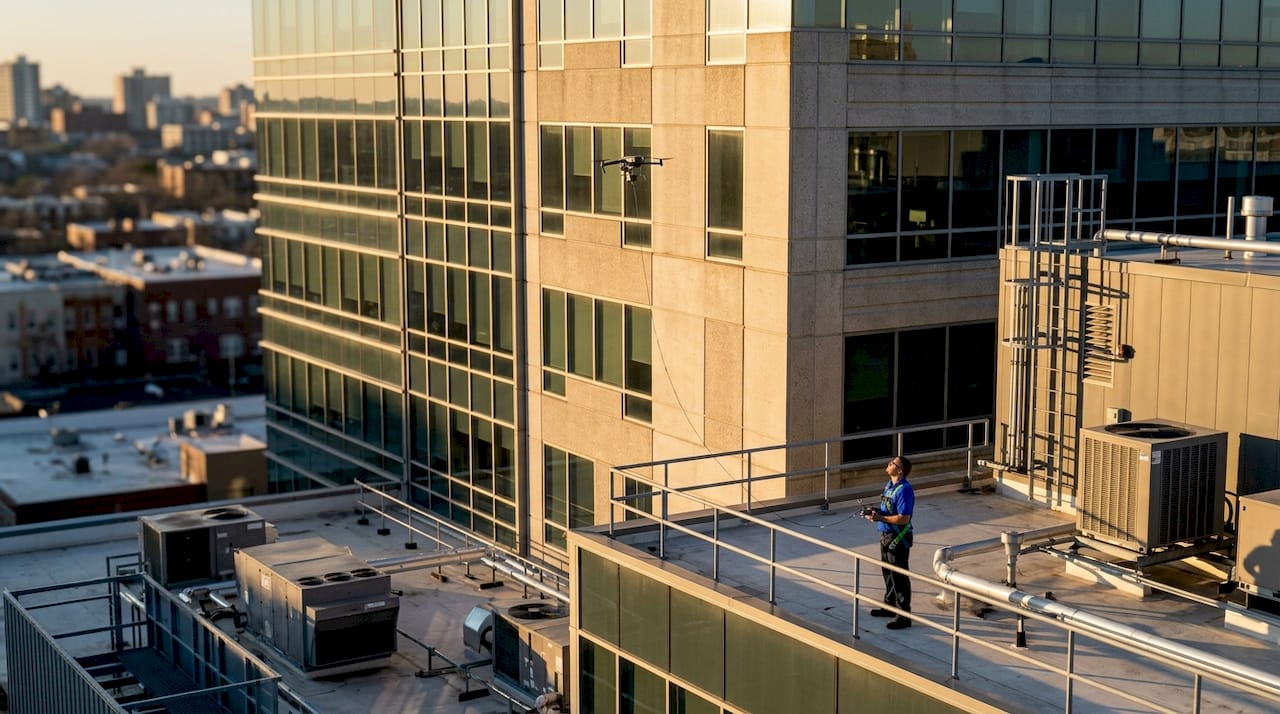
Pro Tip: For high-rise facades and rooftops above 40 feet, drone-based inspections eliminate the need for scaffolding or rope access. Vistadronecleaning uses FAA Part 107-certified pilots and Lucid Bots Sherpa drones to photograph and clean facades on buildings up to 200 feet tall, with crews staying safely on the ground.
5. How South Florida’s climate changes your exterior maintenance plan
South Florida is not a typical commercial real estate environment. The combination of salt spray, year-round humidity above 70%, and annual hurricane exposure creates conditions that shorten material lifespans and compress inspection cycles.
Salt air and storm exposure accelerate exterior material deterioration and require adaptation of maintenance plans beyond standard national guidelines. A maintenance schedule designed for a Chicago office tower will fail a Brickell high-rise within two years.
South Florida-specific checklist adjustments:
- Inspect all metal hardware, fasteners, and frames for corrosion every 6 months, not annually
- Add a mold, mildew, and algae growth line item to every quarterly inspection, particularly on north-facing and shaded surfaces
- Include a post-storm emergency inspection protocol as a standing checklist item, triggered automatically after any named storm
- Check sealant joints on facades twice per year because UV exposure and thermal cycling degrade sealants faster here than in temperate climates
- Verify roof drainage capacity before june 1 every year, since South Florida averages over 60 inches of annual rainfall concentrated in the wet season
The smart exterior maintenance strategies that work in this region treat the local climate as a primary design input, not an afterthought. Buildings in Fort Lauderdale, Boca Raton, and Miami Beach face conditions that demand a higher inspection cadence than any national standard requires.
Key takeaways
A building exterior maintenance checklist works only when inspection findings connect directly to classified, tracked, and closed work orders.
| Point | Details |
|---|---|
| Zone-based inspection | Divide the building into facades, roof, drainage, lighting, and walkways for complete coverage. |
| Inspection frequency | Follow a 5-year FISP cycle for facades, annual professional walkthroughs, and quarterly drainage checks. |
| SWARMP classification | Classify every defect as Safe, SWARMP, or Unsafe at inspection time to drive repair timelines. |
| Documentation discipline | Link dated photos to work orders to stay audit-ready and avoid capital failures exceeding $500,000. |
| South Florida adjustments | Increase inspection frequency for hardware corrosion, mold growth, and post-storm damage checks. |
What I’ve learned from watching South Florida buildings age faster than they should
After years of working with commercial properties across Miami-Dade and Broward, the pattern I see most often is not neglect. It is incomplete follow-through. A property manager runs a solid annual inspection, generates a detailed report, and then the findings sit in a PDF that nobody acts on until a tenant complains or a facade panel loosens.
The checklist is not the hard part. The hard part is the system behind it. Properties that perform well over time have one thing in common: every inspection finding has an owner, a deadline, and a verification step. That is not a technology problem. It is a workflow discipline problem.
The second thing I would push back on is the assumption that visual inspections from the ground are sufficient for high-rise facades. They are not. A crack in a sealant joint at the 18th floor of a Brickell tower is invisible from street level. Drone-based inspections change that equation entirely. You get photographic documentation of every floor, every joint, and every flashing without scaffolding, permits, or road closures. That documentation then feeds directly into your CMMS as a dated, georeferenced record.
The third pitfall is seasonal complacency. South Florida property managers who skip the pre-hurricane season inspection in april or may pay for it in october. Post-storm repairs cost three to five times more than preventive repairs. Budget for the inspection. It is the cheapest line item in your maintenance plan.
, Eliot
How Vistadronecleaning supports your exterior maintenance program
Property managers running a large facility exterior maintenance checklist across high-rise towers in Miami, Fort Lauderdale, or Boca Raton face one consistent obstacle: accessing the building envelope safely and affordably.

Vistadronecleaning deploys FAA Part 107-certified pilots and tethered Lucid Bots Sherpa drones to clean and photograph facades, windows, roofs, and solar panels on commercial buildings up to 200 feet tall. No scaffolding, no boom lifts, no road closures. Most projects complete in 1–3 days at 30–60% lower cost than traditional methods. The drone vs. traditional cleaning comparison shows exactly where the cost and safety advantages are sharpest for South Florida high-rises. Vistadronecleaning also offers eco-friendly exterior cleaning using non-toxic, pure de-ionized water rinses suited to South Florida’s sensitive coastal environment. Request a free quote within 24 hours at vistadronecleaning.com.
FAQ
What is a building exterior maintenance checklist?
A building exterior maintenance checklist is a structured inspection framework covering facades, roofs, drainage, lighting, and walkways. It assigns inspection frequency, defect classification, and documented follow-up tasks to keep commercial buildings safe and compliant.
How often should a commercial building exterior be inspected?
Annual professional visual inspections are the industry best practice, with a mandated 5-year close-up facade inspection for buildings over six stories under FISP. High-risk zones like drainage systems require quarterly checks, and post-storm inspections should occur within 48–72 hours of any significant weather event.
What does SWARMP mean in facade inspections?
SWARMP stands for Safe With a Repair and Maintenance Program. It means the building is not immediately dangerous but requires planned repairs within 5 years. An Unsafe designation requires emergency repair, typically within 90 days, often with public protection measures in place.
Why does South Florida require a different maintenance checklist?
Salt spray, high humidity, and hurricane exposure accelerate material deterioration faster than most U.S. climates. South Florida buildings need more frequent hardware corrosion checks, mold inspections, and mandatory post-storm protocols that standard national checklists do not include.
How does drone inspection improve exterior maintenance programs?
Drone inspections provide photographic documentation of hard-to-access areas like upper-floor facades and roof flashings without scaffolding or rope access. That documentation links directly to work orders, improving both audit-readiness and repair prioritization for large facility exterior maintenance programs.
Recommended
- Why Buildings Need Facade Maintenance: A Property Manager’s Guide, Vista Drone Cleaning
- Complete building cleaning checklist for South Florida high-rises
- Smart exterior maintenance strategies for South Florida buildings
- Shopping Center Facade Maintenance Checklist for Property Managers, Vista Drone Cleaning