How to Compare Exterior Cleaning Bids for Your HOA
Learn how to effectively compare exterior cleaning bids for your HOA. Ensure quality and safety with standardized proposals and clear criteria.
BLUF: to compare exterior cleaning bids fairly, issue a standardized RFP with an itemized pricing template, require on-site walkthroughs and certificates of insurance, and then score every proposal against a weighted checklist that values method and safety as much as price. A bid missing a certificate of insurance (COI) or documentation of an on-site walkthrough should be rejected outright, not “kept in the mix” out of politeness. A bid with vague scope language needs a clarification request before your board even discusses price.
At your next meeting, two things should get flagged in under five minutes: does every proposal show proof of insurance, and does the scope of work match the RFP template you sent out? If either answer is no, that bid goes back to the vendor, not into your comparison spreadsheet.
- Reject: no COI, no walkthrough evidence, no per-surface pricing breakdown.
- Clarify: scope language that says “exterior cleaning” without naming surfaces, methods, or square footage.
- Advance: bids with itemized pricing, method specified per substrate, and photo-report samples attached.
Key Takeaways
Comparing exterior cleaning bids for an HOA works best when boards standardize scope, normalize pricing into comparable units, and score proposals on a weighted matrix that treats safety and method as seriously as cost.
| Point | Details |
|---|---|
| Standardize the RFP | Require surface-by-location scope, specified methods, and measurement rules so vendors price identical work. |
| Normalize pricing | Convert one-time and recurring bids into annualized figures before comparing totals. |
| Weight the scoring matrix | Score methodology and safety above price, using roughly 35% methodology, 25% safety, 25% price. |
| Require documentation clauses | Build 24 to 48 hour defect response times and 48 hour photo reporting into every contract. |
| Consider drone-enabled options | Vistadronecleaning’s FAA Part 107 drone service offers a documented, insured alternative for high-elevation work without scaffolding or lifts. |
Table of Contents
- Comparing Exterior Cleaning Bids for HOA Boards: What the RFP Needs
- How Do You Normalize Bids With Different Pricing Structures?
- How Should You Score Vendors Beyond Just Price?
- What Contract Clauses Should an HOA Require?
- Soft Wash, Pressure, or Drone: Matching Method to Surface
- What Drone-Enabled Cleaning Looks Like in an RFP Response
- Clarification on Handling Unforeseen Damages During Cleaning
- Get a Comparable Bid From Vistadronecleaning
- Sources
- FAQ
Comparing Exterior Cleaning Bids for HOA Boards: What the RFP Needs
Bids only become comparable when every vendor is pricing the exact same scope of work. That’s the entire game. If your RFP is vague, you’ll get five wildly different proposals that can’t be laid side by side, and vague scope requests routinely produce inflated variance and hidden costs once the work actually starts.
Build your RFP around these fields:
- Surface inventory by location. List every building face, walkway, parking structure, dumpster corral, and pool deck separately. Flag delicate substrates like EIFS, painted stucco, and solar arrays so vendors know these require gentler treatment.
- Method per surface. Require vendors to state soft wash or pressure washing for each substrate, along with the MSDS sheet for any chemical they plan to use.
- Measurement rules. Specify who takes measurements (vendor or board-hired surveyor), the units used (square footage, linear footage for railings), and an acceptable tolerance range.
- Access and logistics. Note gate codes, parking restrictions, resident notification requirements, and staging area limits.
Every proposal should arrive with these attachments: a current COI, business and applicable trade licenses, an equipment list, a sample photo completion report, and at least two references from comparable properties.
How Do You Normalize Bids With Different Pricing Structures?
Comparing exterior cleaning cost estimates only works when you convert every bid into the same unit of measurement. One vendor might quote a flat project price. Another itemizes by surface. A third bundles everything into an annual maintenance number. None of those numbers mean anything side by side until you rebuild them into a common format.
Start with an itemized pricing schedule: unit rate per surface, total cost per visit, and an annualized figure if the work recurs. If Vendor A bids $8,400 for a one-time facade wash and Vendor B bids $2,800 quarterly, Vendor B’s annualized cost is $11,200, not automatically the better deal.
- Document whether allowances and contingencies are baked into the total or billed separately.
- Check escalation clauses. A 5% annual increase on a three-year contract adds up faster than boards expect.
- Ask each vendor to break out labor, equipment, and materials so you can see where the price actually comes from.
A defensible tendering process weights price at 30 to 40 percent of the total score, not 100 percent, precisely because raw price comparisons this messy invite bad decisions.
How Should You Score Vendors Beyond Just Price?
Every HOA cleaning bid comparison eventually comes down to a spreadsheet with numbers in it, and that spreadsheet needs weighted categories, not a single price column sorted low to high. A scoring matrix that weights methodology and compliance above raw price produces outcomes boards can actually defend to owners later, especially if a cheaper vendor causes property damage down the line.
A workable weighting structure looks like this:
- Methodology, 35%. Does the vendor specify soft wash versus pressure per surface? Is there a documented on-site walkthrough, not a desk estimate from satellite photos?
- Safety and insurance, 25%. Certified operators, current COI with adequate minimums, and a written safety plan for elevated work.
- Price, 25%. Normalized, annualized, and inclusive of allowances.
- References and reporting, 10%. Comparable-property references and a sample photo completion report.
- Warranty and performance metrics, 5%. Re-treatment terms and stated response times for defects.
Score each criterion 1 to 5, multiply by its weight, and total the columns. When two vendors land within a few points of each other, ask both for a best-and-final offer, or consider a short trial run on one building section before committing to the whole property.
Pro Tip: Any bid that skips the on-site walkthrough should score close to zero on methodology, regardless of how polished the proposal document looks.
Red flags that justify an automatic low score: no equipment list, insurance limits below what your master policy requires, references that don’t answer or don’t exist, and pricing that seems disconnected from the scope you provided.
What Contract Clauses Should an HOA Require?
Winning the bid comparison means nothing if the contract that follows is thin. A commercial cleaning contract needs explicit language covering scope, schedule, price, and what happens when something goes wrong, written at the task level rather than as a vague “general exterior cleaning” line item.
Build these into every contract:
- Exhibit A, listing scope of work and per-surface pricing exactly as bid.
- Response times for defects, typically 24 to 48 hours, plus a re-treatment window if the work doesn’t hold up.
- Documentation delivery, usually within 48 hours of service completion.
- Insurance minimums with the association named as additional insured, plus basic indemnity language.
For term structure:
- Most residential exterior contracts run one to three years, with 30 to 60 day cancellation windows for either party.
- Price escalation should be capped and tied to a stated index, not open-ended.
- Change orders need a signed approval process before any work outside the original scope begins.
- Final payment should be tied to a completed photo report, not just an invoice date.
Our contract tips for recurring exterior maintenance cover renewal timing in more depth for boards planning multi-year agreements.
Soft Wash, Pressure, or Drone: Matching Method to Surface
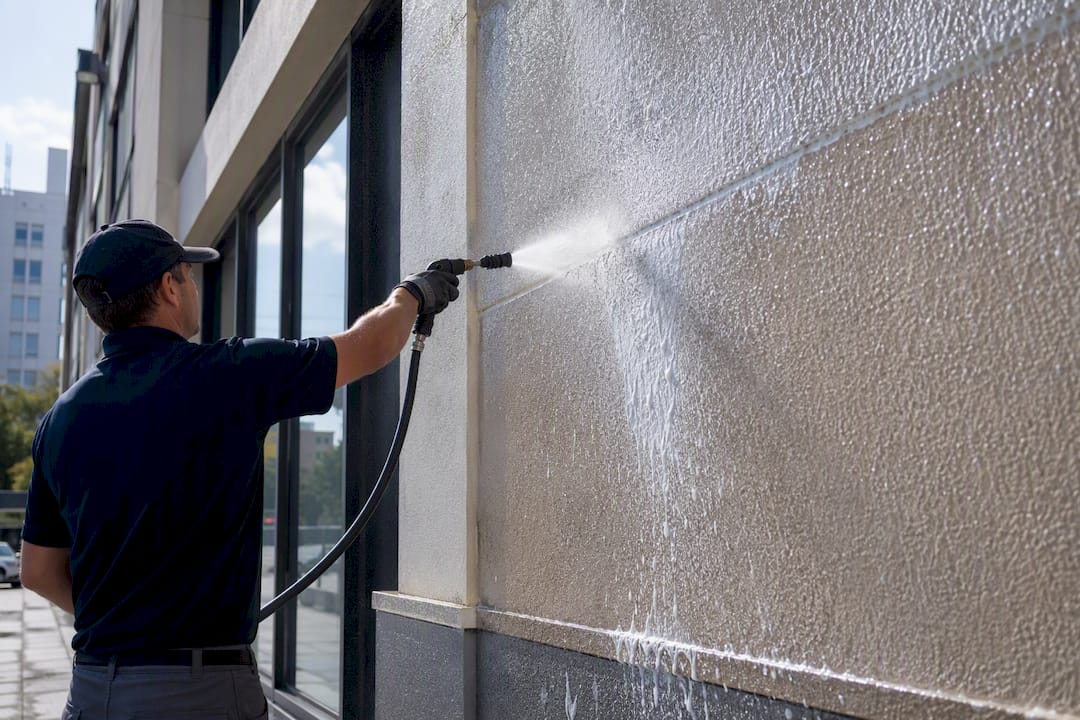
Method selection is where most bid disputes actually start. Pressure washing above roughly 1,500 PSI can strip paint, crack stucco, and force water behind EIFS panels, causing damage that shows up months later as staining or mold. Soft washing, which uses lower pressure and a biodegradable cleaning solution, is the manufacturer-recommended approach for EIFS, painted surfaces, and most roof tile.
For buildings above a few stories, the method conversation expands to include how workers actually reach the surface. Traditional options mean scaffolding, boom lifts, or rope access, each with permitting, road closure, and mobilization costs that add days to a project timeline. Tethered industrial drones have become a documented alternative for high-elevation cleaning that reduces rigging and mobilization needs when operated by certified pilots.
Whatever method a vendor proposes, require them to state the manufacturer-recommended approach in writing for delicate substrates, and confirm run-off containment plans for any coastal property where chemical drift into landscaping or waterways is a real concern. Our safe building washing examples show substrate-matched methods in practice.
What Drone-Enabled Cleaning Looks Like in an RFP Response
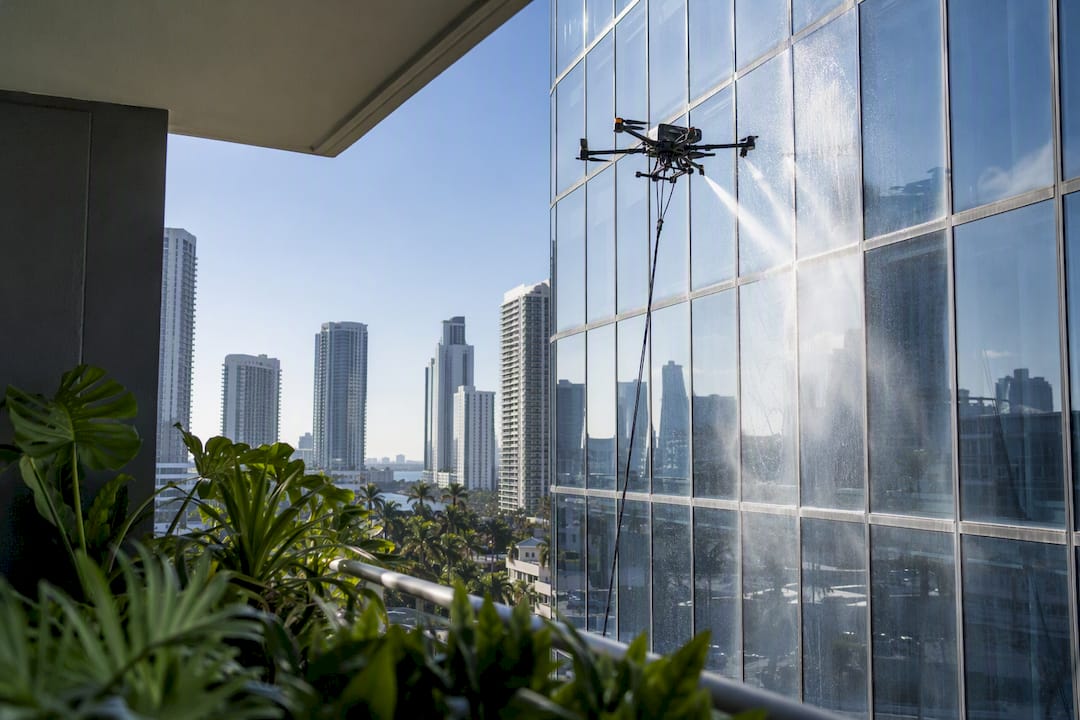
South Florida boards evaluating high-elevation cleaning bids increasingly see drone-based proposals alongside traditional scaffold and lift quotes. Vistadronecleaning operates in this category using FAA Part 107-certified pilots and tethered industrial drones, an approach that keeps crews on the ground and removes the need for scaffolding, boom lifts, or rope access on buildings up to 200 feet.
A compliant proposal in this category should let you request:
- Part 107 pilot certification for every operator assigned to the job.
- Equipment specifications, including the drone model used for the work.
- A certificate of insurance naming your association as additional insured, with stated liability minimums.
- A sample 4K photo documentation report from a comparable project.
- Pricing methodology explaining how the quote was calculated by area and service type.
The proofs that matter most on a high-elevation cleaning bid aren’t pretty renderings. They’re the pilot certification, the equipment list, and a certificate of insurance that a property manager can actually verify before signing anything.
Mobilization for drone-based projects typically runs shorter than scaffold setup because there’s no rigging to install or road closure to coordinate, which also means less disruption for residents living in or near the building during the work.
Clarification on Handling Unforeseen Damages During Cleaning
Every exterior cleaning bid should spell out what happens if something breaks during the job, a cracked window, a damaged light fixture, or paint lifted off a substrate nobody flagged as fragile. This clause matters as much as the pricing schedule, yet many HOA boards never ask for it until after a problem happens.
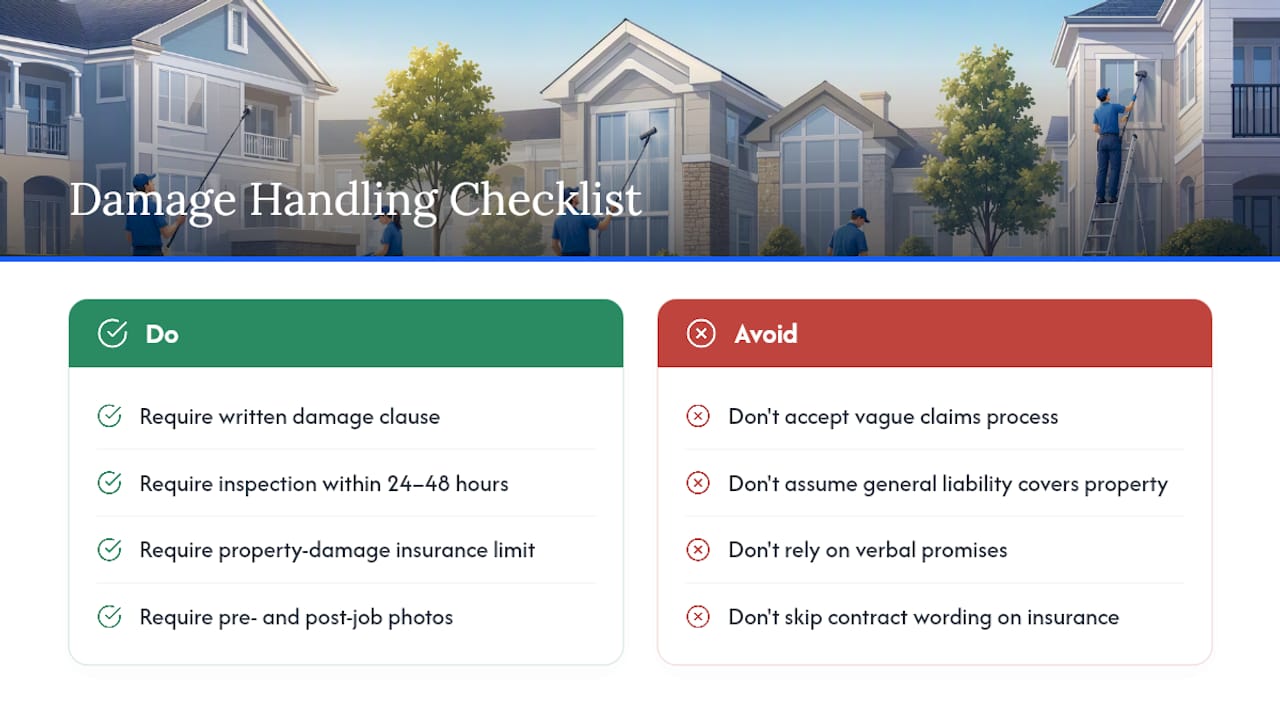
Require every vendor to state, in writing, how they handle damage claims before you sign anything. That means naming who inspects the affected area, how quickly they respond, and whether repairs come out of the vendor’s insurance or get billed back to the association. A reasonable standard is inspection within 24 to 48 hours of a reported issue, matching the same response window you’d expect for any other service defect.
The vendor’s certificate of insurance should cover property damage, not just general liability for injuries. Ask specifically what the policy’s property-damage limit is, and confirm whether it applies to the building itself as well as to landscaping, parked vehicles, or common-area furniture nearby.
Pin down the claims process in the contract, not just the proposal. Who documents the damage? Photos before work begins protect both sides here, since a pre-existing crack or stain can otherwise turn into a dispute about who caused what. Vendors using photo documentation as standard practice, the same completion reports required for acceptance, already have this baseline covered for post-service comparison.
Finally, confirm whether the vendor’s insurance responds directly or whether your association has to file first through its own master policy. That distinction determines how fast a resident’s damaged railing or window actually gets fixed.
Author perspective: balancing cost, risk, and long-term maintenance
Boards get sued over undocumented decisions, not expensive ones. Favor the vendor with better method disclosure and insurance over the cheapest number on the page, and tell owners why.
Get a Comparable Bid From Vistadronecleaning
If your board is comparing traditional scaffold, lift, or rope-access quotes against something faster, Vistadronecleaning gives South Florida associations a fourth option: FAA Part 107-certified drone cleaning that skips rigging, permits, and road closures entirely. Most high-rise facade, window, and roof projects finish in one to three days at 30 to 60 percent lower cost than scaffold or lift methods, with streak-free pure de-ionized water and $2 million in liability coverage backing the work.
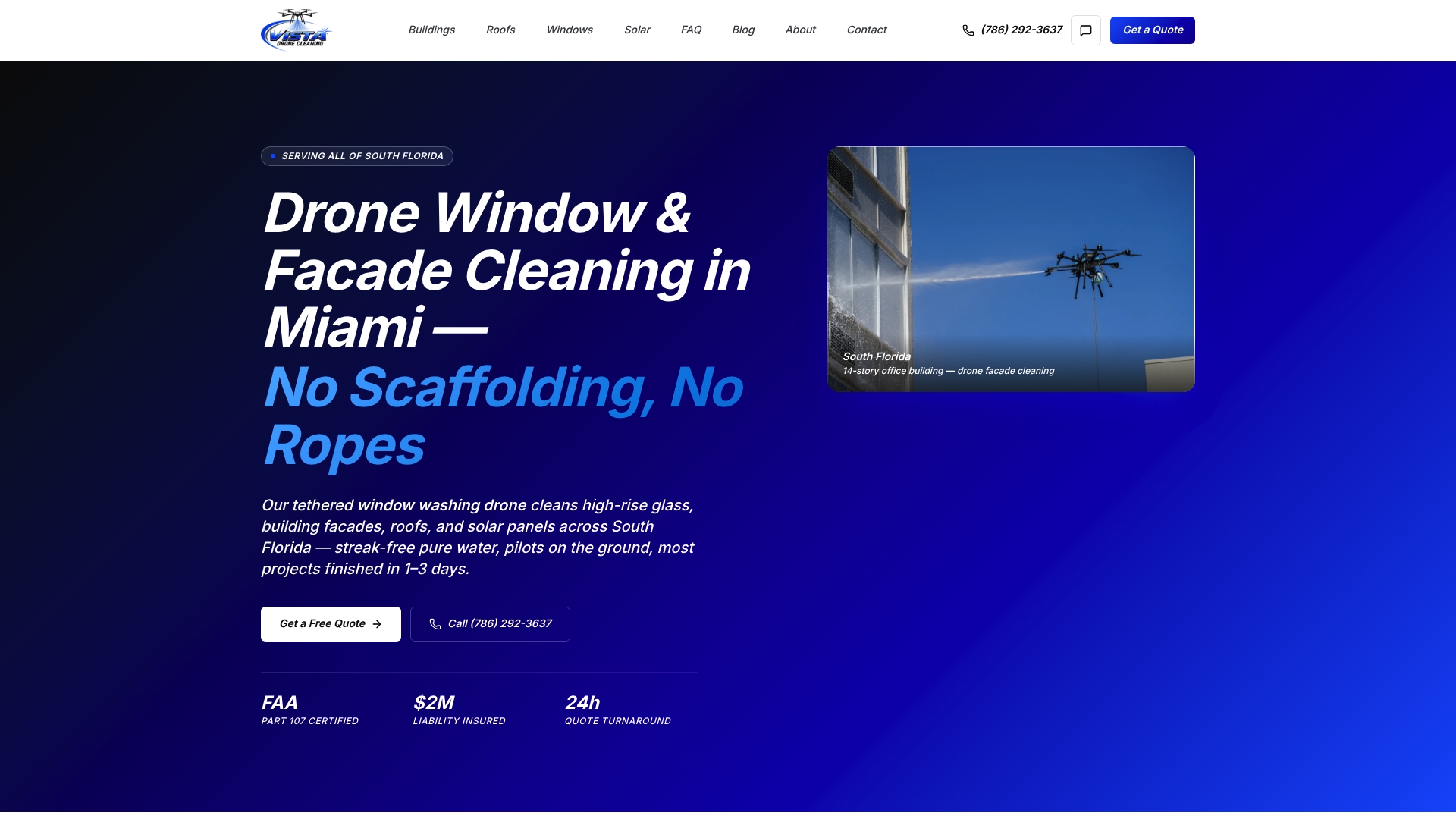
That combination matters most for boards juggling resident disruption alongside price. A shorter mobilization window means fewer notices, fewer parking restrictions, and less time residents spend looking at equipment outside their windows. For communities in Miami, Fort Lauderdale, or Boca Raton weighing solar array cleaning, facade work, or high-rise window washing, our drone versus traditional cleaning comparison walks through the cost and timeline differences in more detail.
Request a free quote for your building within 24 hours, and ask for the same documentation this guide recommends: Part 107 credentials, equipment specs, and a sample photo completion report, so your board’s comparison stays consistent whether Vistadronecleaning is one option among several or the vendor you ultimately select.
Sources
- Commercial Cleaning Bid Request: A Property Manager’s Guide to Exterior Excellence - Poseidon Power Washing
- Sample Commercial Cleaning Contract (Free Template)
- Commercial Building Wash Tendering Checklist | SOAKD
FAQ
What Should an HOA Look for First When Comparing Cleaning Bids?
Check for a certificate of insurance and evidence of an on-site walkthrough before looking at price. Bids missing either should be sent back for clarification, not scored as-is.
Is Exterior Cleaning a Profitable Service to Contract Out?
For the association, exterior cleaning functions as preventive maintenance that protects property value and reduces costly repairs later. For vendors, profitability depends on scope accuracy, which is exactly why itemized RFPs benefit both sides.
What Are Typical Cleaning Contract Terms for HOAs?
Most residential exterior cleaning contracts run one to three years with 30 to 60 day cancellation windows, capped price escalation tied to a stated index, and defect response times of 24 to 48 hours.
How Do I Know if a Bid’s Price Is Too Low?
A bid priced well below competitors usually signals missing scope items, thin insurance coverage, or excluded surfaces rather than genuine savings. Verify scope, insurance minimums, and references before advancing any unusually low bid.
Does Drone Cleaning Work for HOA High-Rise Buildings?
Yes. Tethered industrial drones operated by FAA Part 107-certified pilots can clean windows, facades, roofs, and solar panels on buildings up to 200 feet without scaffolding or lifts, which is the approach Vistadronecleaning uses across South Florida.