
12–15 mph Wind Rule for Drone Cleaning: A Facility Manager Playbook
For facility managers: when to accept or cancel drone facade cleaning. Follow 15 mph manufacturer ceilings, FAA Part 107 duties, and on-site hover checks.

For reliable commercial drone facade cleaning, plan for sustained winds under approximately 15 mph and treat higher gusts as a hard stop. Building height, glass geometry, and facade setbacks can push that threshold lower on any given site. If forecasted sustained winds or gusts exceed your vendor’s published limits, postpone the job rather than pushing through it.
TL; DR:
- Wind thresholds for drone facade cleaning should stay below 15 mph sustained and 25 mph gusts; higher speeds significantly degrade cleaning quality and safety.
- Building features like setbacks, louvers, and height increase turbulence and wind speed, necessitating more conservative wind limits than open ground testing.
- Conducting a hover check at the actual workface and verifying telemetry improve safety, especially on upper floors where ground-level weather data is unreliable.
- Operators should cancel jobs if hover stability or spray pattern wanders during verification, and reschedule within a short window when conditions improve.
- Site-specific wind and weather checks are essential, along with vendor policies combining manufacturer limits and FAA pilot responsibility guidelines.
Table of Contents
- Why wind matters for cleaning quality and safety
- Manufacturer and regulatory guidance on wind and weather
- Site and building factors that lower safe wind limits
- Preflight checks and in-field verification to require from a vendor
- A same-day decision checklist for accepting or canceling a job
- Vista Drone Cleaning’s approach to wind limits in South Florida
- How Vista supports safe, wind-aware drone cleaning
- Documents worth keeping on file for vendor agreements
- Sources
- FAQ
Why wind matters for cleaning quality and safety
Wind does more than rock the aircraft. It drifts spray patterns off target, causes uneven rinsing, and leaves streaks that force a second pass on the same section of glass. On tethered systems, sudden gusts change hover stability enough to trigger automatic altitude adjustments or descent, which interrupts the cleaning pass and adds time to the job.
There’s also a liability dimension that facility managers should weigh before approving a work window.
- Overspray drifting past the building line can reach sidewalks, balconies, or parked cars below.
- Unstable hover at height increases wear on tether lines and increases the chance of an aborted pass.
- Inconsistent rinsing on glass or metal substrates often means a rework visit, which extends tenant disruption.
None of this requires a storm. Moderate, steady wind is often the bigger problem because it looks manageable on the ground while still degrading spray accuracy at height.
Manufacturer and regulatory guidance on wind and weather
Two sources of guidance matter here, and they answer different questions. The Lucid Bots specifications recommend sustained winds at or below 15 mph, with caution advised once peak gusts pass roughly 25 mph, and note that hose size and payload configuration change the tested stable altitude. The Sherpa user manual lists weather minimums including that same 15 mph sustained wind guidance, VFR visibility, and no moderate or heavy rain.
Manufacturer guidance sets a sustained wind ceiling close to 15 mph for the Sherpa, which is the baseline most commercial operators build their own site policy around.
The FAA’s Part 107 rule does not set a numeric wind limit, but it puts the weather decision squarely on the remote pilot in command.
- Part 107 requires minimum visibility of 3 statute miles for the operation.
- It requires cloud clearance of 500 feet below and 2,000 feet horizontal from clouds.
- It holds the remote pilot responsible for confirming that conditions are safe before flight, wind included.
A sound vendor policy combines both: manufacturer wind and gust numbers as the technical ceiling, and Part 107’s visibility and pilot-responsibility rules as the compliance floor.
Site and building factors that lower safe wind limits

A published 15 mph limit assumes open, undisturbed air. Most commercial buildings don’t offer that. Height alone increases wind speed and turbulence compared to ground level, and dense building clusters create a canyon effect where wind funnels between towers and accelerates past corners. Facades with setbacks, sunshades, balconies, or vent louvers add turbulence that a ground-level wind reading never captures.
This is also why a hover flight capability, meaning the aircraft can technically stay airborne, is not the same as a cleaning-effective condition. Field experience from operators cited in industry wind resistance reporting notes that spray stability and rinse quality typically degrade before the aircraft loses safe flight control, which is why cleaning thresholds are usually more conservative than flight thresholds.
- Watch for inconsistent hover during a vendor’s on-site demonstration, drifting rather than holding steady at the workface.
- Visible spray drift during a hover check is a signal to stop before committing to full passes.
- Facade features like deep setbacks or exposed metal louvers are worth flagging in the site walk before scheduling.
Pro Tip: Ask your vendor to run a five-minute hover check at working altitude before the crew commits to a full cleaning schedule for the day.
Preflight checks and in-field verification to require from a vendor
Ground-level wind readings are frequently misleading once you get above the third or fourth floor, which is why in-field verification at the actual workface matters more than a phone weather app.
Sherpa’s daily flight checklist includes a hover check, weather review, and telemetry verification as standard preflight steps, according to the Sherpa daily flight and maintenance checklist, and that same structure is worth writing directly into a vendor’s scope of work.
- Run a hover test at the actual working altitude and record it, confirming position hold and spray pattern before starting any cleaning pass.
- Confirm telemetry and anemometer readings at facade height, along with airspace clearance where required and a signed preflight weather check.
- When conditions sit near the limit, reduce operating altitude, drop to a smaller nozzle or flow rate, run partial passes, or reschedule to a calmer window later that day.
These steps belong in the request for proposal, not just the vendor’s internal process. A contractor that can’t produce hover footage or telemetry logs on request is one to question.
A same-day decision checklist for accepting or canceling a job
On-site supervisors need a quick way to decide, not a lengthy debate once a crew is already staged.
- Check the current forecast for sustained winds and gust peaks against the manufacturer’s published limits and any stricter vendor policy, such as the 12 to 15 mph range some South Florida operators use.
- Run the hover verification at workface height. If position hold drifts or the spray pattern wanders, cancel the pass rather than pushing through it.
- Document the decision, notify affected tenants or building staff, and set a rescheduled window with a buffer day in case conditions haven’t cleared.
A few habits make this repeatable rather than reactive:
- Keep the forecast check and the hover check as two separate steps, since a calm forecast doesn’t guarantee a stable workface.
- Log every go or no-go decision so patterns in seasonal wind risk show up over time.
- Build the reschedule buffer into contracts up front so a postponed day doesn’t strain the tenant relationship.
Vista Drone Cleaning’s approach to wind limits in South Florida
Vista Drone Cleaning runs a wind operating window from low to moderate speeds in the 12 to 15 mph range for high-rise window and facade work, tighter than the raw manufacturer flight ceiling. South Florida’s afternoon sea breeze and convective thunderstorm cycles can turn a calm morning into an unstable one within hours, so we verify wind at the workface, not just the forecast, before starting a job.
, Eliot
How Vista supports safe, wind-aware drone cleaning
South Florida’s shifting afternoon wind patterns are exactly why we built hover verification and telemetry checks into every job rather than relying on a morning forecast alone. Our crews stay on the ground while FAA Part 107 certified pilots run the aircraft, backed by $2M liability insurance on every project.
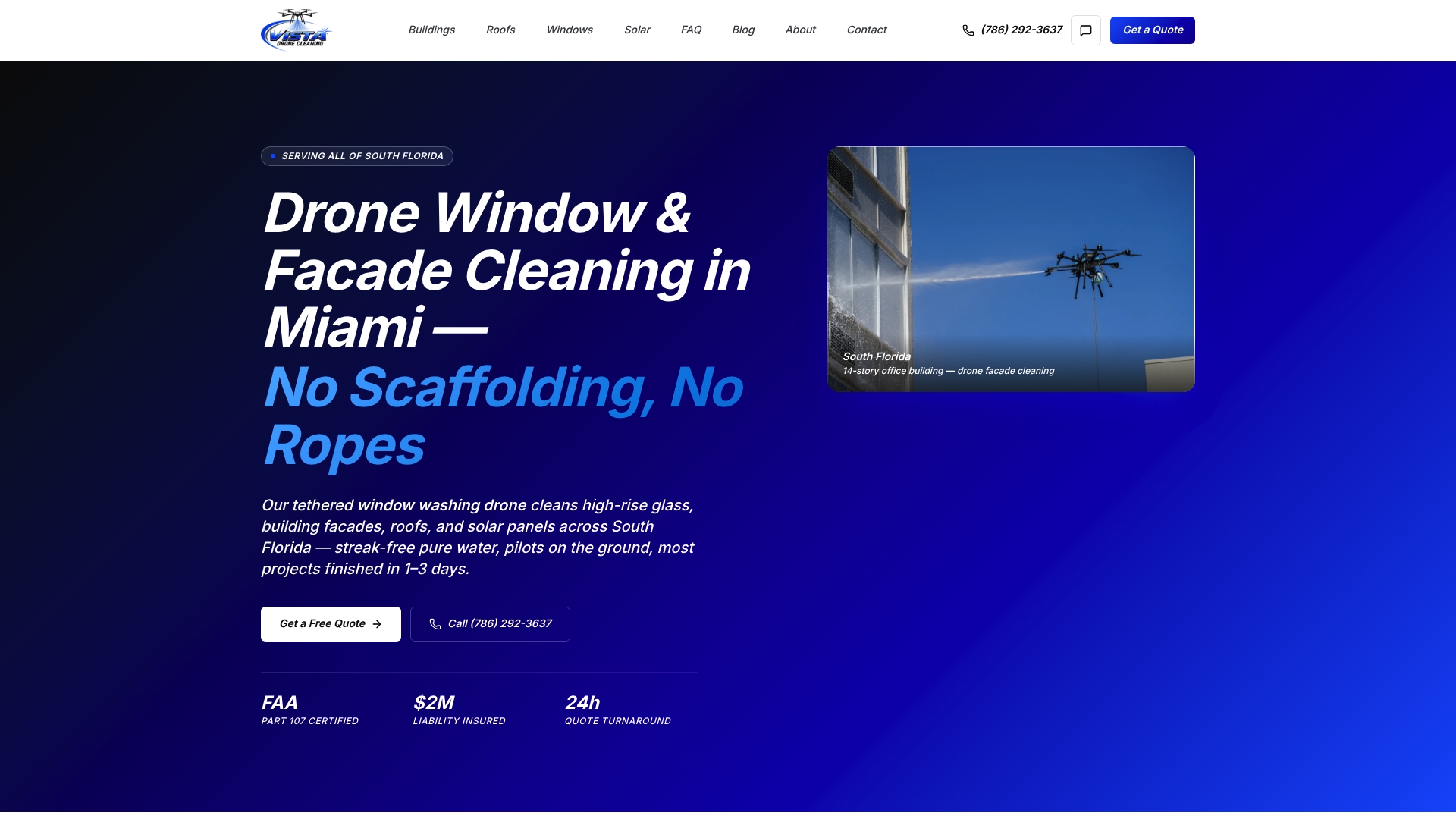
- Drone Facade & Building Cleaning for full exterior soft-wash on high-rise buildings.
- Drone Window Cleaning for streak-free glass using a pure de-ionized water rinse.
- Drone Solar Panel Cleaning for rooftop arrays that need consistent panel-by-panel coverage.
Before we schedule any project, we run a site-specific wind and hover check as part of the quote, so you know what conditions the crew is actually working with at your building’s height. Request a free quote for drone facade cleaning and we’ll confirm wind conditions and scheduling before a single drone leaves the ground.
Documents worth keeping on file for vendor agreements
- FAA Part 107 rule text for visibility, cloud clearance, and pilot responsibility language.
- Lucid Bots Sherpa user manual for weather minimums and the daily checklist.
- NWS forecast products for South Florida to check convective gust risk before scheduling.
For a broader vendor evaluation, use this checklist for vetting a drone cleaning contractor, and if you’re building an audit-ready file for building management, the office cleaning checklist from Octomaids offers a useful format to adapt.
Sources
- Power Tether / Lucid Bots knowledge base
- Lucid Bots Sherpa user manual
- Small Unmanned Aircraft Systems (UAS) Regulations (Part 107) | Federal Aviation Administration
- NHC/NWS forecast products for KMFL / South Florida
FAQ
How windy is too windy for drones?
For commercial cleaning work, sustained winds above roughly 15 mph are generally too windy, based on Lucid Bots’ Sherpa guidance. Gusts approaching 25 mph call for pausing the job even if the sustained reading looks acceptable.
What wind speed will cancel a drone cleaning job?
A job is typically canceled when forecasted sustained winds exceed the vendor’s published limit, often 15 mph per manufacturer documentation, or when a hover check at the workface shows unstable position hold. Some operators, including Vista, use a tighter 12 to 15 mph window for effective cleaning rather than just safe flight.
What is the wind speed limit for drones under FAA rules?
The FAA’s Part 107 rule sets no specific numeric wind speed limit. Instead, it requires the remote pilot to confirm weather conditions are safe for the operation, alongside minimum visibility and cloud clearance requirements.
Why does a drone that can fly still fail to clean effectively?
Flight stability and cleaning stability aren’t the same thing. Spray drift and uneven rinsing tend to show up before wind reaches the aircraft’s actual flight safety limit, which is why cleaning-specific wind thresholds are usually more conservative than raw flight capability, as noted in field reporting on drone wind resistance.