
The Pre-Handover Building Cleaning Workflow That Actually Passes Inspection
Discover a proven pre-handover building cleaning workflow utilizing drone technology for flawless exterior finishes and smooth inspections.
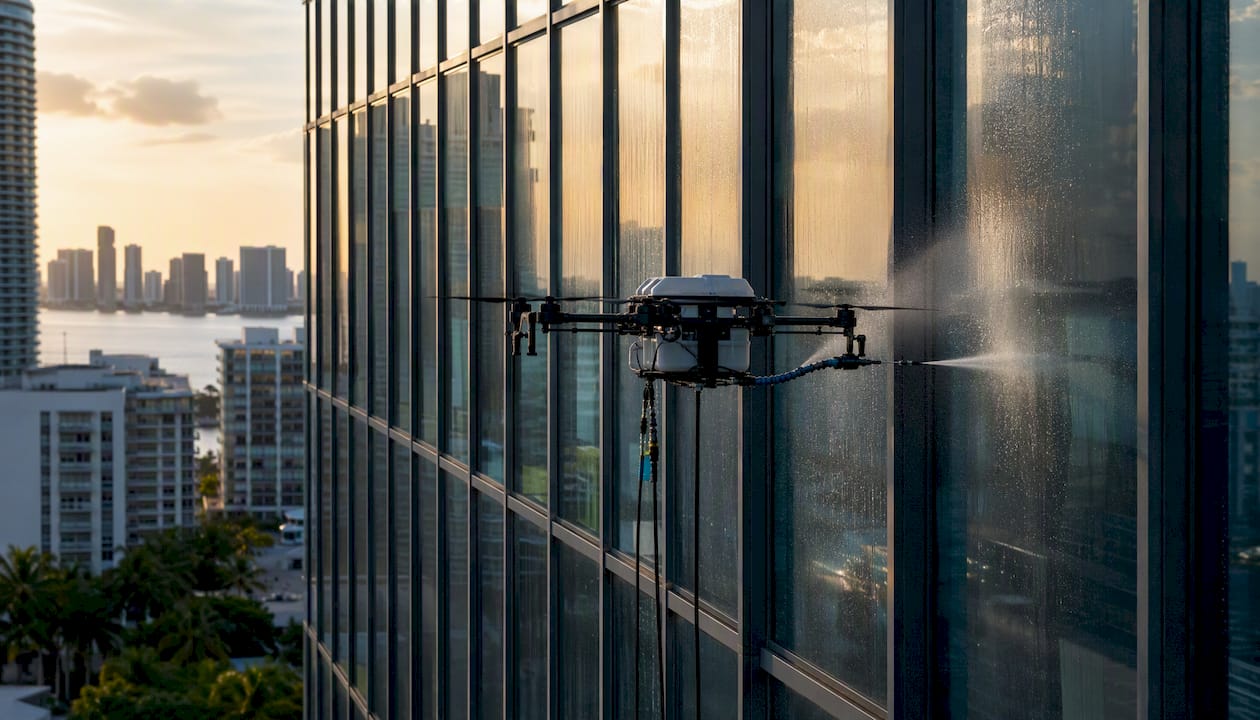
A tethered, FAA Part 107-compliant drone workflow with documented before/after proof and standard $2M liability coverage is the fastest, safest way to deliver pre-handover exterior cleaning for South Florida high-rises. That single operational choice determines whether your building closes out on schedule or sits in a punch-list dispute over streaked glass and unlogged EIFS damage.
Here’s the short version of how the full workflow runs: a certified pilot surveys the site and maps facade substrates, a tethered rig like the Lucid Bots Sherpa gets anchored and pressure-tested, crews clean top-down in segmented passes with continuous documentation, and the job closes with a defect log and geotagged 4K photos that satisfy your handover checklist. Before you call a vendor, have these ready:
- Building address, county, and primary facade materials (glass, EIFS, stone, metal, solar)
- Gross facade area in square feet, broken out by elevation
- Proof of FAA Part 107 pilot certification and $2 million commercial liability insurance
- Preferred work windows (weekday off-hours vs. weekend access)
- A basic site plan showing staging, parking, and pedestrian flow
That’s the whole workflow in miniature. The rest of this guide breaks down each piece so your team, your board, or your ownership group can plan, budget, and sign off on it with confidence.
Key Takeaways
A compliant pre-handover cleaning workflow combines a tethered Part 107 drone system, verified $2 million liability coverage, and geotagged documentation tied to written acceptance criteria.
| Point | Details |
|---|---|
| Choose tethered over battery-powered | Continuous power and fluid supply means fewer interruptions and more consistent finish quality on tall facades. |
| Verify compliance before booking | Confirm Part 107 pilot credentials and $2 million liability coverage in writing before scheduling any job. |
| Require geotagged documentation | Before/after 4K photos and a defect log should be non-negotiable contract deliverables at handover. |
| Budget for South Florida weather | Build a weather-delay allowance into the contract given afternoon storms common in wet season. |
| Vista Drone Cleaning as the local standard | Runs Part 107-certified, $2M-insured tethered jobs across Miami-Dade, Broward, and Palm Beach, typically finishing in 1 to 3 days. |
Table of Contents
- What Is the Pre-Handover Building Cleaning Checklist?
- How Do You Scope a Drone Cleaning Job Before Handover?
- What FAA Part 107 Rules Apply to Drone Facade Cleaning?
- Why Are Tethered Drones Better for High-Rise Facades?
- What Does a Pre-Handover Cleaning Day Look Like?
- How Do You Manage Safety Risks During Drone Cleaning?
- What Documents Should You Get at Handover?
- How Long Does Pre-Handover Drone Cleaning Take?
- How Does Vista Drone Cleaning Handle Pre-Handover Projects?
- What Do Drone Pilots Wish Property Managers Knew?
- Get a Pre-Handover Cleaning Quote for Your South Florida Property
- Sources
- FAQ
What Is the Pre-Handover Building Cleaning Checklist?
Before any vendor can quote accurately, you need to hand over a defined package of site information. Skipping this step is the single biggest reason drone cleaning quotes come back vague or padded with contingency.
Start with identifiers: the building’s address and county (Miami-Dade, Broward, or Palm Beach all carry slightly different permitting norms), the primary facade types across each elevation, and rough facade size estimates. A high-rise glass curtain-wall tower in Brickell prices out very differently than a mid-rise in Coral Springs, even at similar approximate size, because chemistry and pressure differ by substrate.
Next comes access. Note planned egress and staging points, utility locations near tether anchor zones, and any pedestrian or vehicle flow that will need an exclusion zone, think valet lanes in Miami Beach or loading docks in Fort Lauderdale. Flag preferred work windows too. Many South Florida condo boards want work done before 8 a.m. or on weekends to avoid disrupting residents and retail tenants.
Finally, get the regulatory basics in writing before scheduling: the pilot’s Part 107 credentials, proof of $2 million liability insurance, and a documented standard operating procedure for containment and wastewater control. A vendor that hesitates on any of these three should not be on your shortlist.
Pro Tip: Send four to six 4K photos of each elevation plus a rough site sketch before your first call with a vendor. It cuts quoting turnaround roughly in half because the pilot can pre-plan tether points and flight paths remotely.
How Do You Scope a Drone Cleaning Job Before Handover?
A proper site survey converts a vague “clean the building” request into a priced, scheduled, and measurable scope of work. This is where most disputes at handover get prevented, not resolved.
The survey itself should produce elevation sketches noting glazing type, any hydrophobic or low-E coatings, rooftop anchor and tether points, and staging or parking options specific to the property. In dense Miami-Dade corridors, staging often means coordinating with building security for a loading zone; in suburban Broward office parks, it usually just means picking a corner of the parking lot.
Scope gets defined by three variables: surface area, substrate type, and desired finish. A streak-free result on glass calls for different pressure and dwell time than a soft-wash pass on painted EIFS. Here’s a rough planning reference:
| Substrate | Typical Pressure Range | Chemistry Approach | Hold/Dwell Time |
|---|---|---|---|
| Glass/curtain wall | Low to moderate | Pure deionized water, no soap | Minimal, continuous rinse |
| EIFS/stucco | Low | Soft-wash chemical, biodegradable | 5 to 10 minutes |
| Natural stone | Low to moderate | pH-neutral cleaner | 5 to 15 minutes |
| Metal panel/aluminum | Low | Mild detergent, no acid | Minimal |
| Solar panels | Very low | Pure water only, no chemical | None, single pass |
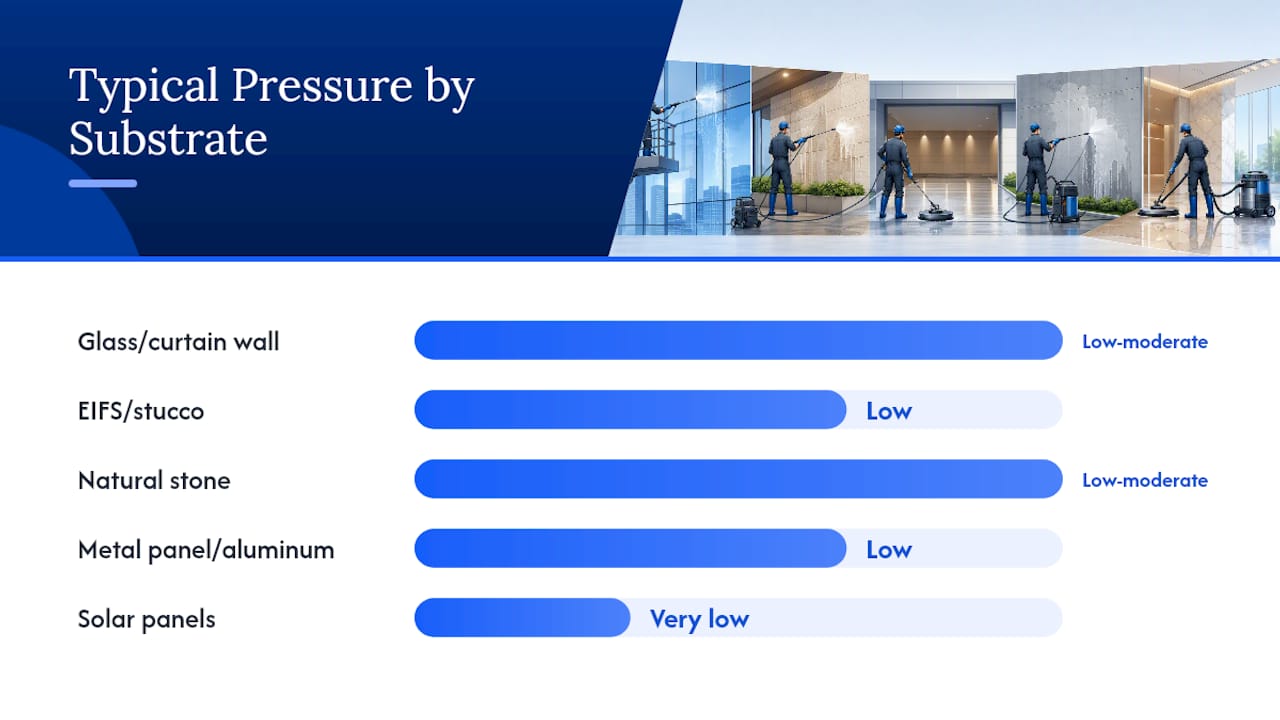
Acceptance criteria need to be defined before the first pass, not negotiated after. That means before/after 4K photos at matching angles, spot checks for streaking or residue, a written defect log, and a formal sign-off tied to your building’s handover milestones.
Pro Tip: On any job over roughly 50,000 square feet, request a pilot pass on one representative panel per elevation during mobilization. It confirms pressure and chemistry settings before the crew commits to the full facade.
What FAA Part 107 Rules Apply to Drone Facade Cleaning?
Every legitimate commercial drone cleaning operation in South Florida runs under FAA Part 107, and the rules directly shape how a job gets planned. The system, including payload, must weigh under 55 pounds, the pilot must maintain visual line of sight throughout the operation, and flights typically stay below 400 feet above ground level unless working within 400 feet of a structure.
Those limits rarely constrain high-rise facade work itself, since tethered rigs operate close to the building envelope by design. Where they matter is in flight planning near restricted airspace, close to Miami International or Fort Lauderdale-Hollywood International, where a waiver or airspace authorization may be required. The full regulatory text lives in 14 CFR Part 107, which is worth having your risk manager review if your property sits inside controlled airspace.
Waivers aren’t instant. When a job genuinely needs one, expect the FAA to ask for specifics on containment and mitigation, geo-fencing, tether anchoring, additional trained personnel, before approving beyond-visual-line-of-sight or congested-area operations. Build that lead time into your handover schedule rather than discovering it a week before closeout.
The two numbers that matter most: the 55-pound Part 107 weight ceiling on drone systems, and the $2 million commercial liability standard for high-rise facade work. Any bidder who can’t confirm both in writing isn’t ready for your building.
Insurance and reporting go hand in hand. Standard market practice for high-rise exterior work is $2 million in commercial liability coverage, and any incident causing $500 or more in property damage must be reported to the FAA within 10 days.
Pro Tip: Ask to see the pilot’s actual Part 107 certificate, not just a company-level insurance certificate. Ask separately for the written containment SOP and, if the site sits near controlled airspace, a documented waiver plan.
Why Are Tethered Drones Better for High-Rise Facades?
Tethered systems solve the one problem that kills battery-powered drone jobs on tall buildings: constant interruptions for battery swaps and fluid refills. A platform like the Lucid Bots Sherpa draws continuous power and fluid through the tether line, which means longer uninterrupted runs, steadier pressure, and a more consistent finish across a 20-story elevation than a fleet of battery-limited drones landing every 15 minutes.
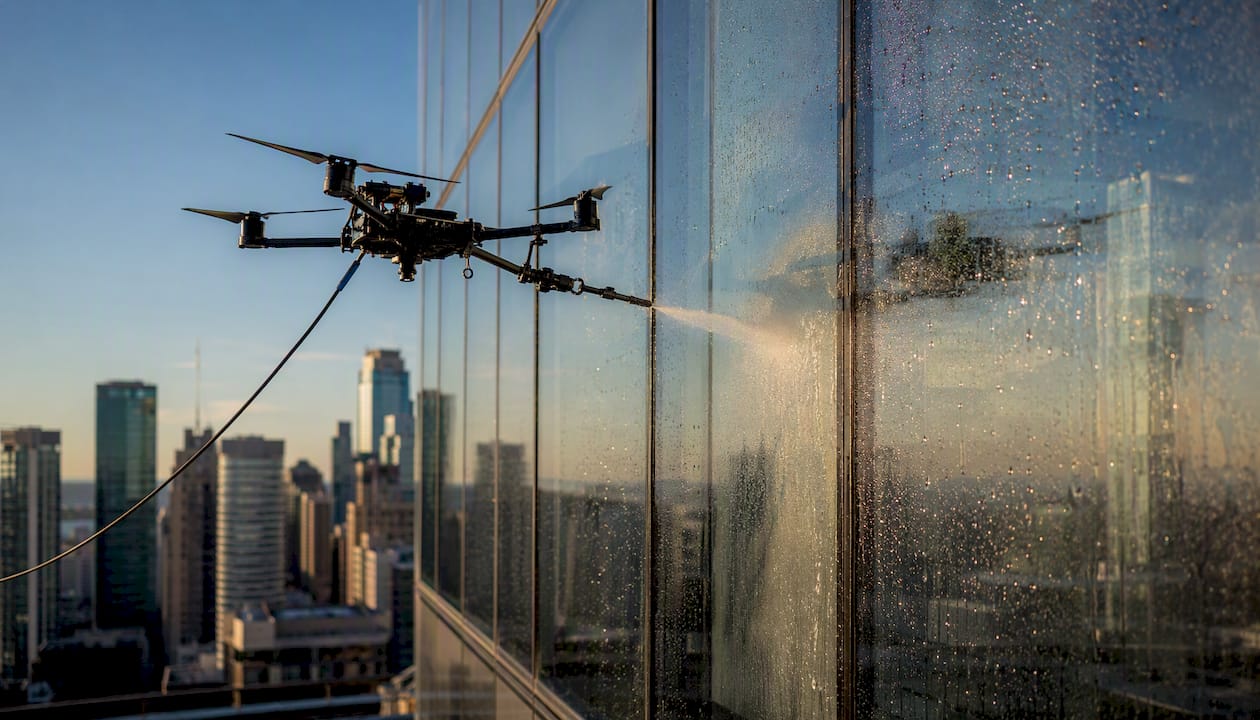
That consistency isn’t cosmetic. Programmable flight paths and closed-loop pressure control hold a steady stand-off distance from the glass or substrate, cutting the human-error variability you get with manual rope-access crews adjusting angle and pressure by feel.
A properly equipped job needs:
- A tethered UAV with regulated pressure output
- A pure or deionized water system, or a soft-wash chemical feed line
- High-pressure hose runs with quick-connect fittings
- Backup batteries for ancillary ground equipment
- Containment kits and spill control materials
- A filtration or settling system for wastewater capture where required
Case data on tethered high-pressure facade cleaning shows that tethered drones can cover considerably more surface area per hour with significantly lower water use compared to manual crews. That gap is exactly why a 30-story tower in downtown Miami finishes in days with a tethered rig instead of the weeks a scaffold crew would need.
Pro Tip: Require the vendor’s written nozzle and pressure presets by substrate before day one. Coated glass and EIFS both scar easily under the wrong setting, and there’s no fixing that after the fact.
What Does a Pre-Handover Cleaning Day Look Like?
The workflow on-site starts with containment and tether anchoring, then moves through a structured top-down pass sequence with documentation running the entire time. Nothing gets cleaned before the exclusion zone is up.
- Mobilization (30 to 45 minutes): Crew arrives, unloads tether system and hoses, confirms staging area with building ops.
- Tether and power setup (20 to 30 minutes): Anchor points secured, power and fluid lines connected, geo-fence boundaries set.
- Pressure and flow test (10 minutes): Pilot confirms output matches the substrate specification from the site survey.
- Test panel pass (10 to 15 minutes): One panel cleaned and reviewed before committing to the full elevation.
- Segmented vertical passes (bulk of the day): Top-down cleaning by elevation, section by section.
- Rolling QA (continuous): Ground tech checks each completed section against the acceptance criteria.
- Rinsing and drying (final pass): Confirms no residue or streaking before moving to the next elevation.
- Defect touch-ups (as needed): Immediate rework on flagged spots rather than a separate return trip.
- Final inspection and handover (30 to 60 minutes): 4K documentation captured, defect log closed out, sign-off collected.
Most jobs run with three roles on site: a pilot, a ground tech or spotter, and a QA inspector, which lines up with the two-to-three person crew model common on drone cleaning jobs across the industry. For more detail on how the cleaning passes and pressure control actually work, the mechanics matter more than they might seem for a job this visual.
Pro Tip: Schedule Miami and Fort Lauderdale jobs for the early morning sea-breeze lull, typically before 10 a.m. before afternoon gusts pick up. Build a weather trigger into the SOP so the crew pauses safely rather than pushing through unsafe wind.
How Do You Manage Safety Risks During Drone Cleaning?
The primary risks on a tethered drone job are rig failure, falling debris or fluid, sudden wind gusts, and bystanders wandering into an active work zone. Every one of those has an established engineering or procedural fix, and your contract should require all of them in writing.
Exclusion zones matter most in dense South Florida settings, sidewalks in Brickell, loading zones in downtown Fort Lauderdale, valet lanes at Boca Raton hotels. Geo-fencing keeps the drone within its planned airspace, physical barriers and spotters keep pedestrians out, and the spotter’s real job is maintaining the pilot’s visual line of sight at all times, which Part 107 requires anyway.
| Risk | Mitigation |
|---|---|
| Rig or component failure | Tethered architecture with redundant power/fluid lines |
| Falling debris or fluid drift | Geo-fenced exclusion zone plus ground barriers |
| Sudden wind gusts | Weather trigger SOP with automatic pause threshold |
| Bystander intrusion | Physical barriers, spotters, and posted signage |
| Emergency shutdown needed | Documented emergency stop procedure known to all crew |
Pro Tip: South Florida’s wet season brings fast-moving afternoon storms with little warning. Require your vendor’s contract to spell out a storm-triggered pause-and-resume procedure, including how lightning within a set radius halts operations automatically.
What Documents Should You Get at Handover?
Acceptance at handover should never be a judgment call made in the moment. It should be a checklist comparison against deliverables agreed to before the job started.
Standard documentation includes geotagged 4K before-and-after photos for every elevation, time-stamped video or gimbal footage of the cleaning passes, total area covered in square feet, a water and chemical usage summary, and a defect punch list with remediation notes for anything reworked on-site.
Your contract exhibits should include a scope map showing exactly which elevations and substrates were covered, any substrate exclusions (say, a decorative element the vendor flagged as too fragile for pressure washing), warranty terms on the cleaning itself, and options for a routine maintenance schedule going forward. Pass/fail criteria need to be spelled out in the contract, not improvised at walkthrough, along with how quickly rework gets scheduled if something fails inspection.
How Long Does Pre-Handover Drone Cleaning Take?
Most pre-handover facade jobs on South Florida high-rises run 1 to 3 days, depending on total facade area and how complicated the substrate mix is.
The variables that move that number, and your budget, are:
- Total facade square footage across all elevations
- Substrate type and the pressure/chemistry it requires
- Vertical complexity, recesses, balconies, curved glazing
- Access and staging complexity at the specific site
- How heavy the existing soiling or staining is
- Whether the job requires off-hour scheduling
- Any permits or road closures the site triggers
Given the throughput difference (roughly 500 square meters per hour per tethered drone versus roughly 100 square meters per hour for a manual crew, per published case data), a mid-rise runs in a single day while a 30-plus story tower with mixed glass and EIFS often needs the full three days.
Build a weather-delay allowance into your budget and negotiate a flat per-hour rework rate up front. That single line item prevents most of the invoice disputes that show up after a job wraps.
How Does Vista Drone Cleaning Handle Pre-Handover Projects?
Vista Drone Cleaning runs pre-handover jobs across Miami-Dade, Broward, and Palm Beach on the same core process outlined above: site survey, substrate mapping, tethered mobilization, segmented cleaning passes, and full documentation at closeout using a Lucid Bots Sherpa tethered rig.
Every job runs with FAA Part 107-certified pilots and $2 million in commercial liability coverage, both confirmed in writing before scheduling. Because the system is tethered and ground-based, most jobs need no rigging, scaffolding, or road closures, which is the detail that usually decides whether a property can hit its handover date without disrupting tenants or residents. Quotes typically turn around within 24 hours of a site review for South Florida properties, and every job closes with geotagged 4K before-and-after documentation matched to the defect log.
Pro Tip: If your building has a specific handover deadline tied to a certificate of occupancy or closing date, say so at the quote stage. Scheduling around a hard date is a different conversation than a flexible maintenance window, and it changes crew allocation.
What Do Drone Pilots Wish Property Managers Knew?
Setup on a tethered rig usually takes 30 to 45 minutes once the crew is on-site, but that number balloons fast if nobody cleared a staging area in advance. The most common snag across Miami, Fort Lauderdale, and Palm Beach jobs isn’t technical. It’s a blocked valet lane or a parking spot that got double-booked.
A few small requests speed everything up: one single point of contact for the day, a designated parking spot for the truck and trailer, a pre-cleared staging area, and someone on-site who can grant access if a locked gate or roof hatch is part of the route. None of that is complicated, but skipping it is how a one-day job turns into a day and a half.
Pro Tip: Ask for a 30-minute on-site planning window before the drone ever launches. That’s when the pilot walks the property, confirms exclusion zones, and marks anything the site survey missed, like a new sidewalk closure or a delivery truck parked where the tether anchor was supposed to go.
Get a Pre-Handover Cleaning Quote for Your South Florida Property
Vista Drone Cleaning is the alternative to scaffolding, boom lifts, and rope-access crews for pre-handover exterior cleaning across Miami-Dade, Broward, and Palm Beach: no rigging, no road closures, and no weeks-long mobilization eating into your closeout schedule.
Every project runs with FAA Part 107-certified pilots, a tethered Lucid Bots Sherpa platform, and $2 million in commercial liability coverage confirmed before the crew ever shows up. If your building’s facade, roof, or solar array needs to be spotless before closing day, request a free quote for your Miami-area high-rise or compare the full cost and method breakdown against traditional window cleaning before you schedule your site survey.
Sources
Regulatory verification should always come from primary FAA sources, while operational SOPs and sample deliverables can come from vendor documentation.
- Small Unmanned Aircraft Systems (UAS) Regulations (Part 107) | Federal Aviation Administration
- Electronic Code of Federal Regulations: 14 CFR Part 107
FAQ
What Is a Pre-Handover Building Cleaning Workflow?
It’s the sequence of site survey, regulatory verification, tethered drone mobilization, cleaning passes, and documented sign-off used to certify a commercial building’s exterior as complete before occupancy or ownership transfer.
Do Drone Cleaning Companies Need FAA Certification?
Yes. Any commercial drone operation, including facade cleaning, must be flown by an FAA Part 107-certified pilot operating within visual line of sight and under the 55-pound system weight limit.
How Much Liability Insurance Should a Drone Cleaning Vendor Carry?
Standard market practice for high-rise facade work is $2 million in commercial liability coverage, which Vista Drone Cleaning carries on every South Florida project.
How Long Does a Pre-Handover Drone Cleaning Job Take?
Most jobs run 1 to 3 days, depending on total facade area, substrate mix, and access complexity at the specific site.
Why Use a Tethered Drone Instead of a Battery-Powered One for High-Rises?
A tethered system draws continuous power and fluid, avoiding frequent landings for battery or fluid swaps and holding steadier pressure across a multi-floor facade than battery-limited drones can manage.