
12 to 15 mph: Vista's Window Cleaning Wind Limits for South Florida
South Florida rules for tethered drone window cleaning: when crews pause at 12 to 15 mph, how local site factors change thresholds, and Vista's scheduling...
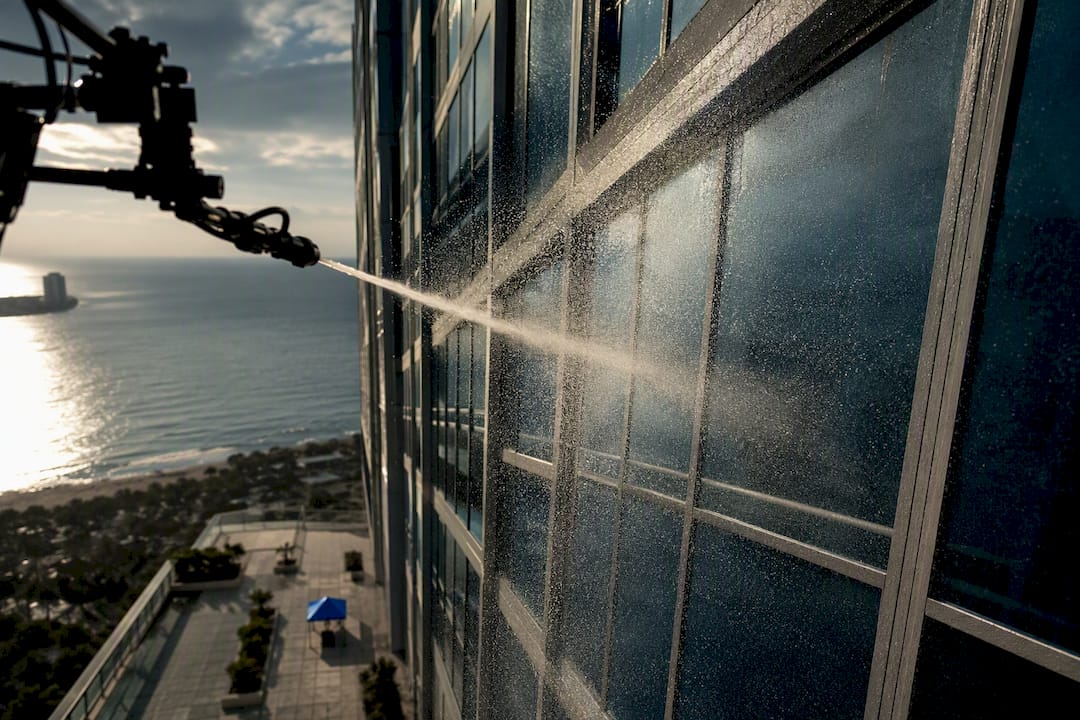
Proceed with tethered drone window cleaning when sustained winds at work height stay under 15 mph and gusts stay below 20 mph. Above that, postpone or drop to a lower, more sheltered altitude. Manufacturer maximums, like the Lucid Bots Sherpa’s 15 mph sustained and 25 mph gust ratings, mark the point where the equipment stops flying safely, not the point where the glass comes out streak-free. Treat those numbers as ceilings, never as targets.
TL; DR:
- Wind thresholds for drone window cleaning are typically 12 to 15 mph sustained or 18 to 20 mph gusts at work height, which is below manufacturer maximums.
- South Florida sites experience higher actual wind speeds due to sea breezes, building effects, and microclimates, requiring even lower operational thresholds.
- Exact on-site wind conditions are best measured with handheld anemometers at facade height, and readings should be trusted over forecast estimates for safety decisions.
- Credible site assessments account for shoreline proximity, building orientation, neighboring heights, and rooftop features to determine safe flying conditions.
- Vista Drone Cleaning adjusts or postpones jobs based on real-time wind data, with documentation, to ensure safety and keep project schedules intact.
Table of Contents
- What Are Safe Window Cleaning Wind Limits for Drones?
- How Do South Florida Sites Change the Wind Math?
- How Should You Monitor Wind and Decide to Fly?
- Scheduling Around Wind Without Losing Project Days
- How Vista Drone Cleaning Decides to Pause a Job
- Get a Weather-Aware Quote From Vista Drone Cleaning
- Sources
- FAQ
What Are Safe Window Cleaning Wind Limits for Drones?
Manufacturer specs give you a starting point, not a green light. Lucid Bots’ own Sherpa user manual advises against flying with sustained winds above 15 mph and flags peak gusts near 25 mph as the outer edge of safe operation. Those figures describe when the aircraft can stay airborne, not when it can produce a flawless finish on 40 panes of glass 150 feet up.
Cleaning demands a steadier platform than a quick inspection flyover. A tethered unit has to hold position within inches while managing hose weight, spray recoil, and constant micro-adjustments, and every gust that pushes the airframe also flexes the tether itself. That’s the piece most property managers never think about.
Peer-reviewed research on tethered UAV dynamics backs this up directly. A 2024 study on cable amplitude and vibration response in tethered UAVs found that cable motion amplitude climbs with peak wind velocity, and that certain gust timing patterns actually maximize the vibration transmitted through the tether. In plain terms: it’s not just how hard the wind blows, it’s how it pulses. A steady 14 mph breeze behaves very differently on the tether than a gusty 10 mph average with 20 mph spikes every few seconds.
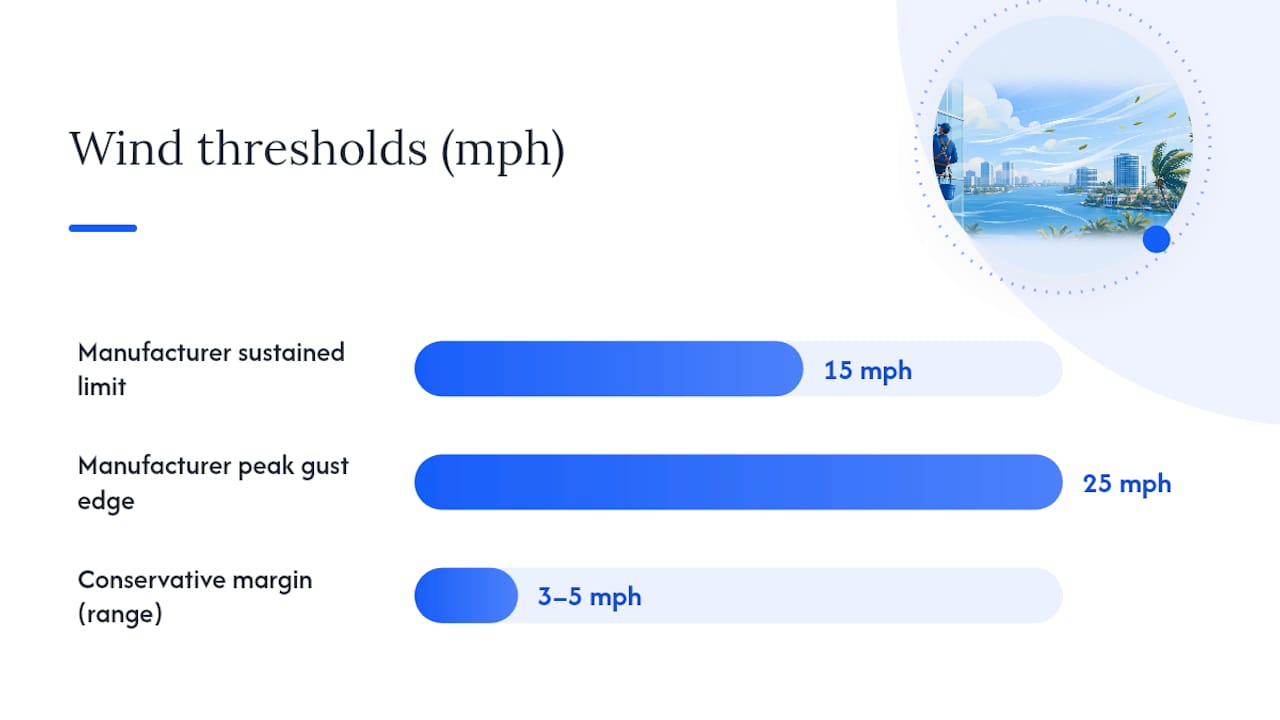
That’s why credible environmental reliability guidance for cleaning drones treats the manufacturer’s maximum wind rating as a technical ceiling, not an operating target, and recommends layering in payload weight, positioning-system accuracy, and site geometry before green-lighting a job. Dual RTK positioning and radar-assisted hold help a drone resist drift, but they don’t cancel out tether vibration or overspray risk.
Here’s what field crews actually track on a windy day:
- Sustained wind at work height, averaged over roughly two minutes
- Short gusts measured over a 3 to 5 second window, which drive most of the tether flex
- Peak gusts, the single highest reading, which set the hard stop
- Gust frequency, since repeated spikes stress the tether more than one-off blips
A conservative margin below the manufacturer’s number, usually 3 to 5 mph, gives crews room to react before conditions cross into unsafe territory.
How Do South Florida Sites Change the Wind Math?
Forecast wind speed and the wind actually hitting a facade at 120 feet are two different numbers, and the gap is often wider in South Florida than almost anywhere else in the country. The region’s sea breeze builds through the morning and typically peaks in the afternoon, especially near the coastline in Miami Beach, Fort Lauderdale, and Delray Beach, where onshore flow can add several extra miles per hour on top of the general forecast. Wet season, roughly June through October, brings a second layer: afternoon convective activity that can spin up gusts with almost no warning.
Buildings compound the problem. Towers spaced close together in Brickell or downtown West Palm Beach create wind tunnel effects between structures, funneling air and accelerating it well past ambient readings. Corners generate vortices that spin faster than the wind hitting the flat facade a few feet away. Rooftop parapets, HVAC stacks, and mechanical penthouses all disrupt airflow in ways a forecast model never sees.
Before authorizing a job on a borderline day, run through this quick site check:
- Distance to shoreline. Properties within a mile of the coast in areas like Coconut Grove or Hollywood Beach see stronger, more consistent onshore gusting.
- Building orientation. A facade facing the prevailing wind direction takes a harder hit than a sheltered side.
- Neighboring building heights. A shorter building next to a taller neighbor often sits in a wind shadow, or gets blasted by deflected airflow, depending on position.
- Rooftop features. Parapets and mechanical equipment near the top floors create localized turbulence that forecasts miss entirely.
- Known local microclimates. Corner units on high floors in coastal towers routinely run windier than the building average.
Pro Tip: Send someone up to the roof or a top-floor balcony 15 to 20 minutes before a scheduled job on any day with a wind advisory or a forecast above 15 mph. A five-minute walk-through with a handheld anemometer tells you more than any app.
How Should You Monitor Wind and Decide to Fly?
Forecasts tell you what the atmosphere is doing three miles away. A handheld anemometer tells you what’s actually hitting the glass. That difference matters most on marginal days, which in South Florida is most days between noon and 4 p.m.
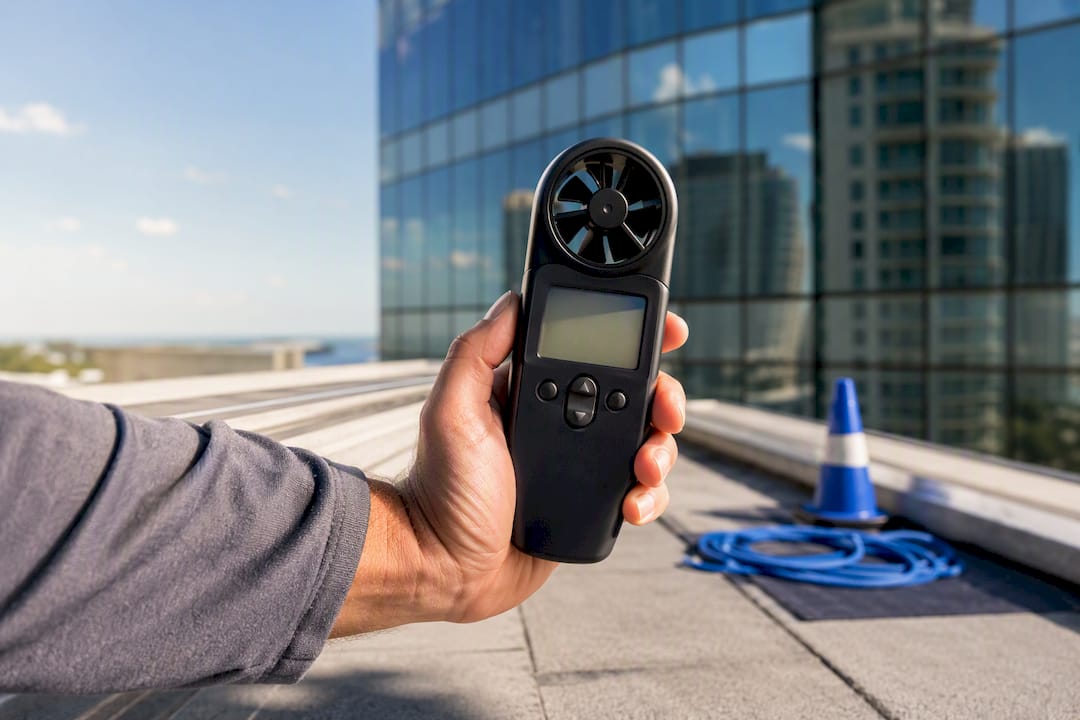
Reliable monitoring on a job site usually combines three sources: a handheld anemometer for spot checks at ground level and, when accessible, at facade height; a temporary mounted sensor for continuous readings during longer jobs; and, on equipment that supports it, winch or tether telemetry that flags unusual load or vibration in real time. Operational guidance from resources like Dronable’s operations manual reinforces the same principle every experienced crew follows: when the on-site reading and the forecast disagree, trust the instrument in your hand.
What actually triggers a decision:
- Postpone if sustained wind at work height exceeds 12 to 15 mph, or gusts exceed 18 to 20 mph
- Reduce altitude and secure hose lines if readings sit in a gray zone just under those numbers
- Continue with active monitoring if wind stays comfortably below thresholds and gust frequency is low
- Reassess every 15 to 20 minutes on any day with a fluctuating forecast
Every job should leave a paper trail: a timestamped weather log, LAANC or airspace authorization records where applicable, time-stamped photos or video of conditions, and a documented sign-off on the go or no-go call. That record protects the property manager and the crew if a question comes up later.
Scheduling Around Wind Without Losing Project Days
The single best fix for wind-related delays is starting earlier than most buildings expect. South Florida’s sea breeze is predictable enough that early-morning windows, typically before 10 a.m. consistently run calmer than early afternoon, when onshore flow and convective buildup both tend to peak.
A few scheduling moves reduce the odds of a wasted trip:
- Book morning blocks first and treat afternoons as flexible overflow, not the primary window.
- Write weather clauses into the proposal so a postponed day doesn’t turn into a billing dispute.
- Phase large facades across multiple days instead of committing an entire building to one forecast.
- Hold a short list of backup dates so a rained-out or gusted-out day slides forward instead of falling off the calendar entirely.
- Keep a short-notice touch-up window open for the rare panel or section that got skipped mid-job.
Pro Tip: If your property sits within a few blocks of the water, ask your cleaning provider for a quote that explicitly builds in a morning-start schedule. It costs nothing extra and cuts weather cancellations dramatically during wet season.
Vista Drone Cleaning builds this thinking into every quote from the start. Site evaluations account for shoreline distance, building orientation, and known local wind behavior before a single date gets proposed, which is part of why most projects still finish in the original 1 to 3 day window even during gustier months.
How Vista Drone Cleaning Decides to Pause a Job
Our FAA Part 107 pilots make the call the same way every time: check the on-site anemometer reading against the forecast, and when they disagree, trust the instrument in front of us. We carry $2M liability coverage specifically because weather decisions on a 150-foot facade aren’t guesses, they’re documented calls.
A recent example: a Brickell high-rise job scheduled for early afternoon got pushed to the next morning slot after our pilot clocked gusts near 22 mph off the bay, well past our threshold, even though the general forecast read 14 mph. We called the property manager, explained the reading, and rescheduled inside the same week. Crews never leave the ground regardless of the outcome. That’s the whole point of tethered flight: the equipment takes the risk exposure, not the person.
, Eliot
Get a Weather-Aware Quote From Vista Drone Cleaning
Skipping scaffolding and lifts means Vista Drone Cleaning can also skip the scheduling headaches that come with them. No rigging crews standing around waiting out a gust, no boom lift rental clock running while a job sits idle. Our FAA Part 107 certified pilots fly tethered industrial drones with pure de-ionized water rinsing, backed by $2M liability insurance, and most projects finish in 1 to 3 days even with South Florida’s afternoon wind patterns built into the plan.

Every quote starts with a real site evaluation, not a generic estimate. We look at shoreline distance, building orientation, and known local wind behavior before proposing a schedule, so the date we give you actually holds. Request a free site evaluation and quote within 24 hours and see how a weather-aware schedule compares to your current scaffold or lift-based cleaning approach.
Sources
- Lucid Bots Sherpa user manual
- Variation law of cable amplitude and vibration response of tethered UAVs under transient wind (2024)
- How to evaluate cleaning drone environmental reliability - VastArrive
FAQ
What Wind Speed Is Too High for Drone Window Cleaning?
Most operators postpone or reduce altitude once sustained winds at work height pass 12 to 15 mph or gusts exceed 18 to 20 mph, well under the Sherpa’s 15 mph sustained and 25 mph gust maximums.
Is Manufacturer Max Wind Rating the Same as a Safe Cleaning Limit?
No. Manufacturer maximums mark the point where the aircraft can still fly safely, while cleaning-quality thresholds sit lower because tether vibration and position-hold accuracy degrade before the equipment reaches its technical limit.
Why Does South Florida Need Lower Wind Thresholds Than Other Markets?
Coastal sea breeze, wet-season convective gusts, and wind tunnel effects between high-rise towers in areas like Brickell and downtown Fort Lauderdale routinely push actual facade-level wind higher than regional forecasts suggest.
How Do Crews Measure Wind on the Job Site?
Crews use a handheld anemometer for spot checks at ground and facade height, sometimes paired with a temporary mounted sensor or tether telemetry, and trust the on-site reading over a distant forecast whenever the two disagree.
Does Vista Drone Cleaning Reschedule for Wind?
Yes. Vista Drone Cleaning’s Part 107 certified pilots monitor conditions on site and reschedule or adjust altitude when readings cross safety thresholds, with the postponement documented and communicated to the property manager the same day.