Rope Access Glass Cleaning: South Florida Safety Guide
Explore the South Florida Safety Guide on rope access glass cleaning. Learn about compliance, benefits, and expert techniques for your building.
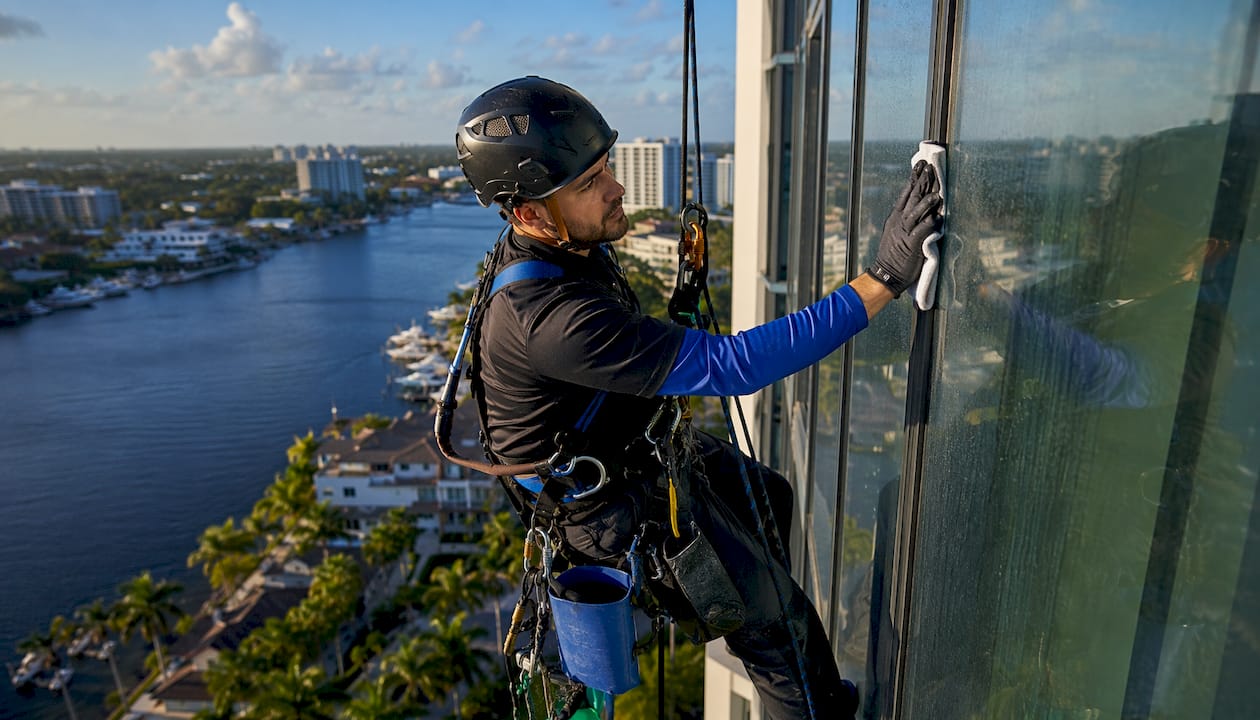
Rope access glass cleaning is the professional method of suspending trained technicians from certified rope and anchor systems to clean exterior glass on tall commercial and residential buildings. Governed by OSHA 29 CFR § 1910.27 and the ANSI/IWCA I-14.1 standard, it is the dominant approach for high-rise glass cleaning on buildings across Miami-Dade, Broward, and Palm Beach counties where scaffolding is impractical. For facilities managers evaluating window cleaning services, understanding the method’s compliance requirements, operational limits, and available alternatives is the starting point for every maintenance decision.
Key attributes at a glance:
- Trained technicians descend on static ropes anchored to certified roof anchor points
- Anchorages must support a minimum of 5,000 lbs per employee in any direction
- Technicians must hold IRATA or SPRAT certification
- Site-specific Risk Assessment and Method Statement (RAMS) required before work begins
- OSHA prohibits rope descent systems above 300 feet unless no safer alternative exists
- Pure water cleaning systems are industry best practice for streak-free results
How rope access glass cleaning actually works
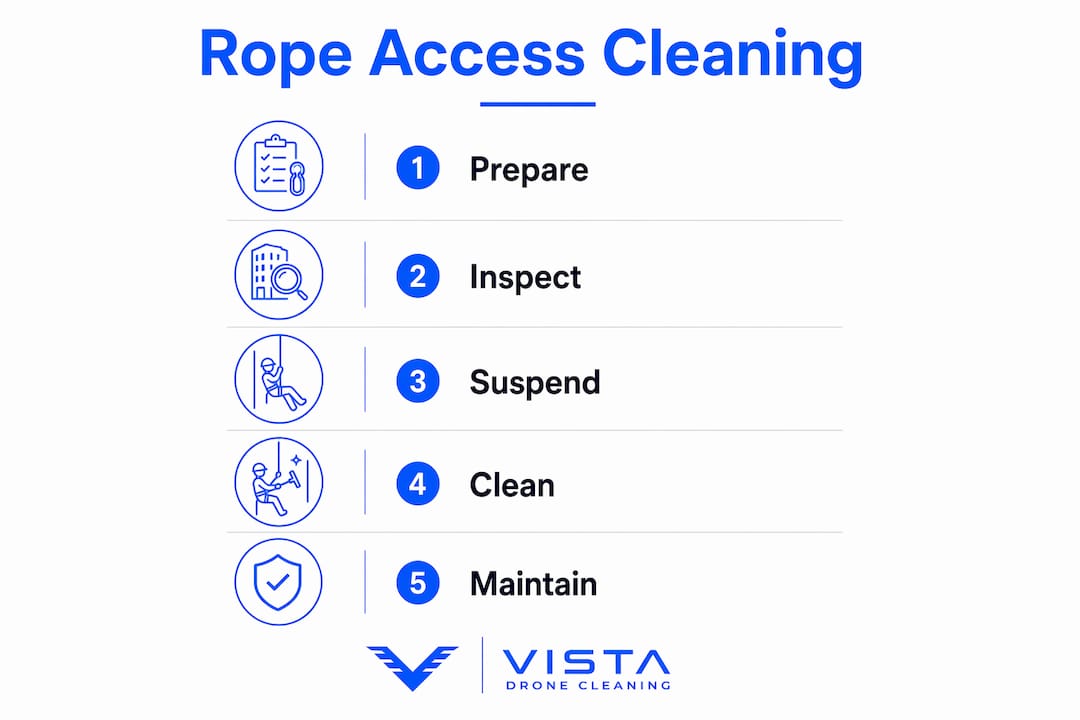
The process begins well before a technician steps off a rooftop. A site survey identifies anchor points, descent paths, and potential hazards such as HVAC equipment, architectural overhangs, and electrical conduit. From that survey, the crew builds the RAMS document, which maps every descent route, weather threshold, and emergency rescue plan specific to that building.
On the day of work, the equipment setup follows a fixed sequence:
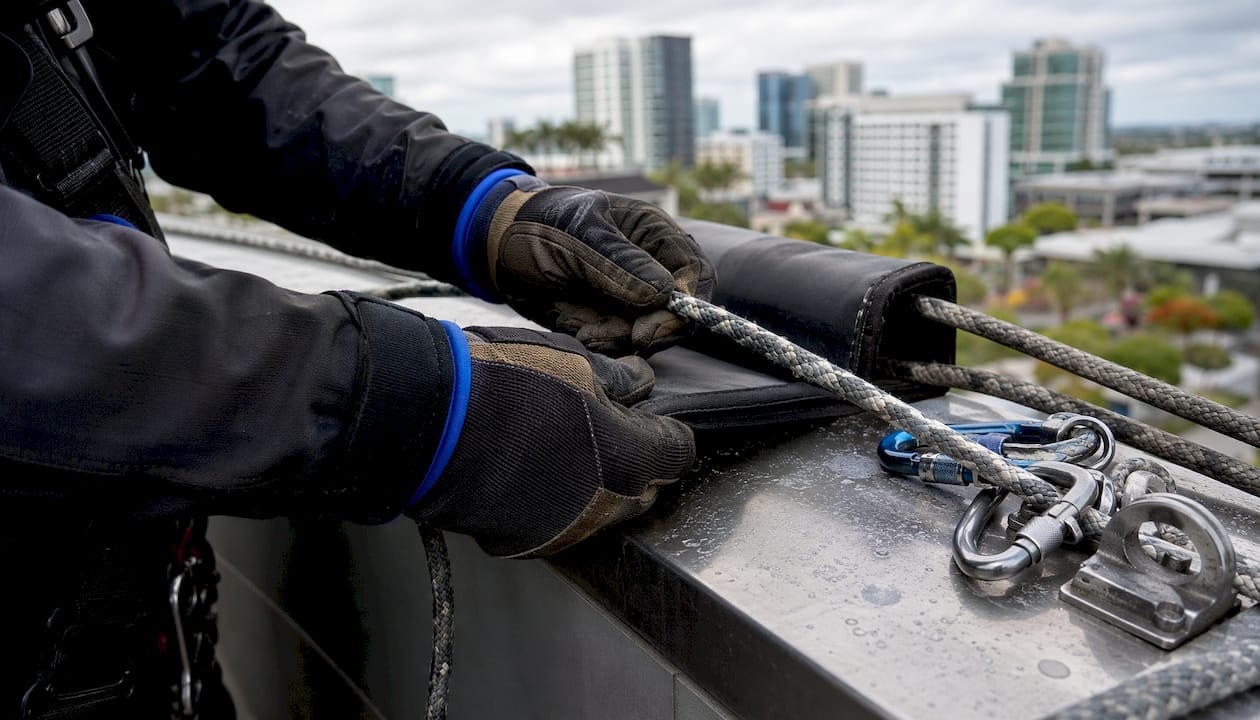
- Anchor rigging: static ropes are connected to certified roof anchors, with tiebacks added wherever counterweights or non-permanent anchors are used
- Descent device attachment: a controlled descent device, carabiners, and a seat board are assembled and inspected before the technician leaves the roof
- Pre-shift inspection: every component is checked at the start of each work shift, and any damaged part is pulled from service immediately
- Descent and cleaning: the technician descends in controlled stages, cleaning glass panels from top to bottom using a squeegee or pure water fed system
- Stabilization: for descents beyond 130 feet, OSHA requires physical stabilization at the work location
- Tool security: squeegees, buckets, and all hand tools are attached by tool lanyards to prevent dropped objects
Pro Tip: Require contractors to show you the pre-shift inspection log before work starts each day. A crew that skips this step is operating outside OSHA compliance, and that liability lands on the building owner.
The core equipment in a rope access window cleaning setup:
| Component | Function |
|---|---|
| Static rope | Primary suspension line, minimum 5,000-lb tensile strength per employee |
| Descent device | Controls rate of descent; must lock when positive action is taken |
| Harness | Full-body fall arrest system, separate anchorage from suspension |
| Carabiners/shackles | Connect rope to anchor and descent device |
| Seat board | Work platform; rated for 300-lb live load minimum |
| Pure water system | De-ionized water delivery for streak-free glass cleaning |
| Tool lanyards | Secure all hand tools against falling |
Professional pure water systems remove dissolved minerals before water contacts the glass, which is why the finish dries without spots. In South Florida’s hard-water environment, this is not optional. Tap water left on glass in Boca Raton or Coral Gables will leave calcium deposits that require abrasive removal later.
Safety standards and compliance every building owner must know
OSHA and ANSI/IWCA set the floor for legal compliance, and building owners carry more responsibility than most realize.
Under OSHA 29 CFR § 1910.27(b)(1), the building owner, not the contractor, must provide written certification that every anchorage has been inspected by a qualified person annually and certified by a professional engineer at least every 10 years. The contractor cannot legally begin work without that written documentation in hand.
Anchorage load requirement: Every rope descent system anchorage must be capable of supporting a minimum load sufficient to safely support each employee attached in any direction, as required by OSHA 29 CFR § 1910.27(b)(1).
One distinction that trips up many facilities managers: OSHA explicitly separates Rope Descent Systems (RDS) from Industrial Rope Access Systems (IRAS). The 5,000-lb anchorage certification requirement under § 1910.27(b) applies to RDS only. IRAS operations fall under different fall protection standards, specifically 29 CFR §§ 1910.140©(12) and ©(13). Knowing which system your contractor uses determines which compliance checklist applies.
Compliance checkpoints for facilities managers:
- Obtain written anchorage certification from a licensed professional engineer before any work starts
- Confirm annual anchorage inspections are current and documented
- Require a site-specific RAMS aligned with ANSI/IWCA I-14.1 before the crew mobilizes
- Verify technician IRATA or SPRAT certification credentials
- Confirm the contractor carries adequate liability insurance
- Check that the building height does not exceed allowed limits for RDS use without a documented exception
Building owners who skip anchorage certification face direct legal liability. IWCA guidance is clear that this duty cannot be delegated to the cleaning contractor. If an anchorage fails and the owner cannot produce current certification, the exposure is significant.
South Florida challenges that change how the work gets done

South Florida’s climate and building stock create conditions that do not exist in most other U.S. markets. Afternoon thunderstorms can appear within 20 minutes during summer months, and OSHA prohibits rope descent system use during gusty or hazardous weather. That means crews working in Miami Beach or Fort Lauderdale often start at dawn and wrap before early afternoon to avoid afternoon squalls.
Regional factors that directly affect scheduling and method selection:
- Wind gusts: Brickell and downtown Miami’s urban canyon effect accelerates wind between towers, creating gusts that exceed safe working thresholds even on otherwise calm days
- High humidity: Constant moisture accelerates mold and algae growth on glass and frames, increasing cleaning frequency compared to drier climates
- Hard water: South Florida municipal water is high in dissolved minerals, making pure water systems mandatory for streak-free vertical glass maintenance
- Architectural complexity: Many Miami-Dade high-rises feature curved facades, cantilevered balconies, and decorative fins that complicate descent paths and require custom rigging plans
- Environmental regulations: South Florida environmental rules require eco-friendly cleaning agents and managed runoff to protect the region’s sensitive coastal ecosystems
A site-specific RAMS that does not address these local factors is not worth the paper it is printed on. Contractors who rely on generic safety plans rather than building-specific documents create compliance gaps that building owners ultimately absorb.
Drone cleaning: a ground-based alternative for South Florida high-rises
Drone-based exterior cleaning has moved from novelty to practical option for many South Florida properties. Instead of suspending technicians from the roof, tethered industrial drones carry pure water delivery systems up the facade while the crew stays on the ground.
Advantages compared to rope access methods:
- No roof rigging, no anchor certification process, no road closures
- FAA Part 107-certified pilots operate within established airspace protocols
- Pure de-ionized water rinse produces the same streak-free result as rope access pure water systems
- Most projects complete in 1–3 days
- Cost savings of 30–60% compared to traditional scaffold or lift methods
- $2M liability insurance coverage
- Effective on buildings up to 200 feet tall
| Factor | Rope access | Drone cleaning |
|---|---|---|
| Crew location | Suspended on facade | Ground level |
| Anchor certification required | Yes (OSHA mandate) | No |
| Permits or road closures | Often required | Not required |
| Typical project duration | Variable | 1–3 days |
| Relative cost | Baseline | 30–60% lower |
| Weather sensitivity | High (wind, storms) | Moderate |
Drone cleaning does not replace rope access in every scenario. Intricate detailing, interior glass, or areas with heavy airspace restrictions may still require technicians on ropes. For the majority of commercial high-rise facades in Miami, Coral Gables, Aventura, and Fort Lauderdale, though, drone methods cover the scope faster and at lower risk. Facilities managers evaluating high-rise cleaning without rope access will find drone operations increasingly competitive on both cost and compliance grounds.
How to keep rope access equipment safe and compliant between jobs
Equipment maintenance is where many contractors cut corners, and the consequences show up fast on a South Florida building where salt air, UV exposure, and humidity accelerate material degradation.
OSHA requires a pre-shift inspection of every rope descent system component before each use. Beyond that daily check, ropes should be inspected for core damage, sheath abrasion, and chemical exposure after every job. Descent devices need periodic manufacturer-specified servicing, and carabiners must be checked for gate function and load markings. Any component that shows wear, corrosion, or deformation comes out of service immediately.
Harnesses deserve particular attention. Salt air in coastal South Florida corrodes metal hardware faster than in inland markets. A harness that passes visual inspection in a dry climate may show hidden corrosion on buckles and D-rings after a season of work in Miami Beach or Hollywood. Require contractors to document harness retirement dates and replacement schedules as part of their equipment log.
Ropes must be protected from contact with building edges, HVAC exhaust, and any chemical runoff from the facade. Rope pads or edge protectors are not optional. A rope weakened by a single sharp edge contact can fail under load without visible external damage.
What certifications should rope access technicians actually hold?
IRATA and SPRAT are the two recognized certification bodies for rope access technicians working in the United States. IRATA requires 1,000 logged hours for certification, while SPRAT requires 500 hours. Both use a tiered level system, with Level 1 covering basic rope work and Level 3 qualifying technicians to supervise operations and train others.
For facilities managers in South Florida, the practical question is whether the crew lead holds at least a Level 2 certification and whether the site supervisor holds Level 3. A crew of Level 1 technicians without a qualified supervisor on site is an OSHA compliance problem, not just a quality concern.
Recertification matters too. Both IRATA and SPRAT require periodic renewal, and a lapsed certification is the same as no certification from a liability standpoint. Ask contractors for current certification cards before signing any window cleaning services contract. Digital verification through SPRAT’s registry takes about two minutes and removes any ambiguity.
Beyond rope access credentials, technicians working in South Florida should hold OSHA 10 or OSHA 30 general industry cards, and any crew working near electrical equipment needs documented electrical hazard awareness training.
How often should high-rise glass be cleaned in South Florida?
South Florida’s combination of salt air, humidity, and frequent rain creates a faster buildup cycle than most U.S. markets. For commercial towers in Miami, Brickell, or Fort Lauderdale, quarterly cleaning is the practical minimum to maintain appearance and prevent long-term glass damage from mineral etching and biological growth.
Oceanfront properties in Miami Beach or Aventura face salt spray that can film glass within weeks of a cleaning. Those buildings typically need cleaning every 6–8 weeks on exposed elevations. Inland properties in Coral Springs, Plantation, or Boca Raton can often extend to a twice-yearly schedule if the building is not adjacent to heavy traffic or construction.
Scheduling around South Florida’s weather patterns also matters. The dry season, roughly november through april, offers the most predictable working windows. Scheduling major cleaning cycles to begin in november and again in april lets crews work efficiently before the summer storm season disrupts outdoor operations. A job hazard analysis completed before each cycle helps crews adapt the plan to current site conditions rather than relying on a generic annual schedule.
Cost and ROI for rope access glass cleaning in South Florida
Rope access window cleaning costs vary based on building height, facade complexity, anchor system condition, and required certifications. For a mid-rise commercial tower in Fort Lauderdale or Coral Gables, the cost drivers include anchor certification fees (a professional engineer inspection is a real line item), crew mobilization, and the time required to rig complex facades.
The ROI case for regular glass cleaning is straightforward. Clean glass improves tenant satisfaction, supports lease renewal rates, and protects the glass itself from permanent mineral etching that requires expensive restoration or panel replacement. A building with deteriorated glass that needs abrasive restoration will spend far more than the cumulative cost of a consistent cleaning program.
Drone cleaning, as noted earlier, runs 30–60% below scaffold-based costs for comparable scope, primarily because it eliminates anchor certification, rigging labor, and permit fees. For facilities managers running annual maintenance budgets across multiple South Florida properties, that difference compounds quickly across a portfolio.
Is Vistadronecleaning the right fit for your building?
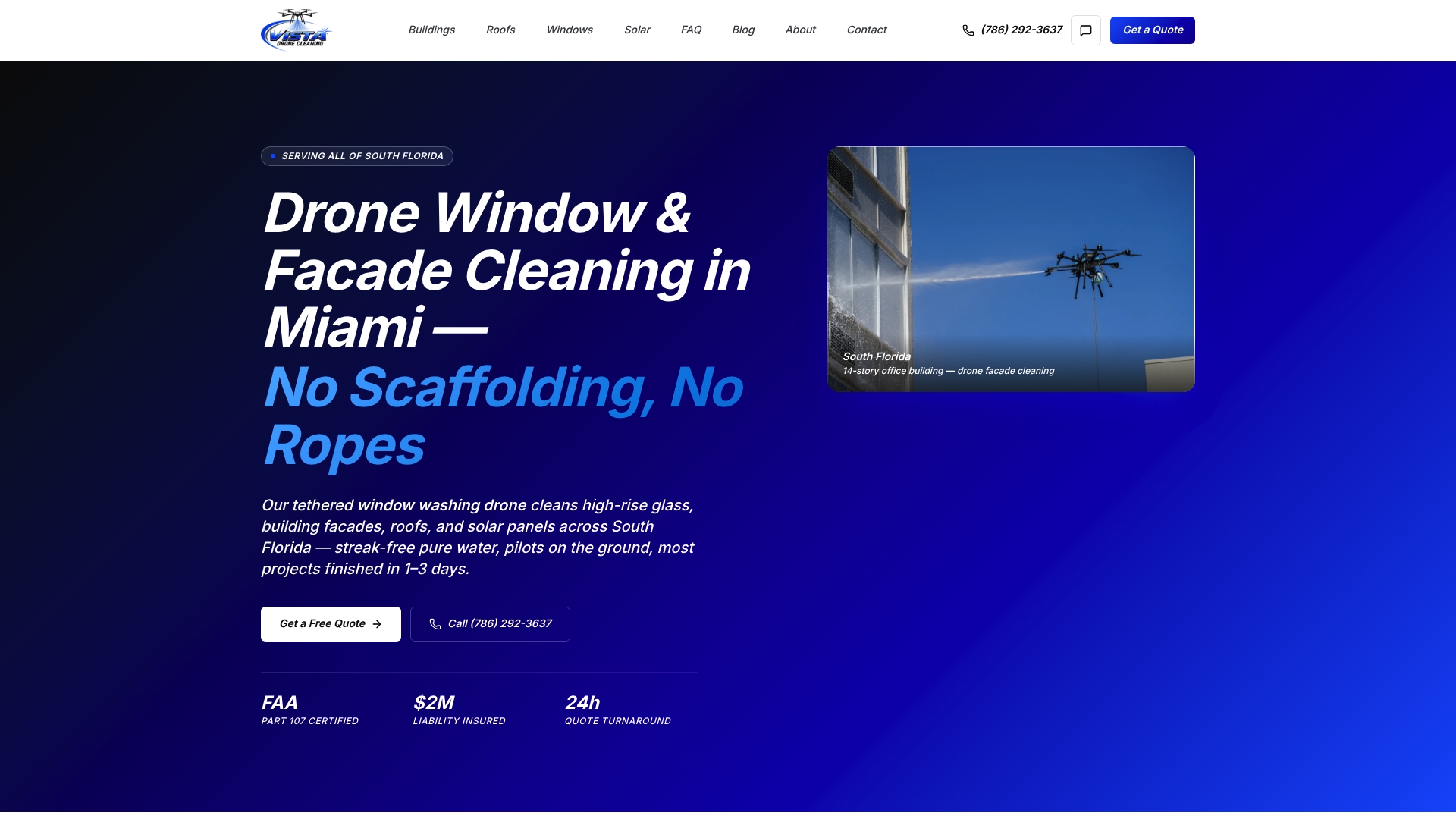
Vistadronecleaning serves commercial properties across Miami-Dade and Broward counties, including high-rises in Brickell, Miami Beach, Fort Lauderdale, and Boca Raton. Using FAA Part 107-certified pilots and tethered Lucid Bots Sherpa drones, the company delivers streak-free exterior glass cleaning with crews staying safely on the ground. No anchor certification process, no road closures, no rigging delays.
For facilities managers who want a faster, lower-cost alternative to traditional suspended access cleaning, drone window cleaning in Miami is worth a direct comparison. Free quotes are available within 24 hours, and the company carries $2M in liability insurance on every job.
Key Takeaways
Rope access glass cleaning requires certified technicians, OSHA-compliant anchorages rated at a minimum of 5,000 lbs per employee in any direction, and site-specific RAMS documentation before any work begins in South Florida.
| Point | Details |
|---|---|
| Anchorage compliance | Building owners must provide written certification that every anchorage supports a minimum load of 5,000 lbs per employee in any direction before contractors begin work. |
| IRATA vs SPRAT hours | IRATA requires 1,000 logged hours; SPRAT requires 500 hours for technician certification. |
| Height limit for RDS | OSHA prohibits rope descent systems above 300 feet without a documented feasibility exception. |
| Cleaning frequency | South Florida high-rises typically need quarterly cleaning; oceanfront buildings may need every 6–8 weeks. |
| Drone cost advantage | Drone cleaning runs 30–60% below scaffold-based costs by eliminating rigging, permits, and anchor fees. |
FAQ
What is rope access window cleaning?
Rope access window cleaning uses trained technicians suspended from certified roof anchors on static ropes to clean exterior glass on tall buildings. It is governed by OSHA 29 CFR § 1910.27 and the ANSI/IWCA I-14.1 safety standard.
How do professionals get a streak-free finish on high-rise glass?
Professionals use pure de-ionized water systems that remove dissolved minerals before water contacts the glass, combined with a methodical top-to-bottom cleaning sequence. In South Florida’s hard-water environment, this approach prevents the calcium spotting that tap water leaves behind.
What do professional window cleaners use to clean glass?
Professional crews use de-ionized pure water fed through a brush or squeegee system, along with pH-neutral or eco-friendly detergents where needed. Abrasive or acidic cleaners are avoided because they can etch glass coatings permanently.
Does WD-40 clean glass?
WD-40 is not a professional glass cleaning product and is not used in commercial high-rise window cleaning services. It leaves an oily residue that attracts dust and is incompatible with the pure water systems professionals rely on for streak-free results.
How often should South Florida high-rises schedule exterior glass cleaning?
Quarterly cleaning is the practical minimum for most commercial towers in Miami-Dade and Broward counties, with oceanfront properties in Miami Beach or Aventura often requiring cleaning every 6–8 weeks due to salt spray accumulation.