
Nine Minutes to Safety: How South Florida Crews Cut Rope Access Risk
Why a timed rescue under nine minutes matters more than gear for rope access risk, and when tethered drones eliminate exposure on South Florida facades.

Rope access carries a manageable risk profile when technicians follow SPRAT or IRATA-aligned protocols, use OSHA-compliant anchors, and rehearse rescues on a fixed schedule. The single most important control is not the rope, the harness, or the anchor. It’s a rescue plan that gets a suspended worker down in under nine minutes, before suspension trauma sets in.
TL; DR:
- Proper rescue planning and rehearsal are crucial, as a rescue within nine minutes prevents most suspension trauma cases.
- Rope access injuries mainly result from post-fall issues like suspension trauma, anchor failure, or environmental hazards, not the fall itself.
- Regular gear inspection, a well-evaluated anchor setup, and a written job safety analysis significantly reduce common preventable accidents.
- Drone technology offers a safe alternative for exterior cleaning tasks, eliminating the risks associated with suspension and anchor failure.
- Effective communication protocols, crew training, and timely rescue drills are the key to improving safety outcomes in rope access work.
Table of Contents
- What Is the Actual Risk of Rope Access?
- The Hazards That Actually Cause Rope Access Injuries
- What OSHA, SPRAT, and ANSI Actually Require
- Controls That Actually Cut Rope Access Risk
- Why Nine Minutes Is the Number That Matters
- Where Drone Cleaning Removes the Rope From the Equation
- How Often Rope Access Gear Needs Inspection
- Staying in Contact: Communication During a Rope Access Job
- PPE Beyond the Harness and Rope
- What Rope Access Accidents Actually Teach Us
- A Practitioner’s View on What Actually Changes Outcomes
- A Lower-Exposure Option for Qualifying Facade and Window Work
- Sources
- FAQ
What Is the Actual Risk of Rope Access?
Rope access exists because it’s fast, affordable, and reaches places a scaffold or lift can’t easily go. In South Florida, that means technicians dangling off high-rises in Brickell, Fort Lauderdale, and Boca Raton to clean glass, inspect facades, or service equipment mounted on 200-foot towers. The industry’s own safety data tells a more reassuring story than most people expect: rope access, when governed by SPRAT or IRATA-aligned systems, has a lower reported injury rate than general construction. The gap between that record and public perception comes down to visibility. A rope technician working 20 stories up looks terrifying to a passerby, even when the system underneath them has more redundancy than a scaffold.
The risk categories that matter most break down into a short list:
- Falls and fall-arrest failures
- Suspension trauma after a fall is arrested
- Anchor and connector failure
- Swing or pendulum falls into structures
- Sharp-edge and equipment-related injuries
- Environmental hazards, especially wind and electrical proximity
Each of those gets its own breakdown below, because the mechanisms differ and so do the fixes.
The Hazards That Actually Cause Rope Access Injuries
A fall itself rarely kills a rope access technician wearing a properly rigged harness. What kills is what happens after the fall is arrested. When a body hangs motionless in a harness, blood pools in the legs, venous return to the heart drops, and the technician can lose consciousness from orthostatic intolerance. OSHA warns that unconsciousness and death can occur in under 30 minutes once suspension trauma begins, and it can start far sooner in a technician with a poorly fitted harness or preexisting cardiovascular strain.
Suspension tolerance is not fixed. Harness fit and body position change how long a technician can safely hang. Practitioners have found that fit checks matter as much as the certification stamp on the harness itself, per NIOSH research on harness fit.
Anchor and connector failures are rarer but far more catastrophic. OSHA’s investigation into a tower fatality traced the death to a wire-form anchorage connector that was side-loaded and positioned outside its rated capacity. The connector wasn’t defective. It was used wrong.
Other hazards round out the list:
- Swing (pendulum) falls: a poorly placed anchor lets a falling technician swing sideways into a wall, corner, or window mullion instead of dropping straight down
- Sharp edges: unprotected parapets and metal trim can abrade or sever a rope under load
- Equipment reaction forces: pressure washers and rotary tools can torque a technician off position mid-task
- Environmental risk: wind gusts above rated limits, wet ropes that lose friction, and proximity to overhead electrical lines
What OSHA, SPRAT, and ANSI Actually Require
Federal and industry standards aren’t abstract paperwork. They translate into specific obligations a supervisor has to check before anyone clips into a rope.
- OSHA’s anchorage guidance commonly points to a 5,000-pound minimum breaking strength for personal fall arrest anchorages, distinguishing certified anchors rated for a specific number of workers from single-point emergency anchors.
- SPRAT’s safe-practices requirements mandate a written job safety analysis (JSA) before work starts, a qualified supervisor on site, and a practiced rescue capability available at all times, not just a plan on paper.
- ANSI and individual manufacturer specifications set connector load limits and redirect angles; exceeding a 120-degree redirect angle on a connector is a recurring root cause in post-incident forensic reviews from the USBR/SPRAT safe-practices guide.
A SPRAT-certified supervisor can technically work on-rope, but only if the rescue plan accounts for retrieving that supervisor promptly too. That single detail catches a lot of crews off guard.
Controls That Actually Cut Rope Access Risk
Most preventable rope access accidents trace back to a skipped step, not a defective product. Here’s the priority order that matters most:
- Write the JSA before boots touch the roof. A site-specific job safety analysis identifies anchor points, edge hazards, wind thresholds, and rescue routes before the first technician clips in.
- Have a qualified person evaluate every anchor. Anchors need independent evaluation for load path, side-loading risk, and access-zone placement, following the USBR/SPRAT guidance on keeping anchors outside the fall zone.
- Build in redundancy. Backup lines and separate anchor points are standard unless a qualified person documents a specific reason to deviate.
- Check harness fit every single time. A loose leg strap can shave minutes off suspension tolerance before anyone notices something’s wrong.
- **Inspect gear on a fixed schedule and retire it on objective criteria, not on a supervisor’s gut feeling about how it looks.
- Train for self-rescue and partner rescue, not just fall arrest. SPRAT-aligned programs expect regular rehearsal, not a one-time certification.
Pro Tip: Run a timed rescue drill, not a talked-through one. Simulate an unresponsive technician and clock the actual time from “worker down” to “worker on the ground.” Teams that do this quarterly consistently find gaps in communication or gear stowage that a tabletop plan never reveals.
Why Nine Minutes Is the Number That Matters
Suspension trauma has a clock running the moment a fall is arrested. NIOSH-cited research indicates a rescue completed within nine minutes prevents suspension trauma in roughly 95% of workers. That number should drive staffing decisions and equipment placement on every job, not just show up in a training manual.
Rescue technique matters as much as speed. NIOSH and CPWR guidance recommends specific immediate actions:
- Deploy trauma straps to relieve leg pressure and support blood flow
- Have the suspended worker pump their legs if they’re conscious and able
- Move to a standing position in the harness the moment it’s safe
- Use a partner-rescue or mechanical retrieval system rather than waiting for outside help
These steps come directly from CPWR/NIOSH rescue-plan guidance, and they buy time when full rescue takes longer than planned. Once a technician is down, call EMS immediately regardless of how they look, and monitor for delayed symptoms. Suspension trauma can present after the fact, not just during the hang.
Where Drone Cleaning Removes the Rope From the Equation
Not every high-rise task needs a technician on a rope 150 feet above a Miami sidewalk. A commercial drone cleaning service uses FAA Part 107-certified pilots operating tethered industrial drones to clean windows, facades, roofs, and solar panels on buildings up to 200 feet tall, with the crew staying on the ground the entire time.
That distinction matters for specific job types:
- Well-suited to drones: exterior glass washing, facade soft-wash, roof cleaning, and solar panel rinsing on accessible building faces
- Still requiring rope access: interior structural inspection, tasks needing hands-on manipulation of hardware, or repair work that a wash system can’t perform
For the facade and glass work that does qualify, eliminating the worker-on-rope exposure also eliminates the suspension trauma and anchor-failure risks discussed above, since no one is suspended in the first place. That’s a genuinely different risk category, not just a faster method.
How Often Rope Access Gear Needs Inspection
Rope, harnesses, and hardware degrade with use, sunlight, and chemical exposure, which is why inspection isn’t a once-a-year formality. A pre-use check happens before every single shift: technicians run ropes through their hands feeling for glazing, flat spots, or fuzzing, and check harness webbing for cuts or UV brittleness. That’s separate from a documented, more thorough inspection that typically happens monthly or quarterly depending on usage volume and manufacturer guidance.
Retirement criteria should be written down and objective, not judgment calls made in the field. A rope that’s taken a hard fall-arrest load gets retired immediately, even if it looks fine, because internal fiber damage doesn’t always show on the surface. Metal hardware gets checked for deformation, corrosion, and sharp burrs that could abrade a line. South Florida’s salt air and UV exposure accelerate wear on both rope and metal connectors faster than in drier, inland climates, which means crews working near the coast in Miami Beach or Fort Lauderdale should tighten their inspection intervals rather than default to a manufacturer’s baseline schedule built for less corrosive environments.
Every inspection needs a paper or digital record: date, inspector, findings, and disposition. When an incident happens, that log is often the first thing an OSHA investigator asks for, and a missing or incomplete inspection history turns a manageable equipment failure into a liability nightmare. Gear that fails inspection gets tagged out immediately and removed from service, not set aside “for now.”
Staying in Contact: Communication During a Rope Access Job
A technician who goes silent 15 stories up is either fine, distracted, or in trouble, and the only way to tell the difference fast is a communication protocol everyone follows without exception. Most crews use two-way radios as the primary channel, with a defined check-in interval, commonly every few minutes on longer tasks, so a missed check-in triggers an immediate response rather than getting noticed ten minutes later.
Radios fail. Batteries die, buildings block signal, and wind noise drowns out transmissions. That’s why rope access teams build in a backup: hand signals for basic status checks, a rope-tug system as a last resort, or a ground-level spotter maintaining visual contact when radio contact briefly drops. The supervisor’s role includes deciding, in advance, exactly what triggers a stop-work call and who has authority to make it.
Emergency communication also has to reach outside the immediate crew. A written protocol specifies who calls 911, who meets EMS at the building entrance, and who has building access codes and elevator override authority ready before anyone clips into a rope, not scrambled together after something goes wrong. Buildings in dense areas like Brickell or downtown West Palm Beach often have security desks and freight elevators that need advance coordination, and a five-minute delay finding the right building contact can matter when the nine-minute rescue clock is already running.

PPE Beyond the Harness and Rope
A harness and a rope are the headline equipment, but they’re not the whole kit. Eye protection is standard on nearly every job, since wind-blown debris, cleaning chemicals, and dust are constant hazards at height. Hard hats or climb-specific helmets protect against falling tools and head contact during a swing fall, and most SPRAT-aligned crews treat helmets as mandatory, not optional, for exactly that reason.
Gloves matter more than most technicians realize early in their careers. Bare hands on a rope for hours cause friction burns and reduce grip control right when precision matters most, so most crews standardize on gloves rated for rope work rather than general-purpose work gloves. Footwear needs a stable sole with good edge grip, since a technician often braces against a facade or ledge while working, and a slick sole undermines that stability regardless of how solid the rope system is.

Beyond personal gear, tool tethers keep dropped equipment from becoming a hazard to people below on the sidewalk, which matters enormously on a job site above a busy street in Miami or Fort Lauderdale. High-visibility clothing helps ground crews track a technician’s position at a glance, and hearing protection becomes relevant on jobs involving pressure washers or power tools running for extended periods. None of this replaces the anchor and rope system. It closes the gaps that a fall-arrest system alone doesn’t cover.
What Rope Access Accidents Actually Teach Us
Post-incident reviews rarely point to a single dramatic failure. They point to small compounding errors: a connector loaded at the wrong angle, a rescue plan that existed on paper but was never timed, a harness fit that shifted mid-shift without anyone rechecking it. The OSHA tower fatality investigation into a wire-form anchorage connector found the hardware itself performed within its design limits. The failure was in how it was positioned and side-loaded on the job, a detail a pre-use anchor evaluation should have caught.
The pattern that shows up again and again in forensic reviews involves redirect angles exceeding 120 degrees on connectors, a factor the USBR/SPRAT safe-practices guide flags as a recurring root cause. It’s not a dramatic equipment failure. It’s a geometry problem that a trained eye catches in seconds if someone’s looking for it.
The lesson that carries the most weight for South Florida crews isn’t about any single piece of hardware. It’s that the technicians who fare best after something goes wrong are the ones whose teams had already rehearsed the exact scenario, timed the response, and knew who was calling 911 before it mattered. Paper plans don’t reveal gaps. Timed drills do.
A Practitioner’s View on What Actually Changes Outcomes
Certifications and inspection logs matter, but the crews with the best safety records share one habit: every technician has real stop-work authority, and supervisors back it up without hesitation, no exceptions for schedule pressure. Rehearse rescues on a fixed calendar, not “whenever there’s time, ” and write down what the drill revealed every single time. The margin between a safe suspension and a dangerous one often comes down to a leg strap tightened one notch, which is a detail no certification checklist fully captures.
, Eliot
A Lower-Exposure Option for Qualifying Facade and Window Work
For a lot of the exterior cleaning tasks that currently send a technician up on rope, there’s a way to get the same result without anyone hanging off the building at all. Vistadronecleaning uses FAA Part 107-certified pilots and tethered industrial drones to clean windows, facades, roofs, and solar panels on South Florida buildings up to 200 feet tall, and the entire crew stays on the ground for the whole job.
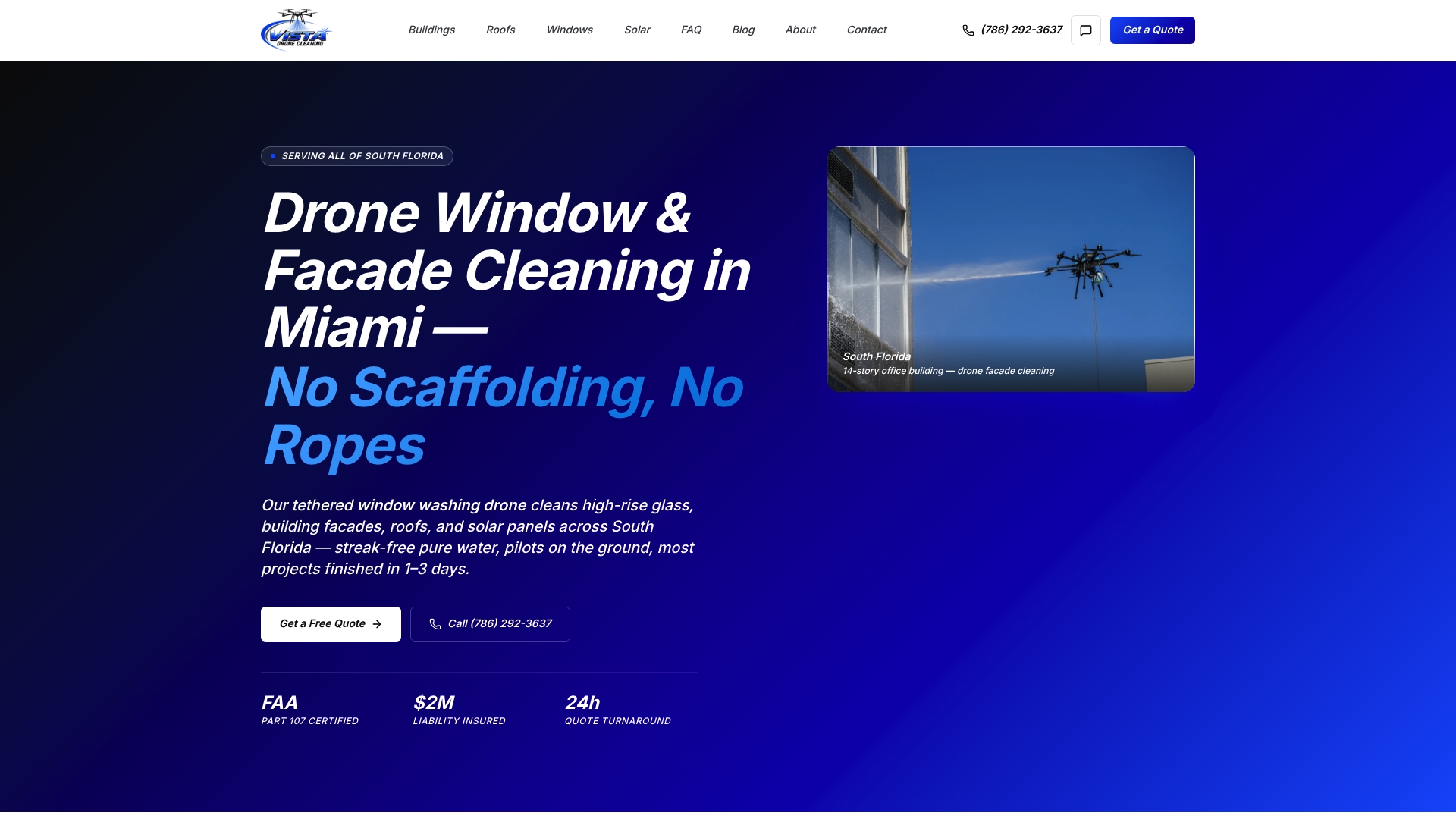
That’s the real contrast: instead of writing a JSA, staging a rescue plan, and rehearsing a nine-minute retrieval before a single window gets touched, a qualifying job goes straight to work, backed by liability insurance and FAA compliance documentation. It’s not a fit for every task. Structural repairs and hands-on hardware work still need a technician on rope. But for exterior glass washing, facade soft-wash cleaning, roof cleaning, and solar panel rinsing, it removes the suspension trauma and anchor-failure risk equation entirely, because no one is suspended.
If you manage a high-rise, condo, or commercial property in Miami-Dade or Broward County and want to know whether your next facade or high-rise window cleaning project qualifies, request a site survey and a free quote within 24 hours.
Sources
- Impact of Harness Fit on Suspension Tolerance
- Safe Practices FAQs | SPRAT
- OSHA Safety and Health Information Bulletin on suspension trauma
FAQ
How Safe Is Rope Access Compared to Other Trades?
Rope access has a favorable safety record when SPRAT or IRATA-aligned protocols are followed correctly, largely because those systems build in redundancy and mandatory rescue planning that many other trades lack. The risk rises sharply when written job safety analyses, anchor evaluations, or practiced rescue capability get skipped.
What Are the Main Hazards Associated With Rope Access?
The core hazards are fall-arrest events, suspension trauma after a fall, anchor or connector failure, swing/pendulum falls, sharp-edge rope damage, and environmental factors like wind and wet lines. Suspension trauma is the most time-sensitive, since OSHA warns unconsciousness can occur in under 30 minutes without prompt rescue.
Has a Climbing or Access Rope Ever Failed on the Job?
Rope itself rarely snaps in properly rated rope access systems, since certified life-safety rope is rated far above typical working loads. Documented failures usually trace to anchor or connector misuse, such as OSHA’s investigation into a side-loaded anchorage connector that contributed to a fatal fall, rather than the rope fiber failing outright.
What Is the Future of Rope Access Work?
Rope access will remain necessary for structural inspection, repair, and hardware work that requires hands-on manipulation. For routine exterior cleaning tasks like window washing, facade soft-wash, and solar panel rinsing, drone-based methods like the ones Vistadronecleaning offers are increasingly replacing rope crews on qualifying jobs, since they remove the worker-on-rope exposure entirely.
How Quickly Does a Rescue Need to Happen After a Fall?
A rescue completed within nine minutes prevents suspension trauma in roughly 95% of workers, according to NIOSH-cited research on suspension tolerance. That benchmark should drive staffing levels, equipment placement, and rescue drill timing on every job site.