What is rope access cleaning? A complete guide
Discover what rope access cleaning is and how it outperforms drones. Learn essential techniques for efficient building maintenance!
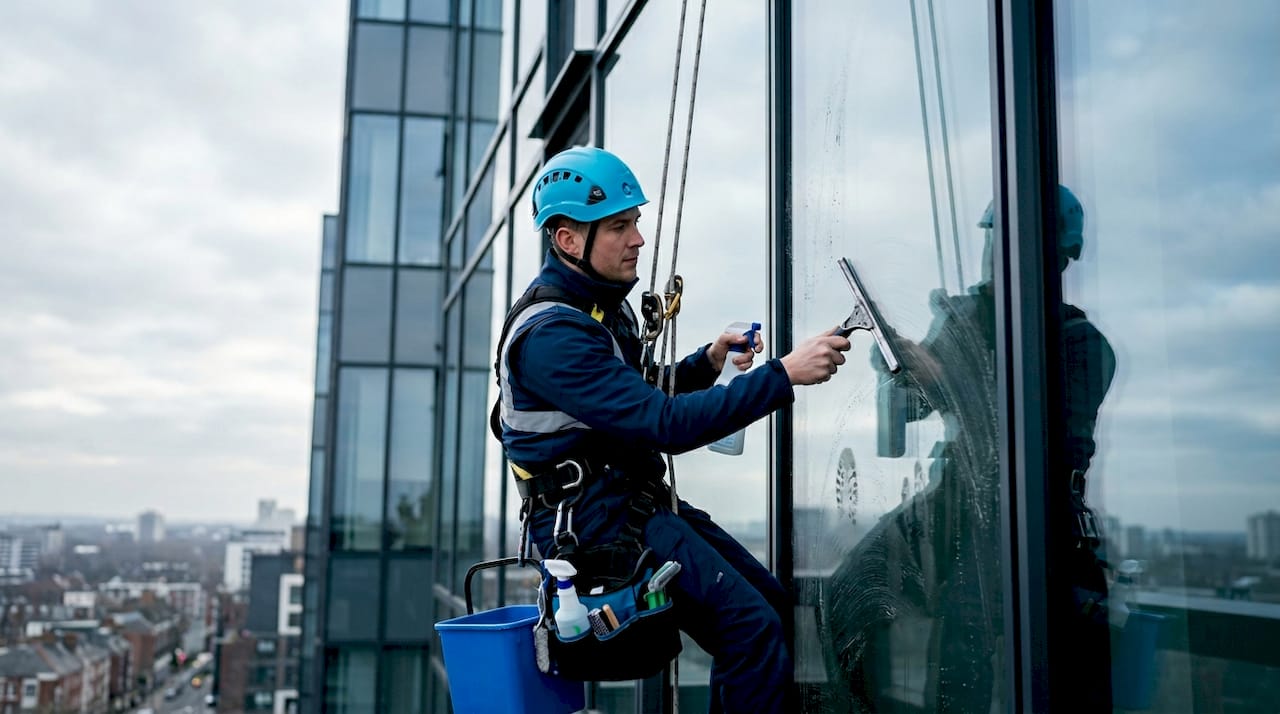
Many South Florida property managers assume rope access cleaning is too risky or a relic of the past. That assumption costs money. Understanding how rope access works and when it outperforms other methods gives you an advantage when managing high-rise facades, textured cladding, or structures demanding hands-on intervention. This guide covers the core techniques, safety certifications, and practical differences between rope access and drone cleaning.
Table of Contents
- What is rope access cleaning and how does it work?
- Rope access cleaning vs. drones: which is right for your building?
- Certification and safety standards in rope access cleaning
- Common challenges and expert tips for effective rope access cleaning
- How to apply rope access cleaning to South Florida commercial buildings
- Why rope access cleaning remains indispensable despite new technologies
- Explore professional rope access cleaning and drone facade washing in Miami
- Frequently asked questions
Key Takeaways
| Point | Details |
|---|---|
| Rope access basics | Uses two ropes and certified equipment to access hard-to-reach exteriors. |
| Hands-on advantage | Allows precise cleaning and repairs where drones cannot physically reach. |
| Certification matters | Technicians must hold current IRATA or SPRAT certification. |
| Safety first | Proper tethering and protocols prevent dropped tools and protect the public. |
| Combined approaches | Drones for inspection followed by rope access cleaning optimizes efficiency. |
What is rope access cleaning and how does it work?
Rope access cleaning involves trained technicians using ropes and harnesses to suspend themselves on a building's exterior. This method reaches surfaces that otherwise require scaffolding or aerial platforms.
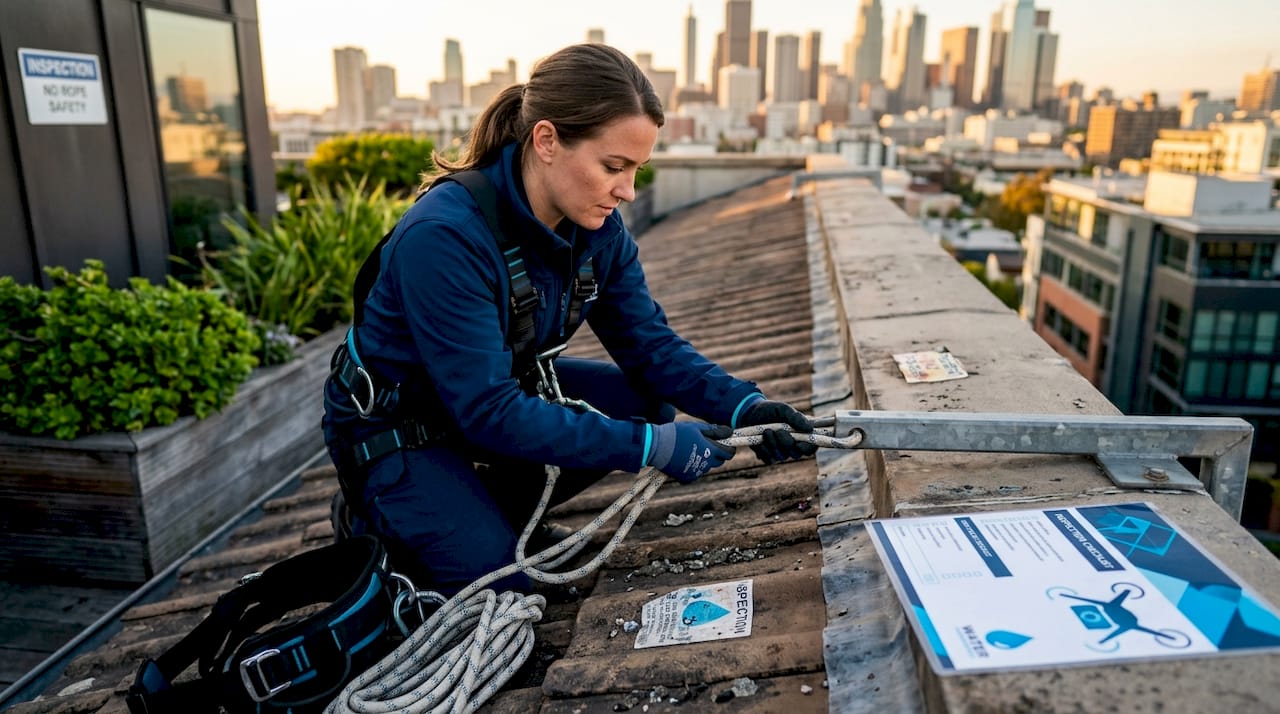
The system relies on a dual-rope approach: a primary working rope and an independent backup safety rope. All hardware, descenders, ascenders, and harnesses, must be traceable, certified, and inspected before every use.
Technicians descend from roof-level anchor points to perform pressure washing, window cleaning, caulking, and minor repairs. They control their position with both hands free for work, using rope access cleaning techniques like controlled descent and horizontal traversal.
Standard setup includes:
- Working rope: Primary suspension.
- Backup safety rope: Independent fall arrest.
- Full-body harness: Connects the technician to both ropes.
- Descender/ascender devices: Control vertical movement.
- Tool tethers: Prevent falling objects.
- Anchor system: Secured and load-tested at roof level.
Pro Tip: Ask for equipment inspection records and anchor test certificates. A hesitation here indicates a weak safety culture.
Rope access cleaning vs. drones: which is right for your building?
The choice between methods depends on one factor: contact. Rope access is preferred for tactile, hands-on cleaning and repairs. Drones excel at visual inspection and rapid washing.
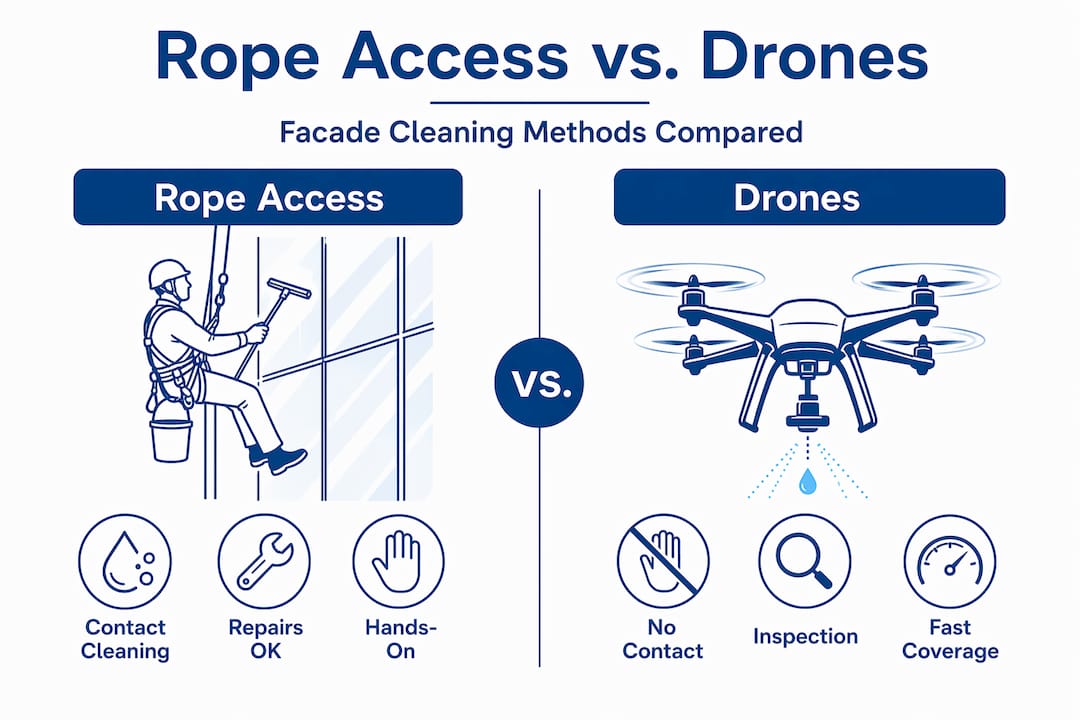
Property managers in South Florida often use a combined strategy: drones identify problem areas like cracked sealant or heavy staining, then rope access crews target those spots with precision.
| Factor | Rope access cleaning | Drone cleaning |
|---|---|---|
| Physical contact | Yes | No |
| Repairs/Caulking | Yes | No |
| Inspections | Limited | Excellent |
| Tenant disruption | Moderate | Minimal |
| Cost per area | Moderate to high | Low to moderate |
| Speed | Slower | Very fast |
| Certification | IRATA or SPRAT | FAA Part 107 |
Comparing rope access vs drone cleaning shows that sequencing, not choosing one over the other, saves the most money.
Certification and safety standards in rope access cleaning
Always verify certification. The two recognized bodies are IRATA (Industrial Rope Access Trade Association) and SPRAT (Society of Professional Rope Access Technicians). IRATA uses three levels: Level 1 technicians work under supervision, while Level 3 supervisors handle rescue planning and system design.
Certification requires documented hours and practical evaluations by independent assessors. Require these documents from any provider:
- Current IRATA or SPRAT cards for all technicians.
- A site-specific written rescue plan.
- Third-party liability insurance covering rope access.
- Pre-job anchor inspection records.
- Hazard identification and risk assessment (HIRA).
Learn more about safety and certification standards for South Florida high-rises.
Pro Tip: Verify the expiry date on IRATA cards. A Level 3 supervisor should be present during any active operation.
Common challenges and expert tips for effective rope access cleaning
The primary risks are controllable hazards like dropped tools. Dropped tools remain a persistent hazard. Every tool must be attached to the technician or rope system with a rated tether.
Standard site management includes:
- Anchor audit: Load-test every point before attachment.
- Tool inventory: Confirm all gear is tethered.
- Exclusion zones: Use barriers to protect pedestrians below.
- Communication: Use radios for clear signaling.
- Rescue dry run: Walk through the plan before the first descent.
"The quality of a rope access operation is measured by the team's plan for when things go wrong."
For more on safe exterior window cleaning, review these protocols before your next contract.
How to apply rope access cleaning to South Florida commercial buildings
Salt air, high humidity, and traffic pollution create thick grime and biological growth on South Florida facades. For buildings in Miami, Brickell, and Fort Lauderdale, exterior maintenance is asset protection.
Rope access remains the best choice for textured concrete, terracotta, and aged glass curtain walls that require direct scrubbing.
| Building type | Recommended approach | Why |
|---|---|---|
| Glass curtain wall | Drone first, rope access for spots | Fast coverage with targeted precision |
| Textured concrete | Rope access | Requires direct contact |
| Balconied mid-rise | Rope access | Complex geometry |
| Flat roof w/ solar | Drone cleaning | Fast, no-contact washing |
| Historic masonry | Rope access | Requires delicate handling |
Steps for building managers:
- Schedule drone surveys to identify issues early.
- Direct rope access crews to specific repairs before they escalate.
- Verify Florida-specific insurance and IRATA credentials.
- Plan for tenant disruption regarding noise and access.
Review commercial building cleaning methods for more South Florida-specific options.
Why rope access cleaning remains indispensable despite new technologies
Drones have revolutionized inspections and large-scale washing, but they operate at a distance. Any application requiring pressure, scrubbing, or sealant injection is still a human job.
The advantages of rope access are clear in repair scenarios. While a drone survey locates a leak at 18 stories, a rope access technician fixes it. They also provide sensory feedback, judging the flex of a panel or the sound of hollow masonry, that software cannot replicate.
The best approach isn't "rope or drone, " but using the right tool for the specific problem.
Explore professional rope access cleaning and drone facade washing in Miami
South Florida buildings require constant maintenance. Combining certified rope access with drone technology is the most cost-effective way to manage high-rise assets.
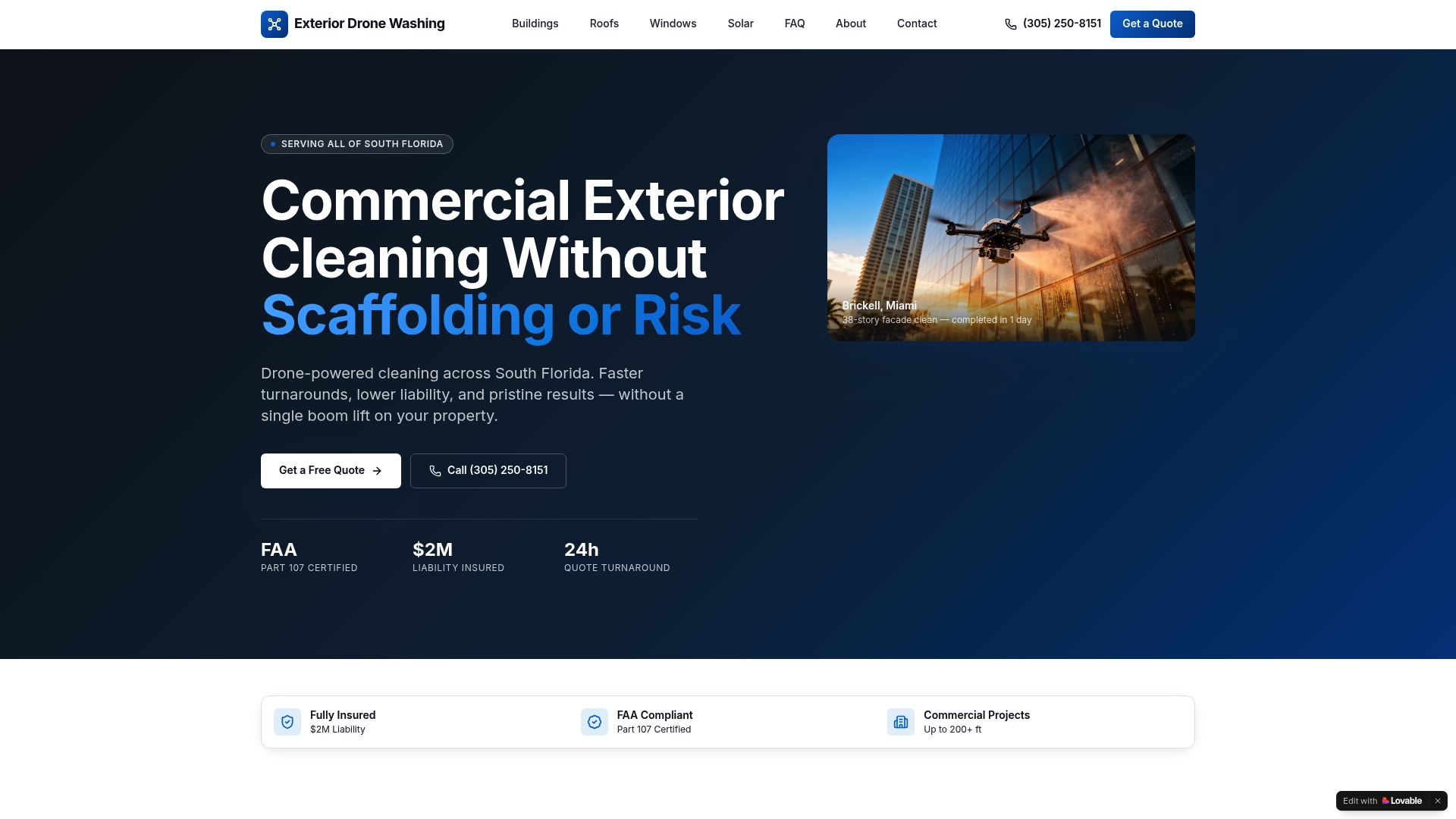
At Vista Drone Cleaning, we work with managers across Miami and Brickell to design programs using both methods. Our network includes IRATA-certified professionals and FAA-compliant drone crews. Whether you need facade washing or targeted repairs, we provide before-and-after documentation. For Brickell district buildings, we offer on-site assessments to plan your maintenance budget.
Frequently asked questions
What is rope access cleaning used for in commercial buildings?
It allows technicians to safely reach hard-to-access areas for cleaning, repairs, and inspections without scaffolding.
Is rope access cleaning safe for my building and occupants?
Yes. Professionals follow dual-rope safety systems and equipment inspections to protect themselves and the public.
When should I choose rope access cleaning over drone cleaning?
Choose rope access for hands-on work like scrubbing, caulking, or repairs where surface contact is required.
How can I verify that rope access technicians are qualified?
Request IRATA or SPRAT cards. These prove the technician has completed required training hours and independent evaluations.
What safety measures prevent dropped tools?
Tethers, holsters, and ground-level exclusion zones prevent tools from falling and protect pedestrians.