Miami Managers: Reduce Rope Descent Risk and Cut Cleaning Costs 30–60%
South Florida property managers: FAA Part 107 tethered drones replace rope descent, cut cleaning costs 30–60%, and finish most jobs in 1–3 days.

In Miami, “rope descent system” increasingly refers to a different approach altogether: FAA Part 107 certified drone cleaning that handles high-rise windows, facades, roofs, and solar arrays without putting anyone on a rope. It keeps crews on the ground, usually finishes faster than traditional access methods, and often costs less. This service is available across South Florida with quotes typically provided within 24 hours.
TL; DR:
- Drone cleaning in South Florida typically costs between $0.12 and $0.25 per square foot for facades and windows, with projects usually completed within 1 to 3 days.
- Certification requirements include an active FAA Part 107 remote pilot license, and projects over people often need FAA airspace clearances or waivers before starting.
- Safety and liability are priorities, with providers needing proof of liability insurance of at least $1 million and documented safety procedures.
- Drone access is limited on buildings with tight setbacks, courtyards, or heavy obstructions, but most projects avoid scaffolding and extensive street closures.
- Requesting detailed flight plans, FAA authorizations, and references from comparable buildings helps verify provider qualifications and project feasibility.
Table of Contents
- What drone-based exterior cleaning actually involves
- Why building owners are moving away from scaffolds and lifts
- Regulatory checklist for South Florida drone cleaning projects
- How to vet a drone cleaning provider before you sign
- What to expect from site review to final walk-through
- Why this matters more in South Florida than most markets
- Get a free quote from Vista Drone Cleaning
- FAQ
- Sources
What drone-based exterior cleaning actually involves
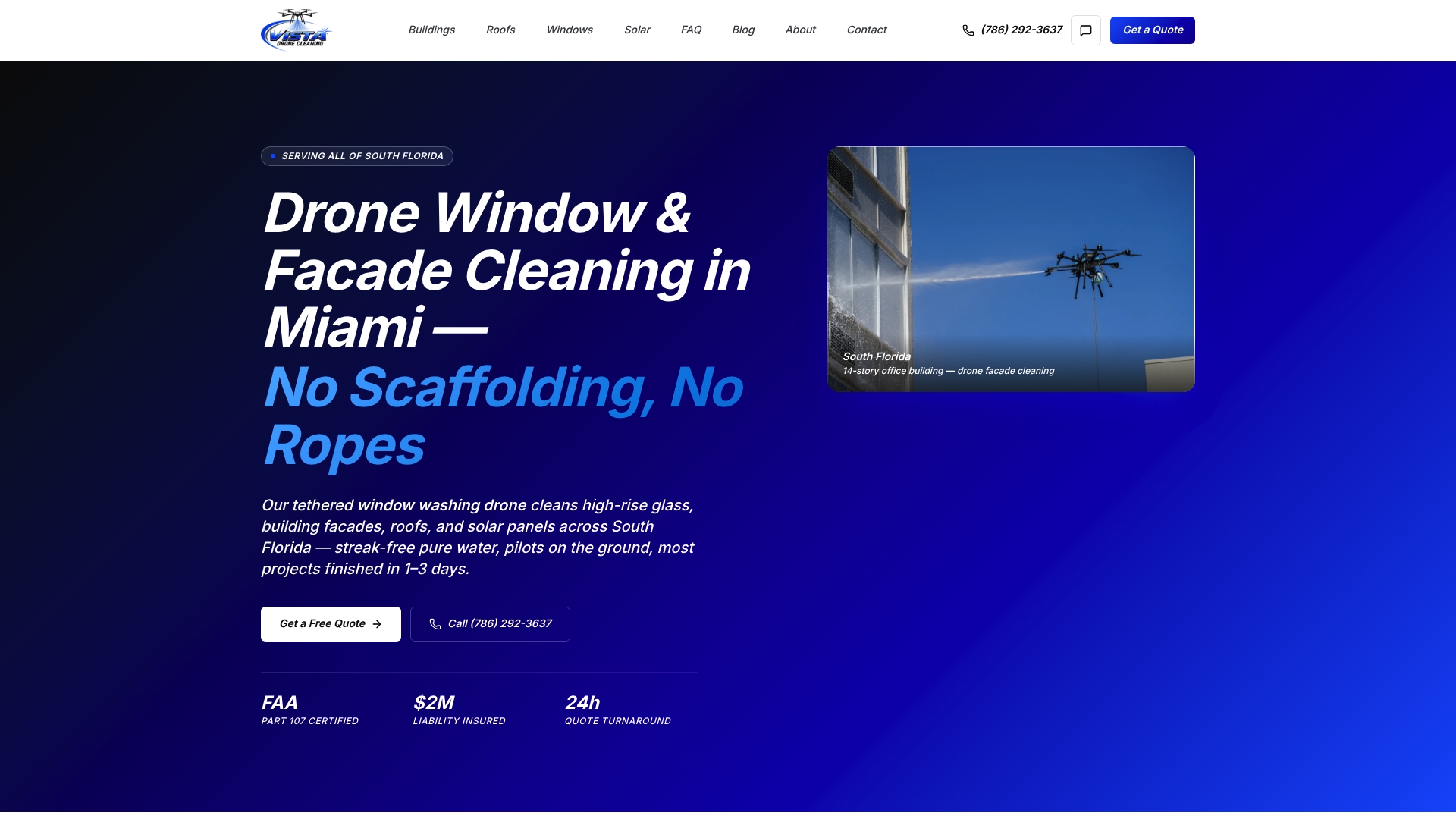
This service uses tethered industrial drones operated by FAA-certified remote pilots stationed on the ground. The drone carries a water line and nozzle system to the work surface while a ground crew monitors flight path, pressure, and safety zones, and every job gets documented in 4K before-and-after footage so building owners can see the result without climbing anything.
The scope covers four main applications:
- Window washing: streak-free cleaning using pure de-ionized water rinses on glass curtain walls and storefronts
- Facade soft-wash: substrate-matched cleaning for stucco, EIFS, concrete, and metal panel exteriors, detailed on our drone facade cleaning page
- Roof soft-wash: gentle cleaning for tile, shingle, and metal roofing without foot traffic on the surface
- Solar panel cleaning: pure-water rinses that avoid scratching photovoltaic glass
There are limits. Extremely tight rooftop setbacks, fully enclosed courtyards, or sites with heavy overhead obstructions can restrict drone access, and some of those buildings still need traditional methods. Rope access itself sits outside what this article covers, since the focus here is the drone-based alternative that avoids rigging altogether.
Why building owners are moving away from scaffolds and lifts
The biggest shift is risk transfer. When no one works at height, the fall-protection calculus changes entirely. The ANSI/ASSP Z359 fall protection code treats systems that prevent a fall as preferable to systems that only arrest one, and removing workers from elevated platforms is the clearest way to satisfy that principle.

Boatswain’s chairs and suspended scaffolds carry a documented risk history. OSHA guidance on window cleaning operations cautions that these methods should be used only when safer alternatives are impractical, which is exactly the gap drone cleaning fills for many South Florida high-rises.
Beyond safety, several practical advantages stack up:
- Simpler compliance: powered platforms and suspended scaffolds fall under detailed OSHA engineering and inspection rules, while drone operations shift much of that burden to the service provider
- Faster timelines: most projects finish in 1 to 3 days with ground-based crews, according to our own project data
- Lower cost: we typically see 30 to 60% savings versus scaffold or lift methods, a figure we report from our own completed projects
- Less urban disruption: no road closures, scaffolding permits, or multi-week staging in dense corridors like Brickell or downtown Fort Lauderdale
Regulatory checklist for South Florida drone cleaning projects
Compliance starts with the FAA’s Part 107 framework, which governs commercial drone operations nationwide. The operations-over-people final rule matters most for building cleaning, since it allows routine operations over people without a waiver when the aircraft and mission meet specific category requirements, which is what makes a drone hovering next to an occupied office tower workable in the first place.
Confirm these points before a project starts:
- The pilot holds an active FAA Part 107 remote pilot certificate
- The operation qualifies under an operations-over-people category, or the provider has secured the appropriate authorization
- Controlled airspace near the property has been checked, since sites near major airports or complex urban zones sometimes require additional clearance
- Temporary flight restrictions tied to high-profile events, common in South Florida during major sporting and maritime events, have been reviewed
On the OSHA side, powered platforms for building maintenance are regulated under 29 CFR 1910.66, which requires engineered stabilization systems, daily inspections, and written emergency plans for traditional rigs. Shifting the work to a drone operator moves much of that ongoing obligation off the building owner’s plate.
Pro Tip: Ask any provider whether a specific project needs a Part 107 waiver or airspace authorization before signing, since skipping that question is the most common cause of delayed start dates.
How to vet a drone cleaning provider before you sign
Credentials matter more than price when the work happens above a parking lot full of tenants and pedestrians. A short evaluation process protects your building and your budget.
- Confirm FAA certification: every remote pilot on the job should carry an active Part 107 certificate
- Check liability coverage: look for at least $1 million, ideally $2 million or more, in general liability insurance
- Match equipment to your building: tethered industrial drones for facades and windows, pure-water systems for solar arrays, substrate-matched soft-wash chemistry for stucco, tile, or metal
- Request documentation: written SOPs, insurance certificates, and FAA authorizations where relevant
- Ask for a site-specific flight plan: a proposed flight path, staging area, and emergency plan as part of the quote lets you compare bids on equal footing, a practice outlined in the FAA’s Part 107 waiver guidance
- Review references: completed projects on comparable South Florida high-rises carry more weight than generic case studies
For buildings with complex structural questions, an independent feasibility or engineering review from a firm like Urban Planning Pros can clarify site constraints before bids go out.
Pro Tip: Have your safety team request a written job hazard analysis from each bidder. A field guide to job hazard analysis shows what a complete one should cover.
What to expect from site review to final walk-through
A typical project starts with a site review and a fixed-price quote, usually followed by a short prep window to confirm access points and water supply. Most buildings in Miami-Dade, Broward, and Palm Beach counties are fully serviced within a few days, based on our completed work, with documentation and a final walk-through closing out the job.
Staging needs are modest compared to scaffolds or lifts:
- A small ground footprint for equipment and the pilot station
- Access to power and water on site
- Basic pedestrian notifications or signage near active flight zones
Tenant coordination is lighter too. Since no rigging goes up and no sidewalks close, most tenants barely notice the work beyond a courtesy notice. Pricing follows project area and service type, detailed on our how we price page, with cost drivers including building height, access difficulty, and substrate type.
Why this matters more in South Florida than most markets
South Florida’s high-rise density, from Brickell to Fort Lauderdale’s beachfront corridor, puts commercial buildings close to foot traffic, tourism, and tight property lines almost every day of the year. Scaffolding and lift staging that might be tolerable in a quieter market creates real friction here, and that friction has a cost in tenant complaints and lost leasing appeal.

The bigger shift is who carries the risk. When a certified drone operator does the work, much of the OSHA powered-platform burden, the engineering, the daily inspections, the written emergency plans, moves off the building owner’s desk. That is a real transfer of exposure, not just a convenience.
Before hiring anyone, ask for written SOPs, proof of insurance, FAA credentials, and sample 4K documentation from a comparable building. Those four items tell you more about a provider than any sales pitch.
, Eliot
Get a free quote from Vista Drone Cleaning
Drone-based exterior cleaning is handled across Miami-Dade, Broward, and Palm Beach counties, appealing to property managers seeking to avoid scaffolding while ensuring thorough cleaning. Projects are conducted by FAA Part 107 certified pilots using tethered industrial drones, include liability insurance, and provide 4K before-and-after documentation for record-keeping.
Our core services cover the full exterior of a commercial property:
- High-rise window cleaning with streak-free pure-water rinses
- Roof soft-wash cleaning for tile, shingle, and metal roofing
- Solar panel cleaning using pure-water rinses safe for photovoltaic glass
| Service | Typical price | Unit |
|---|---|---|
| Drone facade and building cleaning | $0.12 to $0.25 | per square foot |
| Drone window cleaning | $0.12 to $0.25 | per square foot of glass |
| Drone solar panel cleaning | $1 to $3 | per panel |
| Parking garage cleaning | $0.06 to $0.08 | per square foot |
FAQ
What does “drone cleaning” mean for a commercial high-rise?
It means an FAA Part 107 certified pilot operates a tethered industrial drone from the ground to wash windows, facades, roofs, or solar panels without scaffolding, lifts, or rope access. The crew stays on the ground throughout, and the work is documented in 4K video for the building owner’s records.
Is drone cleaning legal for buildings in Miami-Dade and Broward counties?
Yes, when the operator holds an active FAA Part 107 certificate and the project meets the requirements of the operations-over-people final rule, which governs routine commercial drone flights near people and buildings. Some sites near controlled airspace or temporary flight restrictions may need additional FAA authorization first.
How much does drone cleaning cost compared to scaffolding?
Pricing runs by project area and service type, with facade and window cleaning priced between $0.12 and $0.25 per square foot and solar panel cleaning between $1 and $3 per panel.
How long does a typical drone cleaning project take?
Most commercial properties in South Florida are fully serviced in 1 to 3 days, covering prep, cleaning, and a final walk-through. Larger or more complex sites may take longer depending on height, access difficulty, and substrate type.
What questions should I ask before hiring a drone cleaning provider?
Confirm the pilot’s FAA Part 107 certification, request proof of liability insurance, and ask for written safety procedures and sample 4K documentation from a comparable building. You should also ask whether the project needs an FAA airspace authorization, since that affects both timeline and cost.
Sources
- Small unmanned aircraft systems (UAS) regulations, part 107 | FAA
- Clarification on window cleaning operations | OSHA