Hotel Guest Safety and Exterior Cleaning Explained
Learn how hotel guest safety exterior cleaning explained can enhance safety and reduce disruption. Discover efficient, drone-powered solutions!
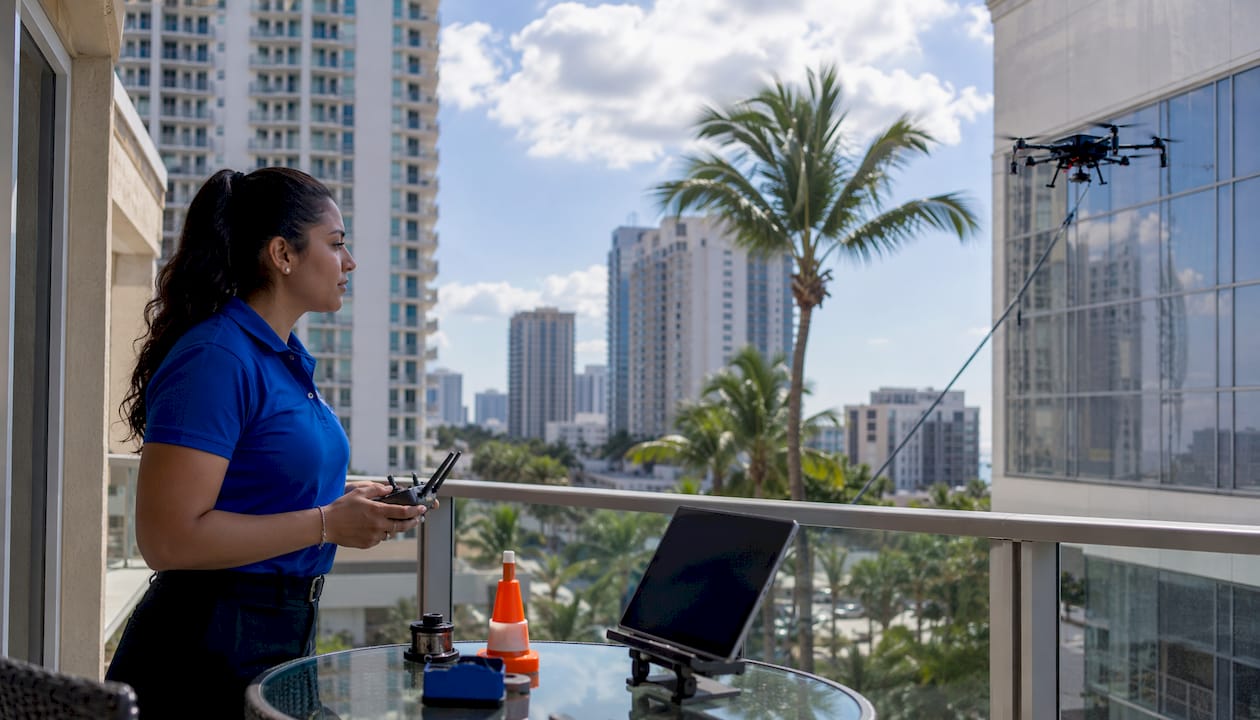

For South Florida hotels, the safest exterior cleaning approach combines FAA Part 107–certified pilots, tethered industrial drones, substrate-matched soft-wash chemistry, and pure de-ionized water rinses. Crews stay on the ground, no scaffolding blocks your entrance, and most projects wrap in 1–3 days.
Three reasons this matters for your property:
- Fall-risk elimination: No workers at elevation means no fall exposure for your crew or guests below.
- Minimal guest disruption: No scaffold at the porte-cochere, no lane closures, no blocked lobby approach.
- Fast turnaround: Projects typically complete within a few days, schedulable between booking windows.
Vistadronecleaning operates this model across Miami-Dade, Broward, and Palm Beach counties, serving hotels from Brickell to Boca Raton.
Table of Contents
- Why exterior cleaning creates real guest-safety risks in South Florida
- How do drone cleaning, scaffolding, boom lifts, and rope access compare?
- How do tethered industrial drones actually clean a hotel facade?
- What operational benefits does this approach deliver for South Florida hotels?
- When are drones not the right tool for the job?
- What compliance documents should every hotel property manager require?
- What questions should your RFP ask a drone cleaning vendor?
- What does a realistic South Florida project timeline look like?
- Key Takeaways
- A perspective on what actually matters on South Florida hotel sites
- Vistadronecleaning serves South Florida hotels with ground-based exterior cleaning
- Useful sources for compliance and technical standards
- FAQ
Why exterior cleaning creates real guest-safety risks in South Florida
South Florida’s climate accelerates every exterior hazard. High humidity and year-round heat drive rapid biological growth: algae, mold, and mildew colonize walkways, pool decks, and stairways fast. That biological film becomes a slip hazard before most inspection cycles catch it. Hotel exterior checklists recommend weekly inspection frequency for walkways, egress paths, and exterior lighting precisely because conditions change that quickly in this climate.
The hazards stack up quickly on an active hotel property:
- Elevated-work fall exposure from scaffolding, boom lifts, or rope access rigs positioned near guest arrival zones
- Falling objects (tools, fasteners, or dislodged debris) over active pedestrian areas
- Blocked egress when scaffold frames or equipment restrict emergency exit paths
- Slip hazards from biological growth on pool decks, walkways, and exterior stairways
Regulatory framing matters here. OSHA 1926.501 requires fall protection for any working surface six feet or more above a lower level. More broadly, OSHA’s general-duty clause (OSH Act Section 5(a)(1)) requires employers to provide a workplace free from recognized hazards. For a hotel property manager, that obligation extends to the vendor you hire: if a contractor’s method creates a recognized hazard on your property, you share exposure.
Compliance signal: OSHA’s general-duty clause does not mandate specific technologies, but adopting safer equipment, such as FAA-certified tethered drones, is a defensible risk-management choice that reduces recognized fall hazards on your property.
How do drone cleaning, scaffolding, boom lifts, and rope access compare?

| Factor | Tethered industrial drones | Scaffolding | Boom lifts | Rope access |
|---|---|---|---|---|
| Safety / fall-risk | Crew stays on ground; no elevated worker exposure | High fall risk; requires full 1926.501 compliance | High fall risk; tip-over and entrapment risk | Significant fall risk; requires full harness/arrest systems |
| Guest disruption | Minimal; no ground staging at entrances | Severe; weeks of blocked entrances and signage | Moderate; large equipment footprint near guests | Moderate; rigging anchors above guest areas |
| Typical timeline | 1–3 days | 1–3 weeks setup + cleaning | 2–5 days | 3–7 days |
| Relative cost | 30–60% lower than scaffold/lift | Baseline | Higher than scaffold | Higher than scaffold |
| Substrate suitability | Glass, EIFS, stucco, concrete, metal, tile, solar | Most surfaces | Most surfaces | Most surfaces; limited on complex geometry |
| Permits / road closures | Typically none | Often required | Often required | Anchor permits may apply |
| Insurance / documentation | COI + before/after 4K | COI required | COI required | COI required |

Pro Tip: When reviewing a vendor’s certificate of insurance, confirm the tethering hardware specs are documented separately. A drone that operates without a physical tether to the ground is a different risk profile than a tethered system, tethering limits drift radius and eliminates the primary failure mode that creates falling-object exposure over guest areas.
How do tethered industrial drones actually clean a hotel facade?
The ground-based workflow starts well before the drone lifts off. Here is the core equipment set a qualified operator should bring to your property:
- Tethered industrial drone (Lucid Bots Sherpa or equivalent) rated for buildings up to 200 feet
- Physical tether hardware with documented load-test results
- FAA Part 107–certified pilots with current flight logs
- Remote fail-safe and emergency recovery system
- Soft-wash payload for biological and stain removal
- Pure de-ionized water rinse system for streak-free glass and solar finishes
The operational sequence runs in this order:
- Site survey (assess facade geometry, substrate types, airspace, and guest-traffic patterns
- SOP and risk plan) written before mobilization, covering chemical handling, emergency recovery, and guest-notification windows
- FAA airspace check: NOTAM filing or ATC coordination if the property sits near a controlled airspace zone (relevant near Miami International, Fort Lauderdale-Hollywood, or Opa-locka airports)
- Mobilization and cordon, minimal ground footprint; no scaffold frames or lane closures
- Cleaning passes, soft-wash chemistry matched to substrate (EIFS, stucco, concrete, metal, tile) followed by a pure de-ionized rinse on glass and solar panels
- 4K before/after documentation: recorded for brand compliance, insurance records, and your own maintenance log
- Final inspection and sign-off
Pure de-ionized water rinses eliminate streaking on glass and reduce the need for detergents near public areas, a meaningful environmental benefit for guest-facing surfaces like lobby glass and poolside windows.
What operational benefits does this approach deliver for South Florida hotels?
The guest-experience case is straightforward: no scaffold blocking the porte-cochere means arriving guests see a clean facade, not a construction site. That first impression feeds directly into review scores and, over time, RevPAR. Scheduling between booking windows (before a conference block, ahead of peak season, or during a low-occupancy gap) keeps the property fully operational throughout.
Safety benefits go beyond optics:
- No elevated workers above active guest arrival or departure zones
- No heavy equipment on pavement that can crack tile or damage landscaping
- No lane closures that force guests to navigate around machinery
Cost and timeline signal: Provider-reported figures from Vistadronecleaning indicate typical projects complete in 1–3 days with relative cost savings of 30–60% compared to traditional scaffold or lift methods. Ask any vendor to document these claims with project references before you accept them in a proposal.
When are drones not the right tool for the job?
Tethered drone cleaning has real limits, and a qualified vendor will tell you about them upfront.
Weather constraints are the most immediate factor in South Florida. Wind speeds above operational thresholds, active thunderstorms, and lightning risk ground any drone operation. During hurricane season (June through November), scheduling must account for multi-day weather windows. A project that starts Monday can be paused by a fast-moving squall line by Wednesday.
Facade complexity can require hybrid approaches. Deep cornices, ornate heritage stonework, or enclosed atria with no clear flight path may still need rope access or scaffold work for specific sections. A competent vendor scopes these areas during the site survey rather than discovering them on mobilization day.
Airspace constraints are a South Florida-specific issue. Properties near Miami International Airport, Fort Lauderdale-Hollywood International, Opa-locka Executive Airport, or hospital heliports in Miami-Dade and Broward may require NOTAM filings or direct ATC coordination before any flight. FAA Part 107 certification covers the pilot’s authority to operate commercially, but airspace authorization is a separate, site-specific step.
What compliance documents should every hotel property manager require?
The OSHA powered-platforms standard sets the baseline for what engineered elevated-work systems must document. Drone operations replace much of that exposure, but the documentation expectation does not disappear. Require these from every vendor:
- FAA Part 107 certificates for every pilot on the project
- Current pilot flight logs
- Tethering hardware specs and load-test results
- Written site-specific SOP
- Written emergency and rescue plan
- Site-specific risk assessment
- Certificate of insurance with at least $2M general liability
- Pollution liability coverage if soft-wash chemicals are used
- Before/after 4K documentation deliverable
| Document | Why it matters |
|---|---|
| FAA Part 107 certificate | Confirms legal authority to operate commercially |
| Tethering load-test results | Proves the tether can contain a failure event |
| Written SOP | Satisfies OSHA general-duty documentation expectations |
| $2M COI | Meets standard hotel procurement thresholds |
| 4K before/after | Supports brand compliance and insurance audit trails |
Pro Tip: Check the COI’s effective dates and confirm the endorsement names your property as an additional insured. A certificate that expired last month or names only the vendor, not your hotel, provides no actual coverage for your property.
The safety comparison between drone and traditional methods is worth reviewing with your risk manager before issuing an RFP.
What questions should your RFP ask a drone cleaning vendor?
Required documents to request upfront:
- FAA Part 107 certificates and pilot flight logs
- Sample SOP from a comparable South Florida hotel project
- Tethering hardware specs and load-test documentation
- Chemical MSDS sheets for all soft-wash compounds
- COI naming your property as additional insured
- Sample 4K before/after deliverable
Sample RFP questions that separate serious vendors from low-bid operators:
- Describe your tethering system. What is the rated load capacity, and can you provide the most recent load-test results?
- How do you handle airspace authorization for properties near Miami International or Fort Lauderdale-Hollywood airports?
- What is your guest-notification protocol, and how do you coordinate cleaning windows with hotel operations?
- Provide two references from South Florida hotel or high-rise projects completed in the past 18 months.
- What is your written procedure if the drone loses power mid-facade?
- How do you match soft-wash chemistry to substrate type, and what MSDS documentation do you provide?
- What does your 4K documentation package include, and how is it delivered?
Score proposals on four dimensions: safety documentation (tether specs, SOP, emergency plan), operational disruption (scheduling flexibility, guest-notification plan), documentation quality (4K deliverable, COI), and price relative to scope. The complete procurement guide covers additional vetting criteria for commercial properties.
What does a realistic South Florida project timeline look like?
A well-run drone cleaning project for a mid-size hotel in Miami-Dade or Broward follows this sequence:
- Pre-site review (1–2 days before mobilization) (facade assessment, airspace check, SOP finalization
- Mobilization (morning of Day 1)) equipment arrives, ground cordon established, guest notification confirmed
- On-site cleaning (Days 1–3) (cleaning passes by facade zone, weather holds permitting
- Final walk and documentation (last day)) 4K footage reviewed, sign-off completed, COI copy filed
| Method | Relative cost | Typical timeline | Permits / closures |
|---|---|---|---|
| Scaffold | Baseline | 1–3 weeks | Often required |
| Boom lift | Higher | 2–5 days | Often required |
| Rope access | Higher | 3–7 days | Anchor permits may apply |
| Tethered drone | Significantly lower | A few days | Typically none |
Cost drivers include building height, total facade area, service type (window wash vs. full soft-wash vs. roof), and substrate complexity. Vistadronecleaning’s pricing methodology page explains how these variables are weighted for Miami-area projects.
Peak scheduling pressure in South Florida runs June through November. High-wind days during hurricane season can pause operations mid-project, so build a one-day weather buffer into any contract signed for that window.
Key Takeaways
Tethered industrial drone cleaning with FAA Part 107–certified pilots is the safest, least-disruptive exterior cleaning method for South Florida hotels, delivering ground-based crews, 1–3 day project windows, and 30–60% relative cost savings versus scaffold or lift methods.
| Point | Details |
|---|---|
| Require FAA Part 107 | Every pilot on your project must hold a current FAA Part 107 certificate. |
| Demand tether documentation | Load-test results for tethering hardware confirm the system can contain a failure event. |
| Minimum $2M COI | Require a certificate of insurance naming your property as additional insured. |
| 4K before/after deliverable | Before/after documentation supports brand compliance and insurance audit trails. |
| Vistadronecleaning | Serves Miami-Dade, Broward, and Palm Beach hotels with tethered drone cleaning in 1–3 days. |
A perspective on what actually matters on South Florida hotel sites
The conversation about hotel exterior cleaning safety tends to focus on the cleaning method itself. That is the right instinct, but it misses where the real risk lives: the transition zone between the cleaning crew and active guest areas.
South Florida hotels are rarely quiet. A Brickell high-rise has valet traffic, rideshare pickups, and conference arrivals happening simultaneously at the same entrance where a boom lift would otherwise be staged. A Fort Lauderdale beachfront property has pool deck foot traffic directly below the facade zones that need the most attention. The method that eliminates elevated worker exposure does not just protect workers. It removes the entire category of falling-object and equipment-contact risk from that transition zone.
The documentation requirement is equally underrated. Property managers who ask for 4K before/after footage and written SOPs are not being bureaucratic. They are creating the paper trail that shortens an insurance claim, satisfies a brand-standard audit, and gives the next operations manager a baseline to work from. Vendors who resist producing those documents are telling you something about how they operate.
Vistadronecleaning serves South Florida hotels with ground-based exterior cleaning
Hotels across Miami-Dade, Broward, and Palm Beach counties face the same core problem: the building needs cleaning, but the method cannot disrupt guests, block entrances, or create new liability. Vistadronecleaning solves that with FAA Part 107–certified pilots, tethered Lucid Bots Sherpa drones, and substrate-matched soft-wash chemistry, no scaffold, no boom lift, no road closure.

Services available to hotel properties include drone window washing, facade cleaning, roof soft-wash, and solar panel pure-water cleaning. Every project includes before/after 4K documentation and a COI with $2M liability coverage. Most hotel projects complete in 1–3 days at 30–60% lower cost than traditional scaffold or lift methods, provider-reported figures available with project references on request.
Request a free site review and quote at vistadronecleaning.com. Responses within 24 hours.
Useful sources for compliance and technical standards
- OSHA 1926.501. Duty to have fall protection: Sets the six-foot threshold for required fall protection on walking/working surfaces; foundational for evaluating any elevated-work vendor proposal.
- OSHA General Duty Clause interpretation (1985): Explains employer obligations to address recognized hazards and the defensibility of adopting safer technologies.
- OSHA Powered Platforms Factsheet (29 CFR 1910.66): Details engineering, stabilization, and emergency-plan requirements for powered building-maintenance platforms; useful for contrasting with drone SOPs.
- Hotel Grounds & Exterior Maintenance Inspection Checklist (POPProbe): Covers inspection cadence for walkways, egress, facade, and exterior lighting with recommended audit frequencies.
- Vistadronecleaning: Ground-Based Exterior Cleaning for South Florida High-Rises: Documents the tethered drone workflow, FAA Part 107 pilot requirements, and local operating model for South Florida properties.
FAQ
What makes tethered drone cleaning safer than scaffold for hotel guests?
Tethered drones keep all workers on the ground, eliminating fall exposure and falling-object risk above active guest areas. Scaffolding creates both hazards directly at the entrance zones guests use most.
Does FAA Part 107 certification cover all South Florida hotel locations?
FAA Part 107 certifies the pilot to operate commercially, but properties near Miami International, Fort Lauderdale-Hollywood, or Opa-locka airports require separate airspace authorization, NOTAM filings or ATC coordination, before any flight.
How should I verify a vendor’s insurance before signing a contract?
Request a certificate of insurance naming your property as an additional insured, confirm the effective dates are current, and verify the liability limit meets at least $2M. Ask for pollution liability coverage separately if soft-wash chemicals are part of the scope.
What cleaning services can tethered drones perform on a hotel?
Tethered industrial drones handle window washing, full facade cleaning, roof soft-wash, and solar panel pure-water cleaning across substrates including glass, EIFS, stucco, concrete, metal, tile, and solar panels.
How long does a typical hotel exterior cleaning project take in South Florida?
Most hotel projects with Vistadronecleaning complete in 1–3 days, including mobilization and 4K documentation, with scheduling flexible around occupancy windows and weather holds during hurricane season.