
The 8 Types of Commercial Storefront Surface Buildup in South Florida
Discover the eight types of surface buildup affecting storefronts in South Florida and learn how to tackle each unique problem effectively.
Eight categories of grime account for nearly every storefront complaint property managers field in Miami-Dade, Broward, and Palm Beach counties: biological growth, atmospheric soiling, hard-water and mineral deposits, salt accumulation, efflorescence, adhesive residue, graffiti, and construction grime. Each has its own cause, its own look, and its own fix.
- Biological growth: green or black streaking near irrigation lines and shaded corners
- Atmospheric soiling: gray traffic film along street-facing glass and lower facade
- Hard-water/mineral deposits: white haze or spotting on glass near sprinkler zones
- Salt accumulation: dull, gritty film on coastal-facing storefronts
- Efflorescence: chalky white bloom on stucco and masonry
- Adhesive residue: sticky outlines from old signage or tape
- Graffiti: paint, marker, or etching on glass and metal
- Construction grime: cement splatter and compacted dust near active job sites
Green streaks below a rooftop drain almost always mean algae. A white haze that won’t wipe off with a rag usually means mineral bonding, not surface dirt. The difference matters because one washes off and the other needs restoration. Walk your properties now and match what you see against this list, then set an inspection cadence based on how exposed the building is to salt air, sprinklers, and traffic.
Key Takeaways
Matching each buildup type to its cause and its substrate, then setting a cleaning cadence around South Florida’s coastal exposure, prevents most of the restoration costs property managers otherwise absorb.
| Point | Details |
|---|---|
| Diagnose before treating | Touch-test the deposit and trace it to its source before choosing a rinse, soft-wash, or restoration method. |
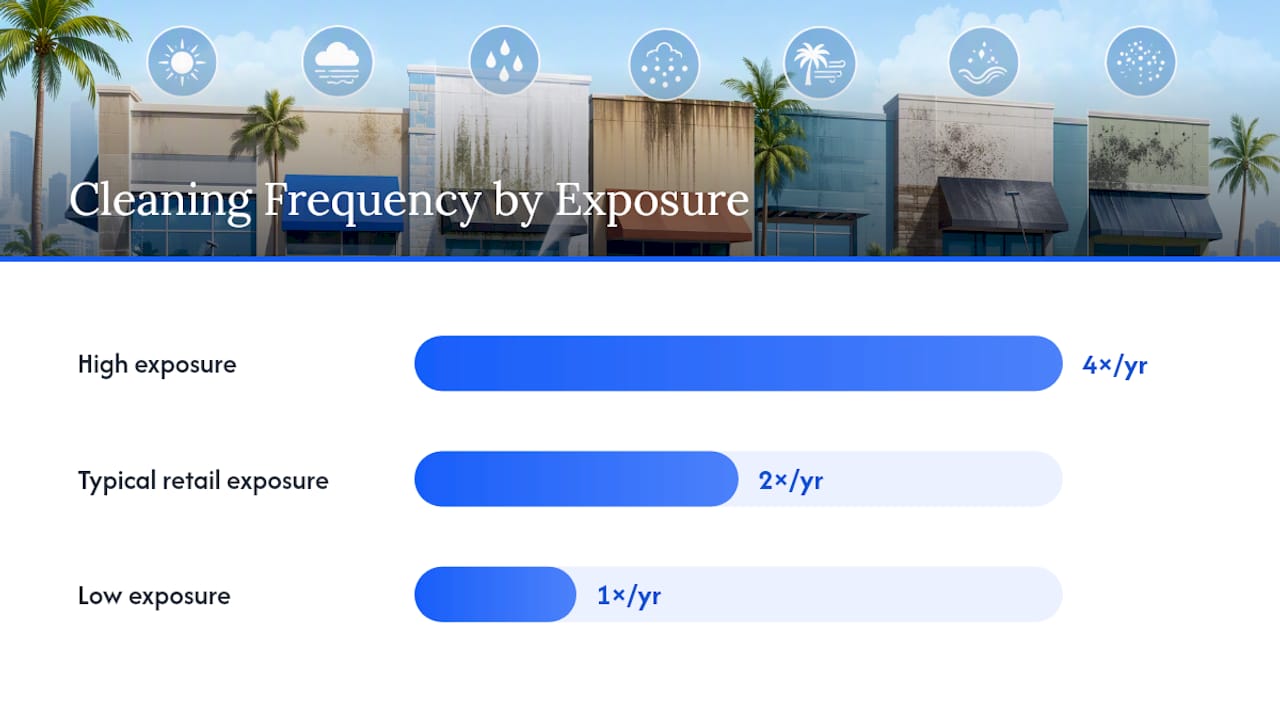
| Match cadence to exposure | Clean quarterly for coastal or irrigation-heavy sites, twice yearly for typical storefronts, annually for low-exposure buildings. |
| Fix the source, not just the stain | Redirect sprinkler heads and seal leaching masonry to stop recurring mineral and salt stains permanently. |
| Use deionized water on glass | Tap water’s mineral content can re-cause the staining a cleaning just removed. |
| Call a specialist for height or bonding issues | Vistadronecleaning’s FAA-certified drone crews reach up to 200 feet with substrate-matched chemistry and $2M liability coverage, often at 30 to 60 percent less than scaffolding or lift methods. |
Table of Contents
- Types of Commercial Storefront Surface Buildup: Causes and Locations
- How Buildup Damages Glass, Metal, Stucco, and Concrete
- Assessing and Treating Storefront Buildup Safely
- Setting a Cleaning Schedule for South Florida’s Climate
- When Buildup Needs a Specialist, Not a Squeegee
- What Most Maintenance Plans Get Wrong
- Get Storefront Buildup Handled Without the Scaffolding Bill
- Sources
- FAQ
Types of Commercial Storefront Surface Buildup: Causes and Locations
Every buildup type has a signature location and a signature cause, and property managers who learn to read both save money on unnecessary treatments.
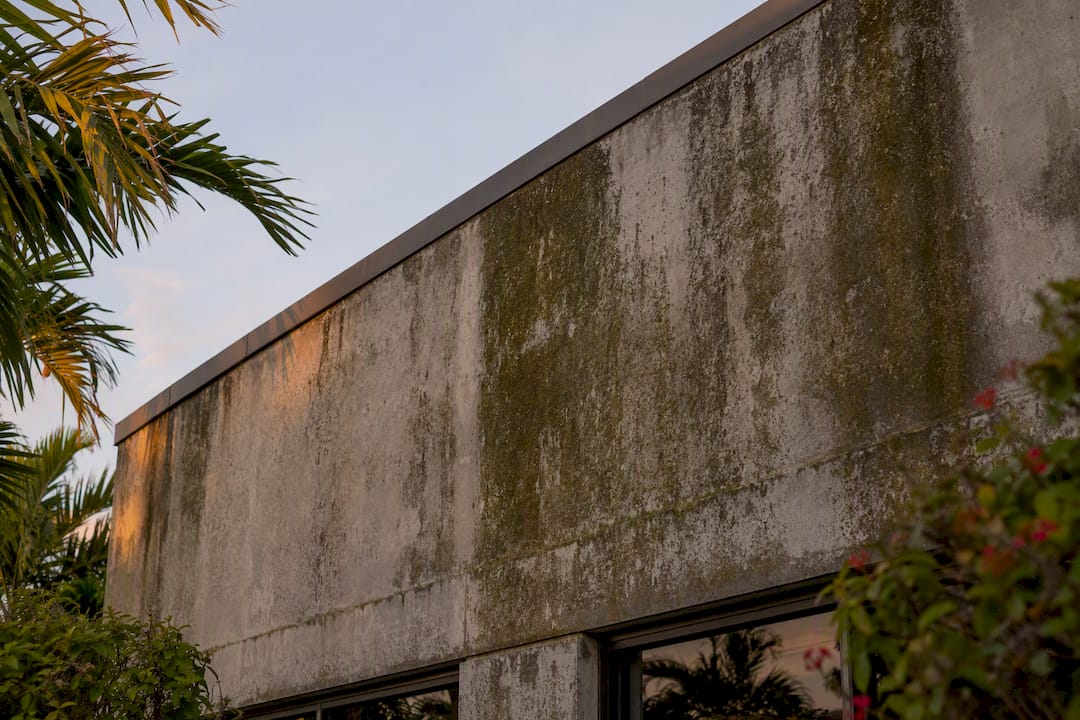
Biological growth (algae, mold, mildew) shows up most on north-facing and shaded elevations, under overhangs, and anywhere roof runoff drips onto stucco or glass. Miami-Dade and Broward’s humidity gives these organisms exactly what they need to colonize a facade within months of a missed cleaning cycle. NOAA climate data indicates that South Florida generally experiences high average relative humidity year-round, which is sufficient to keep masonry and glass damp long after a rain event ends.
Atmospheric soiling and traffic film collects on storefronts facing parking lots, drive-throughs, and arterial roads. Vehicle exhaust and brake dust settle as a thin gray film that dulls glass and darkens light-colored stucco within a single dry season.
Hard-water and mineral deposits trace almost always to sprinkler overspray hitting the base of storefront glass or metal frames. The telltale sign is a spotty white pattern that concentrates at a consistent height, roughly where irrigation heads reach.
Salt accumulation builds on any elevation exposed to onshore wind, which in coastal corridors from Miami Beach to Delray Beach means most of the building envelope. It leaves a gritty, slightly sticky film that resists a plain water rinse.
Efflorescence appears as a chalky white bloom on stucco, block, and precast concrete. It forms when water inside the wall carries soluble salts to the surface and leaves them behind as the moisture evaporates, and it signals water movement through the substrate that needs investigation.
Adhesive residue and graffiti show up around old signage, temporary banners, and street-level glass. Removal method matters here: solvents can haze certain coatings, while mechanical scraping risks scratching anodized metal.
Construction and post-construction grime, cement overspray and compacted dust, appears near any active renovation or adjacent build site and hardens fast if left more than a few days.
How Buildup Damages Glass, Metal, Stucco, and Concrete
Each buildup type does a different kind of damage the longer it sits, and the mechanism determines how urgent removal really is.
Mineral deposits start as loose residue but chemically bond to glass over time, etching the surface and permanently clouding transparency once bonding occurs. That is the difference between a rinse job and a restoration project.
- Salt crystallizes inside masonry pores during repeated wet and dry cycles, and that expansion gradually breaks down stucco and precast surfaces from the inside out.
- Organic growth holds moisture against the substrate underneath it, which accelerates coating failure on painted metal and EIFS panels.
- Efflorescence indicates active water migration through a wall assembly, not just a cosmetic stain, and ignoring it can let the underlying moisture problem worsen.
- Adhesive residue left in place for months can bond harder to the coating, making eventual removal more aggressive than it needed to be.
EIFS and stucco are the most vulnerable substrates because their porous, cement-based surfaces absorb moisture and salts readily. Polished stone and anodized metal resist absorption but etch or oxidize when the wrong chemistry gets used on them. Glass sits in between: it does not absorb, but bonded minerals still etch the outer surface at a molecular level if left untreated for a season or more.
Assessing and Treating Storefront Buildup Safely
A five-minute walk-around before any cleaning contract gets signed prevents most of the substrate damage managers see from mismatched treatments.
- Look first. Note the buildup’s color, texture, and exact location, and photograph it for before/after comparison.
- Touch test. Run a finger across the deposit. Residue that wipes away is surface soiling; residue that feels gritty and won’t budge is likely bonded mineral or efflorescence.
- Check the source. Trace the deposit back to its cause, an irrigation head, a roof drain, a stained neighbor wall, before choosing a treatment.
- Run a test patch. Apply the mildest method in a small, inconspicuous area first, especially on stucco, EIFS, or natural stone.
- Match treatment to severity. Start with a water soak or low-pressure rinse, escalate to soft-wash chemistry (cleaning solution plus surfactant) for biological growth, and reserve a targeted chemical poultice or glass resurfacing for bonded mineral deposits that a rinse won’t touch. Facade cleaning methods documented by Hoffmann Architects confirm that water quality and pressure level both need to match the substrate, not just the stain.
Guardrails matter as much as the treatment itself. High-pressure washing above safe PSI thresholds can blow through EIFS foam and pit soft stone, and acidic cleaners that work fine on concrete can pit limestone or marble accents. Alkaline formulas suit certain mineral soiling but only when the substrate can tolerate the pH.
Source mitigation is the step most maintenance plans skip. Adjusting sprinkler heads away from glass, adding drip-breaks under overhangs, and sealing masonry that leaches salts stop the same stain from returning every quarter.
Pro Tip: Before approving any treatment involving acid-based cleaners, ask the vendor to name the exact substrate it’s rated for. A cleaner safe on tinted glass can permanently haze a polished granite storefront base in a single pass.
Setting a Cleaning Schedule for South Florida’s Climate
Exposure level, not building age or size, should set your cleaning calendar.
- High-exposure properties (coastal frontage, heavy irrigation nearby, adjacent arterial roads) need quarterly attention. Storefront glass in these zones is where hard-water staining from irrigation overspray or marine salt tends to chemically bond fastest, and quarterly service is generally considered the maintenance sweet spot for preventing that bonding.
- Typical retail storefronts set back from the coast or major roads generally do fine on a twice-yearly cycle.
- Low-exposure buildings, inland with minimal irrigation contact, can often stretch to an annual cleaning without visible buildup.
Cladding maintenance guidance from National Facility Contractors backs a similar pattern industry-wide: facades in polluted or high-traffic areas often need washing every six to twelve months, while coastal sites need more frequent service.
The math favors prevention every time. A quarterly rinse costs a fraction of a glass resurfacing job or a stucco restoration once mineral bonding or efflorescence sets in. Practical prevention steps include redirecting sprinkler nozzles away from glass, adding runoff controls under roof drains, applying protective coatings on masonry prone to leaching, and specifying deionized water for glass rinses so mineral-heavy tap water doesn’t undo the work. Our commercial facade restoration guide breaks down how restoration costs compare to routine maintenance in more detail, and a facility team using scheduling software like Runera can build these cadences directly into a recurring maintenance calendar.
When Buildup Needs a Specialist, Not a Squeegee
Some deposits are beyond what a maintenance crew with a hose should attempt.
- Bonded mineral deposits that survive a touch test need multi-stage chemical and mechanical restoration rather than repeated scrubbing that risks scratching the pane.
- Active efflorescence signals water intrusion that a cosmetic clean won’t solve; it needs an envelope assessment first.
- Heights above what a ladder or standard lift safely reaches are where drone-based cleaning changes the economics entirely.
- Any project that would otherwise require scaffolding, boom lifts, or a street closure is worth pricing against a drone alternative before committing.
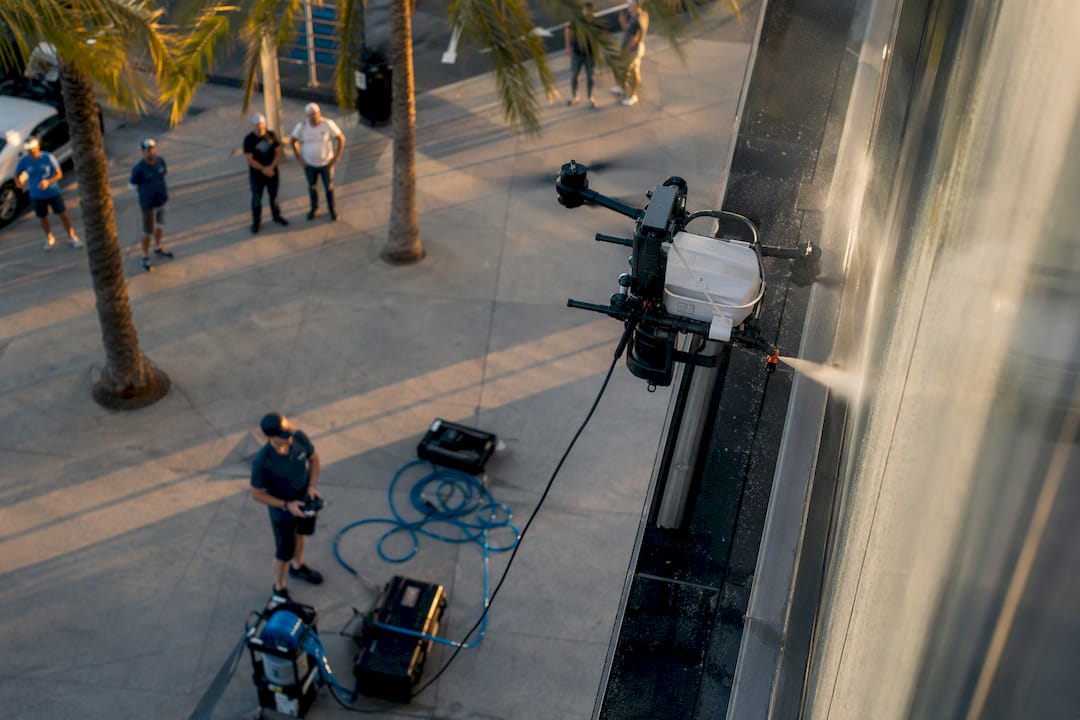
Vistadronecleaning uses FAA Part 107-certified pilots and tethered industrial drones to clean storefronts, facades, and glass up to 200 feet without putting a crew on a rope or closing a lane of traffic. Crews stay on the ground, most jobs finish in one to three days, and clients typically see 30 to 60 percent lower costs than scaffold or lift methods for comparable scope. Every project carries $2 million in liability insurance, uses substrate-matched soft-wash chemistry, and finishes glass with a deionized water rinse to prevent the mineral spotting that tap water leaves behind. When you’re vetting any vendor for bonded or restoration-level work, ask for FAA certification, proof of insurance, documented restoration experience, and before/after photo records before signing anything.
What Most Maintenance Plans Get Wrong
Most storefront maintenance plans treat every stain the same way: hose it down, move on, repeat next quarter. That approach works fine for atmospheric soiling and falls apart completely for efflorescence or bonded mineral deposits, which is exactly why so many properties end up paying for glass resurfacing that a $200 sprinkler adjustment could have prevented.
The conventional advice to “clean more often” misses the actual lever, which is treating the source, not just the symptom. A sprinkler head aimed two feet closer to a storefront than it should be will keep bonding minerals to that glass no matter how frequently someone rinses it. The property managers who get ahead of this problem spend fifteen minutes walking the perimeter identifying causes before they ever call a vendor.
What deserves the most attention isn’t the cleaning schedule at all. It’s the diagnostic step everyone skips: touch the stain, trace it to its source, and only then decide whether this is a rinse, a soft-wash, or a restoration job. Get that sequence right and the schedule mostly takes care of itself.
, Eliot
Get Storefront Buildup Handled Without the Scaffolding Bill
Vistadronecleaning gives South Florida property managers a way to treat bonded mineral stains, salt film, and biological growth on high storefronts without booking a lift, closing a lane, or scheduling around scaffolding permits. Crews stay on the ground while a tethered drone reaches glass and facades up to 200 feet, which typically brings the total cost in at 30 to 60 percent below traditional rigging for comparable jobs.

That matters most for the buildup types this article just covered: mineral bonding and efflorescence that need real restoration work, not a rag and a hose. Every project uses substrate-matched soft-wash chemistry for glass, stucco, EIFS, concrete, and metal, finishes glass with a deionized water rinse to prevent re-spotting, and runs under $2 million in liability insurance with FAA Part 107-certified pilots at the controls. See how the numbers compare directly on our drone vs. traditional window cleaning breakdown, or request a free quote through our Miami drone window cleaning page and get a site-specific proposal within 24 hours.
Sources
FAQ
What are the main types of commercial storefront surface buildup?
The eight categories are biological growth, atmospheric soiling, hard-water and mineral deposits, salt accumulation, efflorescence, adhesive residue, graffiti, and construction grime.
How often should storefronts be cleaned in South Florida?
Coastal or high-irrigation-exposure properties generally need quarterly cleaning, typical retail storefronts do well twice a year, and low-exposure buildings can often stretch to an annual schedule.
Why does hard water leave permanent stains on storefront glass?
Minerals in irrigation overspray or coastal spray can chemically bond to the glass surface over time, etching it in a way that a standard rinse cannot remove once bonding occurs.
Is efflorescence dangerous for a stucco storefront?
Efflorescence itself is cosmetic, but it signals water moving through the wall assembly, and left unaddressed that moisture can damage the substrate underneath.
When should a property manager hire a drone cleaning specialist instead of a standard crew?
Bonded mineral deposits, active efflorescence, and any storefront or facade above safe ladder or lift height are strong candidates; Vistadronecleaning handles these with FAA Part 107-certified pilots and no scaffolding required.