Types of Eco-Friendly Facade Cleaning for Commercial Buildings
Discover the types of eco-friendly facade cleaning for commercial buildings. Learn methods that protect the environment while maintaining value.

TL; DR:
- Eco-friendly facade cleaning removes biological growth and pollutants with methods that minimize environmental impact. The main techniques are superheated steam, soft washing, dry ice blasting, and drone cleaning, each suited for different building surfaces and contamination types. Using certified products and integrated protocols reduces chemical use and carbon footprint while supporting ESG compliance.
Eco-friendly facade cleaning is defined as the removal of biological growth, pollutants, and surface grime using methods and products that minimize chemical runoff, substrate damage, and environmental harm. The primary types of eco-friendly facade cleaning are superheated steam, soft washing with biodegradable agents, dry ice blasting, and drone-based cleaning. Each method eliminates contaminants without relying on harsh solvents, and each carries distinct advantages for commercial high-rises, condominiums, and office towers. Property managers in South Florida and across the country are under growing pressure to meet ESG compliance standards while protecting asset value. The right method depends on your building’s substrate, height, contamination type, and sustainability targets.

1. What are the main types of eco-friendly facade cleaning?
The three primary eco-friendly methods are superheated steam, soft washing, and dry ice blasting, each removing grime without harsh chemicals. Drone-based cleaning has emerged as a fourth category that integrates these methods at height without scaffolding. Together, they represent the full range of green facade cleaning methods available to commercial property managers in 2026. Choosing among them requires matching the method to the facade material, the type of contamination, and the building’s access constraints.
2. Superheated steam cleaning: chemical-free thermal power
Superheated steam cleaning uses water heated to around 150°C to blast biological growth, pollutants, and embedded grime from facade surfaces. Systems like the DOFF machine deliver this thermal energy at controlled pressure, eliminating the need for any detergents. The heat alone kills pathogens, algae, and mold spores on contact. Water consumption stays low because the steam volume is far smaller than a conventional pressure wash.
Key advantages of superheated steam for commercial facades:
- No chemical residue. Zero detergents means zero runoff risk to storm drains or landscaping.
- Pathogen elimination. Temperatures at 150°C kill biological contaminants that low-pressure rinses leave behind.
- Substrate safety. Controlled pressure protects delicate stone, brick, and terracotta that high-pressure washing would erode.
- Reduced water use. Steam delivery uses significantly less water than standard pressure washing.
The method does have limits. It works best on porous masonry and natural stone. Glass curtain walls and coated metal panels require lower temperatures to avoid thermal stress. On very large commercial facades, steam cleaning can be slower than soft washing because the operator must work in close proximity to the surface.
Pro Tip: Set dwell time before rinsing. Allowing the steam to penetrate biological growth for 5–10 seconds before moving the lance dramatically improves contaminant removal and reduces the need for repeat passes.
3. Soft washing with biodegradable agents
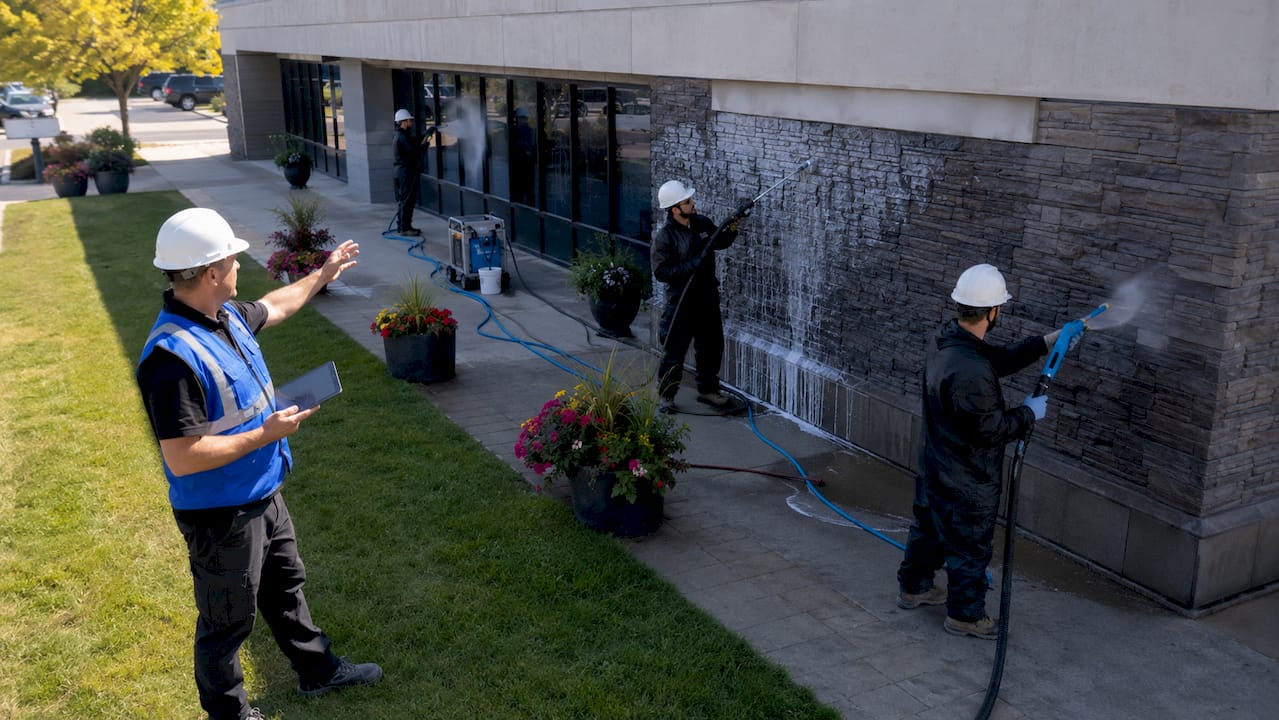
Soft washing is defined as low-pressure water delivery at 150–300 PSI combined with biodegradable detergents to clean facade surfaces without mechanical abrasion. The low pressure protects EIFS, stucco, painted concrete, and aged cladding that standard pressure washing at 2,000+ PSI would damage. The chemistry does the work, not the force. This distinction makes soft washing one of the best eco-friendly commercial cleaning methods for buildings with sensitive exterior finishes.
The process works in three stages:
- Biodegradable foam pre-treatment. A surfactant foam is applied and allowed to dwell, breaking down algae, mold, and atmospheric soiling before any rinsing begins.
- Dwell time. Adequate dwell time is non-negotiable. Skipping it causes ineffective contaminant removal and accelerates biological regrowth on the facade.
- Low-pressure rinse. Water at 150–300 PSI flushes the loosened contamination away without eroding the substrate.
Selecting the right cleaning agent matters as much as the pressure setting. Products certified under EPA Safer Choice or Green Seal GS-42 verify that the formulation is biodegradable, low in volatile organic compounds, and safe for frequent use near waterways. Using a certified agent also protects you from liability if runoff reaches a storm drain.
Pro Tip: Choose a foam agent that rinses clean without leaving a surfactant film. Residue left on the facade attracts airborne particulates faster, shortening the interval between cleaning cycles and increasing your long-term maintenance cost.
4. Dry ice blasting as a sustainable mechanical alternative
Dry ice blasting uses recycled CO2 pellets fired at high velocity to remove biological growth and surface grime through mechanical impact and rapid thermal shock. When a pellet hits the facade surface, it sublimates instantly from solid to gas. That phase change creates a micro-explosion that lifts contaminants away from the substrate. No water is used, and no secondary waste is generated because the CO2 simply returns to the atmosphere.
| Feature | Dry ice blasting | Traditional abrasive blasting |
|---|---|---|
| Secondary waste | None | Grit, dust, and debris |
| Water use | None | High |
| Chemical use | None | Often required |
| Substrate risk | Low to moderate | High |
| CO2 source | Recycled industrial CO2 | N/A |
Dry ice blasting suits hard, non-porous surfaces such as concrete, metal panels, and industrial cladding. It is less appropriate for soft stone or painted finishes where the pellet velocity can cause surface abrasion. The equipment is specialized and the cost per square foot is higher than soft washing, which limits its use to targeted spot treatments or contamination types that resist chemical methods.
5. Drone-based facade cleaning: safe, green, and cost-effective
Drone-based facade cleaning integrates foam pre-treatment and high-pressure rinsing into a single aerial system that operates without scaffolding, boom lifts, or rope access. Cleaning times drop from days to hours, and costs run 30–60% lower than traditional scaffold methods. For commercial high-rises up to 18 stories, this combination of speed and savings is difficult to match with any ground-based approach.
The environmental benefits go beyond the cleaning chemistry itself:
- No heavy machinery. Eliminating scaffold trucks and boom lifts removes a significant source of fuel consumption and site emissions from the project.
- No foot traffic damage. Crews stay on the ground, so facade surfaces and rooftop membranes are never stressed by worker weight or equipment drag.
- Runoff control. Drone cleaning systems can incorporate on-site water filtration to capture chemical runoff before it reaches storm drains, keeping projects compliant with local environmental regulations.
- Reduced site disturbance. No road closures, no sidewalk permits, and no pedestrian disruption during cleaning operations.
Operational success in drone cleaning depends more on chemistry than mechanical force. Foam pre-treatment effectiveness determines cleaning quality because the drone cannot scrub the surface the way a manual operator can. The biodegradable foam must dwell long enough to break down contaminants before the rinse pass. FAA Part 107 certification is the baseline compliance standard for commercial drone cleaning operations in the United States.
The hidden environmental cost of facade access methods is significant. Scaffold and lift systems carry a machinery footprint that drone operations eliminate entirely, making the total project carbon profile substantially lower even when the cleaning chemistry is identical.
6. Integrated green cleaning protocols and certified products
Using certified eco-friendly products is necessary but not sufficient for truly sustainable building cleaning. Green Seal GS-42 and EPA Safer Choice certifications verify that a provider uses documented procedures, trained staff, and resource-efficient equipment. A company that uses a certified product but applies it at the wrong dilution or skips dwell time delivers neither environmental nor cleaning performance.
Integrated green protocols combine several elements:
- Microfiber technology. Microfiber applicators remove up to 99% of surface bacteria with water alone, reducing the volume of chemical product required.
- Dilution control. Precise dosing prevents overuse of green chemicals, reduces water consumption, and protects facade substrates from chemical stress.
- Clean-then-disinfect sequencing. Removing organic matter before applying a disinfectant improves disinfectant efficacy by 40–60% and reduces the total product volume needed.
- Low-VOC formulations. Products evaluated under EPA Safer Choice carry low or no volatile organic compounds, making them safe for frequent use near occupied buildings.
“Choosing truly sustainable commercial cleaning requires verifying operational standards and staff training, not just green product use or marketing claims.”, Sustainability vs. performance in commercial cleaning
The performance gains from integrated protocols are measurable. Integrated green cleaning reduces Global Warming Potential by 47.7% and chemical consumption by up to 82.6% compared to conventional cleaning approaches. For property managers reporting on ESG metrics, those numbers translate directly into documented sustainability outcomes.
Key takeaways
Eco-friendly facade cleaning delivers measurable environmental and financial benefits when the right method is matched to the building substrate, access constraints, and contamination type.
| Point | Details |
|---|---|
| Four core methods | Superheated steam, soft washing, dry ice blasting, and drone cleaning each suit different substrates and contamination types. |
| Dwell time is critical | Skipping chemical dwell time causes poor contaminant removal and faster biological regrowth on the facade. |
| Drone cleaning cuts costs | Drone-based methods reduce project costs by 30–60% and cut cleaning time from days to hours. |
| Certification matters | EPA Safer Choice and Green Seal GS-42 verify products, procedures, and staff training, not just ingredient lists. |
| Integrated protocols win | Combining certified products, microfiber application, and clean-then-disinfect sequencing reduces chemical use by up to 82.6%. |
Why I think property managers underestimate the access problem
Most conversations about sustainable facade cleaning focus on the chemistry. Which product is biodegradable? Which agent has the right certification? Those questions matter, but they miss the bigger variable: how you get the cleaning system to the surface in the first place.
I have seen projects where a property manager selected a genuinely excellent biodegradable soft-wash formulation, then deployed it via a diesel-powered boom lift that idled for two full days on a closed city block. The chemical choice was green. The access method was not. The total environmental footprint of that project was worse than a faster scaffold-free alternative would have been.
Drone-based cleaning changes this calculus entirely. When you remove the scaffold trucks, the boom lifts, and the road closure permits, you eliminate a large share of the project’s carbon and disruption profile before a single drop of cleaning agent touches the building. Sustainable building cleaning is not just about what you spray. It is about the full operational footprint of the job.
Facade cleaning is also becoming a core ESG compliance element, not a cosmetic maintenance line item. Sustainable facade maintenance protects asset value, reduces chemical runoff, and supports occupant well-being in ways that auditors and investors now expect to see documented. Property managers who treat facade cleaning as a low-priority budget item are leaving both environmental and financial value on the table.
My advice: ask any prospective cleaning provider for their access method, their certified product list, and their runoff management plan before you ask for a price. The answers will tell you whether you are hiring a green cleaning company or a conventional company with a green-labeled product.
, Eliot
How Vistadronecleaning delivers eco-friendly facade cleaning in South Florida
Vistadronecleaning operates FAA Part 107-certified tethered industrial drones (Lucid Bots Sherpa) to clean commercial facades, high-rise windows, roofs, and solar panels across Miami-Dade and Broward counties without scaffolding or road closures. Projects finish in 1–3 days at 30–60% lower cost than traditional scaffold methods, using biodegradable cleaning agents and a streak-free pure de-ionized water rinse.

Vistadronecleaning carries $2M liability insurance and provides free quotes within 24 hours. If you are evaluating your options, the drone vs. traditional cleaning comparison breaks down the cost, safety, and environmental differences in detail. For buildings requiring commercial facade cleaning across Miami, Brickell, Fort Lauderdale, or Boca Raton, contact Vistadronecleaning for a site-specific assessment.
FAQ
What is the most eco-friendly method for commercial facade cleaning?
Superheated steam cleaning is the most chemically pure method because it uses no detergents and kills pathogens with heat alone. Drone-based soft washing combines biodegradable chemistry with the lowest access-related environmental footprint for high-rise buildings.
How does soft washing differ from pressure washing for facades?
Soft washing operates at 150–300 PSI with biodegradable detergents, while pressure washing typically runs above 2,000 PSI. The lower pressure protects sensitive substrates like EIFS and stucco while the chemistry handles contaminant removal.
Do eco-friendly facade cleaning products actually perform as well as conventional ones?
Yes. Integrated green protocols using EPA Safer Choice or Green Seal certified products with correct dwell time and clean-then-disinfect sequencing improve disinfectant efficacy by 40–60% compared to conventional single-step approaches.
Why does dwell time matter in eco-friendly facade cleaning?
Skipping dwell time prevents biodegradable agents from fully breaking down biological growth and atmospheric soiling. The result is incomplete cleaning and faster regrowth, which increases cleaning frequency and total chemical use over time.
Is drone facade cleaning compliant with environmental regulations?
FAA Part 107 certification covers airspace compliance for commercial drone operations. Reputable drone cleaning providers also incorporate on-site water filtration to manage runoff and meet local storm-drain regulations, making the full operation environmentally compliant.