Panel Cleaning's Role in ROI Maintenance for South Florida
Discover the role of panel cleaning in ROI maintenance for South Florida. Boost energy output and reduce payback periods with expert services.
TL; DR:
- Scheduled solar panel cleaning in South Florida is essential for maximizing energy output and quick ROI recovery. Using drone-based, contact-free cleaning methods with FAA-certified pilots preserves warranties, reduces fall risks, and lowers operational costs. Regular cleaning based on monitoring thresholds can prevent significant energy losses, often paying for itself within weeks.
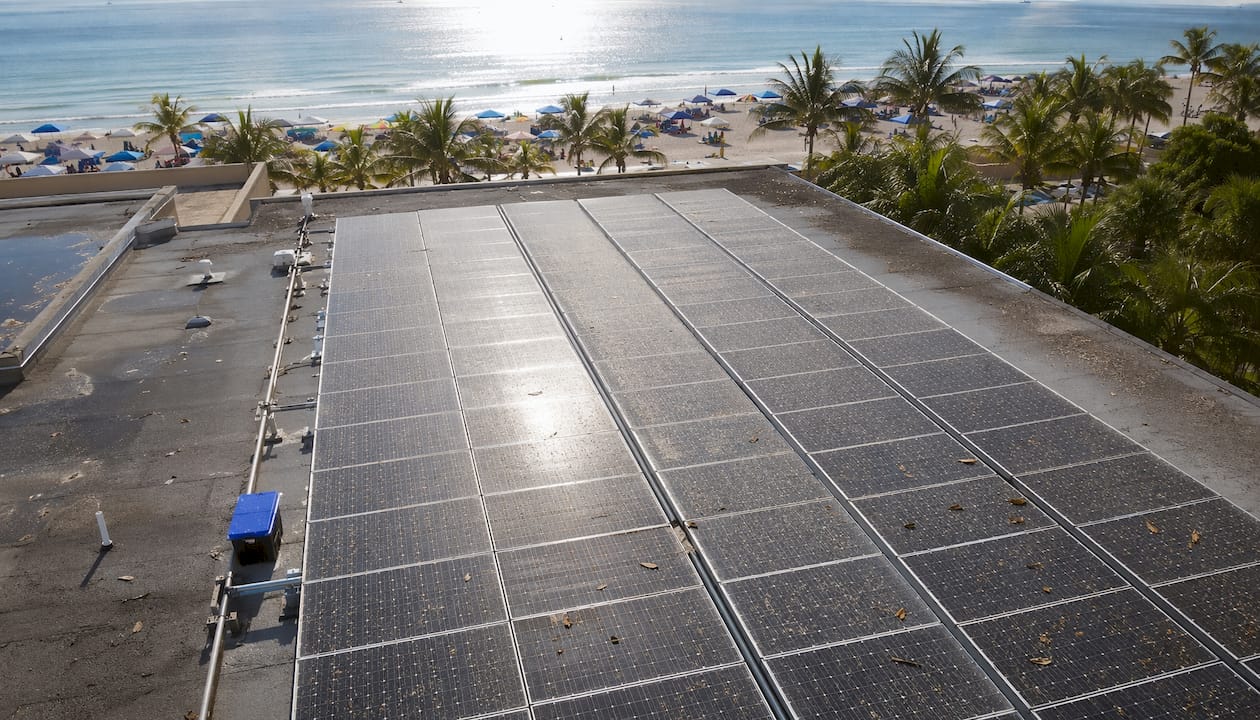
Scheduled solar panel cleaning is not optional maintenance for South Florida commercial properties. It is a direct ROI recovery action. Salt spray off Biscayne Bay, spring pollen, bird droppings along the shoreline, and post-storm residue from Atlantic weather systems all compound into measurable energy losses that extend your system’s payback period month by month. Vistadronecleaning addresses this with FAA Part 107-certified pilots, tethered Lucid Bots Sherpa industrial drones, contact-free pure de-ionized water cleaning, and $2M liability coverage. The core benefits are concrete: restored kWh output, shorter payback periods, zero rooftop fall risk, and preserved manufacturer warranties.
- Salt spray and coastal humidity accelerate soiling on arrays in Miami Beach, Brickell, and Aventura
- Pollen and storm residue create seasonal spikes in soiling loss across Miami-Dade and Broward
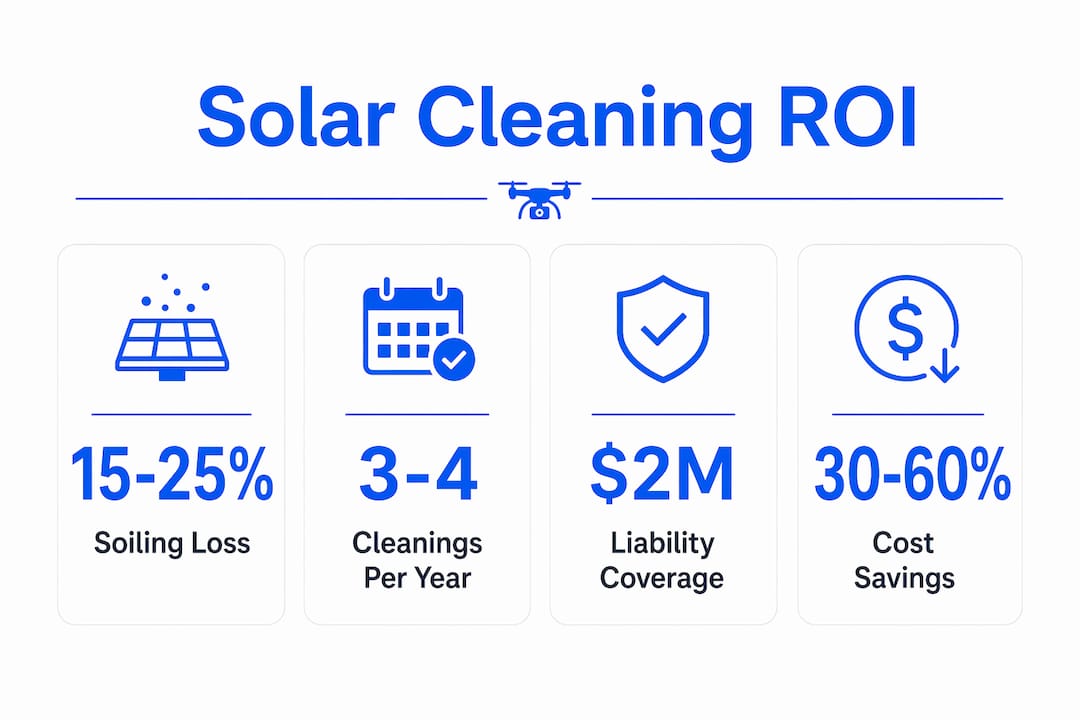
- Commercial soiling losses near highways and ports can reach 15–25% of annual output within 12–18 months.
- Contact-free drone cleaning preserves anti-reflective coatings and avoids microcracking
Table of Contents
- How does soiling cut your solar ROI in South Florida?
- When should you schedule a cleaning? Monitoring triggers explained
- Which cleaning method actually protects your panels?
- What does the ROI actually look like? Two South Florida examples
- What should you require from a panel-cleaning provider?
- What does a South Florida drone cleaning project actually look like?
- Key Takeaways
- Why this matters more than most property managers realize
- Vistadronecleaning serves South Florida commercial solar portfolios
- FAQ
- Useful sources
How does soiling cut your solar ROI in South Florida?
South Florida’s environment is unusually aggressive for rooftop PV. Coastal properties from Miami Beach to Boca Raton deal with salt-laden air that leaves a thin, light-blocking film on panel glass within weeks. Inland warehouses near I-95 or the Port of Miami face diesel particulate and road dust. Add spring pollen seasons, bird droppings from urban shoreline populations, and post-thunderstorm residue from June through November, and you have a soiling environment that outpaces most of the continental US.
The mechanisms matter. Uniform dust reduces irradiance transmission across the whole array. Localized soiling, especially bird droppings, creates hotspots: one shaded cell forces its entire string to underperform, a phenomenon called mismatch loss. Inverter-level data often masks this because the system still “runs, ” just at reduced output.
Regular cleaning must be treated as a core performance-management activity because soiling predictably reduces energy production and revenue. For a 500 kW rooftop losing 10–15% of output, the annual dollar impact at $0.12–$0.18/kWh is substantial. At 10% loss on 500 kW running 1,600 peak hours annually, that is 80,000 kWh gone. At $0.15/kWh avoided cost, that is $12,000 per year in recovered value, from a single cleaning cycle.
When should you schedule a cleaning? Monitoring triggers explained
The most common mistake property managers make is waiting until panels look dirty. By then, losses have been accumulating for months.
- Establish a baseline. Record production data during the first 30–60 days after installation or after a confirmed clean. Normalize for irradiance using your monitoring platform.
- Implement continuous monitoring. A SCADA system or a dedicated PV monitoring platform (string-level or inverter-level) gives you the data to catch drops early.
- Set a trigger threshold. A persistent 5%+ drop versus your irradiance-normalized baseline, with no equipment fault explaining it, is a reliable signal to schedule cleaning.
- Validate with before/after checks. Run normalized production comparisons at similar irradiance before and after cleaning to confirm yield recovery.
For South Florida sites specifically, a practical frequency guide looks like this: coastal warehouses and port-facing assets in Miami or Fort Lauderdale benefit from quarterly or 3–4 cleanings per year. Typical office buildings in Coral Gables or Plantation can often manage semi-annual service. Ground-mount arrays and parking canopies should get semi-annual cleaning plus spot checks during peak pollen season in March and April.
Bundling panel cleaning with commercial rooftop maintenance visits, window washing, or facade work cuts mobilization cost per visit and reduces scheduling overhead.
Pro Tip: Don’t wait for visible dirt. A string-level or inverter-level production drop is an earlier and more reliable indicator than anything you can see from the ground.
Which cleaning method actually protects your panels?
Not all cleaning methods carry the same risk profile, and for commercial arrays in South Florida, the differences matter financially.
| Method | Fall/OSHA Risk | Panel Damage Risk | Speed | Disruption |
|---|---|---|---|---|
| Drone, contact-free pure de-ionized water | Very low (crew on ground) | Very low (no contact) | High | Minimal |
| Rooftop walking crew with brushes | High | Moderate (microcracking risk) | Moderate | Significant |
| Water truck / telescopic pole | Low–moderate | Low–moderate | Slow on large arrays | Moderate |
| Robotic rail systems | Low | Low | High (fixed install) | Low |
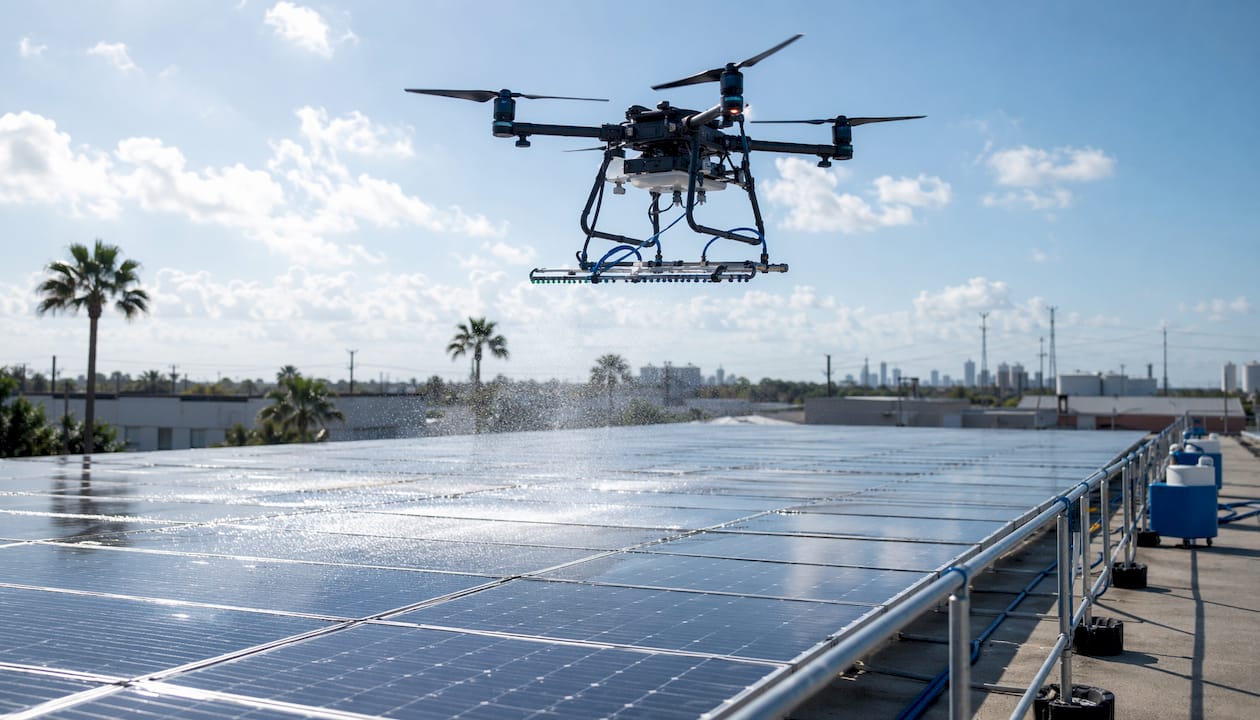
Contact-free cleaning using low-pressure purified de-ionized water preserves anti-reflective coatings and avoids the microcracking that brush and foot-traffic methods cause. Walking on panels creates concentrated mechanical pressure that produces invisible hairline fractures in silicon cells. Those fractures reduce efficiency permanently and can void manufacturer warranties.
Drone cleaning compresses job timelines and eliminates rooftop crews entirely, which removes OSHA fall exposure and the need for scaffolding or road closures. The Lucid Bots Sherpa, a tethered industrial UAS, is the platform Vistadronecleaning uses for high-rise and carport arrays across Miami-Dade and Broward. Drone teams can also capture high-resolution imagery and thermal scans during the same visit, turning a cleaning run into a low-cost condition inspection.
Pro Tip: Avoid brush or abrasive cleaning on commercial arrays. Even soft brushes can cause microcracking on aged modules, and that damage compounds over the system’s 25-year lifespan.
What does the ROI actually look like? Two South Florida examples
The math on panel cleaning ROI is straightforward once you have a baseline.
Quick ROI formula: Estimate kWh lost (baseline output × soiling loss %) → multiply by local avoided cost or self-consumption rate → subtract cleaning cost → calculate net gain and payback period.
| Scenario | Array Size | Soiling Loss | Annual kWh Lost | Rate ($/kWh) | Annual Value Lost | Cleaning Cost (est.) | Net Gain |
|---|---|---|---|---|---|---|---|
| Small commercial rooftop | 500 kW | 10% | ~12,000 kWh | $0.15 | $12,000 | ~$400–$600 | ~$1,200–$1,400 |
| Warehouse near port/highway | 400 kW | 15% | 80,000 kWh | $0.15 | $12,000 | ~$1,500–$2,500 | ~$11,900–$12,900 |
On commercial scales, professional cleaning often yields strong ROI, with many projects paying back within months. The warehouse example above pays back in weeks, not years.
Cost drivers that affect your actual quote include: access complexity (rooftop height, parapet walls), site logistics, panel tilt and angle, soiling severity, whether you bundle with other exterior services, and whether traffic management is needed. Most Vistadronecleaning projects run 1–3 days on site, and drone-based methods typically cost 30–60% less than traditional scaffold or lift approaches.
To present this to a CFO, frame it as production recovery: before/after monitoring screenshots and invoices convert a cleaning line item into a measurable yield-recovery investment.
What should you require from a panel-cleaning provider?
A vendor who cannot produce the following should not be on your shortlist.
- FAA Part 107 certification for all pilots operating drones on your property
- Proof of $2M liability insurance (request a certificate of insurance naming your property)
- Local references in Miami-Dade, Broward, or Palm Beach counties
- Before/after production validation using monitoring screenshots at comparable irradiance
- Equipment documentation (Lucid Bots Sherpa or equivalent tethered industrial UAS)
- Environmental and water-use practices (de-ionized water, no chemical runoff)
- Pre/post production report, high-resolution imagery, and thermal hotspot scan on request
- Warranty-preservation language in the service agreement
Red flags: any vendor who insists on rooftop foot traffic without a documented reason, cannot show monitoring proof, carries ambiguous insurance, or refuses to provide FAA credentials or a safety plan. For rooftop solar safety compliance, those credentials are non-negotiable from a liability standpoint.
Vistadronecleaning provides FAA Part 107-certified pilots, $2M liability coverage, and free quotes within 24 hours. These are the baseline E-E-A-T signals any responsible commercial property manager should demand.
Pro Tip: Ask vendors how they measure yield recovery. The two strongest methods are a reference inverter kept dirty as a control, or normalized before/after measurements at similar irradiance. If a vendor cannot explain either, their “results” are unverifiable.
What does a South Florida drone cleaning project actually look like?
- Site survey and quote: Vistadronecleaning provides a free quote within 24 hours of inquiry.
- Scheduling and FAA checks: Airspace coordination and scheduling typically take 1–7 days depending on location and season.
- On-site cleaning: Most projects complete in 1–3 days. Crews stay on the ground; no scaffolding, no road closures in most cases.
- Post-cleaning monitoring: Allow 1–2 billing cycles to validate yield recovery against your normalized baseline.
South Florida scheduling notes worth building into your calendar:
- Avoid scheduling during active hurricane windows (August through October peak)
- Plan spring pollen touch-ups for April or May in Miami-Dade and Broward
- Schedule post-storm inspections after significant weather events; storm residue is among the fastest-acting soiling vectors in the region
- Bundling with high-rise building maintenance or facade work reduces per-visit mobilization cost
Tenant disruption is minimal. Ground-based drone operations require only a safety perimeter below the array, not building access or elevator coordination.
Key Takeaways
Regular, scheduled panel cleaning is the single most cost-effective ROI maintenance strategy for commercial solar arrays in South Florida, with documented yield recovery that pays back cleaning costs within weeks on larger systems.
| Point | Details |
|---|---|
| Soiling losses are significant | Commercial rooftops near ports or highways can lose 15–25% of annual output within 12–18 months. |
| Use the 5% trigger | A persistent 5%+ drop versus your irradiance-normalized baseline is the signal to schedule cleaning. |
| Contact-free method protects warranties | Pure de-ionized water drone cleaning avoids microcracking and preserves anti-reflective coatings. |
| Bundle to reduce cost | Pairing panel cleaning with facade or roof work cuts mobilization cost per visit. |
| Demand credentials | Require FAA Part 107 certification, $2M liability insurance, and before/after production data from any vendor. |
| Vistadronecleaning for South Florida | FAA-certified, $2M insured, Lucid Bots Sherpa-equipped, with free quotes in 24 hours for Miami-Dade, Broward, and Palm Beach. |
Why this matters more than most property managers realize
The conventional wisdom treats panel cleaning as a once-a-year checkbox. That framing misses what is actually happening financially. South Florida’s soiling environment is not average. The combination of coastal salt, subtropical humidity, heavy pollen seasons, and a six-month storm window creates conditions where a commercial array can lose a meaningful share of its annual output before anyone notices, because inverter dashboards show “system running” rather than “system underperforming.”
The more important shift is treating cleaning as production recovery, not maintenance. That reframe changes the budget conversation entirely. A $2,000 cleaning that recovers $12,000 in annual yield is not an operating expense. It is a return. Property managers who present it that way to ownership groups and CFOs, backed by before/after monitoring curves, get approvals faster and build the case for quarterly schedules on high-soiling assets.
Drone-based contact-free cleaning is not just a safety upgrade over rooftop crews. It is also the method least likely to void your panel warranties or introduce the kind of invisible microcracking that compounds degradation over a 25-year system life. For a commercial asset with a six- or seven-figure installation cost, that distinction has real dollar value.
Vistadronecleaning serves South Florida commercial solar portfolios
South Florida commercial properties lose measurable revenue every month panels go uncleaned. Vistadronecleaning offers a faster, lower-risk path to recovering that output: contact-free pure de-ionized water cleaning using FAA Part 107-certified pilots and tethered Lucid Bots Sherpa drones, with no scaffolding, no rooftop crews, and no road closures.
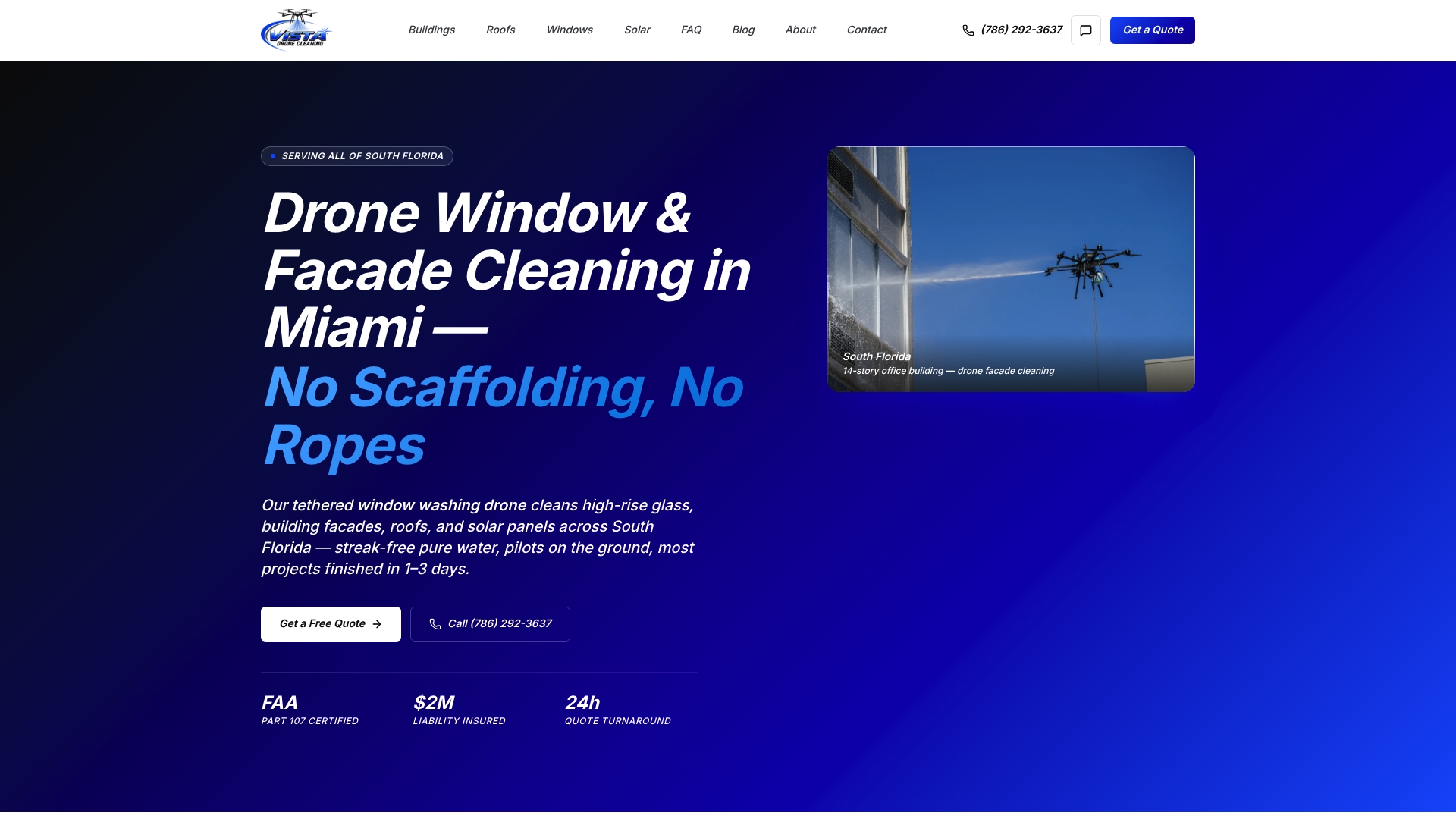
Most projects across Miami-Dade, Broward, and Palm Beach complete in 1–3 days at 30–60% lower cost than traditional scaffold or lift methods. Every job includes before/after production validation so you have the data to show ownership exactly what was recovered. Coverage extends from Miami Beach high-rises to Coral Springs warehouses and Coral Gables office towers.
Request a free solar cleaning quote and get a response within 24 hours.
FAQ
How much output can dirty panels cost a commercial property?
Commercial rooftops near highways or ports can lose 15–25% of annual output within 12–18 months. On a 400 kW array, that translates to tens of thousands of dollars in unrealized energy value per year.
How often should South Florida commercial arrays be cleaned?
Coastal and port-adjacent assets typically need 3–4 cleanings per year. Inland office buildings can often manage semi-annual service, with spot checks after major storms or during peak pollen season.
Why is contact-free drone cleaning better for commercial panels?
Contact-free pure-water cleaning avoids the microcracking that brush and foot-traffic methods cause, preserves anti-reflective coatings, and eliminates rooftop fall risk entirely. It is the method least likely to void manufacturer warranties.
What credentials should I require from a panel-cleaning vendor?
At minimum: FAA Part 107 certification for drone pilots, proof of $2M liability insurance, and before/after production monitoring data. Vistadronecleaning provides all three, plus free quotes within 24 hours.
How long does a drone panel-cleaning project take on site?
Most commercial projects in South Florida complete in 1–3 days on site, with no scaffolding or road closures required in the majority of cases.
Useful sources
- PV Magazine India: Why solar panel cleaning is critical for stronger ROI: industry analysis on soiling as a financial performance issue, with data on generation improvements after cleaning.
- Solar Power World: Drone cleaning 101: practical overview of drone O&M for solar, covering fall risk reduction and job-timeline compression.
- CleanMySolarPanels: Commercial solar panel cleaning ROI, CFO-friendly framing of cleaning as production recovery, with before/after monitoring methodology.
- Solarco: ROI of solar panel cleaning for business, worked ROI examples and payback calculations for commercial arrays.
- Brightness Window Cleaning: Commercial solar panel cleaning guide, property manager-focused guide covering soiling loss ranges and the 5% monitoring trigger.
- PSBios: Drone cleaning for large-scale PV systems, technical case for contact-free pure-water drone cleaning and warranty preservation.
- FAA Part 107 regulations, primary source for commercial drone operator certification requirements in the United States.
- NREL PV performance and monitoring resources, recommended for irradiance normalization methodology and baseline performance benchmarking.