
Clean Solar Panels 1–2 Times a Year in South Florida, Measure to Save
Measurement first advice for South Florida homeowners: clean panels about 1–2 times a year, watch inverter data to trigger cleanings, or hire drone pros...
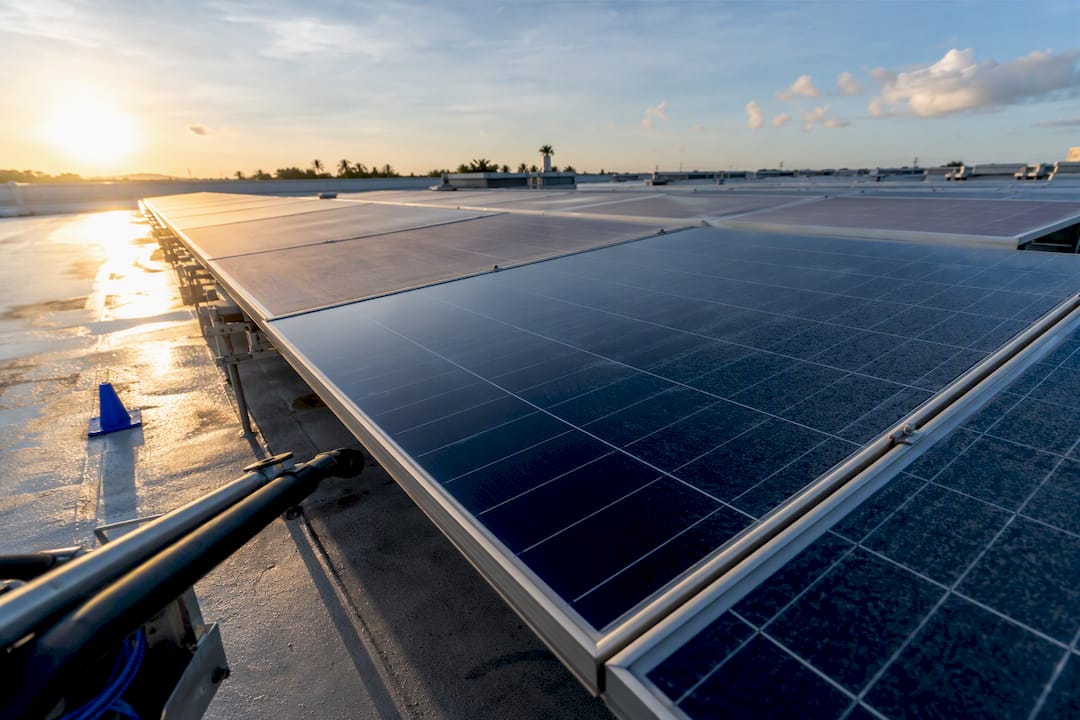
Clean most residential solar panels about once or twice a year, increasing frequency if you have heavy dust, pollen, bird droppings, salt spray, or nearby farmland. South Florida’s mix of humidity, coastal air, and seasonal pollen usually lands homeowners in that same one to two-visit range, though bird-heavy roofs and post-construction dust can push it higher. The real answer comes from your production data, not a fixed date on the calendar.
TL; DR:
- Most residential panels only require cleaning once or twice a year unless located in high dust, pollen, bird traffic, or coastal salt zones.
- Condition-based cleaning, guided by production data and visual inspection, is more effective than fixed calendar schedules.
- DIY cleaning is safe for accessible panels using low-pressure water and soft tools, but hazards or extreme soiling warrant professional services.
- Drone cleaning offers a safe and cost-effective option for multi-story or hard-to-reach rooftops, with proper certification and documentation.
- Regular monitoring of output decline and visual signs should drive cleaning decisions rather than fixed dates, maximizing energy recovery.
Table of Contents
- Solar Panel Cleaning Frequency: What Changes the Baseline
- Signs Your Solar Panels Actually Need Cleaning
- DIY Cleaning vs. Hiring a Pro: Safety and Warranty Basics
- When Extra Cleanings Actually Pay for Themselves
- The Right Way and Time to Clean Solar Panels
- Drone Cleaning for Large or Hard-to-Reach Solar Arrays
- What Most Homeowners Get Wrong About Cleaning Schedules
- Need a Professional for a Large or Hard-to-Reach Array?
- Sources
- FAQ
Solar Panel Cleaning Frequency: What Changes the Baseline
The once or twice a year rule comes straight from manufacturer and industry guidance, and it holds up for most homes with a typical roof pitch and no unusual soiling sources nearby, according to Enphase’s maintenance guide. But that baseline is a starting point, not a fixed law. Peer-reviewed modeling shows the real optimal schedule depends heavily on local soiling rates, and condition-based cleaning consistently beats a rigid calendar approach, per research published on PMC.
Here’s how that plays out by condition:
- Rainy or humid climates: Once a year is often enough. Rain rinses off loose dust naturally, and annual soiling losses in these regions typically run under 1 to 2%, according to regional soiling data.
- Wooded or high-pollen areas: Two to three cleanings a year, timed around spring and fall pollen peaks when sticky yellow film builds up fast.
- Dusty, arid, or agricultural zones: Three to four cleanings a year. Arid and farm-adjacent regions can lose 4 to 8% of production annually to soiling buildup, per the same regional data.
- Coastal salt-spray zones: Two to three cleanings a year, since salt residue doesn’t wash off with rain the way loose dust does.
- High bird-traffic roofs: Spot cleaning as needed, sometimes monthly, since droppings block cells directly rather than just dimming the whole panel.
Certain events should trigger a cleaning outside your regular schedule regardless of climate: a dust storm, a construction project nearby, harvest season if you’re near farmland, a pollen peak, or a stretch of bird activity you notice on the roofline.
South Florida sits in an interesting middle zone. Miami-Dade, Broward, and and Palm Beach counties get enough rain to keep loose dust in check most of the year, but the salt air off the coast in places like Miami Beach, Fort Lauderdale, and Boca Raton leaves a mineral film that rain alone won’t clear. Add in seasonal bird activity and pollen from South Florida’s landscaping, and most homes here do well with two cleanings a year: one in late spring before the wet season and one in late fall once pollen and dry-season dust settle in. Experimental field data backs this pattern, showing that rainfall intensity and seasonality strongly shift the optimal cleaning window, per an Energies field study.
Signs Your Solar Panels Actually Need Cleaning
Don’t clean on a fixed date if the panels don’t need it. Use these checks instead.
- Compare production against expected output, not just yesterday’s numbers. A 10% drop on a cloudy day is weather, not dirt. A steady decline over several sunny weeks is a soiling signal.
- Walk your roofline and look, or check with binoculars if access is limited. Look for a dull gray or brown film, visible bird droppings, pollen dust, or streaking near the panel edges.
- Photograph the panels every month or two. Side-by-side photos make gradual buildup obvious in a way a quick glance won’t.
- Pull inverter or monitoring-app data before deciding. Most systems log daily and monthly kilowatt-hour output, so a documented dip against your own seasonal average is a far better trigger than guesswork. Learning to measure energy recovery after cleaning turns this into a repeatable habit rather than a one-off check.
DIY Cleaning vs. Hiring a Pro: Safety and Warranty Basics
Safety comes first, every time, no exceptions. Before touching a panel, shut down the system at the DC disconnect so no current runs through the array while you’re working near it. If your roof is steep, high, or hard to access safely from a ladder, that’s your cue to stop and call a professional instead of improvising.
For ground-level or easily accessible arrays, DIY cleaning is workable if you stick to safe methods:
- Use a soft brush or squeegee designed for glass, not a stiff-bristle deck brush.
- Rinse with a garden hose on a gentle setting, or deionized water if you want a streak-free finish.
- Skip pressure washers entirely. High-pressure spray can crack seals or force water under the frame, per Popular Mechanics’ cleaning guidance.
- Avoid ammonia-based glass cleaners or abrasive powders, which can degrade anti-reflective coatings over time.
Hire a professional when panels sit on a steep or multi-story roof, when soiling is heavy enough that a garden hose won’t cut it, or when you want documented before-and-after output numbers. A solid vendor checklist includes proof of insurance, relevant certifications, and a willingness to show you production data rather than just a clean-looking photo.
Pro Tip: Never assume rain “counts” as your annual cleaning in a coastal area. Rain removes loose dust but often leaves mineral and salt residue behind, which still blocks light and needs a manual rinse to clear.
When Extra Cleanings Actually Pay for Themselves
The crossover point is simple in concept: clean again only when the energy you recover is worth more than the cleaning cost. Three variables decide it: how many kilowatt-hours you’re losing to soiling, your local electricity rate, and what a cleaning visit costs.
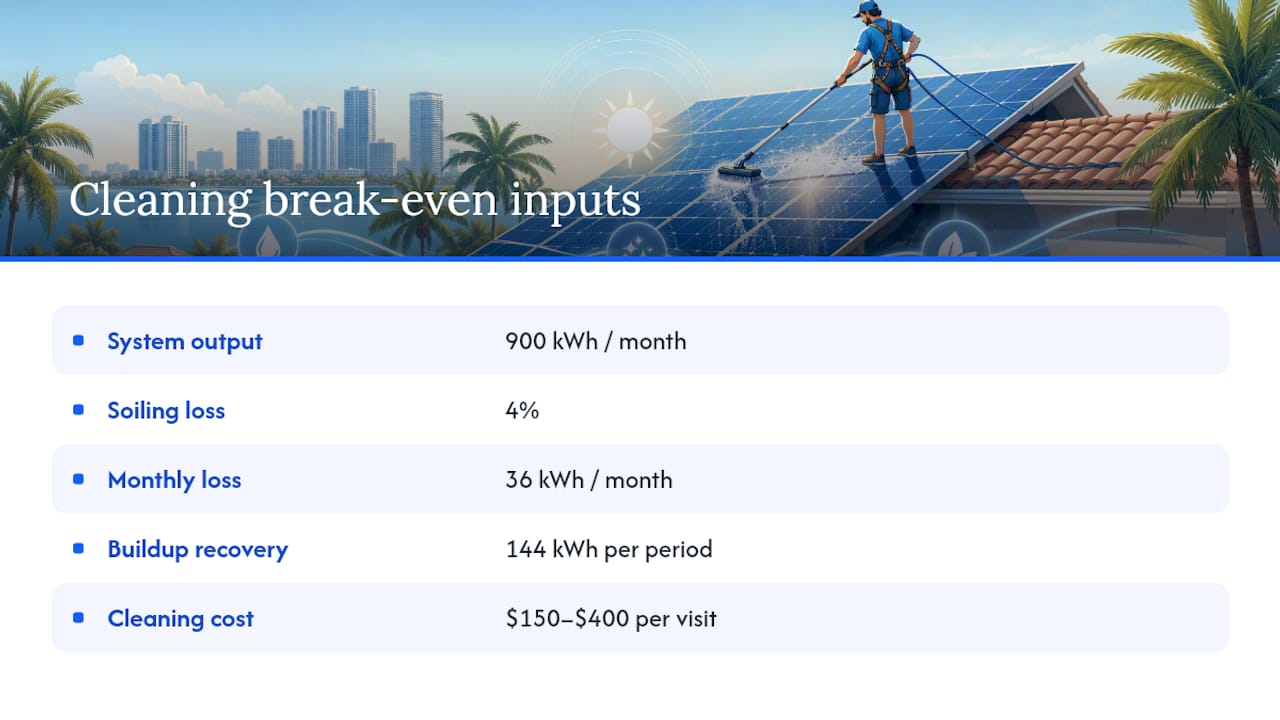
Say a Broward County homeowner loses 4% of production to salt residue and pollen over four months, on a system that normally produces 900 kWh monthly. That’s roughly 36 kWh a month in lost output, or about 144 kWh over the buildup period. At a typical Florida residential rate, that’s a modest dollar loss, one that may or may not clear the cost of a professional visit depending on local pricing, which residential guides put in the roughly $150 to $400 per visit range.
That’s a modest recovery, and it’s exactly why humid regions rarely justify more than one or two cleanings a year. The math changes fast in arid or agricultural zones, where soiling losses run several times higher and each cleaning recovers far more energy per visit.
Peer-reviewed modeling of condition-based cleaning policies found gains of up to roughly 9% in long-term cost-effectiveness compared with fixed periodic schedules, according to the PMC review of soiling and cleaning economics.
The smartest move for any homeowner is a measurement-first test: schedule one cleaning, log your inverter output for two weeks before and after, and calculate your own recovery number. That real figure beats any generic estimate.
The Right Way and Time to Clean Solar Panels
Timing and technique matter almost as much as frequency. Get either wrong and you risk cracked glass, voided warranties, or a wasted cleaning that doesn’t actually restore output.
- Clean early morning or late afternoon, never midday. Glass that’s hot from direct sun can crack when hit with cooler water, a thermal shock risk that’s easy to avoid by timing around it.
- Rinse first to loosen loose debris, then use a soft brush or squeegee for a gentle scrub on anything that doesn’t rinse away clean.
- Finish with a clean water or deionized rinse to avoid mineral spotting, especially important in South Florida’s hard water areas.
- Skip harsh detergents and pressure washers entirely. Soft, low-pressure water is enough for the film that actually blocks sunlight.
- If your roof requires a ladder, harness, or extended reach, stop and call a professional. No cleaning schedule is worth a fall.
Rain handles light dust reasonably well on its own, but it’s not a substitute for a manual cleaning when salt residue, pollen film, or bird droppings have built up. Those don’t rinse away the way loose dirt does.
Drone Cleaning for Large or Hard-to-Reach Solar Arrays
Large residential arrays, multi-story roofs, and commercial rooftop systems often make ladder access risky or impractical. That’s where drone-based pure-water cleaning fits in. FAA Part 107-certified pilots fly a tethered industrial drone over the array and rinse each panel with deionized water, which leaves no streaking or mineral residue behind and skips the need for scaffolding, lifts, or rope crews entirely.
Vista Drone Cleaning handles this work across Miami-Dade, Broward, and Palm Beach counties, backed by $2M liability insurance and typical project turnarounds of one to three days. Before hiring anyone for a large or hard-to-access array, ask for:
- Proof of FAA Part 107 certification and insurance coverage
- Before-and-after production or yield documentation
- A clear timeline and access plan that doesn’t require scaffolding or road closures
Facility managers overseeing commercial rooftop solar maintenance should treat these documents as standard due diligence, not an extra ask.
What Most Homeowners Get Wrong About Cleaning Schedules
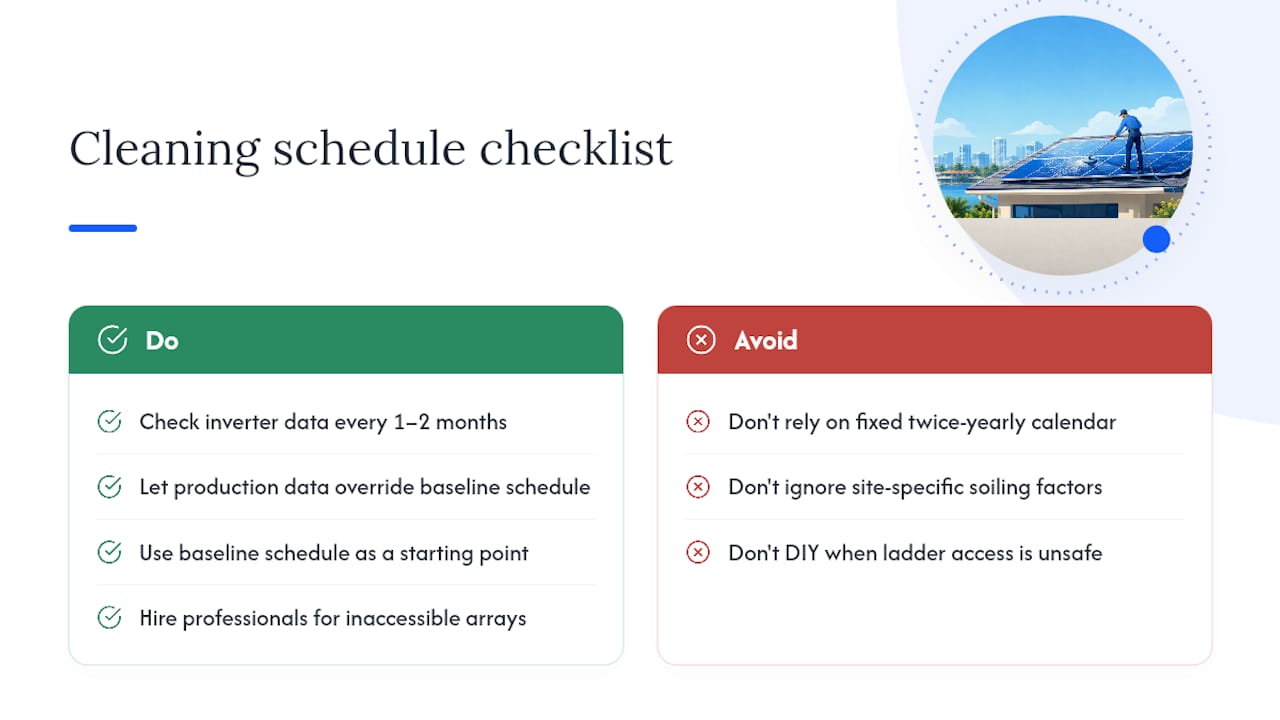
Most guidance treats cleaning frequency like a fixed appointment, twice a year, mark your calendar, done. That’s backwards. The panels don’t care what the calendar says. They care about the actual film sitting on the glass, and that film builds up at wildly different rates depending on your roof, your neighborhood, and even which side of the house catches more bird traffic.
The homeowners who get the most out of their systems are the ones who check inverter data every month or two and clean when the numbers say so, not when a reminder pops up. Follow the baseline schedule as a starting point, but let your own production data override it. And if the array sits somewhere a ladder shouldn’t go, that’s not a DIY problem to push through. It’s a job for someone with the right equipment and insurance.
, Eliot
Need a Professional for a Large or Hard-to-Reach Array?
If your solar array sits on a steep roof, a multi-story building, or a hard-to-access commercial rooftop, a drone-based pure-water wash gets the job done without scaffolding, lifts, or road closures, and usually at 30 to 60% lower cost than traditional access methods. Commercial drone cleaning services for rooftop solar arrays are available throughout Miami-Dade and Broward counties, performed by FAA Part 107-certified pilots, with a streak-free deionized water rinse.

Most projects wrap in one to three days, and every job includes before-and-after documentation so you can see the actual output recovery, not just a shinier roofline. If you manage a commercial building, condominium, or rooftop array that’s outgrown ladder access, request a free solar panel cleaning quote and get a site review scheduled within 24 hours.
Sources
- Impact of dust and temperature on photovoltaic panel performance: A model-based approach to determine optimal cleaning frequency
- Solar panel cleaning and maintenance: A guide for optimal performance
- Yes, Dirt on Your Solar Panels Can Zap Their Power. Here’s How to Clean Them.
- Energies study on soiling and cleaning cycles (2022)
- Solar panel soiling and production loss (2026 regional summary)
FAQ
Do solar panels need to be cleaned often?
Not usually. Most residential systems only need cleaning once or twice a year, with more frequent visits only in dusty, coastal, or bird-heavy conditions.
What is the 33% rule in solar panels?
There’s no established industry standard called the “33% rule” for solar cleaning or performance. If you’ve seen this term, it likely refers to a specific financial or sizing rule unrelated to cleaning frequency, so treat it with caution rather than as a cleaning benchmark.
What is the 20% rule for solar panels?
Like the 33% rule, no verified industry framework by this exact name applies to cleaning frequency. Definitions circulating online vary, so it’s best not to rely on it for maintenance decisions.
How do I know if my solar panels need cleaning?
Check your inverter or monitoring app for a sustained output drop compared to your seasonal average, then visually inspect the panels for dust film, bird droppings, or pollen buildup to confirm the cause before scheduling a cleaning.