
Measure First: Drone Cleaning Restores South Florida Solar After Rain
Rain helps, but rarely cleans South Florida solar panels. Measure yield, inspect glass, then use drone pure water cleaning to recover output.
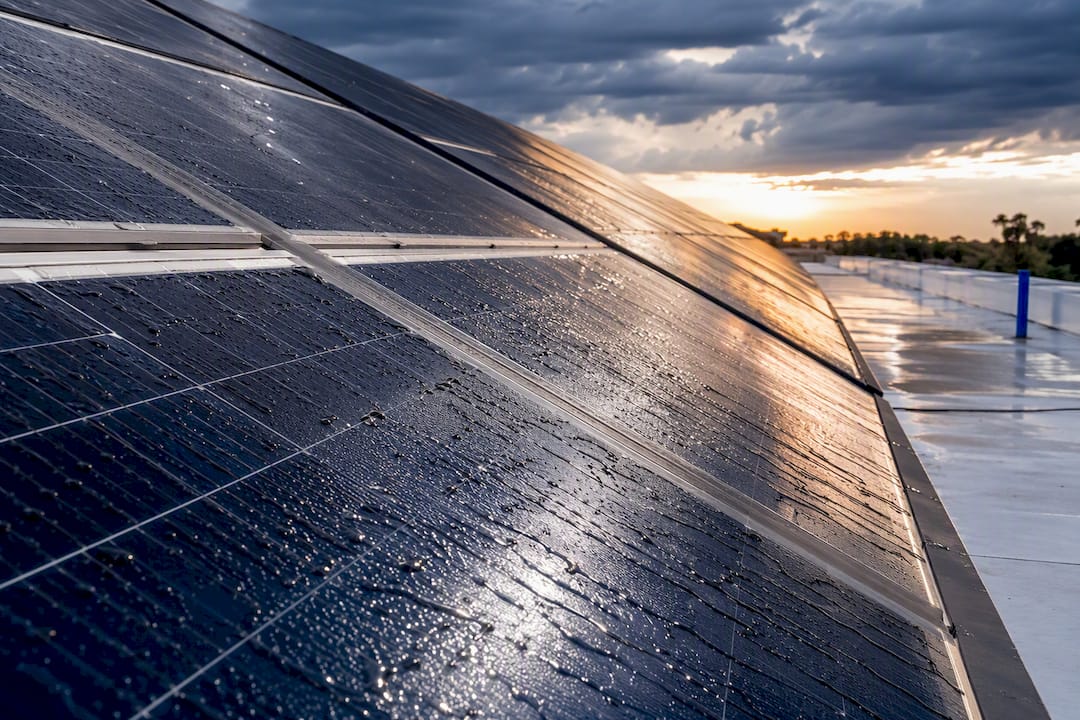
Rain sometimes helps, but it rarely delivers a spotless, high-output panel. Treat rain as a partial cleaning agent, not a maintenance plan. A hard, fast South Florida downpour rinses off loose dust well; a light, lingering drizzle often leaves streaks, pollen film, and mineral spots behind. The fix isn’t guessing. It’s checking your output numbers and panel surface, then scheduling a real cleaning when the data says so.
TL; DR:
- Rain mostly removes loose dust but is ineffective against sticky contaminants like bird droppings, salt crust, and pollen film, which often require manual cleaning.
- Light, lingering rain can temporarily boost panel output by cooling the cells and shifting light spectra, but it rarely produces a truly clean surface.
- Routine inspections based on expected output drops and visual checks are more reliable than relying solely on rainfall to determine when to clean panels.
- For commercial arrays in South Florida, monthly coastal property checks are recommended, while inland sites can often extend cleaning intervals to every four to six weeks.
- Professional cleaning with deionized water and drone-based methods provides a safer, more effective, and warranty-compliant alternative to DIY rinses or waiting for rain to do the work.
Table of Contents
- Does Rain Clean Solar Panels? What Actually Happens on the Glass
- When Rain Falls Short: Contaminants South Florida Panels Actually Face
- How to Check If Your Panels Need Cleaning, Not Just a Guess
- How Often Should You Clean Solar Panels in South Florida?
- DIY Rinse or Professional Cleaning? What Actually Makes Sense
- How a Commercial Cleaning Specialist Actually Assesses Rain Damage
- The Real Lesson Buried in the Rain-Cleaning Debate
- Get a Solar Panel Cleaning Quote for Your South Florida Property
- Sources
- FAQ
Does Rain Clean Solar Panels? What Actually Happens on the Glass
Rain removes loose dust through three mechanisms: droplet impact knocks particles loose, gravity-driven runoff carries them down the panel’s tilt, and continuous flow rinses the surface clean of anything not bonded to the glass. That process works well on dry, powdery soil sitting on a steeply angled array during a heavy downpour.
It works far less on anything sticky. Rain intensity matters more than total rainfall, DLR’s 2024 experimental study found, because short bursts generate enough runoff velocity to carry particles away while long, gentle drizzle just wets the dust and leaves it to dry into a film.
There’s a second wrinkle: rain can make your production numbers look better without actually cleaning anything.
- Wet panels run cooler, and cooler silicon converts light more efficiently.
- Cloud-diffused light after a storm shifts the solar spectrum in ways that can briefly raise output.
- Conference research on rainy-weather PV performance confirms these effects appear even when surface soiling hasn’t changed.
Statistic callout: Modeling work published in Renewable Energy shows rain’s effect on output is genuinely dual sided: heavy rain often boosts performance by removing dust, while light rain can actually reduce it by smearing contaminants across the cell surface.
When Rain Falls Short: Contaminants South Florida Panels Actually Face
Hydrophilic grime (fine road dust, dry sand) rinses off in almost any rain. Hydrophobic and sticky contaminants don’t. That’s the category causing most of the underperformance on Miami-Dade and Broward rooftops.
- Pollen film, heavy through spring across Palm Beach and Broward County, binds to warm glass and often needs more than one storm to budge.
- Bird droppings create a hardened, uneven film that light rain barely touches; for effective solutions, see our guide on bird proofing solar panels Canberra. Vista Drone Cleaning’s research on bird droppings shows how concentrated the output loss can be around a single dropping cluster.
- Salt spray and crust, a near-constant issue on coastal arrays from Miami Beach to Fort Lauderdale, bonds to glass as it dries and resists anything short of a hard rinse.
- Hard-water mineral spots, left behind after rain evaporates unevenly, create a faint haze that most owners never notice from the ground.
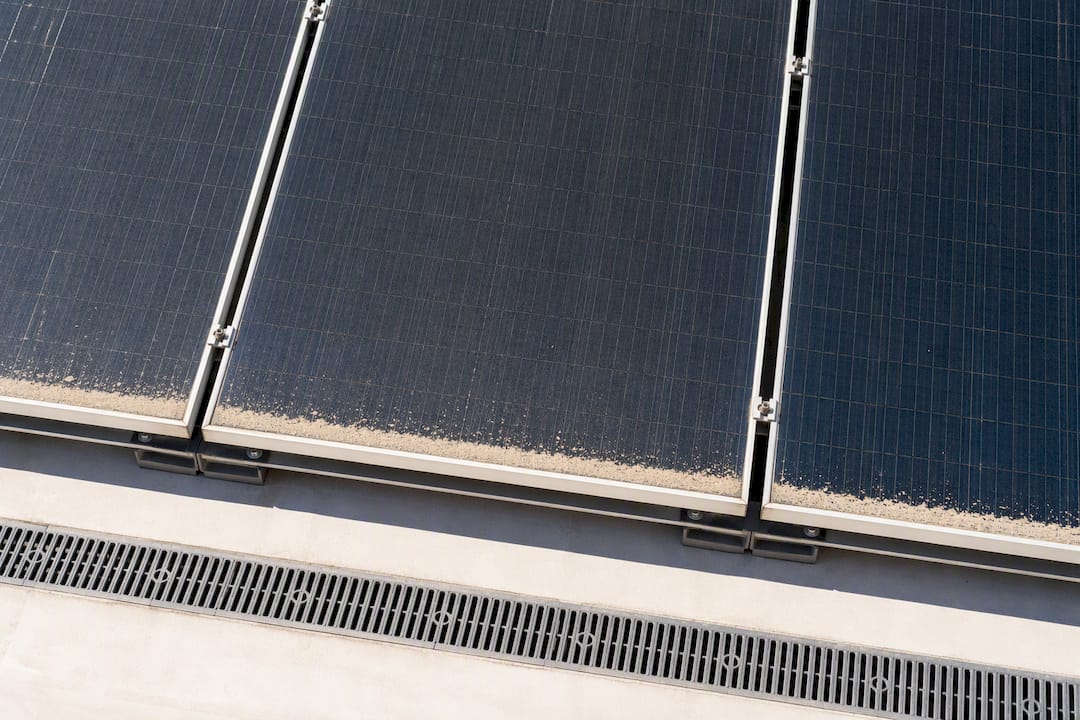
A 2013 study confirmed relying on rainfall alone is not a robust cleaning strategy, since rain rarely produces a genuinely clean state on modules with bonded contaminants. Flat or low-tilt arrays, common on South Florida commercial rooftops, make this worse: runoff pools instead of draining, leaving dirty edge strips and localized hotspots that a 2025 study on soiling patterns links to long-term cell stress.
Pro Tip: After the first hard rain following a dry stretch, walk your roof line and look at the panel edges specifically, not just the center. Edge strips are where residue collects first and where losses start.
How to Check If Your Panels Need Cleaning, Not Just a Guess
Skip the guesswork and check three things in this order.
- Compare expected output to actual output. Pull your inverter or monitoring app’s daily generation baseline and compare it against a clear-sky day from the same month last year. A gap that doesn’t track with weather is a soiling signal.
- Check the soiling ratio if your monitoring platform reports one. This metric isolates output loss attributable to dirt versus shading, temperature, or degradation.
- Do a visual walk-through. Look for streak patterns, cloudy haze near the frame edges, and any visible bird-dropping clusters, especially after several weeks without a hard rain.
- Run a controlled test. Isolate one panel or string, note its output, rinse it by hand or hire a spot-clean, then compare the reading against the rest of the array after the next significant rain.
Statistic callout: A 2026 empirical study of coastal and industrial-adjacent solar sites found soiling-related losses vary meaningfully from year to year and that routine maintenance, not rainfall, is what keeps output consistent. As a working threshold, a persistent 2 to 5 percent output gap that doesn’t recover after normal rainfall is generally worth investigating with a physical inspection.
How Often Should You Clean Solar Panels in South Florida?
There’s no single rainfall number that tells you when panels are clean. DLR’s rain-threshold modeling found simple rain-sum thresholds consistently overestimate how clean rain actually leaves a panel, since tilt, wind direction, and soiling type all shift the outcome.
What works instead is combining three variables: how hard it rained, how many dry days preceded it, and what you actually see on the glass.
- Coastal properties (Miami Beach, Fort Lauderdale beachside, Boca Raton oceanfront) face salt crust year-round and warrant a monthly visual check at minimum.
- Inland commercial sites with heavier vehicle or industrial dust nearby should inspect every four to six weeks.
- Low-pollen, low-traffic sites can often stretch inspections to quarterly, tightening up during spring pollen season.
The cost-benefit case is straightforward: a soiling loss sitting in the mid-single digits, sustained across a commercial array for months, usually costs more in lost generation than a single scheduled cleaning.
DIY Rinse or Professional Cleaning? What Actually Makes Sense
A garden hose rinse costs nothing and works fine for a single residential panel you can safely reach from the ground. Commercial rooftop arrays are a different calculation entirely.
- DIY drawbacks: tap water leaves mineral spots that mimic the hard-water haze rain itself can cause; ladder work on a 30 to 200-foot commercial roof is a real fall risk; some manufacturer warranties specify approved cleaning methods and voiding them is expensive.
- Professional advantages: pure deionized water rinses clean without leaving the mineral residue tap water does; documented before-and-after results support insurance and warranty claims; trained access means no scaffolding, lifts, or rooftop foot traffic.
Comprehensive reviews of PV soiling point to intelligent cleaning methods, including drone-based systems, as delivering meaningful efficiency recovery in environments where soiling is persistent rather than occasional. For tall commercial buildings or complex rooftop arrays across Miami-Dade and Broward, drone-based pure-water cleaning removes the fall-risk equation entirely since crews never leave the ground.
Pro Tip: If your array sits under a rooftop HVAC unit or near a flat parapet, check those zones first. Debris collects there faster than anywhere else on the roof, and it’s usually the last spot owners inspect.
How a Commercial Cleaning Specialist Actually Assesses Rain Damage
A professional assessment doesn’t start with a hose. It starts with a checklist: a visual pass for streaking and edge buildup, a yield comparison against expected output, and a quick adhesion check to see whether residue is loose dust or something bonded to the glass.
That last distinction matters more than most owners realize. Loose dust responds to almost any rinse. Bonded residue, salt crust, or dried mineral spotting needs deionized water specifically, because standard tap water reintroduces the same mineral problem it’s supposed to solve.
This process is conducted across South Florida commercial properties using FAA Part 107 certified pilots and tethered drones for pure-water rinses on rooftop arrays. The service includes liability insurance and provides quotes promptly, which helps facility managers coordinate around tenant schedules and roof access windows.
- Visual inspection identifies streaking, edge strips, and dropping clusters before they compound.
- Yield checks confirm whether a suspected gap is soiling or something else entirely, like shading or panel age.
- Pure-water rinses eliminate the hard-water spotting that tap-water rinses (and, ironically, some rain) leave behind.
The Real Lesson Buried in the Rain-Cleaning Debate
The myth that rain “handles it” survives because it’s partly true, and that’s exactly what makes it dangerous. Heavy, fast rain on a steep array genuinely does most of the work. The problem is that most South Florida rain doesn’t arrive that way, and most commercial arrays aren’t tilted steeply enough to benefit fully even when it does.
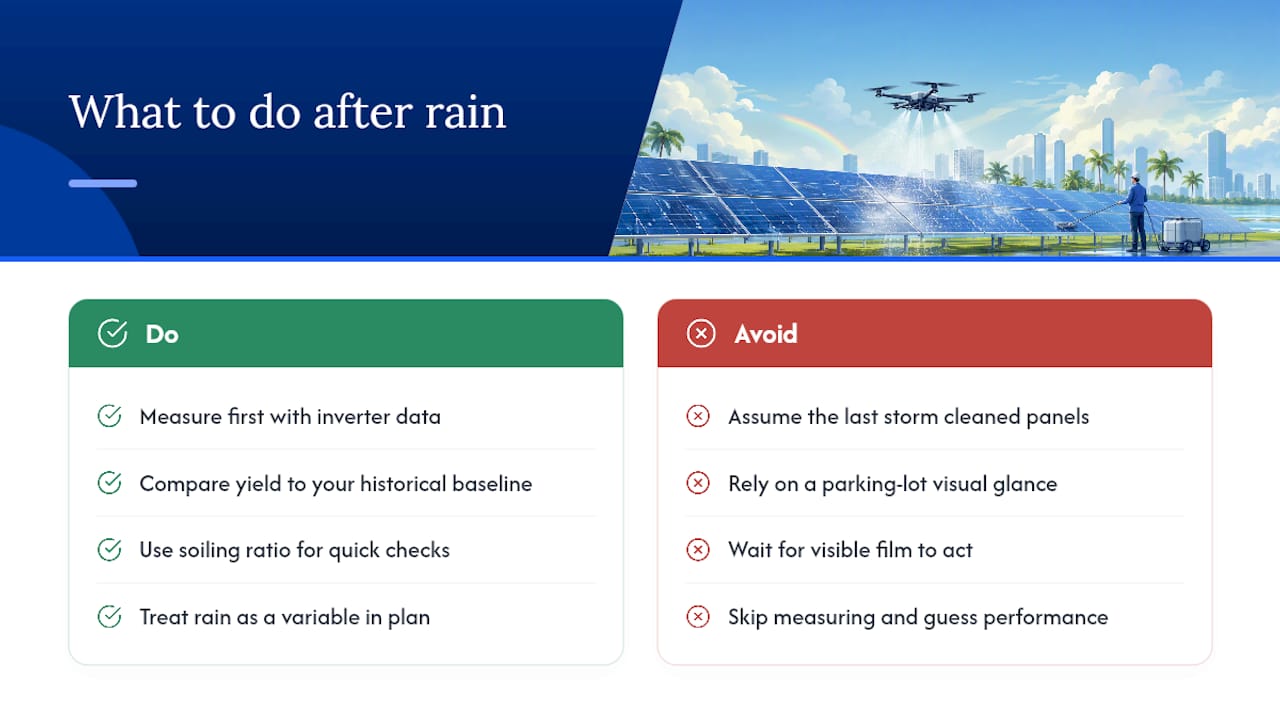
Conventional advice tends to stop at “check your panels occasionally, ” which is too vague to act on. The research supports something sharper: measure first, then decide. A soiling ratio or a yield comparison against your own historical baseline tells you more in five minutes than a visual glance from the parking lot ever will.
What I’d prioritize if I owned a commercial array here: stop assuming the last big storm did the job, and start treating your inverter data as the actual source of truth. Rain is a variable in your maintenance plan, not a substitute for one. Owners who wait for a visible film on the glass are usually already losing several percent of output they never noticed.
, Eliot
Get a Solar Panel Cleaning Quote for Your South Florida Property
If your yield data or a walk-through inspection shows rain isn’t keeping up, Vista Drone Cleaning gives commercial property managers a way to fix it without scaffolding, lifts, or rooftop foot traffic. Crews stay on the ground while FAA Part 107 certified pilots operate tethered drones for a pure deionized water rinse across rooftop arrays up to 200 feet tall, on buildings throughout Miami-Dade, Broward, and and Palm Beach counties.

The service includes liability insurance, with projects typically completing in one to three days at costs lower than traditional scaffold or lift-based cleaning. For property managers, HOA boards, and solar array operators who need documented before-and-after results for insurance or performance guarantees, that combination offers advantages over a DIY rinse. Request a free solar panel cleaning quote and get a response within 24 hours.
Sources
- Cleaning of Photovoltaic Modules through Rain: Experimental Study and Modeling Approaches (DLR 2024)
- Evidence that rainfall does not guarantee complete PV cleaning (2013 study)
- Empirical evidence of soiling-induced performance loss and the need for routine maintenance
- PV performance during low irradiance and rainy weather conditions (conference paper)
FAQ
Is Rain Enough to Clean My Solar Panels?
Rain removes loose dust reasonably well, especially during a hard, fast downpour, but it rarely clears bonded contaminants like bird droppings, salt crust, or pollen film. Check your output data rather than assuming rain handled it.
What Happens if Solar Panels Get Rained On?
Nothing harmful. Panels are sealed and rated for outdoor exposure, and rain typically produces a short-term output boost from panel cooling and spectral shifts, separate from any actual cleaning effect.
Will WD-40 Clean Solar Panels?
No. WD-40 and similar petroleum-based products can leave a residue film that attracts dust and may violate manufacturer warranty terms, deionized water is the standard safe choice for panel cleaning.
How Often Should Commercial Solar Arrays Be Cleaned in South Florida?
Coastal properties facing salt spray should inspect monthly, while inland sites with less pollen or industrial dust can often stretch to quarterly checks, tightening the schedule during spring pollen season.