
How Curb Appeal Drives Retail Property Value
Discover how enhancing curb appeal boosts retail property value through increased shopper engagement, leasing success, and higher sale prices.
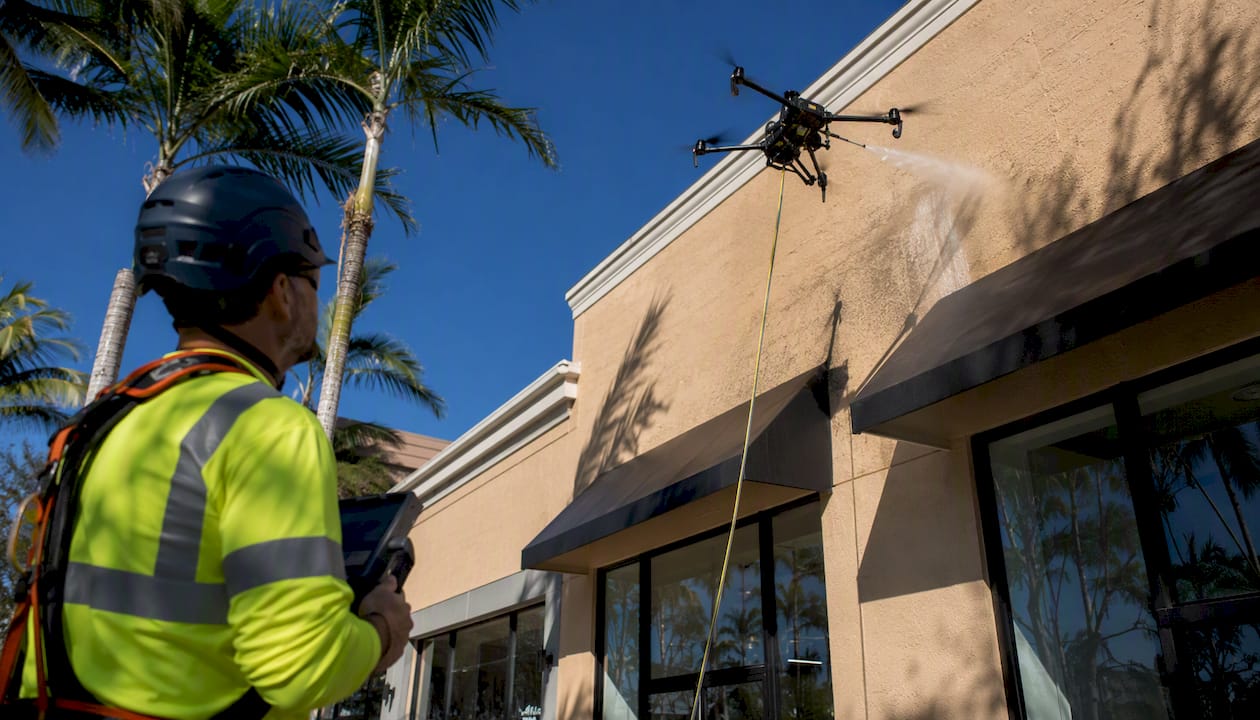
Curb appeal directly increases retail property value, and the effect is measurable. A well-maintained exterior signals quality to shoppers before they step inside, to prospective tenants evaluating your center, and to appraisers and lenders reviewing your asset. The role of curb appeal in retail property value runs through three channels simultaneously:
- Shopper behavior: Cleaner, better-lit retail environments correlate with longer dwell times and higher consumer spending, according to environmental design research linking store environment quality to in-store sales performance.
- Leasing outcomes: Storefront upgrades frequently trigger lease-up of previously vacant spaces and owner-reported increases in perceived property value, as documented in community economic development case studies.
- Sale price and appraisal: Industry analyses suggest targeted exterior maintenance can correspond to rental-rate or sale-price uplifts in the range of up to approximately 7% in comparable markets.
Research suggests curb-appeal factors can account for up to ~7% of sale price or rental premium in comparable markets: a meaningful return on what are often modest cosmetic investments.
Key Takeaways
Curb appeal is a measurable financial input for retail properties: the architectural and atmospheric dimensions of a building’s exterior are statistically linked to sales prices, rents, and lease velocity.
| Point | Details |
|---|---|
| Up to ~7% value effect | Industry analyses suggest well-maintained exteriors can correspond to rental or sale-price uplifts of up to approximately 7% versus neglected properties. |
| Cleaning is the highest-ROI first step | Façade soft-wash and window cleaning often cost under $15,000 and can support faster lease-up worth multiples of that investment. |
| Document everything for appraisers | Before/after photos, contractor invoices, and maintenance logs support positive condition adjustments in formal appraisals. |
| Track KPIs before and after | Measure vacancy days, rent per sq ft, and lease inquiry rate at baseline, 30 days, 6 months, and 12 months post-project. |
| Vistadronecleaning for South Florida retail | FAA-registered drone cleaning completes most retail façade projects in 1–3 days at 30–60% lower cost than scaffold methods, with 4K documentation included. |
Table of Contents
- How curb appeal shapes retail property value: the mechanism
- How curb appeal changes rents, sale prices, and tenant mix
- Which physical elements determine retail curb appeal
- What curb-appeal projects cost and what they return in South Florida
- Do appraisers and lenders actually care about curb appeal?
- Your prioritized curb-appeal action plan
- A South Florida retail center: before and after drone cleaning
- How to measure whether your curb-appeal investment worked
- What South Florida retail owners often get wrong about curb appeal
- Vistadronecleaning cleans South Florida retail façades without scaffolding
- Sources
- FAQ
How curb appeal shapes retail property value: the mechanism
In retail real estate, curb appeal refers to the sum of visual impressions a property creates from the street, the parking lot, and the approach: the façade condition, signage clarity, landscaping, pavement quality, lighting, and window cleanliness. It is not a single feature but a composite signal.
Academic research identifies three dimensions: architectural (building form, materials, maintenance), atmospheric (lighting, cleanliness, landscaping), and authenticity (character, local identity). The architectural and atmospheric dimensions show the strongest measurable effects on market value. Authenticity choices, like bespoke murals or artisan finishes, improve customer perception but produce weaker statistical influence on appraised prices.
The causal chain is straightforward. A shopper approaching a retail center forms a quality judgment in seconds. That judgment shapes whether they enter, how long they stay, and how much they spend. Tenant sales performance, in turn, is what underwrites the rents tenants can afford to pay. Those rents feed into income-based valuation models. A property with consistently higher foot traffic and tenant sales commands higher rents, lower vacancy, and a stronger NOI, all of which flow directly into appraisal and sale-price calculations.
How curb appeal changes rents, sale prices, and tenant mix
The evidence connecting exterior quality to financial outcomes is not anecdotal.
Hedonic-pricing research using survey data, transaction records, and spatial regression found that the atmospheric and architectural dimensions of curb appeal have a statistically significant positive impact on retail real estate sales prices. This is the most rigorous academic evidence available on the topic, and it isolates curb appeal as a value driver independent of location and size.
On the leasing side, storefront improvement case studies document a consistent pattern: owners who invest in façade upgrades frequently lease spaces that had sat vacant, generate new rental income, and report perceived increases in overall property value. One underappreciated finding from those studies: improvements to one storefront often prompt neighboring owners to upgrade theirs, amplifying foot traffic at the district level. For retail center landlords pitching an HOA board or a co-owner group, that spillover effect is a compelling argument.
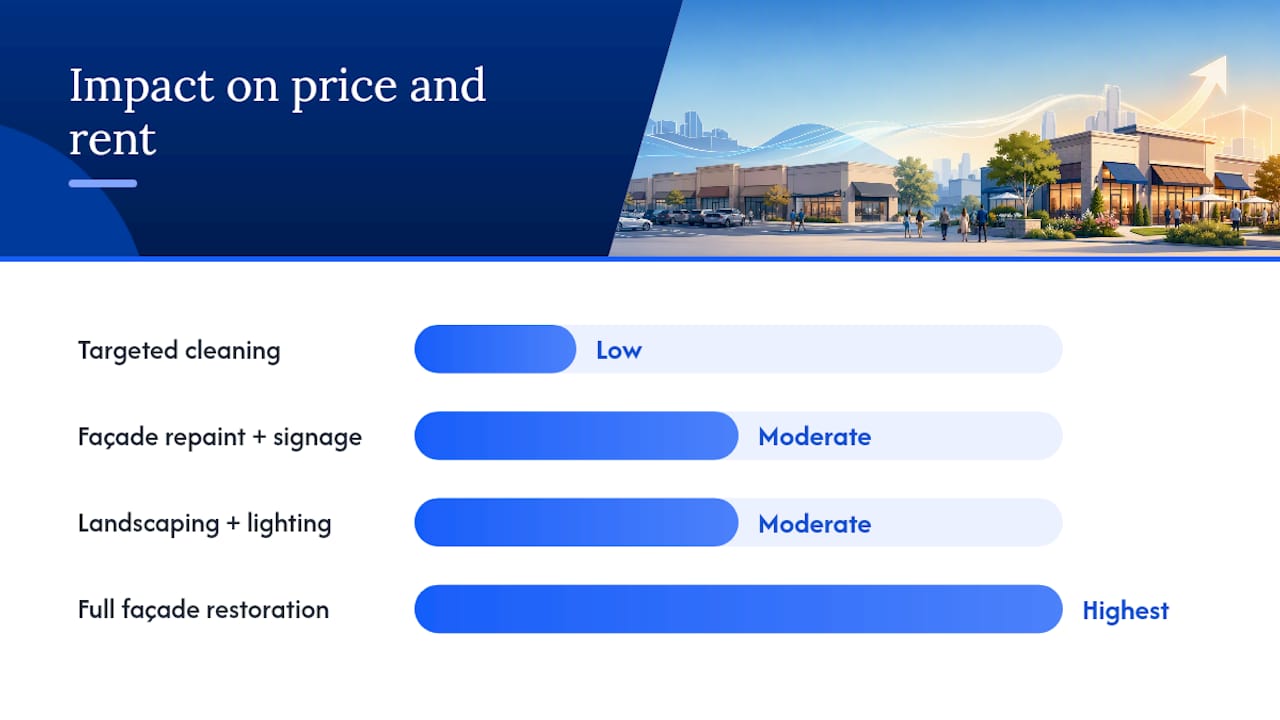
| Improvement Type | Typical Value Effect | Evidence Basis |
|---|---|---|
| Targeted cleaning (pressure wash, windows) | Preserves asset value; cited additions of several thousand dollars to sale price | Industry analysis |
| Façade repaint + signage refresh | Rental-rate premium, faster lease-up | Case study documentation |
| Full façade restoration | Strongest sale-price uplift; supports appraisal comps | Hedonic pricing research |
| Landscaping + lighting upgrade | Improved foot traffic, dwell time, tenant sales | Environmental design research |
Which physical elements determine retail curb appeal
Every element below contributes to the architectural or atmospheric dimensions that research ties to market value. Audit each one before budgeting.
- Façade condition: Staining, efflorescence, peeling paint, and mildew are the fastest signals of deferred maintenance. A soft-wash cleaning cycle or repaint is often the single highest-visibility fix. In South Florida, schedule soft-wash at least annually given salt spray and algae growth rates near the coast.
- Signage: Faded, cracked, or misaligned signs undercut tenant brand equity and make a center look dated. Quick win: replace fluorescent tubes in illuminated signs and re-level any tilted panels.
- Windows and glass: Streaked or film-covered glass reads as neglect from 50 feet away. Clean glass is one of the cheapest improvements per square foot of visual impact.
- Landscaping: Overgrown or dead plantings signal inattention. In South Florida, fallen palm fronds and salt-burned ground cover are the most common culprits. Monthly maintenance contracts keep this manageable.
- Parking and pavement: Cracked asphalt, faded striping, and standing water deter shoppers before they reach the door. Seal-coating and re-striping are mid-range investments with immediate visual payoff.
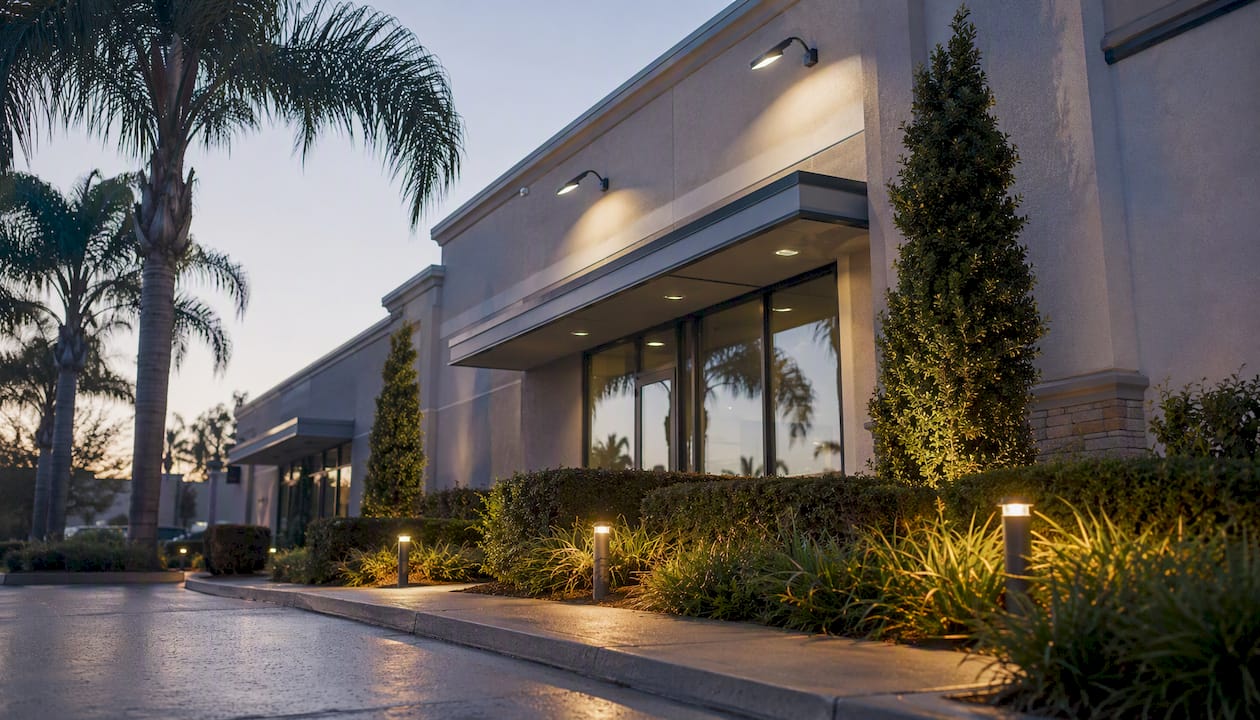
- Lighting: Poorly lit parking lots and entrances raise safety concerns that suppress evening foot traffic. LED retrofits pay back quickly in energy savings and tenant satisfaction.
- Entrances and canopies: Damaged canopies, rusted frames, and worn entry mats are high-visibility defects. Pressure washing and touch-up painting extend canopy life significantly.
- Accessibility: Federal ADA guidance specifies minimum accessible parking spaces, path widths, and surface conditions. Any curb-appeal project must preserve or improve these features, not compromise them. Non-compliance creates liability that can affect financing.
- Safety cues: Visible security cameras, clean sight lines, and unobstructed lighting all signal a well-managed property. Tenants notice, and so do their customers.
Pro Tip: In South Florida, schedule a post-hurricane-season exterior audit every November. Salt corrosion, algae, and storm debris accumulate fastest between June and October. Catching damage before the winter leasing season means your property looks its best when tenant interest peaks.
What curb-appeal projects cost and what they return in South Florida
South Florida’s coastal humidity, salt air, and year-round sun accelerate exterior wear faster than most inland markets. Budget accordingly.
Cost ranges by project scope:
- Low (cleaning, minor repairs, signage refresh): Roughly $2,000–$15,000 for a mid-size retail strip. Includes pressure washing, window cleaning, sign tube replacement, and touch-up paint. Timeline: days to two weeks. No permits typically required.
- Mid (repaint, landscape redesign, lighting upgrade): Roughly $15,000–$75,000 depending on building size and material. Timeline: two to six weeks. Exterior paint on stucco or EIFS may require a permit in some municipalities.
- High (façade restoration, canopy replacement, parking repave): $75,000 and up. Timeline: one to four months, including permitting. Salt-corrosion remediation and EIFS repair add cost in coastal zones.
For cost-saving approaches specific to South Florida buildings, sequencing matters: clean first, then assess what actually needs repainting or repair. Owners who repaint over dirty or mildewed surfaces waste money within 18 months.
Two illustrative ROI scenarios (transparent assumptions):
Scenario A, Cleaning-focused refresh: A 20,000 sq ft retail strip in Fort Lauderdale invests $8,000 in façade soft-wash, window cleaning, and sign refresh. Assumptions: one vacant 1,200 sq ft unit at $28/sq ft NNN. If the refresh contributes to leasing that unit within 60 days rather than 180 days, the owner captures roughly $37,000 in additional annual rent. Payback on the cleaning investment: under three months.
Scenario B: Mid-range repaint and landscape: A Boca Raton retail center spends $45,000 on exterior repaint, new landscaping, and LED lighting. Assumptions: current average rent of $32/sq ft across 30,000 sq ft. Payback: under 12 months, before accounting for any sale-price uplift.
These scenarios use conservative assumptions. Actual results depend on market conditions, tenant mix, and execution quality.
| Project Type | Estimated Cost (South FL) | Timeline | Primary Value Driver |
|---|---|---|---|
| Cleaning + signage refresh | $2,000–$15,000 | Days–2 weeks | Faster lease-up, foot traffic |
| Repaint + landscape + lighting | $15,000–$75,000 | 2–6 weeks | Rent premium, tenant retention |
| Façade restoration + parking | $75,000+ | 1–4 months | Sale-price uplift, appraisal comps |
Do appraisers and lenders actually care about curb appeal?
Yes, and the mechanism is more direct than most owners realize.
Appraisers use observable building condition as an input to both the cost approach (replacement cost minus depreciation) and the sales comparison approach (comparable adjustments for condition). A property with visible deferred maintenance, stained façades, or damaged canopies will receive a negative condition adjustment relative to better-maintained comps. That adjustment reduces the appraised value directly.
On the lender side, the concern is NOI. A property with high vacancy or below-market rents, partly attributable to poor exterior condition, produces a weaker income stream. Lenders sizing a loan against NOI will offer less. Conversely, documented improvements that support higher rents or faster lease-up strengthen the income case.
Practical documentation steps:
- Photograph the property before and after every improvement, with date stamps.
- Retain contractor invoices and maintenance schedules.
- Collect tenant sales data (where lease agreements permit) to show performance trends.
- Pull lease comparables from neighboring centers to demonstrate rent-premium positioning.
- For pre-occupancy cleaning projects, document the condition at delivery to establish a baseline for future appraisals.
A one-page condition summary with before/after photos and a maintenance log is often enough to support a positive appraiser adjustment. Most owners never prepare one.
Your prioritized curb-appeal action plan
Three tiers, ordered by speed and capital required.
Quick wins (this week, under $15,000):
- Pressure wash the entire façade, parking lot, and entry areas.
- Clean all windows, including upper-floor glass.
- Replace burned-out or flickering sign and parking-lot lights.
- Clear dead landscaping and remove debris.
- Re-stripe faded parking spaces and accessible stalls.
Near-term projects (next 90 days, $15,000–$75,000):
- Repaint the façade in a color scheme consistent with tenant brand standards.
- Redesign landscaping with salt-tolerant, low-maintenance species appropriate for South Florida.
- Install or upgrade accessible paths and ramps to meet ADA parking standards.
- Upgrade parking-lot lighting to LED.
Strategic investments (6–18 months, $75,000+):
- Full façade restoration, including EIFS repair, caulking, and corrosion remediation.
- Canopy replacement or structural repair.
- Parking lot repave and drainage correction.
- Unified signage program across all tenant bays.
Contractor-hiring checklist:
- General liability insurance (minimum $1M per occurrence; $2M preferred for larger properties).
- Aviation liability if drones are used (FAA Part 107 certification required).
- State contractor license and local business tax receipt.
- References from comparable retail properties in South Florida.
- Substrate-appropriate chemistry (soft-wash for stucco and EIFS; pressure-appropriate for concrete).
- Written site safety plan and crew briefing protocol.
For a complete building exterior maintenance checklist, property managers can use a structured audit format to track condition across all elements.
Pro Tip: Time your exterior refresh to land four to six weeks before your primary leasing season. In South Florida, that typically means completing work by late January or early February, ahead of the spring leasing cycle when tenant demand peaks. A freshly cleaned and repainted center photographs better for listings and shows better during walkthroughs.
A South Florida retail center: before and after drone cleaning
A retail strip center in Miami-Dade County, approximately 18,000 sq ft with a two-story façade and ground-floor storefronts, had accumulated two years of algae staining, salt-deposit streaking, and window film. One 1,400 sq ft unit had been vacant for four months, and the property manager attributed part of the difficulty in showing it to the center’s overall exterior condition.
The owner engaged a drone-based exterior cleaning crew. Using tethered industrial drones with soft-wash chemistry matched to the stucco and glass substrates, the crew cleaned the full façade, all storefront windows, and the canopy soffits without scaffolding or road closures. The project completed in two days. The owner received 4K before/after documentation of the full building face.
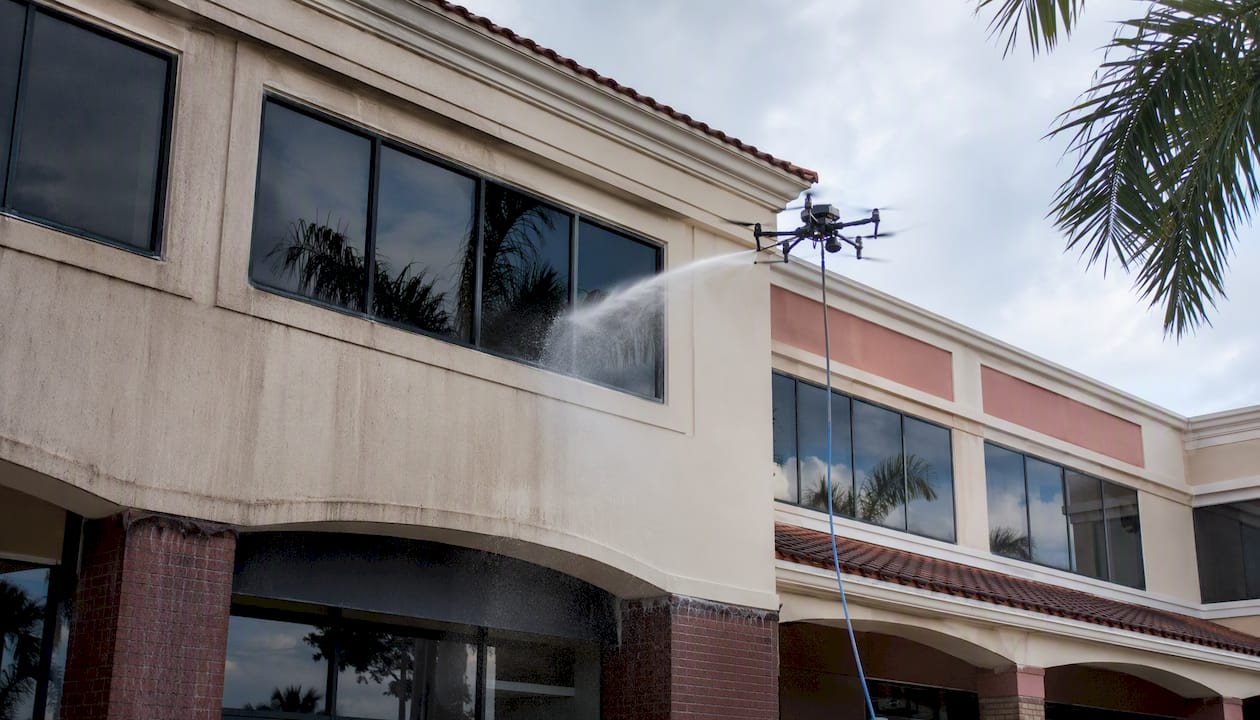
Within six weeks of the cleaning, the vacant unit received two qualified tenant inquiries and was leased. The property manager noted that the refreshed exterior was referenced in both conversations.
Vendor evaluation checklist for exterior cleaning on retail assets:
- FAA Part 107 certification for any drone operations.
- Minimum $2M liability insurance, with aviation endorsement.
- Substrate-matched chemistry (separate protocols for glass, stucco, EIFS, concrete, metal).
- 4K before/after photo and video documentation included in scope.
- Ground-only crew operations (no workers at height, no rigging).
- Written scope of work with substrate-specific methods stated.
For a broader look at cleaning methods and substrate compatibility, property managers can review method-by-substrate guidance before selecting a vendor.
How to measure whether your curb-appeal investment worked
Tracking results is what separates a documented ROI from a gut feeling.
KPIs to establish before any project begins:
- Foot traffic count or estimate (manual count, sensor data, or third-party tools like Placer.ai).
- Tenant sales per square foot, where lease agreements allow disclosure.
- Lease application rate and inquiry volume for vacant units.
- Vacancy days per unit over the trailing 12 months.
- Rent per square foot on new leases and renewals.
- Appraisal comparables from neighboring properties.
Measurement timeline:
- Baseline (before project): photograph all elements, record vacancy days, pull current rent roll, note any tenant complaints about exterior condition.
- 30 days post-completion: recount foot traffic, note any new tenant inquiries, photograph current condition.
- 6 months post-completion: compare lease velocity, vacancy days, and any rent changes on renewals.
- 12 months post-completion: compare full-year rent roll, request updated appraisal comps, assess whether any sale-price positioning has shifted.
Keep a simple photo log with date stamps for every exterior element. Tenant surveys, even informal ones, can capture perception shifts that foot-traffic data misses. When using third-party foot-traffic platforms, confirm their data methodology and respect any tenant confidentiality provisions in your lease agreements before sharing sales data externally.
What South Florida retail owners often get wrong about curb appeal
Most owners treat exterior maintenance as a cost center rather than a revenue lever. That framing leads to deferred cleaning cycles, reactive repairs, and missed leasing windows. The research tells a different story: the atmospheric and architectural dimensions of a building’s exterior are statistically linked to sales prices, not just aesthetics.
The other common mistake is sequencing. Owners repaint before cleaning, or replace landscaping before fixing drainage. The result is money spent twice. A proper audit, starting with a thorough exterior clean and condition assessment, tells you what actually needs capital and what just needed maintenance.
In South Florida specifically, the coastal environment compresses timelines. Salt spray and humidity mean a building that looked acceptable in January can show visible algae and staining by June. Annual soft-wash cycles are not optional in Miami-Dade or Broward; they are the minimum to avoid accelerated degradation. For retail centers near the water in areas like Miami Beach, Aventura, or Pompano Beach, twice-yearly cleaning is worth modeling into the operating budget.
Commercial brokers in competitive coastal markets consistently note that a clean, modern façade helps retain higher-quality tenants and reduces vacancy risk. That observation aligns with what the hedonic-pricing literature finds: exterior quality is not decorative. It is a financial input.
Vistadronecleaning cleans South Florida retail façades without scaffolding
For retail centers in Miami-Dade, Broward, and Palm Beach counties, the fastest path from a stained, streaked exterior to a leasing-ready building is a drone-based cleaning program. Vistadronecleaning uses FAA Part 107-certified pilots and tethered industrial drones to clean high-rise windows, building façades, roofs, and solar panels on commercial properties up to 200 feet tall, with crews staying safely on the ground throughout.
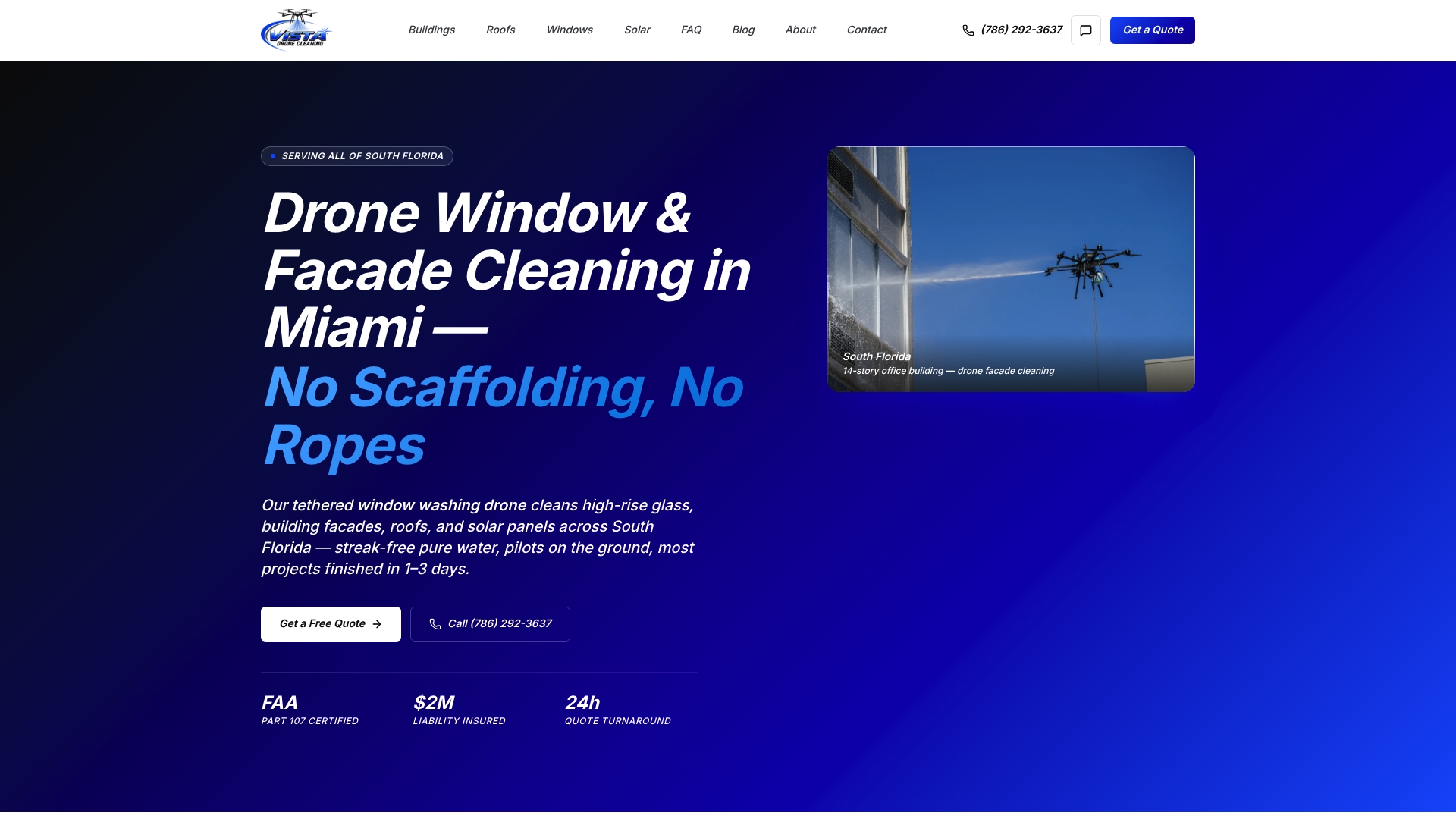
Every project includes 4K before/after documentation you can use for appraisers, lenders, and leasing materials. Vistadronecleaning carries $2M liability insurance and provides free quotes within 24 hours.
For retail center owners ready to connect exterior condition to leasing performance, request a free site review or compare drone versus traditional cleaning methods to see where the cost and timeline differences are sharpest for your property type.
Sources
- Understanding the contribution of curb appeal to retail real estate values
- Downtown Storefront Improvements Analyzing Return on Investment (Issue 180, March 2015) – Community Economic Development
- Commercial Property Curb Appeal ROI: Quantifying the Value of Exterior Maintenance - RueVac Property Services RueVac Property Services
- Ada
- Understanding the contribution of curb appeal to retail real estate values (Portland State / research excerpt)
FAQ
Does curb appeal increase retail property value?
Yes. Hedonic-pricing research finds that the architectural and atmospheric dimensions of curb appeal have a statistically significant positive effect on retail real estate sales prices, and industry analyses suggest well-maintained exteriors can correspond to uplifts of up to approximately 7% versus comparable neglected properties.
Does curb appeal affect a commercial appraisal?
Directly. Appraisers use observable building condition to make adjustments in both the cost and sales comparison approaches; visible deferred maintenance, staining, or damaged features typically produce a negative adjustment relative to better-maintained comparable properties.
What are the most common curb-appeal mistakes retail owners make?
The two most frequent are repainting before cleaning (which wastes money when mildew or salt deposits cause premature paint failure) and treating exterior maintenance as discretionary rather than scheduling it on an annual cycle, which allows South Florida’s coastal conditions to accelerate degradation between leasing seasons.
What is the fastest curb-appeal improvement for a retail property?
Façade soft-wash and window cleaning deliver the highest visual impact per dollar spent and typically complete in one to three days without permits or tenant disruption. For high-façade retail centers, drone-based cleaning through a service like Vistadronecleaning removes the cost and delay of scaffolding entirely.
Recommended
- Facade Cleanliness and Tenant Attraction: 2026 Guide, Vista Drone Cleaning
- Why Buildings Need Facade Maintenance: A Property Manager’s Guide, Vista Drone Cleaning
- Retail Facade Cleaning Without Parking Closure: 2026 Guide, Vista Drone Cleaning
- Shopping Center Facade Maintenance Checklist for Property Managers, Vista Drone Cleaning