
Why High-Rise Windows Streak After Rain: A Manager's Guide
Discover why high-rise windows streak after rain and learn effective cleaning tips. Ensure crystal-clear views and enhance maintenance strategies!
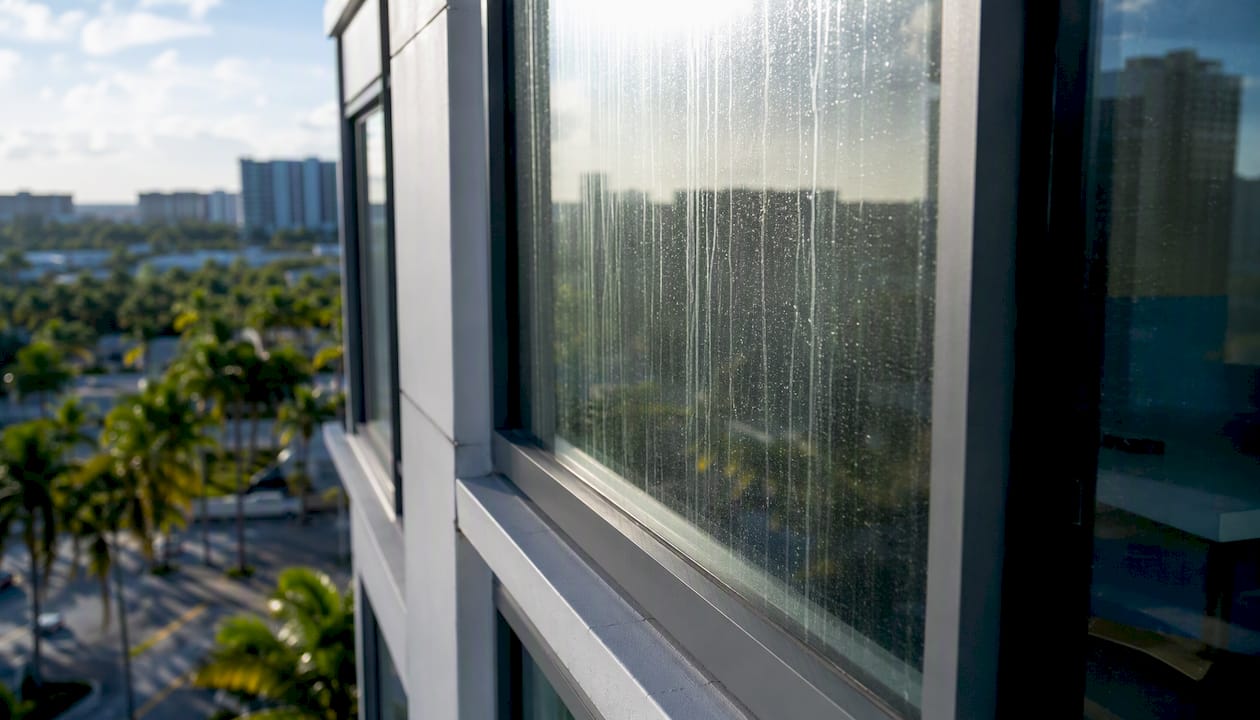

High-rise window streaks after rain come from what the rain collects, not the water itself. Raindrops scavenge airborne particles (pollen, soot, dust) on the way down, then pick up more residue from frames, ledges, and rooflines as they run across the glass. When the water evaporates, those particles stay behind as visible deposits. Research confirms that truly clean glass dries clear from rain; streaking is almost always a sign of underlying buildup or runoff.
Three immediate actions for your maintenance schedule:
- Clean glass and frames before any forecasted heavy rain, especially during South Florida’s spring pollen season.
- Inspect gutters and rooflines above each affected pane. Roof runoff is a major streak source that window cleaning alone won’t fix.
- When mineral or salt deposits keep reappearing, a pure de-ionized water rinse or a professional cleaning service like Vistadronecleaning will outperform standard tap-water methods.
Table of Contents
- Why do high-rise windows streak after rain?
- How do South Florida conditions change your streaking risk?
- How can you diagnose what left the streaks?
- What maintenance schedule actually prevents post-rain streaking?
- When should you call a professional high-rise cleaner?
- Maintenance checklist you can paste into your CMMS
- Key Takeaways
- The part most managers underestimate
- Vistadronecleaning handles the full exterior, not just the glass
- FAQ
Why do high-rise windows streak after rain?
Rain starts relatively pure. As a droplet falls through the atmosphere, it acts as a tiny collector, pulling in whatever is suspended in the air: pollen grains, traffic soot, fine dust, and in coastal areas, salt particles. Scientists call this process atmospheric scavenging, and it means a droplet arriving at your 20th-floor window is already carrying a payload before it touches the glass.
Once on the surface, the droplet runs downward, picking up more material from ledges, frames, and any existing film on the glass. It then sheets or beads, depending on the surface condition, and eventually evaporates. The water disappears; the particles don’t. What you see as a streak is the concentrated residue left behind in the droplet’s path.
Pre-existing hard-water films complicate this further. Mineral deposits from earlier cleaning cycles or prior rain events sit dormant on the glass until new moisture reactivates them, spreading the residue wider with each storm.
Pro Tip: Different deposit patterns tell you different things. Vertical gray streaks running from frame edges usually mean traffic film or soot. Chalky white spots clustered in the center of panes point to mineral buildup. Brown or green drips from the top of the pane almost always trace back to gutter or roofline runoff.
How do South Florida conditions change your streaking risk?
South Florida’s combination of coastal exposure, year-round humidity, heavy traffic, and active construction makes post-rain streaking more frequent and more severe than in most U.S. markets. Commercial properties here face salt, sun, and traffic film as recurring issues that push cleaning cadence higher than a standard quarterly schedule.
Risk factors worth tracking for each property in your portfolio:
- Distance from the coast (salt spray intensity drops significantly beyond a mile inland)
- Tree canopy overhangs, particularly ornamental palms and ficus common in Coral Gables and Coconut Grove
- Proximity to high-traffic corridors (I-95, US-1, Brickell Avenue) for traffic film accumulation
- Active construction nearby, which generates fine concrete and silica dust
- Screen condition on operable windows (dirty screens act as particle filters that deposit debris directly onto glass when rain passes through them)
A waterfront condo tower in Aventura, for instance, faces salt spray, high humidity, and seasonal Saharan dust simultaneously. That combination typically warrants monthly or bi-monthly professional cleaning rather than the quarterly schedule that might work for an inland office park in Plantation.
How can you diagnose what left the streaks?
Start with a visual inspection from the ground or a safe interior vantage point before anyone approaches the glass at height. Then follow these steps, staying within safe access limits:
- Inspect the roofline and gutters above the affected panes. Overflow staining or organic debris near the top of the streak pattern points to a drainage problem, not just a glass problem.
- Wet a small test area with pure water. If the deposit dissolves and rinses clean, it’s likely salt or loose pollen. If it stays, you’re dealing with mineral scale or bonded film.
- Apply a small amount of mild dish soap to a non-abrasive pad and agitate gently on a test patch. Traffic film and pollen lift with light surfactant. Mineral scale won’t.
- Check for white crust at window edges. Salt deposits dissolve with plain water; mineral scale does not. That distinction tells you whether you need a surfactant or a targeted mineral-removal product.
- Photograph every pattern before touching anything. A 4K image taken at the right angle captures deposit texture and distribution, which helps a contractor scope the job accurately.
Safety note: steps 1 and 5 are safe for any staff member. Steps 2 through 4 require ground-floor or safely accessible windows only. Do not attempt elevated access without certified fall protection. Any pattern that traces to roofline or gutter runoff should trigger a roof and gutter inspection before the next window cleaning cycle.
What maintenance schedule actually prevents post-rain streaking?
A cleaner substrate and a clear roofline are the two variables that most reliably reduce rain-driven streaking. Fixed calendar schedules miss this. Exposure level is what should drive frequency.

| Exposure Level | Building Type | Suggested Frequency |
|---|---|---|
| Low | Inland office, minimal traffic, no canopy | Quarterly |
| Moderate | Urban mid-rise, moderate traffic, some tree cover | Bi-monthly |
| High | Coastal, heavy traffic corridor, construction nearby | Monthly |
| Very High | Beachfront, Brickell/downtown, active construction | Monthly to bi-weekly |
Best practices to build into every service contract:
- Clear gutters and downspouts before rainy season (May through October in South Florida).
- Schedule a pre-rain clean during peak pollen months (February through April) to minimize particulate load on the glass.
- Replace or clean window screens at least twice a year; dirty screens are a frequently overlooked streak source.
- Specify a pure de-ionized water final rinse on every professional service call to prevent mineral spotting.
- Include roofline and ledge cleaning on the same service visit as window cleaning, separate contracts for each create gaps.
- Document with 4K before/after photos on every visit for warranty and insurance purposes.
Pro Tip: After a Saharan dust event, which South Florida sees most summers. Schedule a professional deep clean within two weeks. Dust that bakes onto glass in the heat becomes significantly harder to remove than fresh deposits.
When should you call a professional high-rise cleaner?
Call a professional when access, stain severity, or recurrence makes in-house work unsafe or inefficient. For any glass above the second floor, that threshold arrives quickly. Rainwater on truly clean glass dries clear; if streaks keep returning after in-house cleaning, the underlying film hasn’t been removed and a professional-grade process is needed.
When evaluating vendors, require these credentials:
- FAA Part 107 certification for any drone-based cleaning operation
- $2M liability insurance minimum
- Pure de-ionized water capability for final rinses
- Tethered industrial drones or equivalent safety systems that keep crews on the ground
- 4K before/after documentation included in the scope
- Project timeline estimate (most commercial jobs should complete in 1–3 days)
- Demonstrated cost comparison versus traditional scaffold or lift methods
Ask vendors directly: What are your fall-protection protocols? Do you clear roofline and gutter sources before cleaning glass? What’s your warranty on mineral spot recurrence?
Vistadronecleaning meets all of these criteria. The company operates with FAA Part 107-certified pilots and tethered industrial drones to clean buildings up to 200 feet without scaffolding or rope access, and uses a streak-free pure de-ionized water rinse backed by $2M liability insurance. Most projects complete in 1–3 days at 30–60% lower cost than traditional scaffold methods.
Maintenance checklist you can paste into your CMMS
- Inspect gutters, downspouts, and roofline above each affected facade
- Photograph all stain patterns in 4K before any cleaning attempt
- Test a small patch with pure water to identify deposit type
- Schedule pre-rain clean during February–April pollen season
- Book professional cleaning if stains persist after two in-house attempts
- Verify vendor carries $2M liability insurance and FAA Part 107 certification (for drone services)
- Specify de-ionized final rinse in every professional cleaning contract
- Include roofline and ledge clearance in the same service scope as window cleaning
- Specify streak-free high-rise glass cleaning steps in your RFP language
- Track cleaning dates, deposit types, and weather events in your CMMS for cadence optimization; job management software built for window cleaning operations can automate recurring work orders and vendor scheduling
Key Takeaways
Post-rain streaking on high-rise glass is a substrate and runoff problem, not a weather problem: clean glass with a clear roofline dries streak-free after rain.
| Point | Details |
|---|---|
| Root cause | Rain scavenges airborne particles and reactivates existing films; clean glass dries clear. |
| South Florida priority | Coastal salt, traffic film, and pollen make monthly to bi-monthly cleaning standard for high-exposure buildings. |
| Scheduling rule | Match cleaning frequency to exposure level (coastal/urban/tree canopy), not a fixed calendar. |
| When to escalate | Call a professional when stains recur after in-house cleaning or when access requires elevated equipment. |
| Vistadronecleaning | Meets all vendor criteria: FAA Part 107 pilots, tethered drones, pure de-ionized rinse, $2M insurance, 1–3 day project timelines. |
The part most managers underestimate
The window is rarely the real problem. After working with commercial properties across Miami-Dade and Broward, the pattern is consistent: a building that keeps streaking after every storm almost always has a roofline or gutter issue feeding debris onto the glass. Managers order window cleaning; the streaks return in two weeks; they order window cleaning again. The cycle continues because the source was never addressed.
South Florida’s combination of coastal salt, year-round pollen, and intense afternoon rain makes this issue more acute in this region compared to many others. A Brickell tower and a Fort Lauderdale beachfront hotel differ significantly in maintenance challenges from an inland office park, so treating them identically wastes budget. The buildings that stay cleaner longer are the ones where the roofline, gutters, screens, and glass are all maintained together on an exposure-matched schedule.
Vistadronecleaning’s approach (FAA Part 107-certified pilots, tethered industrial drones (Lucid Bots Sherpa), pure de-ionized water rinse, and $2M liability insurance) addresses the full exterior in a single mobilization. That matters because combining roof, ledge, and glass cleaning in one visit removes the source and the symptom at the same time. Building facade maintenance done this way produces results that last noticeably longer between service calls.

Vistadronecleaning handles the full exterior, not just the glass
For South Florida property managers dealing with recurring post-rain streaks, the fastest path to lasting results is a single-mobilization service that clears the roofline, ledges, and glass in one visit. Vistadronecleaning does exactly that across Miami-Dade, Broward, and Palm Beach counties, using ground-based crews, tethered industrial drones, and a pure de-ionized water final rinse that leaves no mineral spotting.

Most commercial projects complete within a few days. The company’s drone window washing process eliminates scaffolding, road closures, and permit delays, and comes backed by $2M liability insurance and 4K before/after documentation. Compared to traditional scaffold or lift bids, this method often provides significant cost savings.
Request a free quote within 24 hours at vistadronecleaning.com/high-rise-window-cleaning or review the drone vs. traditional cleaning comparison before your next RFP.
FAQ
Why do windows streak after rain even when they looked clean?
Rain picks up airborne particles during its fall and reactivates existing mineral or salt films on the glass. Even a light residue layer is enough to produce visible streaks once the water evaporates.
How often should South Florida high-rises schedule window cleaning?
Exposure level determines frequency. Coastal and high-traffic buildings in areas like Miami Beach or Brickell generally require more frequent cleaning, while lower-exposure inland properties often manage a less frequent schedule.
Does a pure de-ionized water rinse actually prevent streaking?
Yes. De-ionized water contains no dissolved minerals, so it evaporates without leaving spots. It’s the standard final-rinse method for commercial high-rise glass and a key differentiator in professional bids.
What credentials should I require from a high-rise window cleaning contractor?
Require FAA Part 107 certification for any drone-based work, $2M liability insurance, pure de-ionized water capability, and 4K before/after documentation. Vistadronecleaning meets all of these standards for South Florida commercial properties.
Can cleaning the roofline reduce window streaking?
Directly. Gutter overflow and roofline debris are among the most common streak sources on high-rise glass. Including roofline and ledge clearance in the same service scope as window cleaning removes the source, not just the symptom.