No Road Closures: High Rise Window Cleaning for South Florida HOAs
South Florida HOAs: FAA Part 107 tethered drone cleaning that avoids road closures. Confirm $2M insurance, LAANC, and 4K documentation.
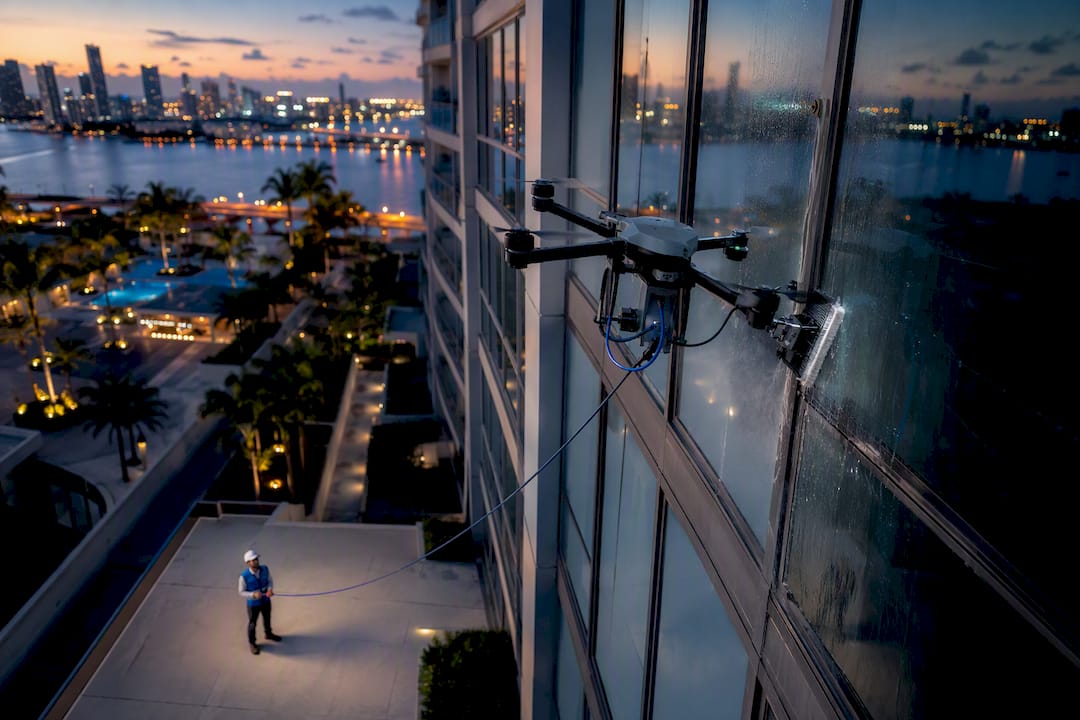
Yes: FAA Part 107-certified tethered drone cleaning washes high-rise windows and facades without shutting down a single lane. Crews and equipment stay on the ground or tethered overhead, so there’s no scaffold staging, no lift truck blocking traffic, and no permit application sitting on a city desk for weeks. Vista Drone Cleaning runs this exact service across Miami-Dade, Broward and and Palm Beach counties, backed by Part 107 pilots, $2 million in liability insurance, and a pure de-ionized water rinse that leaves no streaks or spots.
TL; DR:
- Tethered drone cleaning uses a ground or rooftop crew, avoiding the need for scaffold staging or traffic disruption, and can typically complete projects within a few days.
- The process relies on FAA Part 107-certified pilots operating under strict airspace authorization, with most flights limited to 400 feet unless structure-based exceptions apply.
- Cost savings come from eliminating multi-day rigging, permits, and traffic control plans, making drone cleaning cheaper and faster than traditional scaffold or lift methods.
- The system delivers streak-free results with pure de-ionized water and captures 4K footage for documentation, providing verifiable records for property owners.
- Before hiring, verify the operator’s FAA certification, LAANC authorization or waivers, and liability insurance of at least $2 million, and request sample before-and-after videos.
Table of Contents
- How does tethered drone window cleaning actually work?
- What benefits does drone cleaning offer over scaffolding and lifts?
- What FAA rules govern drone window cleaning near buildings?
- What should you ask a drone cleaning provider before hiring?
- What does a no-closure cleaning day look like on site?
- Do South Florida buildings actually see results like this?
- When does drone cleaning make the most sense?
- Get a Free Quote From Vista Drone Cleaning
- Sources
- FAQ
How does tethered drone window cleaning actually work?
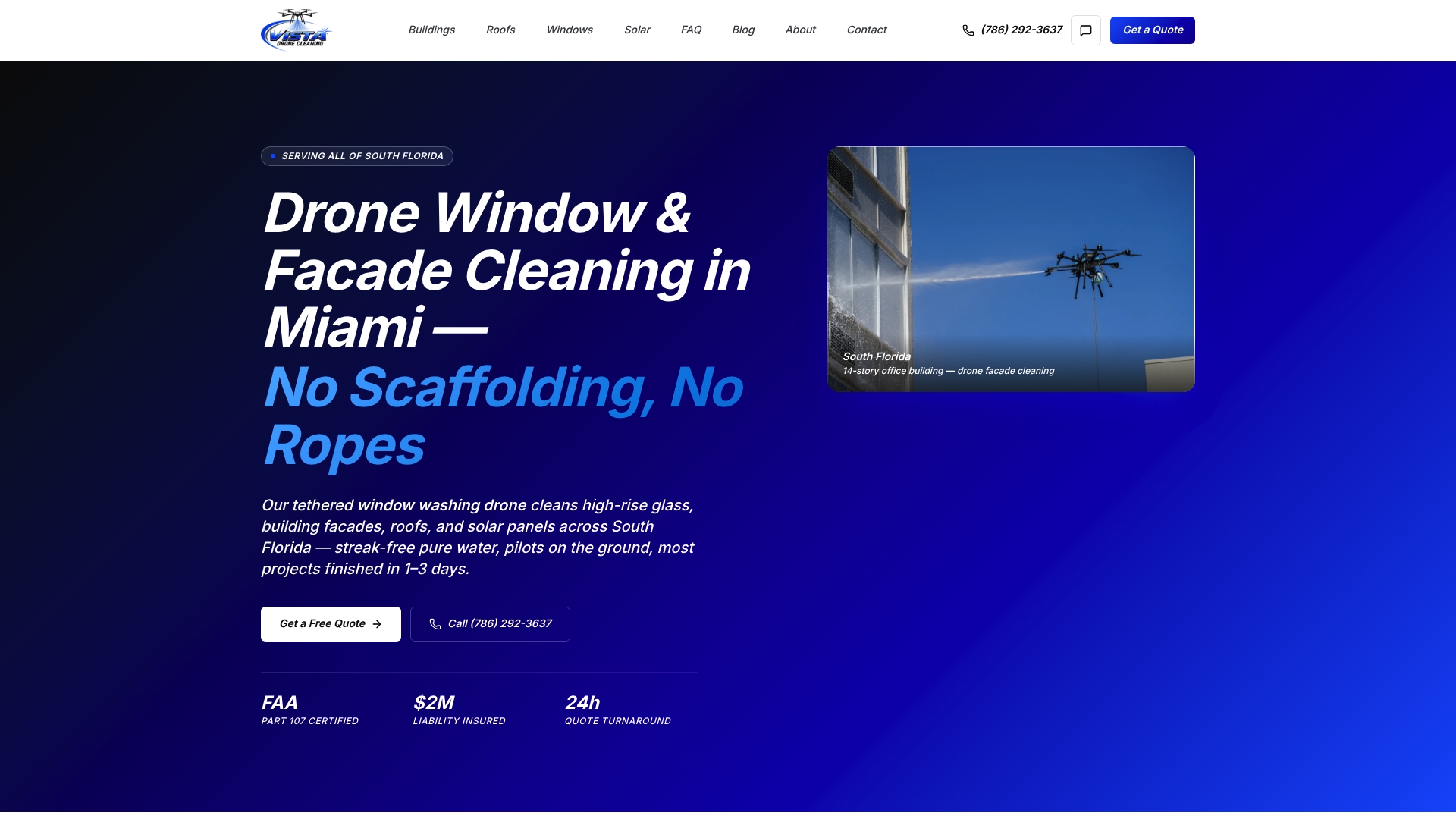
A tethered industrial drone platform, flown by an FAA Part 107-certified remote pilot, does the physical washing while a ground crew manages logistics from the sidewalk or a rooftop staging point. A visual observer tracks the aircraft and airspace the entire time, which is standard practice under Part 107. There’s no boom lift parked in a traffic lane and no scaffold frame climbing the facade.
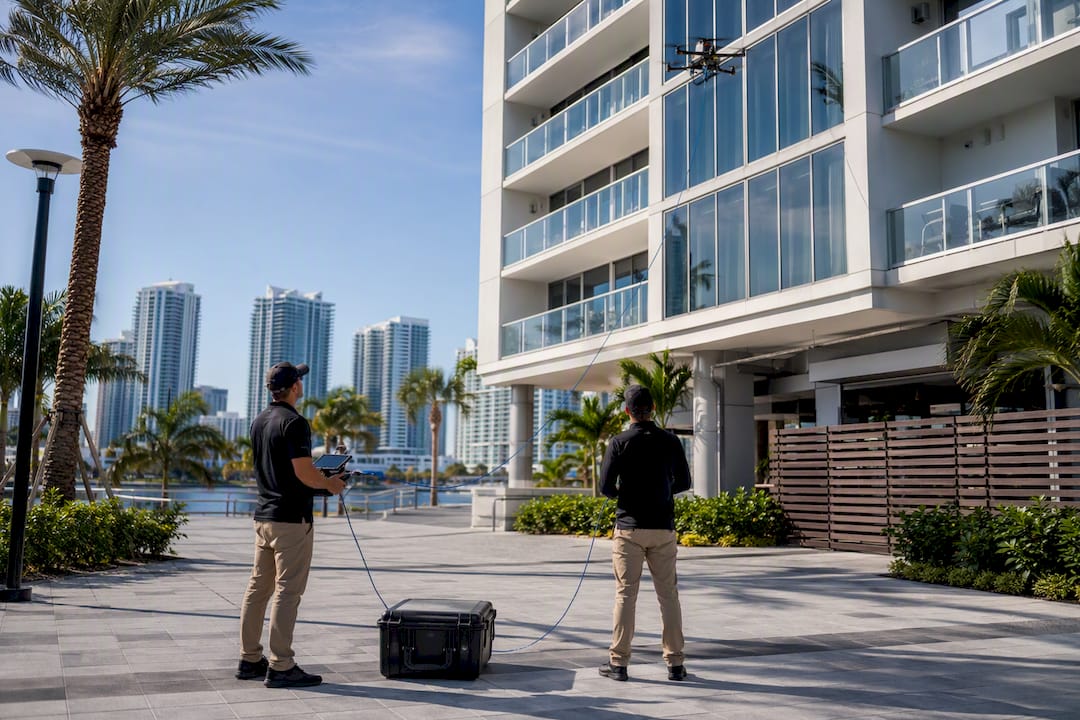
The cleaning system itself relies on pure de-ionized water pushed through a remote nozzle, which leaves zero mineral residue and dries streak-free on glass, unlike tap water. For facades, crews can add substrate-matched soft-wash chemistry calibrated for stucco, EIFS, concrete, metal panels, or tile, since a chemical mix that’s safe on glass can etch a painted surface. Onboard cameras capture 4K footage throughout the job, which becomes the before-and-after documentation building owners keep on file.
These platforms handle buildings up to 200 feet, reaching recessed balconies and setbacks that a straight-line boom lift often can’t touch. A typical crew runs two to three people: the pilot, the spotter, and a ground technician managing water lines and staging. Setup usually takes under an hour because there’s no scaffold to erect or rope rigging to inspect.
- Tethered drone, ground operator, and visual observer make up the core crew
- Pure de-ionized water eliminates spotting and mineral streaks on glass
- Soft-wash chemistry is matched to the specific substrate, not applied blanket-style
- Reach extends past 200 feet without rope access or lift equipment
- 4K video and photo documentation record the job as it happens
The result is a cleaning method that behaves less like a construction project and more like a scheduled service visit, which is exactly what most property managers actually want.
What benefits does drone cleaning offer over scaffolding and lifts?
The biggest shift is where the risk sits. With scaffolding, rope access, or boom lifts, workers are suspended or standing at height for hours, and that exposure is the single largest liability line item in most high-rise maintenance contracts. Tethered drone cleaning keeps every person on the ground, which removes the at-height injury risk from the job site entirely.
Time and cost follow the same logic. Industry data on drone facade cleaning shows projects that once took several days can often finish in a single day, with meaningful reductions in both labor time and total cost compared to scaffold or lift crews. Vista Drone Cleaning’s own projects typically wrap in a few days with a meaningful cost advantage compared to traditional rigging methods, largely because there’s no multi-day setup or teardown built into the price.
- No scaffold staging area means no blocked sidewalks or parking spots
- No road closure permits, traffic control plans, or city sign-offs required
- Tenants and hotel guests see minimal disruption compared to weeks of rigging
- Streak-free pure-water rinse plus 4K documentation gives owners a verifiable record
Removing road closures also means removing the permitting delays that come with them, which is often the real bottleneck on urban jobs in Brickell or downtown Fort Lauderdale.
What FAA rules govern drone window cleaning near buildings?
Every legitimate operator flying commercially in South Florida works under FAA Part 107, which sets the baseline rules for small unmanned aircraft. Property managers don’t need to become aviation experts, but knowing the framework helps you ask the right questions.
- Remote pilot certification. The Remote Pilot in Command (RPIC) must hold a valid Part 107 certificate, and operations generally happen during daylight or civil twilight hours with Remote ID broadcasting active.
- Altitude limits. Part 107 caps most flights at 400 feet above ground level, though structure-based exceptions allow drones to fly higher when working within 400 feet laterally of a tall building, which covers most South Florida high-rises.
- Airspace authorization. Many commercial districts in Miami-Dade and Broward sit inside controlled airspace near airports, and LAANC provides near-instant digital authorization for most altitudes cleaning crews actually need.
- Waivers for edge cases. Operations that exceed standard limits, such as flying over pedestrians or beyond visual line of sight, require a formal Part 107 waiver, and the FAA typically wants documented safety mitigations before approving one.
Ask any contractor for their LAANC authorization records and, if applicable, waiver paperwork. A reputable operator keeps this documentation on hand for every job, not just when asked.
What should you ask a drone cleaning provider before hiring?
Vetting a vendor for high-rise work means checking paper, not just price. Start with credentials: request the pilot’s Part 107 certificate number, proof of current LAANC authorization or a documented waiver if the job requires one, and a certificate of insurance showing at least $2 million in liability coverage.
Safety planning matters just as much. Ask how the crew manages ground perimeters, how many spotters are on site, and what the fail-safe procedure looks like if the drone loses connection or battery power mid-job. A vendor who can’t answer this clearly in one sentence probably hasn’t thought it through.
- Confirm Part 107 pilot ID and current medical/currency status
- Request LAANC authorization or waiver documentation for the specific site
- Verify $2 million (or higher) liability insurance in writing
- Get a fixed-price proposal with named exclusions, not a vague estimate
- Ask what substrate-matched chemistry they’ll use on your specific facade material
Pro Tip: Ask for a sample 4K before-and-after clip from a comparable building before signing. It tells you more about actual water pressure and rinse quality than any sales pitch will.
What does a no-closure cleaning day look like on site?
A drone cleaning job follows a tighter, more predictable rhythm than a rigging project, mostly because there’s so little to physically build before work starts.
- Pre-job survey. The provider checks the building’s airspace classification, confirms LAANC status or waiver needs, and walks the site to plan staging and water access.
- Setup. Crews arrive, mark a small ground perimeter with cones or signage, and position the tethered drone system, all typically inside an hour, with no scaffold zone eating into parking or sidewalk space.
- Execution. The pilot flies the facade or window sections in passes, watching wind speed and visibility, while pedestrian and vehicle flow around the building continues uninterrupted.
- Closeout. The crew checks for overspray or debris, delivers the 4K before-and-after documentation to the property manager, and schedules the next maintenance cycle if the client wants recurring service.
Most jobs on mid-rise and high-rise South Florida buildings finish within one to three days total, start to finish.
Do South Florida buildings actually see results like this?
Picture a 22-story condominium tower in Coral Gables with heavy salt spray staining on the north-facing glass, or a Fort Lauderdale office building whose ownership needed the facade cleaned before a tenant walkthrough without shutting down the loading zone below. These are the kinds of jobs where tethered drone cleaning replaces what would otherwise be a multi-week scaffold permit process.
That shift in liability exposure is often the detail that gets a maintenance committee to approve the vendor switch, even before the cost savings do.
- FAA Part 107-certified pilots on every job
- $2 million liability insurance coverage
- Pure de-ionized water rinse for streak-free glass
- 4K before-and-after documentation delivered with every project
When you’re comparing bids, ask providers for hard numbers: hours of tenant or traffic disruption avoided, photo evidence of stain or salt removal, and a clear definition of what counts as job completion.
When does drone cleaning make the most sense?
Drone cleaning earns its place on high-rise maintenance contracts once you actually weigh what scaffold and lift jobs cost in permitting time alone, not just labor. Miami-Dade and Broward permitting offices can take weeks to approve a road closure or sidewalk shed, and that delay often costs more in tenant frustration than the cleaning itself.
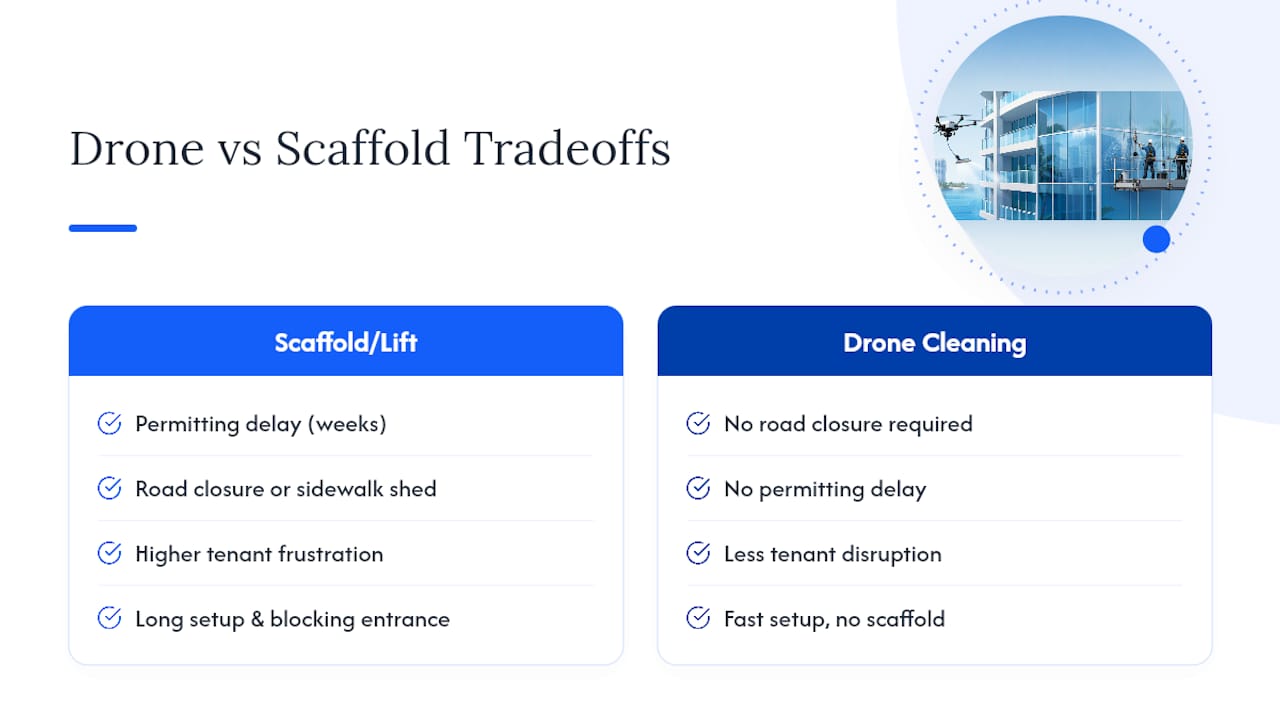
I’d point property managers toward drone cleaning any time a building sits on a busy corridor, faces height restrictions for lift equipment, or simply can’t tolerate a scaffold blocking the entrance for a month. It’s less obviously the right call on a low-rise strip retail center where a lift can set up and finish in an afternoon anyway.
The practical next step is straightforward: request a free site review, ask for proof of Part 107 certification and current insurance, and if a provider offers a short demo video of a comparable building, watch it before you sign anything.
, Eliot
Get a Free Quote From Vista Drone Cleaning
Vista Drone Cleaning gets your high-rise clean without touching the street below it. That’s the actual difference from scaffold and lift crews: no road closure permits, no parking lane blocked for weeks, no ladder trucks idling outside your lobby entrance.
Every job runs on FAA Part 107-certified pilots, backed by $2 million in liability insurance and a pure de-ionized water rinse that leaves glass streak-free. Most projects on Miami-Dade, Broward, and Palm Beach buildings finish in a few days with cost savings compared to traditional rigging methods, and every job wraps with 4K before-and-after documentation you can hand straight to your board or ownership group. Whether it’s window washing, facade soft-wash, roof cleaning, or solar array maintenance, the service works the same way: ground crew, tethered drone, no rigging.
See how the drone cleaning process compares to traditional window cleaning, then request a free quote. Vista Drone Cleaning typically responds with pricing within 24 hours of a site review.
Sources
- Small Unmanned Aircraft Systems (UAS) Regulations: Part 107
- Drone Cleaning vs Traditional Methods: Time, Safety, and Profit Compared, LucidBots
FAQ
Can you clean high-rise windows without closing a road?
Yes. Tethered FAA Part 107 drone cleaning operates from the ground or a rooftop, so it doesn’t require the road closures, parking restrictions, or sidewalk sheds that scaffolding and boom lifts typically need.
Is drone window cleaning legal for commercial buildings in Florida?
It’s legal under FAA Part 107 when the operator holds a valid remote pilot certificate and secures LAANC authorization or a waiver where the airspace requires it.
How much does drone facade cleaning cost compared to scaffolding?
Vista Drone Cleaning’s projects typically cost less than traditional scaffold or lift-based cleaning, largely because there’s no multi-day rigging setup or teardown built into the job.
How long does a drone cleaning project take?
Most high-rise projects in Miami-Dade, Broward, and and Palm Beach counties finish within a few days, compared to the longer timelines scaffold permitting and setup often require.
What insurance should a drone cleaning contractor carry?
Look for at least $2 million in liability insurance, along with documented proof of the pilot’s FAA Part 107 certification and current LAANC authorization for the job site.
Does drone cleaning work on solar panels and roofs, not just windows?
Yes. The same pure-water, tethered drone approach cleans roofs and rooftop solar arrays without foot traffic on the roof surface or lift equipment staged nearby.