Wind Turbine Cleaning: A South Florida Property Manager's Guide
Discover effective wind turbine cleaning methods to boost energy output and extend blade life. Learn about drone solutions in South Florida.

TL;DR:
- Drone-based wind turbine cleaning in South Florida effectively removes salt and biological fouling, maintaining efficiency and blade life. It offers a low-cost, safe, and environmentally compliant alternative for routine maintenance on accessible onshore and nearshore turbines. Proper site assessment, certification, and scheduling ensure optimal performance and regulatory compliance.
Wind turbine cleaning directly affects energy output and blade lifespan, and drone-based methods are a practical option for many onshore and nearshore turbines in Miami-Dade, Broward, and Palm Beach counties.
- Surface contamination from salt spray, insects, and biological fouling can reduce aerodynamic efficiency measurably. An MDPI study found turbines with clogged nacelle filters experienced power output drops equivalent to about 7–10% in affected periods.
- Industry guidance frames cleaning as preventive maintenance that preserves blade coatings and extends asset life, not a cosmetic task.
- Vistadronecleaning operates FAA Part 107-certified drone crews across South Florida and provides wind turbine drone cleaning for eligible onshore and nearshore sites.
The action sequence is simple: inspect → clean → verify. Everything below tells you how to execute each step safely and cost-effectively.
Table of Contents
- Why wind turbine cleaning is a preventive maintenance investment
- Common turbine cleaning methods and when each fits
- Are drones suitable for your South Florida turbine site?
- Safety, risk assessment, and environmental compliance
- How often should you inspect and clean South Florida turbines?
- What affects price and how long a project takes
- How to vet a turbine-cleaning contractor
- Quick decision matrix: drone cleaning or turbine specialist?
- Vistadronecleaning: South Florida’s drone exterior cleaning option
- Key Takeaways
- What South Florida turbine cleaning actually looks like on the ground
- Authoritative sources and suggested reading
- FAQ
Why wind turbine cleaning is a preventive maintenance investment
Blade contamination changes the aerodynamic profile of a rotor. Insects, salt crystals, pollen, and biological growth roughen the leading edge, increasing drag and reducing lift. Over time, that surface degradation compounds: contamination accelerates leading-edge erosion, which shortens coating life and eventually requires expensive structural repairs.
South Florida adds its own pressure. Salt spray from Biscayne Bay and the Atlantic coats blades year-round, and humidity above 70% for most of the year creates ideal conditions for algae and mold. Bird migration corridors over Miami-Dade and Broward bring heavy fouling during fall and spring. After a tropical storm, debris and salt-laden moisture can deposit a thick glaze on blades overnight.
Cleaning also sequences correctly into broader O&M. Cleaning before other maintenance tasks prevents contaminants from entering sensitive components and gives technicians a clear surface to spot new cracks, oil seeps, or coating failures. That sequencing alone reduces secondary damage and improves repair accuracy.
Pro Tip: Schedule blade cleaning immediately before your next scheduled O&M visit. Technicians get a clean surface to inspect, and you avoid paying for a separate mobilization.
Common turbine cleaning methods and when each fits
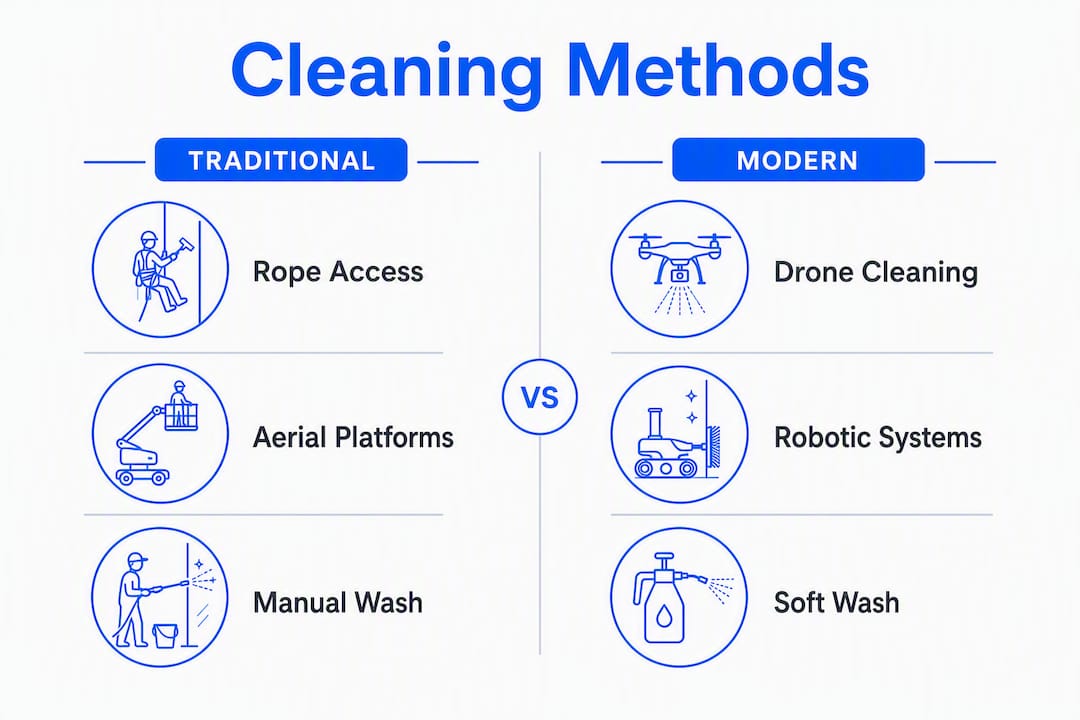
Five methods dominate the field. Each has a distinct cost profile and set of access requirements.
- Rope access: Technicians descend from the nacelle on certified rigging. Precise, close-up work; suitable for severe contamination and coating repairs. Requires IRATA/SPRAT credentials and a full rescue plan.
- Aerial work platforms / boom lifts: Ground-based lifts reach lower sections of the tower and root of the blade. Limited by terrain, ground bearing capacity, and maximum reach height.
- Ground/boat-based washing: High-pressure lances from the ground or a vessel. Effective for tower exteriors; limited reach and pressure at blade height.
- Robotic systems: Automated crawlers attach to the blade surface. Consistent pressure; high mobilization cost and limited availability in South Florida.
- Drone-based washing: Drone systems with adjustable pressure (60–120 bar) and flow rates of 6–10 L/min handle blade and tower surfaces without rigging. Modular water and battery swaps extend runtime. Suitable for low-to-moderate contamination on accessible onshore and nearshore turbines.
| Method | Best for | Safety complexity | Relative cost | Inspection synergy |
|---|---|---|---|---|
| Rope access | Severe fouling, coating repair | High | High | Excellent |
| Boom lift | Tower base, blade root | Moderate | Moderate | Good |
| Ground/boat wash | Tower exterior | Low | Low | Limited |
| Robotic system | Uniform blade surfaces | Low (once deployed) | High (mobilization) | Moderate |
| Drone wash | Accessible onshore/nearshore | Low (crew on ground) | Low–Moderate | Good (4K imaging) |
Rope access and aerial platforms remain necessary when contamination is severe or structural repair is involved. Drones fill the gap for routine cleaning cycles where access is straightforward.

Are drones suitable for your South Florida turbine site?
The short answer: yes, for most onshore and nearshore turbines with moderate contamination, within the limits below.
Technical limits to verify:
- Wind speed: Most commercial cleaning drones operate safely below 20–25 mph sustained wind. South Florida’s afternoon sea breeze regularly exceeds that; morning windows are typically the operational sweet spot.
- Height and payload: Drone water modules carry finite volume. Larger turbines may require multiple payload swaps per blade, adding time on site.
- Pressure and chemistry: Systems delivering 60–120 bar handle typical salt and biological fouling. Oil contamination or hardened grease usually requires rope access and solvent chemistry.
- Offshore exposure: True offshore turbines require marine-rated equipment, vessel support, and additional FAA coordination. Nearshore sites within line-of-sight are generally feasible.
Regulatory and airspace requirements:
| Requirement | Detail |
|---|---|
| FAA Part 107 | Required for all commercial sUAS operations; pilots must hold current certification |
| BVLOS waiver | Required if the drone flies beyond visual line of sight (rare for most turbine sites) |
| Airspace authorization | LAANC or FAA waiver for controlled airspace near Miami Executive, Fort Lauderdale/Hollywood, or Palm Beach International |
| Local permitting | Miami-Dade and Broward may require site-specific permits for water discharge or chemical use |
Decision flow for site managers:
- Confirm turbine height and access road condition.
- Check prevailing wind data for the site (NOAA buoy data for coastal sites).
- Identify airspace class and proximity to controlled airports.
- Assess contamination type: salt/bio fouling = drone-eligible; oil/structural damage = specialist required.
- Verify the contractor holds FAA Part 107 and $2M+ liability insurance.
- If all five checks pass, drone cleaning is appropriate. If any fail, escalate to rope-access specialists.
Safety, risk assessment, and environmental compliance
A site-specific risk assessment is non-negotiable before any cleaning activity. For South Florida coastal sites, that means accounting for salt-corrosion risk to equipment, afternoon wind gusts, and proximity to sensitive marine ecosystems.
Pre-work checklist every contractor must provide:
- Written site-specific risk assessment signed by a qualified supervisor
- Emergency response plan with a named first-aid administrator and evacuation route
- FAA Part 107 pilot certificates and current airspace authorization
- Proof of liability insurance ($2M minimum for commercial turbine work)
- PPE inventory: harnesses, helmets, goggles, and chemical-resistant gloves for any crew near chemistry
- Before/after 4K photo and video documentation protocol
Environmental controls specific to South Florida:
- Cleaning agents must be biodegradable and approved for use near coastal waterways; Miami-Dade and Broward county stormwater rules prohibit untreated chemical runoff into drainage systems.
- Runoff capture mats or berms are required when washing near storm drains or retention ponds.
- Chemical safety data sheets (SDS) must be on site and available to inspectors.
For eco-friendly chemistry selection and substrate-matched soft-wash protocols, verify the contractor can provide product-specific SDS documentation before signing a contract.
Pro Tip: Photograph runoff containment setup before cleaning begins. That image, combined with the SDS on file, is your documentation if a county inspector asks questions later.
How often should you inspect and clean South Florida turbines?
Coastal and nearshore turbines in Miami-Dade and Broward typically need inspection every 3–6 months and full cleaning at least twice per year. Protected onshore sites in western Palm Beach County may extend to annual cleaning with quarterly visual checks.
Inspection indicators that mean clean now, not later:
- Visible salt glaze or white crystalline deposits on the leading edge
- Streaking patterns near the blade root or trailing edge
- Algae or biological growth visible from ground level
- SCADA data showing rising nacelle temperature or repeated partial shutdowns (a clogged nacelle filter is a common hidden cause)
- Unexplained drops in power output during periods of adequate wind
Seasonal triggers for South Florida:
- Post-hurricane/tropical storm: Inspect within 72 hours of storm passage for debris, salt glaze, and coating damage.
- Fall/spring bird migration: October through November and March through April bring peak fouling from migratory species along the Atlantic flyway.
- Dry season (November–April): Dust events from the Everglades and agricultural areas west of Fort Lauderdale deposit fine particulate on blade surfaces.
Treat SCADA nacelle temperature as your early-warning system. A sustained rise of several degrees above baseline, with no change in ambient conditions, often points to a filtration or surface-fouling issue that cleaning will resolve before it becomes a repair.
What affects price and how long a project takes
Cost drivers for turbine cleaning in South Florida fall into five categories: access complexity, contamination severity, number of turbines and blades, water and chemistry requirements, and documentation deliverables. Drone cleaning reduces mobilization costs by eliminating rigging, scaffolding, and road closures, which is where traditional methods accumulate the most overhead.
Typical pricing structures:
- Per-blade pricing: common for small fleets; easy to scope and audit
- Per-turbine day rate: suits larger sites with multiple units
- Fixed-project price: preferred for single-mobilization contracts with defined scope
- Change orders: triggered by undisclosed contamination type, access restrictions discovered on site, or additional documentation requirements
Project timeline from first contact to final report:
| Phase | Typical duration |
|---|---|
| Site survey and quote | 1–2 days |
| Risk plan and approvals | 2–5 days |
| Cleaning (on site) | 1–3 days per turbine cluster |
| Post-cleaning inspection and reporting | 1–2 days |
For ROI-focused maintenance scheduling, build the cleaning cost into your O&M budget as a line item alongside filter replacement and lubrication cycles.
How to vet a turbine-cleaning contractor
Use this numbered checklist before issuing a purchase order.
- Confirm FAA Part 107 certification for every pilot on the project. Ask for certificate numbers and verify at FAA DroneZone.
- Request a certificate of insurance showing $2M+ general liability and name your property as an additional insured.
- Ask for documented turbine or high-rise experience in South Florida. References from Miami-Dade, Broward, or Palm Beach sites are more relevant than out-of-state work.
- Review the proposed cleaning chemistry. Substrate-matched, biodegradable formulations are required for coastal sites; ask for the SDS.
- Demand a written scope of work that lists inclusions, exclusions, runoff containment method, and photographic deliverables.
- Check corrosion-control protocols for drone equipment. Salt air degrades unprotected electronics; ask how the contractor protects and maintains their systems.
Use the contractor vetting checklist to structure your RFP evaluation.
Sample questions to ask candidates:
- “What is your emergency rescue plan if a technician is incapacitated at height?”
- “Can you provide before/after 4K documentation as a contract deliverable?”
- “Which cleaning agents do you use on salt-fouled blades, and do you have the SDS on file?”
Red flags that should end the conversation:
- Refusal to provide insurance certificates or pilot credentials
- No site-specific risk assessment in the proposal
- Generic scope with no runoff containment plan
- No documented experience with turbines or structures above 100 feet
Quick decision matrix: drone cleaning or turbine specialist?
| Criteria | Drone cleaning | Turbine specialist (rope access) |
|---|---|---|
| Contamination type | Salt, bio, dust, pollen | Oil, hardened grease, structural damage |
| Turbine height | Up to accessible operational height | Any height |
| Offshore exposure | Nearshore only | Offshore capable |
| Leading-edge condition | Intact coating, surface fouling | Erosion, delamination, cracks |
| Rescue complexity | Low (crew on ground) | High (at-height rescue plan required) |
| Timeline | 1–3 days | 3–7+ days |
Push toward a specialist when:
- Visible erosion, delamination, or structural cracking is present
- Oil contamination requires solvent chemistry and confined-space protocols
- The turbine is true offshore with no line-of-sight access
- Manufacturer-authorized coating repair is part of the scope
For routine salt and biological fouling on accessible South Florida onshore sites, drone cleaning is the faster and lower-cost path.
Vistadronecleaning: South Florida’s drone exterior cleaning option
South Florida property managers dealing with salt-fouled turbines, solar arrays, and building facades have a local, FAA-certified option that skips the scaffolding entirely.

Vistadronecleaning deploys FAA Part 107-certified pilots and industrial tethered drones across Miami-Dade and Broward counties. No rigging, no road closures, no boom lifts. Most projects wrap in 1–3 days at 30–60% lower cost than traditional scaffold methods. The team carries $2M liability insurance, delivers before/after 4K documentation on every project, and uses substrate-matched, biodegradable chemistry suited to South Florida’s coastal environment.
For turbine sites that qualify, the same drone platform handles blade and tower surface cleaning, nacelle exterior wash, and solar panel pure-water cleaning for any co-located PV arrays. Request a free site survey and quote at vistadronecleaning.com/wind-turbine-drone-cleaning. Quotes come back within 24 hours.
Key Takeaways
Routine wind turbine cleaning is a measurable O&M investment: surface fouling reduces aerodynamic efficiency, accelerates coating erosion, and can suppress power output by 7–10% in affected periods, according to the MDPI study.
| Point | Details |
|---|---|
| Inspect on a schedule | Coastal South Florida turbines need inspection every 3–6 months; clean at least twice per year. |
| Use SCADA as an early warning | Rising nacelle temperature or unexplained output drops often signal a cleaning need before visible fouling appears. |
| Match method to contamination | Salt and bio fouling: drone-eligible. Oil, structural damage, or offshore exposure: use rope-access specialists. |
| Demand proof before signing | Require FAA Part 107 certificates, $2M insurance, SDS documentation, and a written runoff containment plan. |
| Vistadronecleaning | FAA-certified drone cleaning for eligible South Florida turbine sites, with 4K documentation and $2M liability coverage. |
What South Florida turbine cleaning actually looks like on the ground
The environmental conditions in Miami-Dade, Broward, and Palm Beach are genuinely different from what most cleaning guides assume. Salt air doesn’t just foul blades; it corrodes unprotected drone electronics, degrades chemical containers, and shortens the window between contamination and coating damage. The practical reality is that a turbine sitting two miles from the coast in Broward County needs a cleaning schedule that a turbine in a dry inland climate simply doesn’t.
What gets overlooked in most procurement conversations is the sequencing problem. Managers often schedule cleaning after other O&M tasks, which means technicians are working on surfaces still coated in salt glaze and biological growth. Cleaning first gives every subsequent inspection a clean baseline. That’s not a minor efficiency gain; it’s the difference between catching a hairline crack early and missing it under a layer of fouling.
Drone-based approaches make the most sense for South Florida’s typical onshore and nearshore turbine profile: accessible sites, moderate contamination, and a need for documented deliverables that satisfy insurance and regulatory requirements. The crew-on-ground model also removes the at-height rescue complexity that drives up cost and planning time for rope-access work.
Authoritative sources and suggested reading
- Energy yield and nacelle filtration: MDPI study on nacelle air filtration and turbine performance — best source for SCADA-linked inspection triggers and power-loss evidence.
- Preventive maintenance framing: Dangle Academy wind turbine cleaning guide — practical O&M framing and cleaning-as-asset-care rationale.
- Blade coating and contamination: Solwinda on rotor blade cleaning and coating — leading-edge erosion mechanics and coating lifecycle.
- Safety and risk assessment: AcraStrip safety precautions for wind turbine cleaning — pre-work checklist, PPE, emergency response, and chemical guidance.
- Drone cleaning technical specs: Riggers Pumps drone-based high-pressure washing — pressure, flow rate, and module specs for drone wash systems.
- Maintenance sequencing: Wind Systems Magazine maintenance guidance — why cleaning precedes other O&M tasks.
- Local procurement checklist: Vistadronecleaning contractor vetting guide — South Florida-specific RFP and credential checklist.
FAQ
How much does wind turbine cleaning cost in South Florida?
Pricing depends on turbine count, contamination type, and access complexity. Drone-based cleaning typically costs 30–60% less than scaffold or lift methods due to lower mobilization overhead; request a fixed-project quote that includes runoff containment and documentation deliverables.
How often should turbines be cleaned in a coastal South Florida environment?
Coastal and nearshore turbines in Miami-Dade and Broward generally need full cleaning at least twice per year, with visual inspections every 3–6 months. Post-storm checks after any hurricane or tropical system are also required regardless of schedule.
Does drone cleaning work on all wind turbines?
Drone cleaning suits onshore and nearshore turbines with salt, biological, or dust fouling and intact blade coatings. Oil contamination, structural erosion, or true offshore locations require rope-access specialists with solvent chemistry and at-height rescue capability.
What certifications should a turbine-cleaning contractor carry?
At minimum: FAA Part 107 pilot certification for drone operators, $2M general liability insurance, and documented experience with turbines or structures above 100 feet. For any chemical application near coastal waterways, require biodegradable-approved SDS documentation.
Can Vistadronecleaning clean wind turbines in South Florida?
Vistadronecleaning provides drone-based exterior cleaning for eligible onshore and nearshore turbine sites across Miami-Dade and Broward counties, with FAA Part 107-certified pilots, $2M liability insurance, and before/after 4K documentation on every project.