
Why Hotels Need Streak-Free Windows to Protect Their Brand
Keeping hotel windows streak-free boosts guest perceptions and review scores. Discover easy steps to enhance your property's cleanliness.
Streak-free windows are one of the highest-ROI, lowest-effort improvements a South Florida hotel can make to protect guest perception, review scores, and long-term glazing assets. Start here: (1) assign a facilities lead to run a daily lobby glass spot-check before 8 AM, (2) require before/after 4K photos from every exterior cleaning vendor, and (3) schedule an exterior inspection with an FAA Part 107-certified provider like Vistadronecleaning before the next peak tourist season. Those three steps cost almost nothing to implement and directly address the most visible cleanliness signals your guests photograph and post.
Key Takeaways
Streak-free windows are a measurable guest-experience KPI that directly affects review scores, repeat bookings, and long-term glazing costs for South Florida hotels.
| Point | Details |
|---|---|
| Cleanliness drives bookings | Ecolab research shows 40% of guests rank cleanliness in their top three hotel-selection factors, making glass appearance a direct booking variable. |
| Demand-based scheduling outperforms fixed calendars | Trigger cleaning passes by salt spray, pollen season, post-storm deposits, and occupancy surges rather than a fixed date. |
| Require pure deionized water and documentation | Specify sub-10 ppm TDS water and before/after 4K photos in every vendor contract to verify streak-free results. |
| Window cleaning is preventive maintenance | Professional passes catch seal failures and facade deterioration early, avoiding costly capital repairs. |
| Vistadronecleaning for South Florida high-rises | FAA Part 107-certified drone cleaning reaches 200 feet with no scaffolding, completing most hotel facade projects in 1–3 days. |
Table of Contents
- Why streak-free window cleaning matters more than most hotels realize
- What actually causes streaks and why a rushed cleaning often makes things worse
- Proven streak-free methods your hotel should require from vendors
- How to set a cleaning schedule and the KPIs that keep vendors accountable
- Access methods, safety tradeoffs, and how to minimize guest disruption
- When drone cleaning is the right call for a South Florida hotel
- How to build the financial case for a streak-free window program
- An operational checklist your facilities team can use today
- A direct take on what most hotels get wrong about window cleaning
- Vistadronecleaning serves South Florida hotels with streak-free, low-disruption high-rise cleaning
- Sources
- FAQ
Why streak-free window cleaning matters more than most hotels realize
Guests form a cleanliness judgment within seconds of arrival, and glass is one of the first surfaces they read. An Ecolab consumer study found that 40% of surveyed guests ranked cleanliness among their top three hotel-selection factors, behind only price and location. That same research identified cleanliness as the leading driver of both positive reviews and the kind of negative ones that stick on TripAdvisor and Google for months.
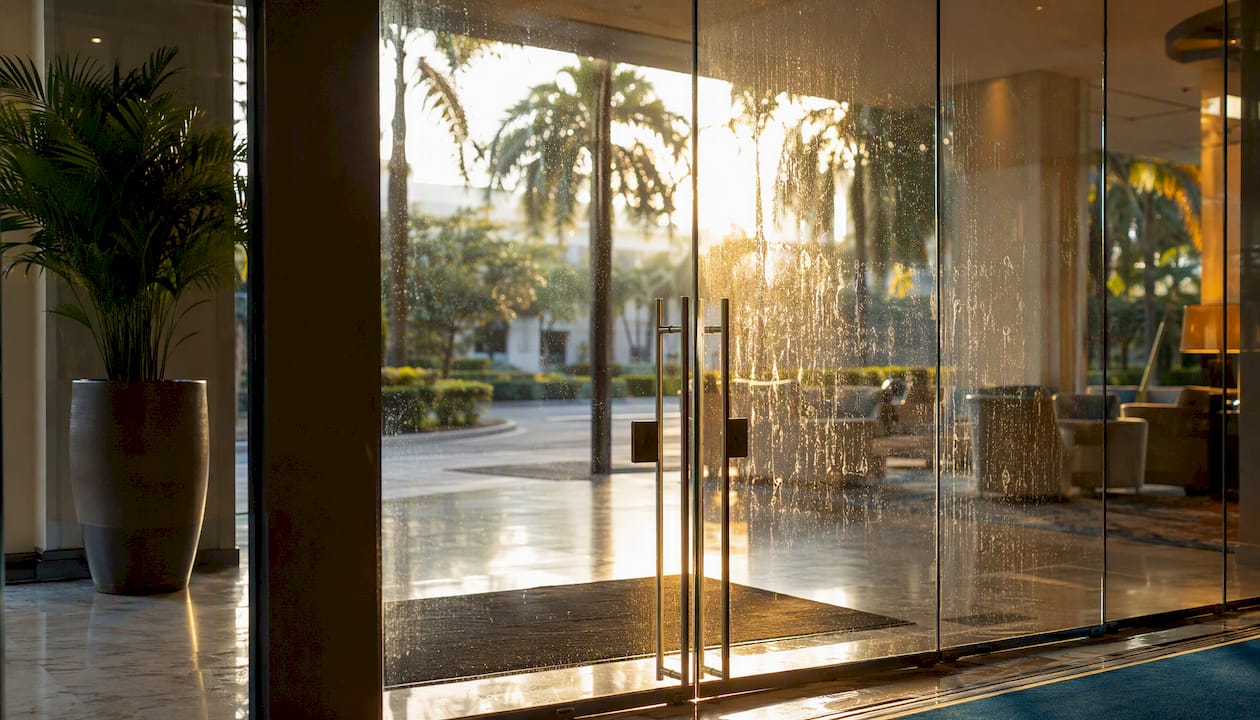
Windows are a proxy for the whole property. A guest who spots a streaked lobby door or a hazy pool-facing pane doesn’t think “the glass needs cleaning.” They think “this place isn’t maintained.” That mental shortcut is fast and largely unconscious, which is exactly what makes it dangerous for your brand.
The practical consequences show up in measurable ways. Lower cleanliness scores on OTA platforms reduce click-through rates on your listing. Guests who post photos of their stay capture streaked glass in the background without realizing it, and those images circulate. Repeat booking rates drop when the property doesn’t match the aspirational photos on your website.
South Florida compounds the problem. Salt spray off Biscayne Bay and the Atlantic coats Brickell, Miami Beach, and Fort Lauderdale facades within days of a cleaning. Spring pollen season in Broward and Palm Beach counties adds a film that turns any residual moisture into a visible streak. After a tropical storm, mineral-laden runoff dries on glass and leaves deposits that a standard squeegee pass won’t remove.
The glass areas that most directly shape first impressions:
- Lobby entry doors and floor-to-ceiling glass walls
- Porte-cochère and valet drop-off windows
- Restaurant and bar windows facing the pool or street
- Pool deck glass panels and sliding doors
- Guest-room windows on lower floors visible from the arrival path
Demand-driven cleaning schedules for these high-traffic areas consistently outperform fixed calendar-based routines because they respond to actual conditions rather than an arbitrary date.
What actually causes streaks and why a rushed cleaning often makes things worse
Streaks come from four sources: dissolved minerals left behind when water evaporates, detergent residue from incorrect dilution, re-soiling from dirty squeegee blades or contaminated microfiber, and incomplete rinsing that leaves a thin film on the glass surface.
South Florida’s municipal water supply runs hard in many areas. When a crew uses tap water without treatment and lets it air-dry, the calcium and magnesium salts crystallize into the white haze that’s almost impossible to remove with a second pass of the same water. The problem compounds when a vendor uses too much detergent. More soap does not mean cleaner glass; it means more residue to rinse, and if the rinse is rushed, the residue stays.
Squeegee hygiene is underrated. A blade that has picked up grit from a previous pane drags that grit across the next one, leaving micro-scratches and a faint smear. Microfiber cloths that aren’t rotated frequently enough redistribute the oils and minerals they’ve already absorbed. These are the failure points that separate a professional pass from a rushed in-house attempt.
Interior glass has a different profile. Fingerprints, cosmetic residue, and HVAC condensation are the main culprits. Housekeeping cadence matters more here than water chemistry, and a daily wipe with a clean microfiber and a low-residue glass cleaner is usually sufficient for lobby-level interior panes.
Pro Tip: Ask any exterior cleaning vendor to show you a TDS (total dissolved solids) meter reading of the water they’re using. Pure or deionized water should read below 10 ppm. A reading above 50 ppm means the water will leave mineral deposits when it dries, regardless of technique. This one question separates vendors who understand streak-free chemistry from those who don’t.
Professional cleaning passes also serve as early facade inspections. Trained crews regularly spot seal failures, glass corrosion, or facade deterioration during a wash operation, flagging issues before they become six-figure remediation projects.
Proven streak-free methods your hotel should require from vendors
Pure deionized water paired with correct mechanical technique produces the most consistent streak-free finish on exterior hotel glass. The physics are straightforward: water with no dissolved solids leaves nothing behind when it evaporates, so no minerals, no film, no streaks.
Method profiles by building type and situation:
- Pure/deionized water systems: Best for exterior glass at any height. Water is purified to below 10 ppm TDS, applied under pressure, and left to air-dry without a squeegee pass. No detergent, no residue, no secondary rinse needed. The preferred method for South Florida coastal properties where salt and mineral load is high.
- Water-fed poles: Telescoping poles that deliver purified water to the brush head. Effective up to roughly 60–70 feet from ground level, low guest disruption, no access equipment needed. A practical choice for mid-rise hotel wings and ground-floor restaurant windows.
- Squeegee and microfiber: The standard for interior glass, spot cleaning, and low-level exterior work. Requires clean blades, fresh microfiber, and correct detergent dilution. Highly dependent on technician skill and tool hygiene.
- Boom lifts and aerial work platforms: Rapid coverage for mid-rise facades, but require permits, traffic cones, and cordons in busy areas like Brickell or South Beach. Guest disruption is moderate to high during setup and operation.
- Rope access (IRATA-certified): High-skill method for complex facades, curved glass, or areas where lifts can’t reach. Higher labor cost, but no ground footprint. Requires documented rescue plans and IRATA certification from every technician.
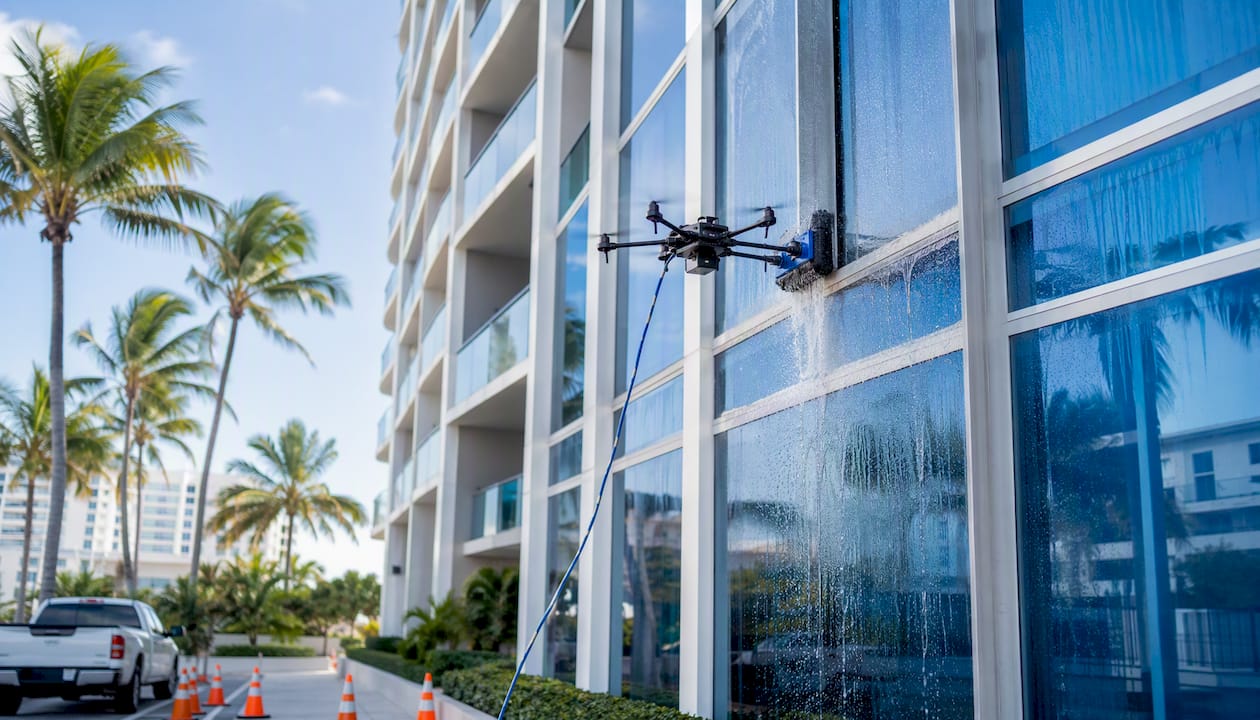
- Drone-assisted cleaning: Tethered industrial drones reach facades up to 200 feet, keep crews on the ground, and need no scaffolding or road closures. Particularly suited to dense South Florida urban environments where street access is limited and guest disruption tolerance is low.
When choosing a method, match it to your building profile and the time of year. Water-fed poles work well for Fort Lauderdale beach-facing mid-rises during shoulder season. A drone pass makes more sense for a 30-story Brickell tower during peak occupancy when you can’t afford a cordon on the arrival drive.
Pro Tip: Require before/after 4K photos and a short video of at least one cleaning pass as a standard deliverable in every vendor contract. This documentation proves streak-free technique, creates a visual baseline for the next service, and gives you evidence if a corrective pass is needed. Operational best practices include test rinses with purified water and rotating microfiber heads as verification steps.
Pure-water systems also reduce chemical use significantly. No detergent in the process means no chemical runoff into landscaping, pool areas, or storm drains, which aligns with sustainability commitments many South Florida hotels now include in their brand messaging. For properties pursuing LEED or Green Key certification, this is a documentable operational improvement.
How to set a cleaning schedule and the KPIs that keep vendors accountable
Frequency should be demand-driven, not calendar-driven. The right trigger for a cleaning pass is the condition of the glass, not the date on a spreadsheet. That said, South Florida gives you predictable triggers: salt spray accumulation after any sustained onshore wind, spring pollen season (roughly February through April in Miami-Dade and Broward), post-storm mineral deposits after a tropical system, and occupancy surges during Art Basel, Ultra, and spring break that put more eyes on your property.
A practical prioritized schedule for South Florida hotels:
- Lobby entry doors and floor-to-ceiling glass: Daily spot-check by housekeeping or front-of-house staff; full professional wipe 2–3 times per week.
- Porte-cochère and arrival-path windows: Professional pass 2–3 times per week; daily spot-check during peak occupancy.
- Restaurant and pool-facing windows: Weekly professional pass; increase to twice weekly during high-season months (December through April).
- Guest-room exterior panes (lower floors, visible from grounds): Monthly professional pass; increase after any tropical weather event.
- Upper-floor exterior facades: Quarterly full pass minimum; add a post-storm pass after any named storm or significant weather event.
- Deep-clean windows and wall coverings: Include windows in annual deep-clean plans and increase frequency during inclement weather seasons.
Vendor KPIs to include in your RFP or service contract:
- Streak-free compliance rate: Minimum 95% of inspected panes pass a streak-free visual check on random post-service inspection.
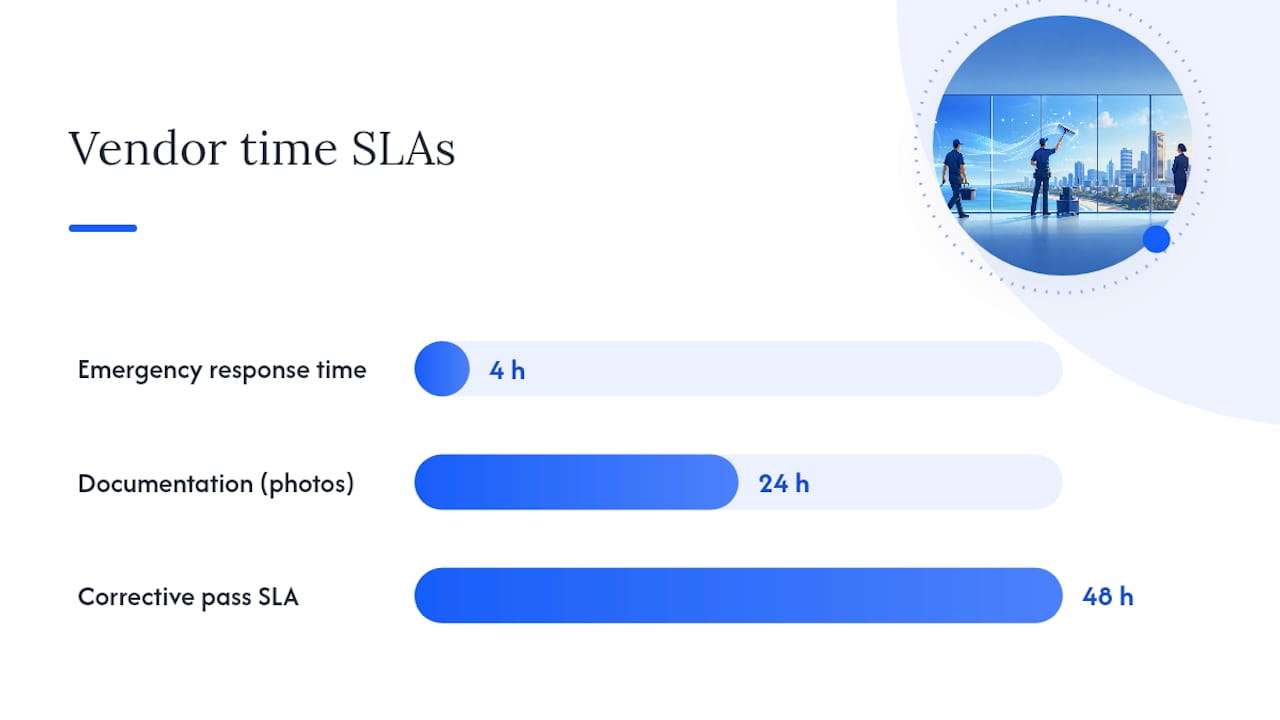
- Emergency response time: Vendor must mobilize for spot-cleaning within 4 hours of a written request during peak season.
- Documentation: Before/after 4K photos delivered within 24 hours of each service visit.
- Corrective pass SLA: Any pane failing the streak-free standard must be re-cleaned within 48 hours at no additional cost.
- Facade defect reporting: Vendor submits a written report of any observed seal failures, corrosion, or surface damage within the service documentation.
These clauses are short enough to drop directly into a standard facilities services agreement. The streak-free compliance rate and corrective pass SLA are the two that vendors notice most, because they create accountability for the finish quality, not just the activity of showing up.
Access methods, safety tradeoffs, and how to minimize guest disruption
The right access method balances three variables: safety for workers and guests, disruption to hotel operations, and cost relative to your building profile. No single method wins on all three for every property.
Ground-based water-fed poles are the least disruptive option for anything reachable from grade. No equipment staging, no permits, minimal runoff management. The limitation is reach: above roughly 60–70 feet, pole systems lose pressure consistency and the operator can’t see the glass surface clearly enough to verify quality.
Boom lifts and aerial work platforms cover mid-rise facades quickly, but they require a ground footprint. In dense areas like Brickell, South Beach, or Las Olas in Fort Lauderdale, that footprint often means a lane closure or a cordon across the arrival drive, which is a real problem during check-in windows. Permits add lead time, and the equipment staging itself signals “construction” to arriving guests.
IRATA rope access eliminates the ground footprint entirely. Technicians descend from the roof, which means no street-level disruption. The tradeoff is cost and scheduling: IRATA-certified crews are smaller, and complex facades take longer to cover. Every rope-access vendor should carry documented rescue plans and proof of IRATA certification for every technician on the job.
Drone-assisted cleaning changes the disruption calculus for South Florida high-rises. Tethered industrial drones reach facades up to 200 feet, keep the entire crew on the ground, and require no scaffolding, rigging, or road closures. For a 25-story hotel in Brickell or a beachfront tower in Aventura, a drone pass can cover the full facade in 1–3 days with no cordon on the arrival drive and no guest-visible rigging overhead.
Trust signals to require from any access vendor before signing a contract:
- FAA Part 107 certification (drone pilots)
- IRATA certification documentation (rope-access technicians)
- Proof of liability insurance with policy limits of $2M or higher
- Written rescue/emergency plan specific to your building
- Before/after 4K photo documentation as a standard deliverable
Schedule exterior work to avoid the 7–10 AM and 3–5 PM check-in/check-out peaks. Runoff from any cleaning method creates slip hazards on arrival paths; coordinate with the front desk so bell staff can manage guest flow around wet surfaces.
When drone cleaning is the right call for a South Florida hotel
Drone cleaning is often the fastest, least disruptive option for mid- to high-rise hotel facades in dense South Florida environments, provided the vendor uses FAA Part 107-certified pilots and tethered industrial drones rather than consumer-grade equipment.
That time and disruption difference matters most during peak occupancy.
Vendor due-diligence checklist for drone cleaning in Miami-Dade, Broward, and Palm Beach:
- FAA Part 107 pilot certificate (request the certificate number and verify at FAA DroneZone)
- $2M+ liability insurance certificate naming your property as an additional insured
- Before/after 4K documentation included as a standard deliverable
- References from at least two hotel or commercial high-rise projects in South Florida
- Written local weather plan covering sea breeze timing, sudden afternoon storms, and wind speed thresholds for grounding operations
- Runoff and chemical mitigation strategy in writing (pure-water systems produce no chemical runoff)
South Florida-specific scheduling note: salt-air corrosion risk is highest on east-facing facades in Miami Beach, Sunny Isles, and Pompano Beach. Schedule drone passes for these facades more frequently than inland-facing glass, and avoid scheduling during peak pollen weeks (late February through March) when a fresh cleaning will show deposits within 48 hours. Non-disruptive facade washing strategies for South Florida hotels cover these scheduling nuances in detail.
How to build the financial case for a streak-free window program
Window cleaning is preventive maintenance, not a cosmetic line item. That reframe matters when you’re presenting the budget to ownership.
The direct cost drivers are access method, building height and facade complexity, cleaning frequency, documentation requirements, and South Florida seasonality (post-storm passes add cost but are non-negotiable for coastal properties).
Where the ROI comes from:
- Review score protection: A one-point improvement in a hotel’s cleanliness score on major OTA platforms correlates with measurable increases in click-through and booking conversion. Cleanliness is the top driver of positive reviews in Ecolab’s consumer research, which means a consistent streak-free program directly protects the metric that drives organic bookings.
- Glazing replacement avoidance: Mineral deposits left on glass for extended periods etch into the surface. Removing etched deposits requires professional restoration or glass replacement, both of which cost significantly more than a regular cleaning pass. Professional cleaning teams also detect seal failures and facade deterioration during service, catching issues before they become capital repairs.
- Complaint remediation savings: A guest complaint about visible dirt or streaks on windows takes front-desk time, sometimes a room move, and occasionally a comp. Multiply that across a season and the cost of prevention looks modest by comparison.
- Reduced rework costs: Requiring pure-water systems eliminates the need for corrective passes caused by detergent residue. One clean pass done right costs less than one pass plus a callback.
Cost-saving levers worth building into your vendor contract: move from reactive to scheduled cleaning, specify pure-water systems as a contract requirement, and use drone options for upper-floor facades to eliminate lift permit costs. For South Florida hotels, bundling post-storm passes into an annual contract at a fixed rate also smooths budget predictability.
An operational checklist your facilities team can use today
A streak-free glass program doesn’t require a full facilities overhaul. It requires clear ownership, a short daily protocol, and vendor accountability built into the contract.
Daily and weekly actions:
- Assign one front-of-house or housekeeping staff member to inspect lobby entry doors and ground-floor glass before 8 AM daily; log pass/fail with a phone photo.
- Keep a supply of clean microfiber cloths and a low-residue glass cleaner at the front desk for immediate spot corrections on interior glass.
- Designate a facilities lead to review vendor before/after photos within 24 hours of each exterior service visit and flag any panes that don’t meet the streak-free standard.
- Log all exterior cleaning visits, weather events, and guest complaints about glass appearance in a single shared document (a simple Google Sheet works).
Vendor accountability actions:
- Include streak-free compliance rate, corrective pass SLA, and documentation requirements in every service contract (see the KPI list in the scheduling section above).
- Request a TDS meter reading from any new vendor before the first service visit.
- Review the building exterior maintenance checklist to integrate window cleaning into your broader facade care calendar.
- For common hotel facade cleaning oversights, audit your current vendor contract against the checklist before renewal.
Seasonal adjustments for South Florida:
- Increase lobby and entry-path cleaning frequency in December through April (peak tourist season, maximum guest eyes on the property).
- Schedule a full exterior pass within 72 hours after any tropical weather event.
- Add a pollen-season pass in late February or early March before the spring break surge.
- For coastal properties in Miami Beach, Sunny Isles, or Pompano Beach, treat east-facing glass as a separate high-frequency zone.
A direct take on what most hotels get wrong about window cleaning
Most hotel operations teams treat window cleaning as a scheduled task rather than a managed standard. The schedule gets set once, usually by a facilities manager who inherited it from the previous one, and it runs on autopilot until a GM notices a guest complaint or a bad review mentions dirty windows.
The problem with that approach is that it optimizes for activity, not outcome. A vendor can show up on schedule, complete the pass, and still leave streaks if the water quality is wrong, the tools are contaminated, or the technique is rushed. Without before/after documentation and a streak-free compliance check, you have no way to know whether the service you paid for actually delivered the result you needed.
The shift that makes the biggest practical difference is treating streak-free glass as a measurable KPI, the same way you’d treat room cleanliness scores or response time on maintenance requests. Set the standard in writing, require proof, and hold vendors to a corrective pass SLA. That single change in how you manage the contract produces better results than switching vendors every two years.
For South Florida hotels specifically, the other underestimated factor is access method. A lot of properties default to whatever vendor they’ve used for years, often one that uses tap water and a squeegee from a ladder. That approach was never going to produce consistent streak-free results on a 20-story glass facade in a salt-air environment. The building profile and the local conditions require a method that matches them.
A three-step pilot is the lowest-risk way to test a new approach: (1) commission a site survey with before photos of your highest-visibility glass, (2) run a single cleaning pass with a vendor using pure deionized water and proper documentation, and (3) review the before/after photos and any guest feedback over the following 30 days. The result either justifies the program or tells you exactly what to adjust.
Vistadronecleaning serves South Florida hotels with streak-free, low-disruption high-rise cleaning
South Florida hotels need a vendor who understands both the building profile and the local conditions. Vistadronecleaning operates across Miami-Dade, Broward, and Palm Beach counties using FAA Part 107-certified pilots and tethered Lucid Bots Sherpa industrial drones that reach facades up to 200 feet, with crews staying safely on the ground throughout. No scaffolding, no road closures, no rigging visible to arriving guests.
Every project includes a pure deionized water rinse for a streak-free finish, before/after 4K documentation delivered within 24 hours, and $2M liability insurance. Free quotes are available within 24 hours.
To start a pilot project, request a site survey and include your building height, facade material, and preferred service window in the inquiry. Request a quote for drone window cleaning in Miami or review how drone window cleaning compares to traditional methods before your next vendor conversation.
Sources
The following sources were cited in this article and are worth bookmarking for ongoing policy and operational reference:
- Ecolab Hotel Cleanliness Consumer Survey
- Why first impressions matter in hospitality and how to get them right: Unger
- Hotel facade & window cleaning systems: Hotel Facility Guide
FAQ
What do hotels use to clean windows without leaving streaks?
Professional hotel window cleaning relies on pure or deionized water systems (below 10 ppm TDS), water-fed poles, and clean squeegee-and-microfiber technique. The key is water quality: tap water leaves mineral deposits when it dries, while deionized water evaporates clean.
How often should a South Florida hotel clean its exterior windows?
High-visibility areas like lobby doors and arrival-path glass warrant professional attention 2–3 times per week, with full exterior facade passes monthly for lower floors and quarterly for upper floors. Add a pass within 72 hours after any tropical weather event.
What is the dish soap trick for streak-free window cleaning?
A small amount of dish soap mixed with water and white vinegar works for small interior smudges, but it tends to leave residue on exterior panes unless followed by a pure-water rinse. Professional exterior cleaning skips detergent entirely and uses deionized water to eliminate residue at the source.
What should hotel managers require from a window cleaning vendor?
Require proof of FAA Part 107 certification (for drone vendors) or IRATA certification (for rope-access crews), $2M+ liability insurance, before/after 4K documentation, a corrective pass SLA of 48 hours, and a TDS meter reading confirming sub-10 ppm water quality before the first service visit.
Does window cleaning actually affect hotel review scores?
Yes. Ecolab’s consumer research identifies cleanliness as the top driver of positive hotel reviews and a leading cause of negative ones. Glass is one of the first surfaces guests assess on arrival, and streaked or hazy windows register as a cleanliness failure even when guests don’t consciously notice the glass itself.