What Causes Falls in Traditional Window Cleaning
Discover what causes falls in traditional window cleaning. Learn key risks and safety tips to protect workers and improve compliance.
TL; DR:
- Ladder instability causes most falls during traditional window cleaning, accounting for 81 percent of incidents. Property managers should focus on proper setup, environmental hazards, and human error to enhance safety. Drone cleaning provides a risk-free alternative by eliminating the need for ladders and height exposure.
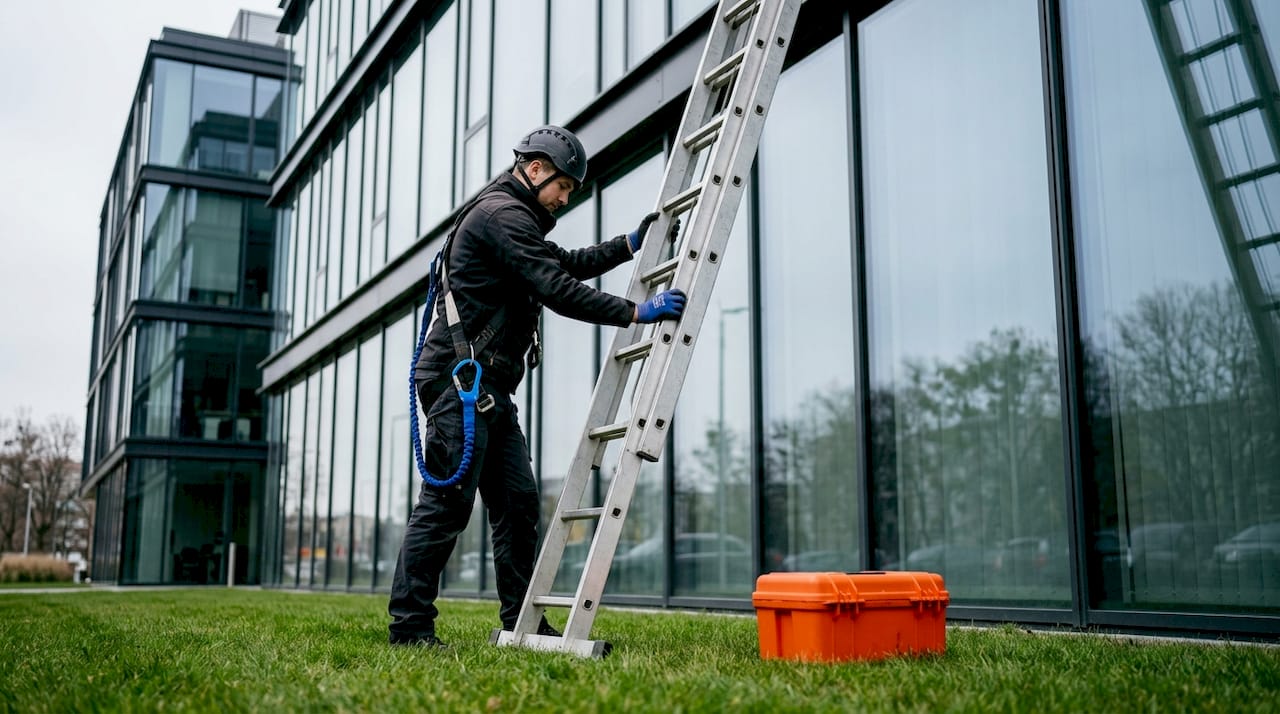
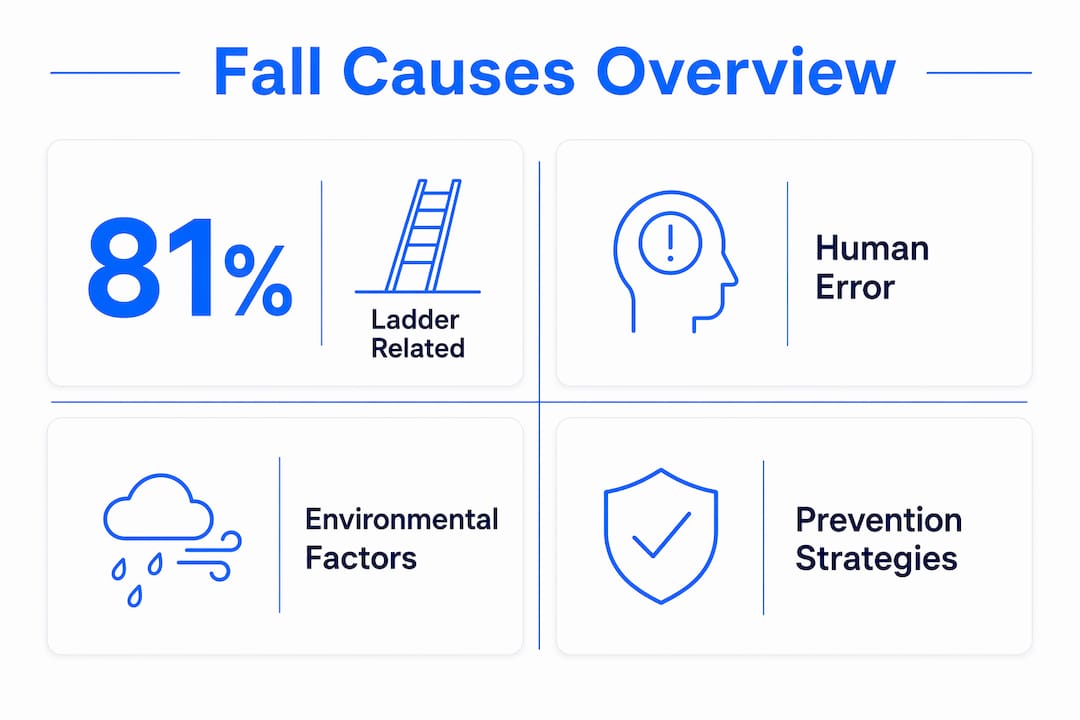
Ladder instability is the primary cause of falls in traditional window cleaning, accounting for 81% of all falls in the trade, with one in three of those incidents resulting in serious or fatal injury. Safety professionals use the term “working at height hazards” to describe this category of risk, and the phrase covers far more than just ladder mechanics. Overreaching, improper base setup, and South Florida’s uneven terrain all compound the danger. For property managers and safety compliance officers overseeing commercial buildings in Miami-Dade and Broward counties, understanding what causes falls in traditional window cleaning is the first step toward enforcing standards that actually protect workers.
What causes falls in traditional window cleaning?
Falls in traditional window cleaning trace back to three root causes: ladder failure, human error, and environmental conditions. These causes rarely act alone. A wet deck in Fort Lauderdale combined with a technician who overreaches to avoid repositioning the ladder is a textbook scenario for a tip-over. The UK Health and Safety Executive confirms that nearly all ladder falls happen because the ladder moves unexpectedly, not because the worker loses grip. That finding shifts the focus from personal protective equipment to ladder placement and terrain preparation.
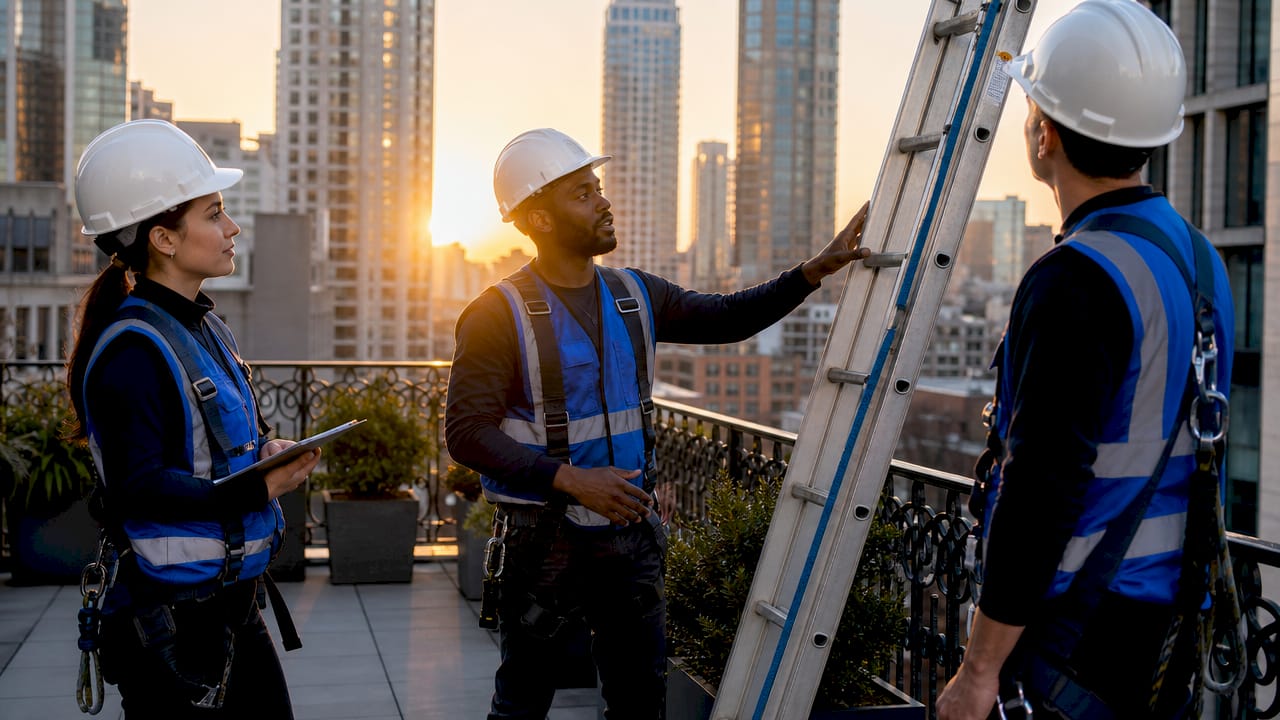
Property managers often assume that falls only matter at great heights. That assumption is wrong. Falls at heights under 10 feet cause a disproportionate share of serious injuries because workers skip fall protection at those elevations. A second-floor window sill in Coral Gables sits 8–12 feet off the ground. That is enough height to cause a life-altering injury when a ladder shifts on a sloped patio.
How do ladder setup errors cause falls?
Ladder setup errors are the most preventable cause of falls during window cleaning, yet they remain the most common. OSHA’s 4-to-1 rule requires that for every four feet of ladder height, the base must sit one foot away from the wall. That ratio produces a 75-degree angle, which is the geometry of a stable ladder. Deviating from it by even a few inches on soft South Florida soil can cause the base to kick out under load.
The terrain across Miami-Dade and Broward counties creates specific setup challenges:
- Soft or sandy soil near coastal properties in Miami Beach and Aventura allows ladder feet to sink and shift under a technician’s weight.
- Decorative rock and gravel bases around building perimeters in Boca Raton and Coral Springs provide no consistent load-bearing surface.
- Sloped concrete patios and pool decks common in Coconut Grove and Plantation tilt the ladder’s base angle away from the required 75 degrees.
- Wet pavers and tile around hotel and condominium entrances in Brickell become slick after South Florida’s frequent afternoon rain.
- Grass and mulch landscaping along building facades in Pompano Beach and Hollywood compress unevenly under ladder feet.
Improper ladder base setup on uneven or soft terrain is a direct path to ladder failure. The Levelok ladder stabilization system addresses this directly. Levelok provides up to 10 inches of vertical adjustment, outperforming factory levelers and compensating for the ground variability that South Florida properties present. Property managers who vet contractors should ask whether crews carry aftermarket leveling equipment as a baseline requirement.
Pro Tip: Require contractors to document their ladder setup procedure for each job site, including soil type, slope angle, and leveling equipment used. A written setup log creates accountability and surfaces unsafe practices before an incident occurs.
How does human error lead to window cleaning accidents?
Human error causes falls in window cleaning through a predictable pattern: a technician reaches beyond the ladder’s side rails to avoid the time cost of repositioning. That single decision shifts the center of gravity outside the ladder’s stable base and creates a tip-over risk. Overreaching is the primary behavioral cause of ladder instability in window cleaning, and it happens on nearly every job where productivity pressure exists.
The behavioral sequence that leads to a fall typically follows these steps:
- The technician reaches the limit of safe access from the current ladder position but has only a small section of glass remaining.
- Repositioning feels inefficient, especially on a busy commercial property in Brickell or a hotel facade in Fort Lauderdale where the crew is working against a tight schedule.
- The technician extends beyond the side rail, shifting body weight outside the ladder’s footprint.
- The ladder tips or slides, and the fall happens before the technician can correct.
- The incident is classified as a ladder fall, but the root cause was a scheduling and culture problem, not a ladder problem.
Complacency compounds this pattern. Normalizing deviance, which means treating unsafe shortcuts as routine because nothing bad has happened yet, is the main danger in high-rise and mid-rise window cleaning. A crew that has overreached on 200 jobs without incident stops perceiving it as a risk. Safety training must directly address this psychology, not just repeat equipment checklists.
Pro Tip: Schedule safety audits on days when crews are under time pressure, not on low-volume days. Unsafe behavior surfaces when productivity demands are highest, not when the job is easy.
What environmental factors in South Florida increase fall risk?
South Florida’s climate and landscaping create window cleaning safety risks that do not exist in most other markets. Afternoon thunderstorms in Miami-Dade and Broward counties arrive with little warning and leave surfaces wet for hours. A ladder set up on a dry concrete pad at 9 a.m. may be sitting on a slick surface by 2 p.m. without any change in the crew’s setup.
The table below maps the most common South Florida environmental hazards to their specific fall risk:
| Environmental factor | Where it appears | Fall risk created |
|---|---|---|
| Afternoon rain and humidity | Across all Miami-Dade and Broward properties | Wet surfaces reduce ladder foot traction |
| Sandy or soft coastal soil | Miami Beach, Aventura, Pompano Beach | Ladder base sinks and shifts under load |
| Decorative rock landscaping | Boca Raton, Coral Gables, Coral Springs | No flat load-bearing surface for ladder feet |
| Sloped patios and pool decks | Coconut Grove, Plantation, Hollywood | Base angle deviates from OSHA 4-to-1 rule |
| Confined urban building perimeters | Brickell, downtown Fort Lauderdale | Limited space forces non-standard ladder angles |
Beyond terrain, confined urban layouts in Brickell and downtown Fort Lauderdale force crews to place ladders at angles that do not meet the OSHA 4-to-1 standard. A building with a narrow sidewalk and a wall of glass directly above a planter box leaves almost no room for a compliant setup. Crews either compromise the angle or skip the job section entirely. Neither outcome is acceptable from a safety compliance standpoint.
Fall prevention strategies: what actually works?
Effective fall prevention in window cleaning requires layered controls, not a single fix. The hierarchy runs from eliminating the hazard at the top to personal protective equipment at the bottom.
Equipment and standards that reduce risk
Fall protection equipment following ANSI Z359 standards, which go beyond OSHA minimums, includes full-body harnesses, anchorage points rated for fall arrest loads, and self-retracting lifelines. Contractors who adopt ANSI Z359 voluntarily signal a safety culture that exceeds regulatory compliance. Property managers in Miami-Dade and Broward should treat ANSI Z359 adoption as a contractor selection criterion, not a bonus.
A critical compliance gap affects many South Florida properties. Fall protection regulations apply based on hazard height, not the type of work being performed. Federal OSHA requirements begin at four feet for general industry. Many property managers incorrectly assume that residential or low-rise window cleaning falls outside these requirements. That assumption creates liability exposure when an incident occurs.
Safer alternatives that reduce ladder use
Water-Fed Pole systems allow technicians to clean windows from the ground using purified water fed through telescoping carbon fiber poles. They eliminate ladder use entirely for windows up to approximately 60 feet. For buildings above that height, drone window cleaning removes the worker from the hazard zone completely. Crews operate from the ground while the drone handles the facade. The fall risk drops to zero for the cleaning crew.
For high-rise properties in Miami, Brickell, and Fort Lauderdale, the risks of scaffolding and traditional access methods are well documented. Rope access and boom lifts introduce their own fall and equipment failure risks. Drone-based cleaning eliminates those access methods entirely.
Pro Tip: When reviewing contractor bids, ask specifically whether the crew has a documented emergency rescue plan for suspended workers. Rescue plans for suspended workers must include staged equipment and practiced procedures. Waiting for external emergency services risks fatal suspension trauma.
Key Takeaways
Ladder instability combined with human error and South Florida’s environmental conditions creates the conditions for falls in traditional window cleaning, and property managers who address all three factors reduce incident risk more effectively than those who focus on equipment alone.
| Point | Details |
|---|---|
| Ladders cause most falls | Ladder-related incidents account for 81% of window cleaning falls, with 33% classified as serious or fatal. |
| Low heights are not safe | Falls from 8–12 feet cause severe injuries when workers skip fall protection at those elevations. |
| Overreaching is the top human error | Extending beyond ladder side rails shifts the center of gravity and causes tip-overs on nearly every job type. |
| South Florida terrain adds unique risk | Soft soil, wet pavers, and sloped patios across Miami-Dade and Broward create non-standard ladder conditions. |
| ANSI Z359 exceeds OSHA minimums | Contractors who voluntarily meet ANSI Z359 standards demonstrate a safety culture worth prioritizing in vendor selection. |
The pattern I keep seeing on South Florida properties
After reviewing incident reports and site conditions across Miami-Dade and Broward, the pattern is consistent. The fall almost never happens on the first job at a new site. It happens after a crew has worked the same property 10 or 15 times and stopped looking at the terrain as a variable. The sloped patio in Coral Gables that required a Levelok on the first visit gets treated as a flat surface by the sixth visit because nothing went wrong on visits two through five.
That is normalization of deviance in practice. It is not carelessness. It is the human brain doing what it does: updating its risk model based on recent experience. The problem is that recent experience without an incident does not mean the hazard disappeared. It means the crew got lucky.
Property managers who treat safety compliance as a checkbox exercise will always be one unlucky afternoon away from a serious incident. The managers who build it into contractor selection, site audits, and ongoing documentation create a system that catches the drift before it becomes a fall. That is not a philosophical position. It is what the incident data supports.
South Florida’s conditions make this more urgent than in most markets. The combination of frequent rain, coastal soil variability, and the dense urban layouts of Brickell and downtown Fort Lauderdale means that a ladder setup that worked last month may not work this month. Static safety plans fail here. Dynamic site assessment on every visit is the standard that actually protects workers and limits liability for property owners.
, Eliot
A safer path for South Florida property managers
Traditional window cleaning methods put workers at height on every job. For commercial high-rises, condominiums, and office towers across Miami and Fort Lauderdale, that exposure adds up across hundreds of cleaning cycles per year.

Vistadronecleaning operates FAA Part 107-certified tethered drones, specifically the Lucid Bots Sherpa, to clean building facades, windows, and rooftop surfaces up to 200 feet with crews staying on the ground. No scaffolding, no boom lifts, no rope access, and no ladder setup on soft South Florida soil. Most projects across Miami-Dade and Broward complete in 1–3 days at 30–60% lower cost than traditional scaffold methods. Vistadronecleaning carries $2M in liability insurance and delivers free quotes within 24 hours. See how drone cleaning compares to traditional methods for your property.
FAQ
What percentage of window cleaning falls involve ladders?
Ladder-related falls account for 81% of all falls in window cleaning, with 33% of those incidents resulting in serious or fatal injuries.
Is overreaching really that dangerous on a ladder?
Overreaching shifts a technician’s center of gravity beyond the ladder’s stable base, which causes tip-overs. It is the primary behavioral cause of ladder falls in window cleaning.
Do OSHA fall protection rules apply to low-rise window cleaning?
Federal OSHA fall protection requirements begin at four feet for general industry. Property managers who assume low-rise or residential window cleaning is exempt face real compliance and liability exposure.
What is the OSHA 4-to-1 ladder setup rule?
The OSHA 4-to-1 rule requires the ladder base to sit one foot away from the wall for every four feet of ladder height, producing a 75-degree angle that keeps the ladder stable under load.
How does drone cleaning reduce fall risk for South Florida buildings?
Drone window cleaning keeps the entire crew on the ground, eliminating ladder setup, overreaching, and height exposure entirely. Vistadronecleaning uses tethered industrial drones to clean facades up to 200 feet across Miami-Dade and Broward counties.