SPRAT vs IRATA for U.S. Technicians: 500 vs 1,000 Hours, Plus Drones
Career-first SPRAT vs IRATA comparison for U.S. technicians. Compare 500 vs 1,000 hour timelines, employer preferences, costs, dual-cert options, and when...
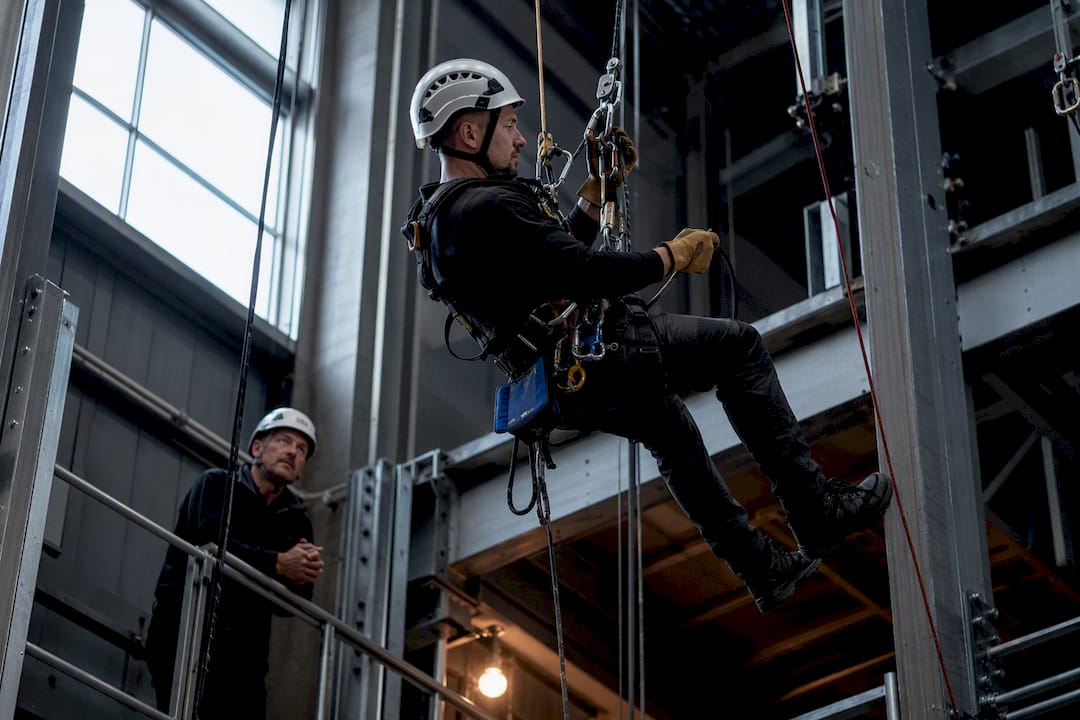
IRATA generally suits technicians targeting international, offshore, or heavy industrial work, while SPRAT tends to fit North American building services careers better and lets you climb the ranks faster. Many working technicians eventually hold both, since dual certification opens doors in both markets without forcing a choice. If you work in the United States, either credential works, but you still have to follow OSHA rules and whichever presiding regulatory authority governs your job site.
TL;DR:
- Most U.S. technicians choose SPRAT first for faster progression, typically reaching Level 3 in about six months with 500 logged hours.
- IRATA often requires around 1,000 hours and 12 months between levels, making it better suited for international and offshore industrial work.
- Dual certification reduces hiring friction by covering both domestic building services and international industrial markets, but requires careful logbook management.
- Certification costs vary; IRATA courses tend to be more expensive and time-consuming due to its structured syllabus, while SPRAT prices are generally lower and faster to complete.
- In most North American jobs, including window cleaning and telecom towers, SPRAT is the industry standard, whereas IRATA dominates offshore and heavy industrial projects.
Table of Contents
- SPRAT vs IRATA: The Quick Comparison
- How IRATA Membership, Assessments, and Levels Work
- SPRAT Certification: Governance, Speed, and Where It Fits
- SPRAT vs IRATA Levels: Hours, Time, and Responsibilities
- Which Industries and Employers Prefer Which Certification?
- How to Choose Between SPRAT and IRATA
- Training Content and Assessment Methods Compared
- Safety Standards and Operational Procedures: What Each Organization Emphasizes
- Where Each Certification Is Recognized Worldwide
- What Drives Employer Preference Between the Two
- What Certification Actually Costs
- Why Dual Certification Makes Sense for Many Technicians
- When Drone Cleaning Beats Rope Access Entirely
- A Ground-Based Option Worth Comparing
- Where to Verify Certification and Regulatory Details
- Sources
- FAQ
SPRAT vs IRATA: The Quick Comparison
Both organizations certify rope access technicians through logged hours, skills assessments, and safety knowledge testing, but the resemblance mostly ends there.
- IRATA (Industrial Rope Access Trade Association) is a UK-founded, company-membership model built around global industrial and offshore markets.
- SPRAT (Society of Professional Rope Access Technicians) is a U.S.-based nonprofit with individual and company certification paths, dominant in North America.
- Recognition: IRATA has stronger footing internationally and offshore; SPRAT is the default in most U.S. and Canadian building-services contracts.
- Progression speed: IRATA typically asks for around 1,000 logged hours and about 12 months between levels; SPRAT commonly runs closer to 500 hours and 6 months.
- Structure: IRATA certifies through audited member companies; SPRAT certifies individuals directly, alongside its own Certification Requirements.
How IRATA Membership, Assessments, and Levels Work
IRATA doesn’t certify individuals directly. It certifies through member companies that agree to periodic audits of their training, equipment, and safety records. That structure matters for employers: hiring an IRATA-member company means the crew’s training pipeline has already been vetted by IRATA itself, not just by the technician’s resume.
Assessments happen through IRATA’s Training, Assessment and Certification Scheme, administered by independent, IRATA-approved assessors who aren’t affiliated with the training company being tested. You can verify any company’s membership status directly on irata.org before signing a contract or accepting a job offer, including checking listings like this example member company.
Level progression requires accumulating experience and passing assessments; Level 3 technicians supervise teams and handle rescue operations. The payoff is broad acceptance: offshore wind, oil and gas, and industrial inspection contracts overseas often name IRATA specifically. The tradeoff is more paperwork and a longer runway to full independence.
SPRAT Certification: Governance, Speed, and Where It Fits
SPRAT runs a more flexible model. Individuals get certified directly, evaluated by SPRAT-approved Evaluators rather than only through an employer’s membership status, and the organization allows direct entry at Level 2 or 3 for technicians who can document prior rope hours and competency instead of starting from zero.
Upgrade timing between SPRAT levels typically requires 500 logged hours worked and a minimum six months in the current level before testing for the next one, according to guidance widely cited by training providers. That’s roughly half the hour requirement and half the wait time IRATA usually asks for, which is exactly why so many U.S. technicians choose SPRAT first: it gets you working at a higher level faster.
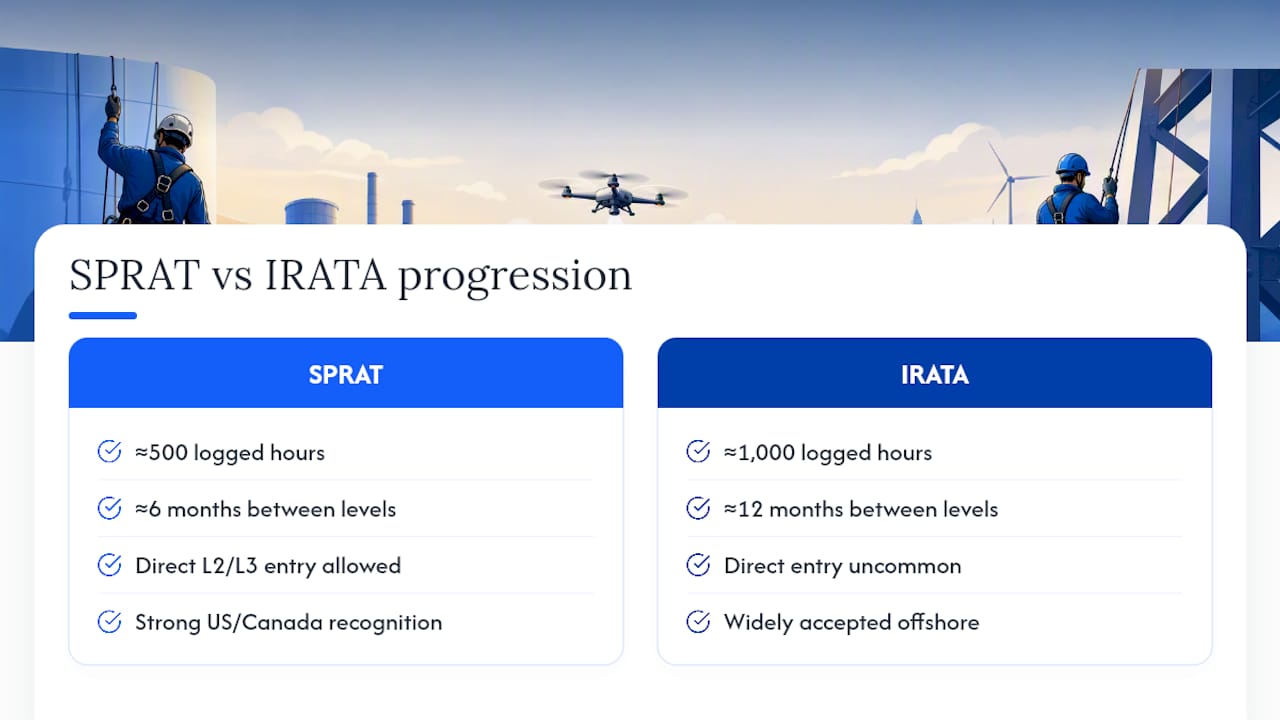
SPRAT shows up constantly in building maintenance, window cleaning, telecom tower work, and wind energy technician roles across the U.S. and Canada. The tradeoff runs the other direction from IRATA: strong domestic recognition, but you’ll hit more resistance trying to use a SPRAT card on an international offshore contract that specifically requires IRATA.
SPRAT vs IRATA Levels: Hours, Time, and Responsibilities
Both systems require recertification, generally every three years, and both expect a technician to relog hours and pass a fresh skills assessment rather than simply renew on paper; keeping updated site safety boards UK prominently displayed helps ensure adherence to safety protocols on site. Verification matters here too: employers checking a candidate’s status should confirm active certification directly with IRATA or SPRAT rather than taking a printed card at face value.
Which Industries and Employers Prefer Which Certification?
Offshore wind, oil and gas platforms, and large-scale international industrial inspection contracts lean heavily toward IRATA, largely because client prequalification requirements overseas often name it explicitly. Bridge and civil engineering firms working internationally tend to follow the same pattern.
In the U.S. and Canada, building services work, window cleaning, telecom towers, and domestic wind energy jobs accept SPRAT as the default, and many employers won’t ask for anything else. Regional comparisons consistently show this split holding up: SPRAT dominates North American day-to-day contracts, IRATA dominates cross-border industrial ones.
Dual certification removes friction when your client list spans both worlds. A technician who bounces between a Florida high-rise contract and an offshore inspection job overseas benefits from holding both cards rather than gambling on which one a given client will demand.
How to Choose Between SPRAT and IRATA
- Identify your target sector and geography first. Offshore or international industrial work points toward IRATA; domestic building services point toward SPRAT.
- Weigh how fast you want to progress. SPRAT’s shorter hour and time requirements get you to Level 3 faster if speed matters more than global reach right now.
- Check what your target employers actually require. Call a few companies you’d want to work for and ask which certification they prequalify contractors against.
- Compare training access and cost near you. Availability of approved training centers and assessors in your region often decides this as much as anything else.
- Consider dual certification if your career could go either direction. Many technicians earn SPRAT first for speed, then add IRATA later for international mobility.
When vetting a training provider, ask directly: Is this company an audited IRATA member, or are the trainers individually credentialed SPRAT Evaluators? Can they show you their assessor’s credentials? Do they offer a documented logbook system you can carry to your next employer?
Pro Tip: Ask any training provider how they handle logbook verification before you pay for a course. A provider that can’t explain how your hours get documented and countersigned is a red flag, regardless of which certification they’re teaching.
Training Content and Assessment Methods Compared
Both organizations cover the same foundational skills: rope systems, backup devices, rescue techniques, anchor point evaluation, and hazard assessment. The difference shows up in structure and sequencing.
IRATA’s training follows its published TACS framework closely, with assessments built around a fixed syllabus that every approved training center delivers in roughly the same order, regardless of country. That consistency is part of the appeal for multinational employers. An IRATA Level 2 technician trained in one country has passed essentially the same practical tests as one trained anywhere else, assessed by an independent examiner unaffiliated with the training company.
SPRAT gives Evaluators more latitude in how they structure a course, as long as the outcomes match SPRAT’s published Certification Requirements. That flexibility lets training centers tailor content toward regional work, building maintenance in one region, tower climbing in another, without changing the certification’s validity.
Assessment day itself looks similar on both sides: practical rope skills demonstrations, rescue scenario execution, and a written knowledge test. IRATA assessments tend to run longer and more formally scripted, reflecting the industrial and offshore contexts where a mistake can be catastrophic and clients demand documented uniformity. SPRAT assessments are thorough but generally faster to schedule, partly because the individual-certification model doesn’t require coordinating around a company’s audit calendar.
Neither approach is inherently more rigorous. They’re built for different operating environments, and that shows in how each one tests you.
Safety Standards and Operational Procedures: What Each Organization Emphasizes
Both organizations require redundant backup systems, rescue-ready supervision, and documented equipment inspection, but they frame the rules differently.
IRATA’s safety documentation reads like an industrial standard because it largely is one: built around offshore and heavy industrial risk profiles where a single audit failure can shut down a member company’s certification entirely. That audit pressure pushes IRATA member companies toward standardized equipment logs, consistent rescue drills, and formal incident reporting up the chain to IRATA itself.
SPRAT’s safety framework, laid out in its Safe Practices document, puts explicit emphasis on deferring to whatever regulatory authority governs the job site. SPRAT’s own guidance states plainly that technicians must follow the presiding regulatory authority, and where that authority’s rules are stricter than SPRAT’s baseline, the stricter rules win. That’s a meaningful operational difference: SPRAT positions itself as a floor that adapts to local law, while IRATA positions itself as a portable standard meant to travel across borders with minimal reinterpretation.
In practice, both produce competent technicians. The philosophical difference is uniformity versus adaptability, and which one you value more often depends on whether you’re building a career that crosses borders or one that stays rooted in a single country’s regulatory system.
Where Each Certification Is Recognized Worldwide
IRATA reports member companies operating across dozens of countries, with especially deep penetration in Europe, the Middle East, and offshore energy markets worldwide. It’s the name that shows up on industrial prequalification lists from oil and gas operators, offshore wind developers, and civil engineering firms working outside North America.
SPRAT’s footprint concentrates heavily in the United States and Canada, where it functions as the practical industry default for building maintenance, telecom, and domestic energy work. Outside North America, SPRAT certification is accepted in some cases but far less consistently than IRATA, which is precisely why technicians planning international careers tend to add IRATA even after starting with SPRAT.
Neither organization publishes a single global “market share” figure, and comparing raw technician counts across two differently structured systems, one company-audited, one individually certified, doesn’t produce a clean apples-to-apples number. What’s consistent across industry write-ups is the geographic pattern itself: IRATA’s strength runs international and industrial, SPRAT’s strength runs domestic and commercial. That pattern has held steady for years and shapes almost every hiring decision downstream of it.
What Drives Employer Preference Between the Two
Employer choice usually comes down to who’s writing the contract requirements above them. A facilities management company bidding on a U.S. office tower rarely gets asked for IRATA. An industrial contractor bidding on an offshore platform inspection almost always does, because the client’s own insurance and safety prequalification documents name it specifically.
Insurers and regulators generally accept either standard when paired with proper documentation and competent Level 3 supervision on site, according to industry comparisons of the two systems. But some clients, particularly in offshore and heavy industrial sectors, write IRATA into their vendor contracts explicitly, leaving no room for a SPRAT-only crew to bid.
That’s pushed a growing number of training providers to offer combined or streamlined pathways for technicians who already hold one certification and want the other. It’s also why larger rope access companies increasingly staff crews with mixed certifications, holding whichever card a given contract demands rather than betting the whole business on one standard.
What Certification Actually Costs
Course pricing varies by region and training provider, but the fee structure looks similar across both systems: a training course fee, a separate assessment/examination fee, and a certification or registration fee paid to the organization itself once you pass.
IRATA courses tend to run longer in scheduled days because of the syllabus depth and the formal assessment structure, which usually translates into a higher total course price. Layer on the fact that IRATA certification flows through an audited member company, and there’s often an added cost baked into that company’s overhead, since member companies absorb audit compliance costs that get reflected somewhere in what they charge trainees.
SPRAT courses are frequently priced lower for entry-level certification, partly because the individual-certification model skips the company-audit layer entirely. Direct-entry options for experienced technicians can also reduce total cost, since someone entering at Level 2 or 3 skips paying for redundant Level 1 instruction they don’t need.
Recertification for both systems, generally required every three years, typically costs less than initial certification since it doesn’t require relearning the full syllabus. Neither organization publishes one universal fixed price across every region, since local training centers set their own course fees. Anyone comparing costs should request current pricing directly from training centers in their area rather than relying on figures quoted by unrelated blogs, which go stale quickly.
Why Dual Certification Makes Sense for Many Technicians
Holding both credentials isn’t redundant. It’s a hedge against a job market that hasn’t standardized. Training providers increasingly build combined SPRAT and IRATA course tracks specifically because holding both credentials reduces hiring friction across markets that each demand their own paperwork.
The practical strategy most experienced technicians land on: earn SPRAT first if you’re starting your career in North America, since the faster progression gets you to Level 3 responsibilities sooner. Add IRATA later once you know your career is heading toward offshore, international, or heavy industrial contracts.
Managing both credentials mostly comes down to logbook discipline. Keep a single, meticulously documented hour log that satisfies both organizations’ requirements, since much of what counts as qualifying rope time overlaps. Track your two separate recertification clocks independently. It’s easy to let one lapse while focused on the other, and a lapsed certification means retesting rather than a simple renewal.
Dual-certified technicians also tend to command more flexibility when negotiating contracts, since they’re not locked out of bids that specify one standard over the other. For a technician building a long-term career rather than chasing a single job, that flexibility is often worth the added cost and administrative overhead of maintaining two active certifications.
When Drone Cleaning Beats Rope Access Entirely
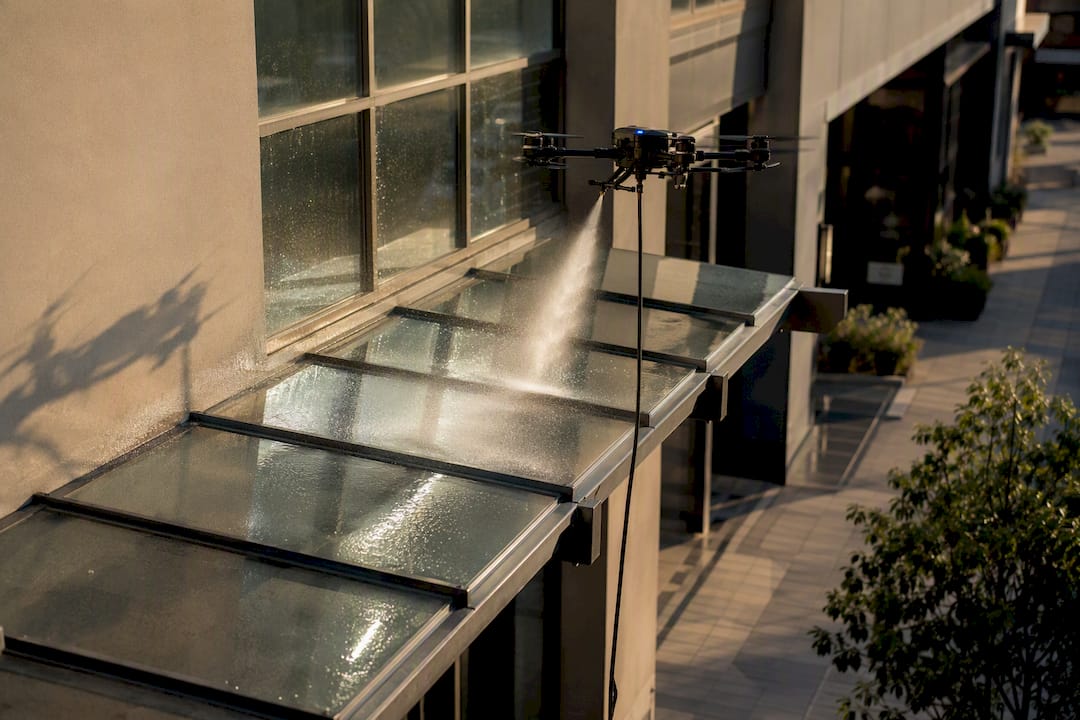
Sometimes the better answer for a building owner isn’t which rope access certification a crew holds. It’s whether the job needs rope access at all. For most routine high-rise window washing, facade cleaning, and roof soft-wash work in Miami, Fort Lauderdale, and Boca Raton, tethered industrial drones flown by FAA Part 107 pilots reach the same 200-plus-foot elevations without putting anyone on the glass.
Rope access still makes sense for jobs a drone can’t touch: complex rigging around structural obstructions, heavy equipment installation, confined-space work, or anything requiring hands-on manipulation beyond a wash-and-rinse cycle. But for straightforward exterior cleaning, drone-based methods let crews stay grounded entirely, cutting both safety exposure and project timelines. Property managers weighing methods should ask their vendor which approach actually fits the scope, not which one they’re used to selling.
— Eliot
A Ground-Based Option Worth Comparing
Rope access certification matters when the job genuinely calls for a technician on a line. But a large share of South Florida’s routine high-rise exterior cleaning, window washing, facade rinsing, roof soft-wash, doesn’t need anyone rigged to the building at all. Vistadronecleaning runs FAA Part 107-certified pilots and tethered industrial drones to clean buildings up to 200-plus feet tall from the ground, which means no scaffolding, no rope crew scheduling, and no rigging permits slowing down your project timeline.

For property managers in Miami-Dade and Broward comparing options, drone projects often finish faster and at lower cost than traditional scaffold or lift methods. See the full cost and time breakdown or request a free quote through Vistadronecleaning’s Miami window cleaning page within 24 hours.
Where to Verify Certification and Regulatory Details
- IRATA membership and certification pages for member company verification and TACS details.
- SPRAT Certification Requirements for direct-entry rules and individual certification pathways.
- SPRAT’s OSHA and presiding-authority guidance for U.S. regulatory compliance.
- ISO standards referenced by both organizations for fall-protection and lifting equipment context.
Sources
- Do SPRAT-certified rope access technicians working in the United States need to follow OSHA regulations? | SPRAT
- About certification | IRATA
- Membership requirements | IRATA
- Certification | SPRAT
- IRATA or SPRAT? Choosing the Right Certification | Pacific Ropes
FAQ
How Much Does SPRAT Certification Typically Cost?
Pricing varies by training center and region, but SPRAT courses generally cost less than comparable IRATA courses since SPRAT’s individual-certification model skips the added expense of company-audit compliance. Contact training centers directly for current rates, since neither organization publishes one fixed national price.
What Jobs Can You Get With SPRAT Certification?
SPRAT certification opens doors in North American building maintenance, high-rise window cleaning, telecom tower work, and domestic wind energy technician roles, where it functions as the industry-standard credential.
What Is the Best Rope Access Certification?
Neither certification is universally “better.” IRATA generally fits technicians targeting international, offshore, or industrial careers, while SPRAT usually suits those building a North American career who want faster level progression.
What Does It Mean to Be SPRAT Certified?
It means you’ve passed a SPRAT-approved Evaluator’s practical and written assessment at your level, logged the required rope hours, and agreed to follow SPRAT’s Safe Practices, including deferring to any stricter local regulatory authority like OSHA where it applies.
Can You Hold Both SPRAT and IRATA Certifications?
Yes, and many working technicians do exactly that. Dual certification reduces hiring friction for anyone whose client list spans both North American building services work and international or offshore industrial contracts.